Clients get told to sub-meter their gas, and then the argument starts about delivery pressure, corrected volume, what signal can be taken off the utility meter set, who is allowed to touch the piping, and what Measurement Canada requires. This page holds what we know about picking the right one, so that argument can finish on the first phone call.
Updated 3 September 2026. Every spec on this page carries the link it was read from.
Start here
What a gas meter is actually counting
Three different numbers get called "the gas reading", and most ordering mistakes begin by confusing them.
Line volume, standard volume and energy
A diaphragm or rotary meter displaces a fixed physical volume per cycle and counts the cycles, so its index accumulates gas at whatever pressure and temperature existed at the meter. That is volume at line conditions, and it is not what anybody buys. Corrected volume is that same reading scaled to a legal base point, 15 °C and 101.325 kPa in SI or 60 °F and 14.73 psia in Imperial, which is what "standard" means in Canada's Electricity and Gas Inspection Regulations. Energy is the third number, in gigajoules, and it is what the bill is denominated in.
How the bill gets from m³ to dollars
Enbridge takes the metered cubic metres, multiplies by a Pressure Elevation Factor for the site's elevation, then multiplies by the heating value published for that service area. The factor is small and it goes both ways: Enbridge's own worked example puts a Toronto household at 1.0057 on 2,400 m³ a year, which adds about 14 m³, and the same usage in Barrie at 0.9904, which takes about 23 m³ off. The heating value moves as the supply mix moves, and Enbridge publishes it, most recently 39.08 MJ/m³ in the South service area and 39.04 MJ/m³ in the North, effective 1 April 2026.
The utility meter reads the whole site at the point of delivery, and Enbridge says plainly that it strives to read a residential meter every other month. That is one number, six times a year, for a building that might run a boiler, a make-up air unit and a process line off the same service. Sub-metering is how gas use gets split by process, by building or by piece of equipment, and it is the only way to see the overnight baseline that tells you a burner is cycling when nothing is running.
A raw index pulse counts volume at line pressure, and gas at higher pressure carries far more energy per cubic foot. Dresser's own meter-sizing table puts the multiplier at 1.045 at 1 psig, 2.675 at 25 psig and 12.86 at 175 psig, and it is the same multiplier on every size in the line: the 800 acfh 8C175 and the 2,000 acfh 2M175 both land on 12.86. Wire a counter to a raw pulse on a 25 psig line and read it as billable volume and you are out by a factor of nearly three.
A meter's rated CFH is only true at the differential and the line pressure printed on its capacity table. Honeywell's AL-425 is rated 425 SCFH at 0.25 psig and 0.5 in W.C., 898 SCFH at the same line pressure and 2 in W.C., and 1,462 SCFH at 25 psig and 2 in W.C. Enbridge's application form defaults to 7 in W.C., which is 0.25 psig, so a capacity figure quoted from a higher-pressure column is describing a service the site does not have.
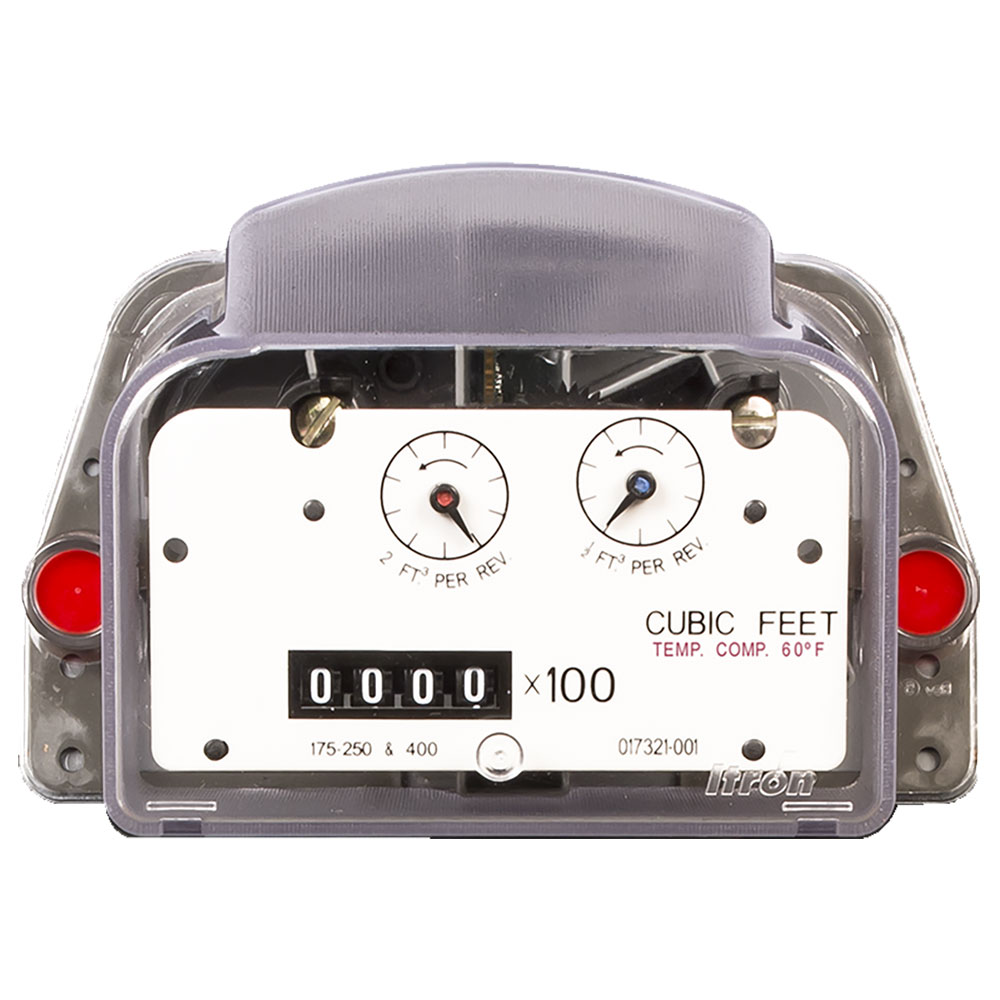
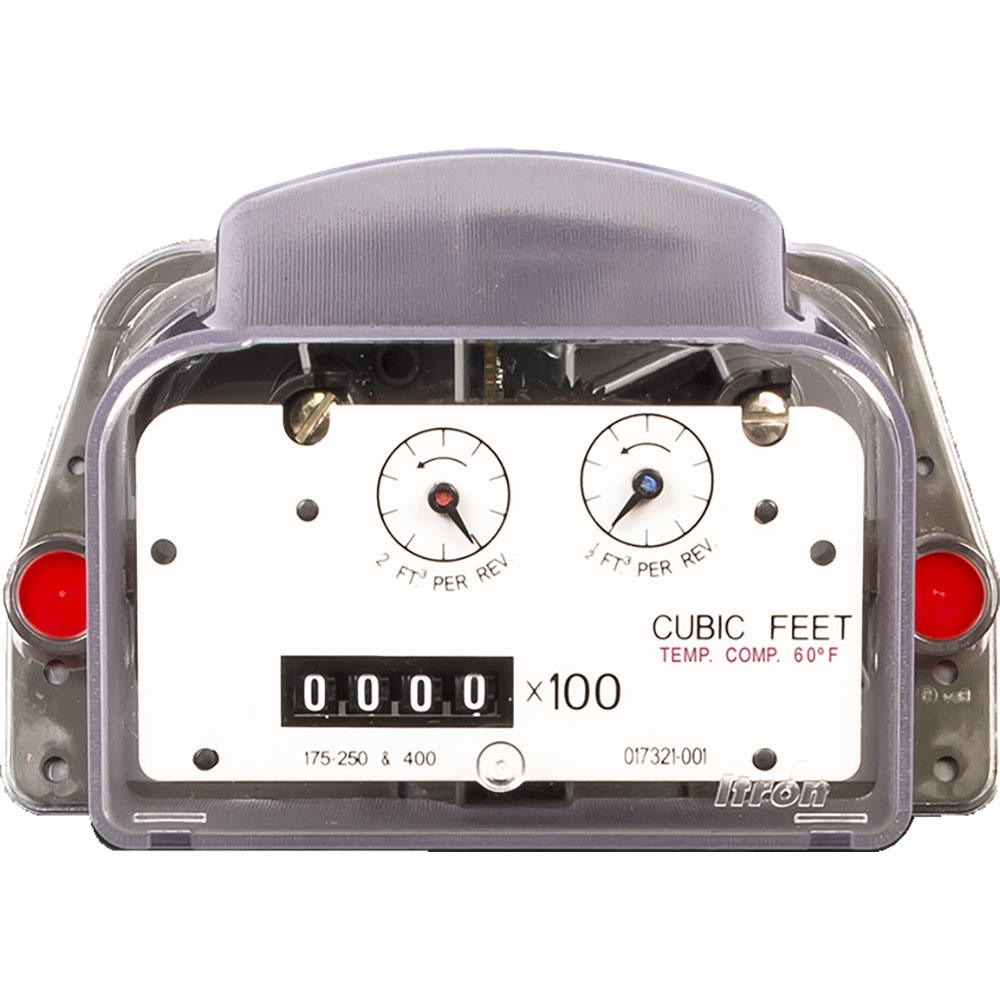
North American gas indexes read in cubic feet as often as cubic metres, and many print a multiplier so the number on the dials is in tens or hundreds of units. No manufacturer manual in this research stated a multiplier for a specific catalog model, so treat every multiplier as not stated until the model's own documentation confirms it. Every index also rolls over at its digit limit, and the rollover value is model-specific too.
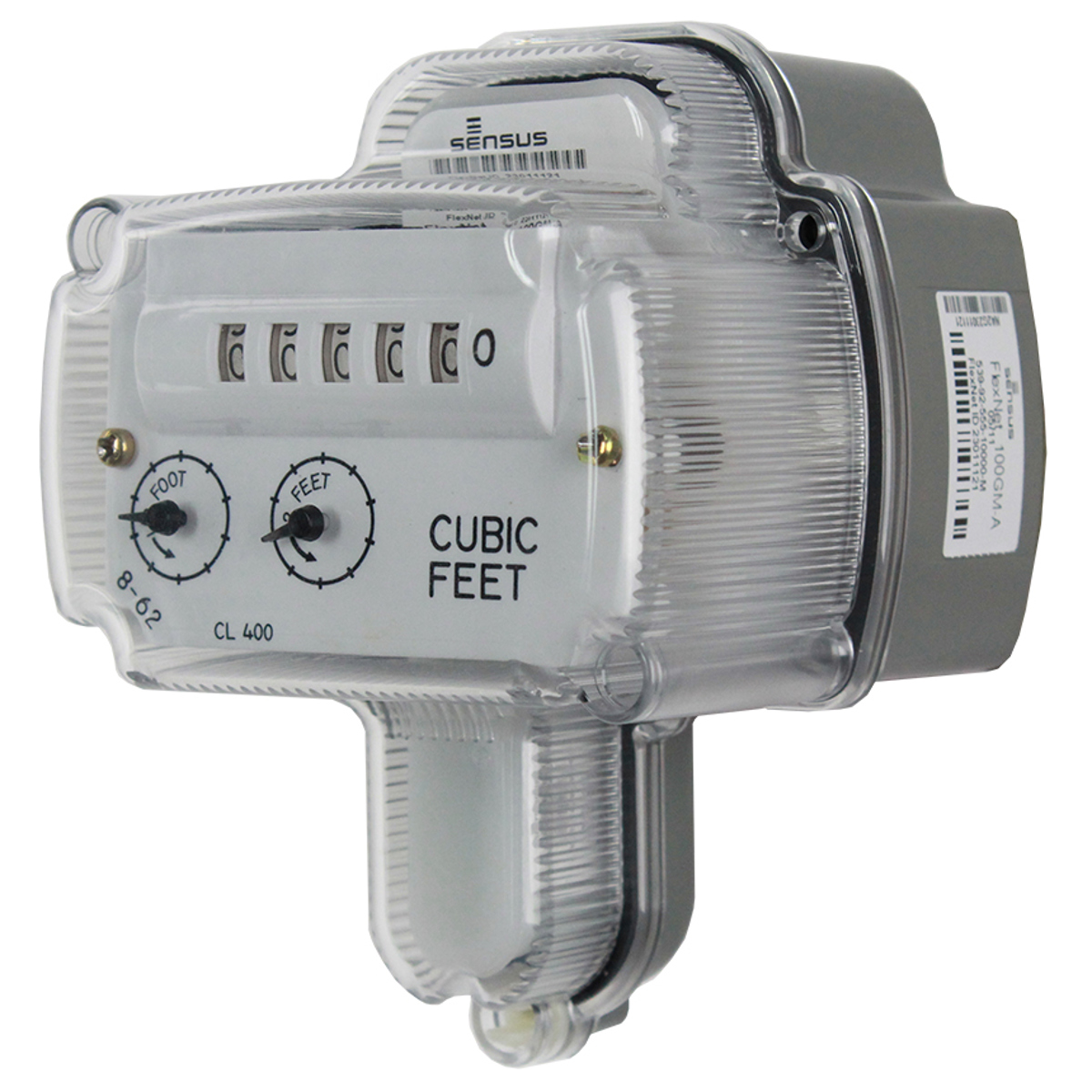
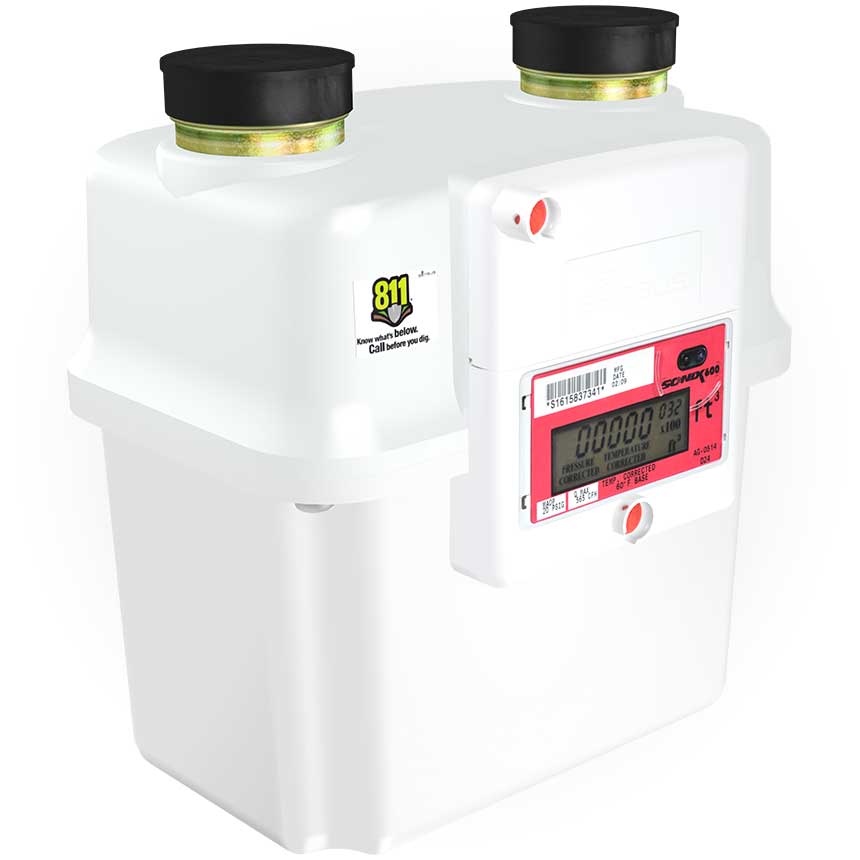
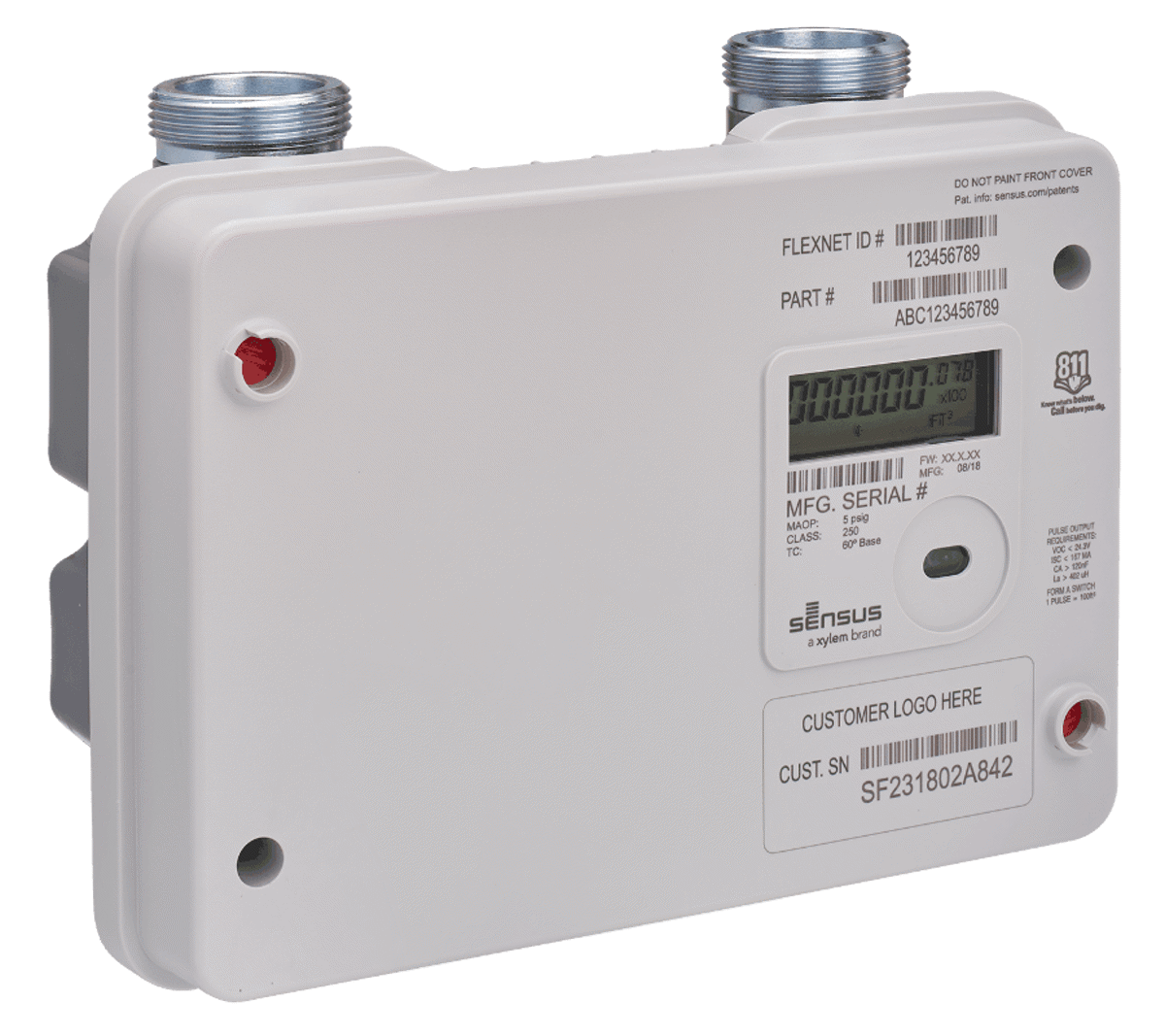
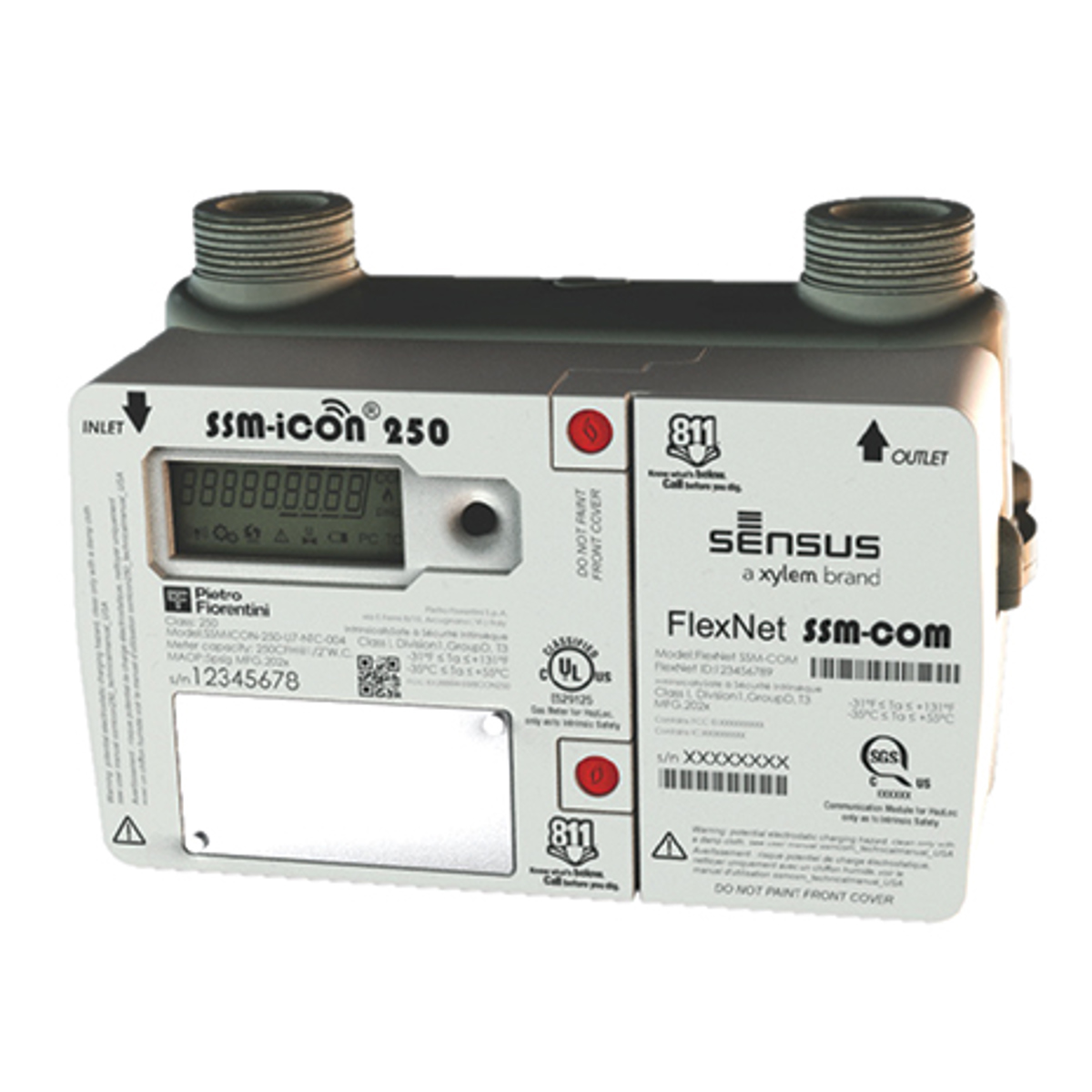
Itron's Gen5 500G, the Cellular 500G, the Sensus SmartPoint GM and Dresser's AMR Adapter all read the meter index and report over the utility's own radio network. None of them documents a pulse contact, a 4-20 mA loop or a Modbus port for anyone else. The evidence here is thinner than we would like: the marketing pages describe capability rather than terminals, and the datasheets sit behind a customer portal, so treat this as strongly indicated rather than proven and ask the utility before promising a signal.
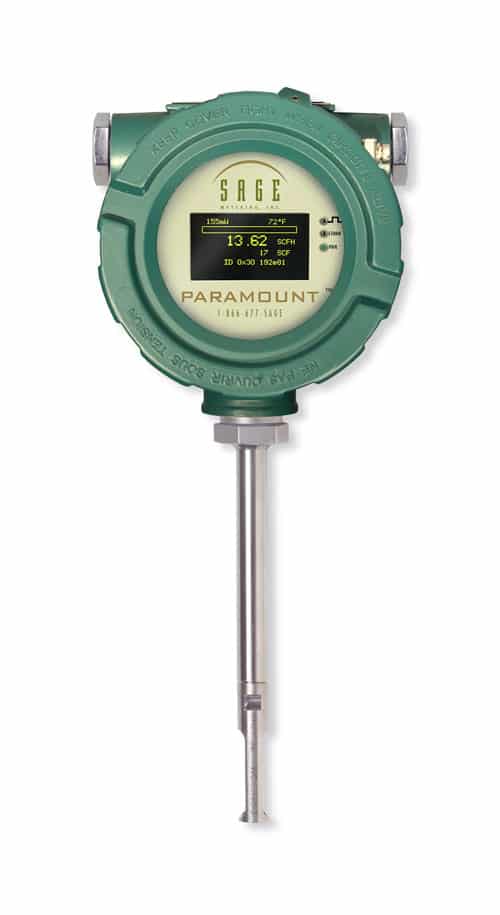
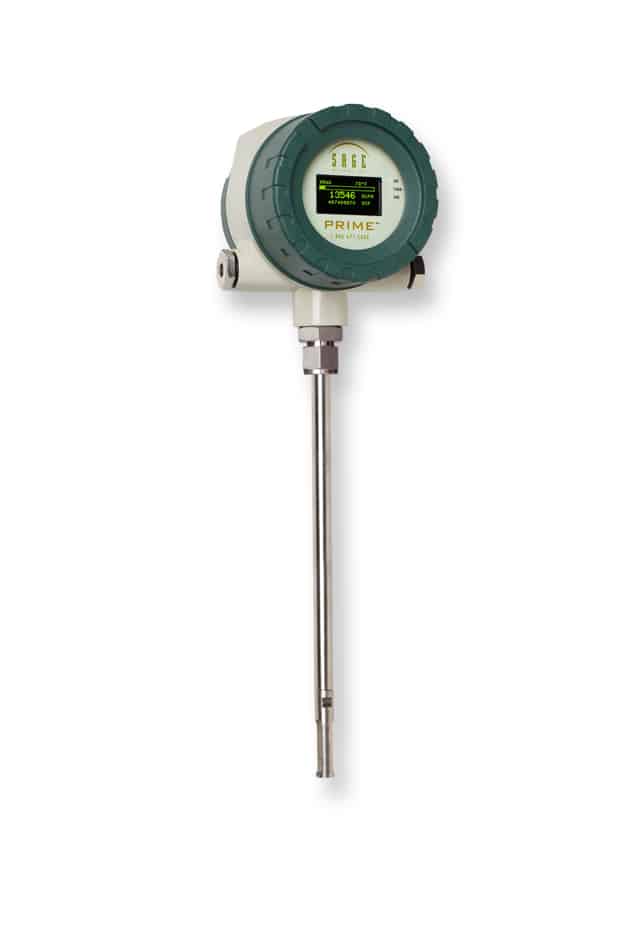
Hazardous-location ratings move by model, not by brand. Fox Thermal's FT2A tops out at Division 2 while the FT1, FT3 and FT4A are Division 1 in Groups B, C and D, and Sage's Paramount is Division 2 with Division 1 as an option. Get the site's area classification drawing before you pick a model number, because the correctors and pulsers in this catalog carry Ex ia ratings for a reason.
How the measurement is made, and where each family runs out
Two families, and the choice between them comes down to capacity, pressure and how much straight pipe you have.
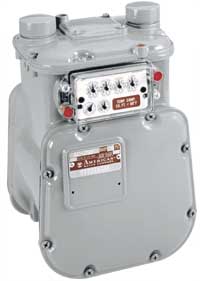
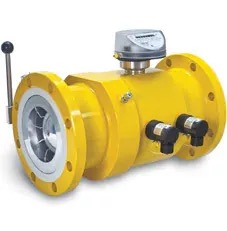
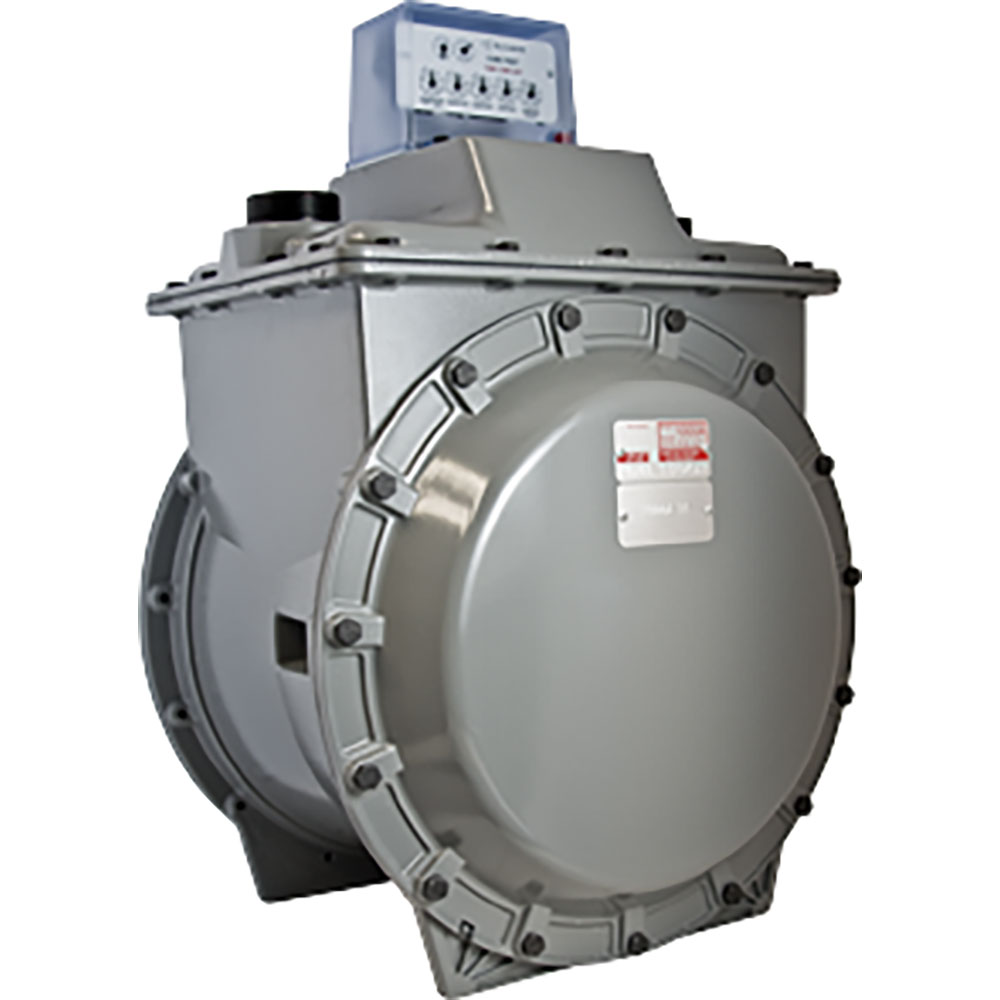
Positive-displacement meters trap a known volume and count it. A diaphragm meter fills and empties four bellows chambers through graphite-filled slide valves and drives the index off a crank, and a rotary meter spins two figure-eight impellers that are geared so they never touch, displacing a fixed volume four times a revolution. Both read accurately at very low flow, neither needs straight pipe upstream, and their volumetric accuracy does not depend on getting the velocity profile right.
The other family infers flow from something else. A turbine meter reads rotor speed, which is proportional to gas velocity, so it needs a developed velocity profile and real straight run. An ultrasonic meter times sound pulses with and against the flow, and a thermal-mass meter measures how fast the stream carries heat away from a heated element, which gives mass flow directly and needs no separate pressure or temperature correction to reach standard cubic feet.
Diaphragm (positive-displacement bellows)
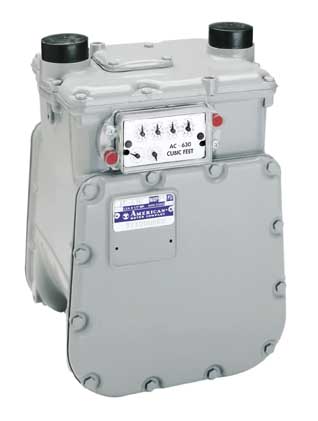
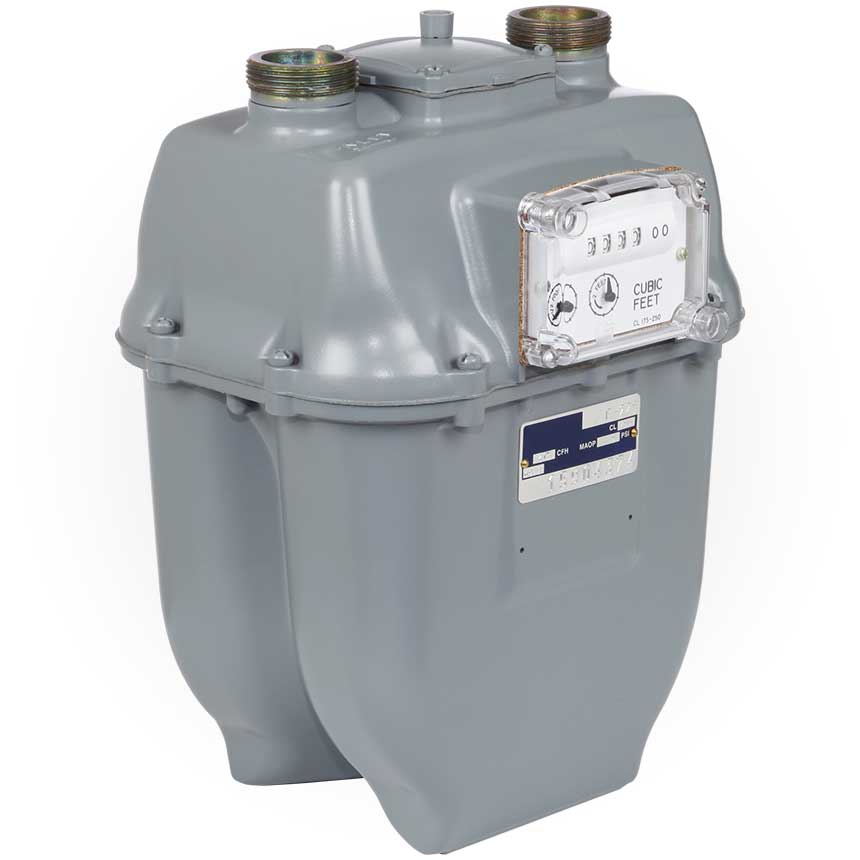
Two or four bellows (convoluted diaphragm) chambers inside a die-cast case fill and empty alternately as gas pressure moves them; graphite-filled phenolic slide valves direct gas to each chamber in sequence, and a mechanical linkage drives the index (and, optionally, a pulser/AMR module) once per fixed displaced volume. Because displacement is mechanical and positive, the meter reads accurately at very low flow and needs no straight-run pipe.
Good at
No straight-run requirement
Accurate at very low flow, wide practical turndown for its size
Low unit cost, decades of field history
Measurement Canada's default class for residential billing
No external power required
Weak at
Top capacity tops out in the low thousands of CFH before rotary/turbine become more compact
Bellows and valves are moving parts subject to long-term wear
Larger classes (AL-800+) are bulky relative to a rotary meter of similar capacity
Limited to 100 psig MAOP even at the largest classes sourced this pass
Capacity250-2,300 SCFH at 0.5 in W.C. differential across sourced classes (AC-250 to AL-2300); larger classes (AL-5000, AC-630, etc.) exist in the product line but capacity not independently sourced this pass
PressureMAOP 5-100 psig depending on class
Turndownnot stated
Straight runnone required (positive displacement)
Sensitivitynot sourced this pass for dirt/oil/pulsation; not oil-lubricated, no strainer requirement stated in sources retrieved
Best for
Residential and small-commercial connected loads up to roughly 2,300 CFH at standard utility delivery pressure
Installations with no straight-run pipe available
Avoid when
Load exceeds the largest available diaphragm class
Line pressure well above 100 psig
Footprint is constrained and capacity needed exceeds ~800 CFH (rotary is more compact per unit capacity)
Two figure-eight impellers rotate inside a precision case, timed by external gears so they never touch each other or the case wall. Gas differential pressure drives the impellers; each rotation displaces a fixed known volume four times per revolution. A geared-down instrument drive turns the index or a pulser/AMR/corrector accessory. Volumetric accuracy is largely independent of gas density, pressure and temperature because it is still positive displacement.
Good at
Compact footprint per unit of capacity vs diaphragm
Volumetric accuracy independent of gas density/pressure/temperature
Wide rangeability on larger sizes (up to ~170:1 on some classes)
Accepts the same corrector/AMR/pulser accessory ecosystem as diaphragm meters
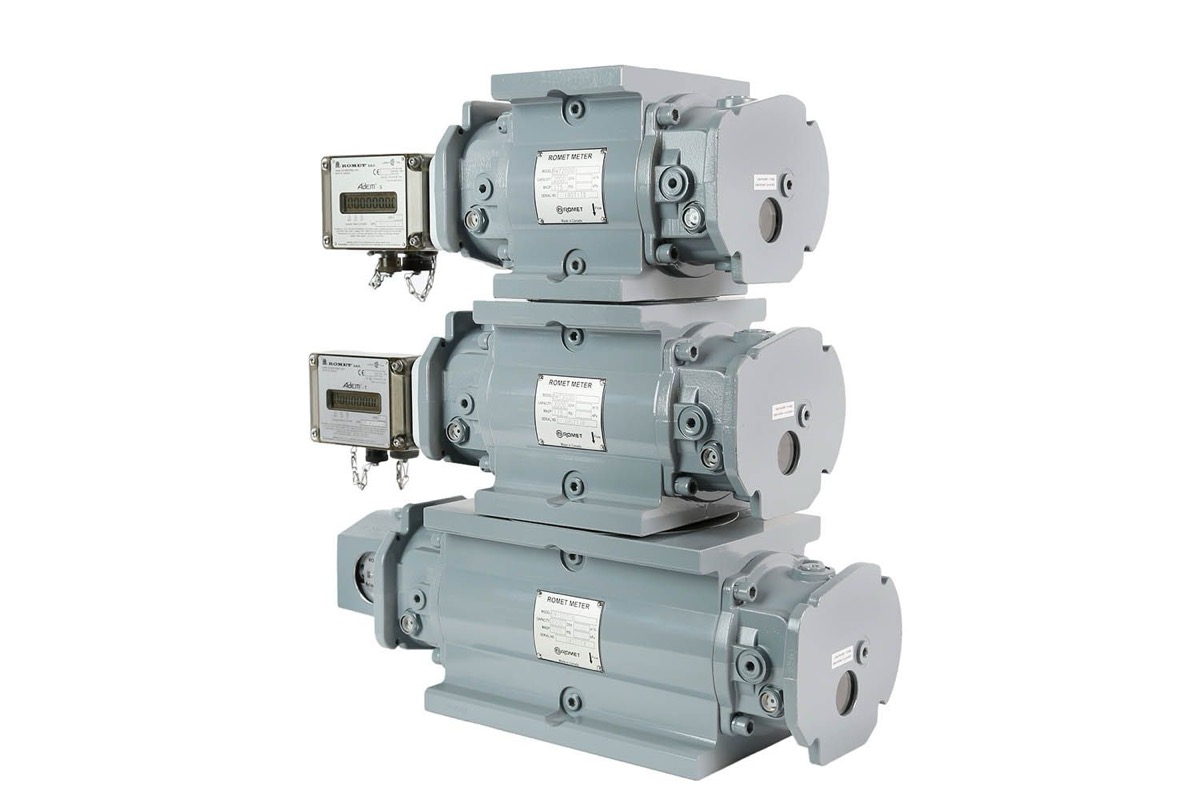
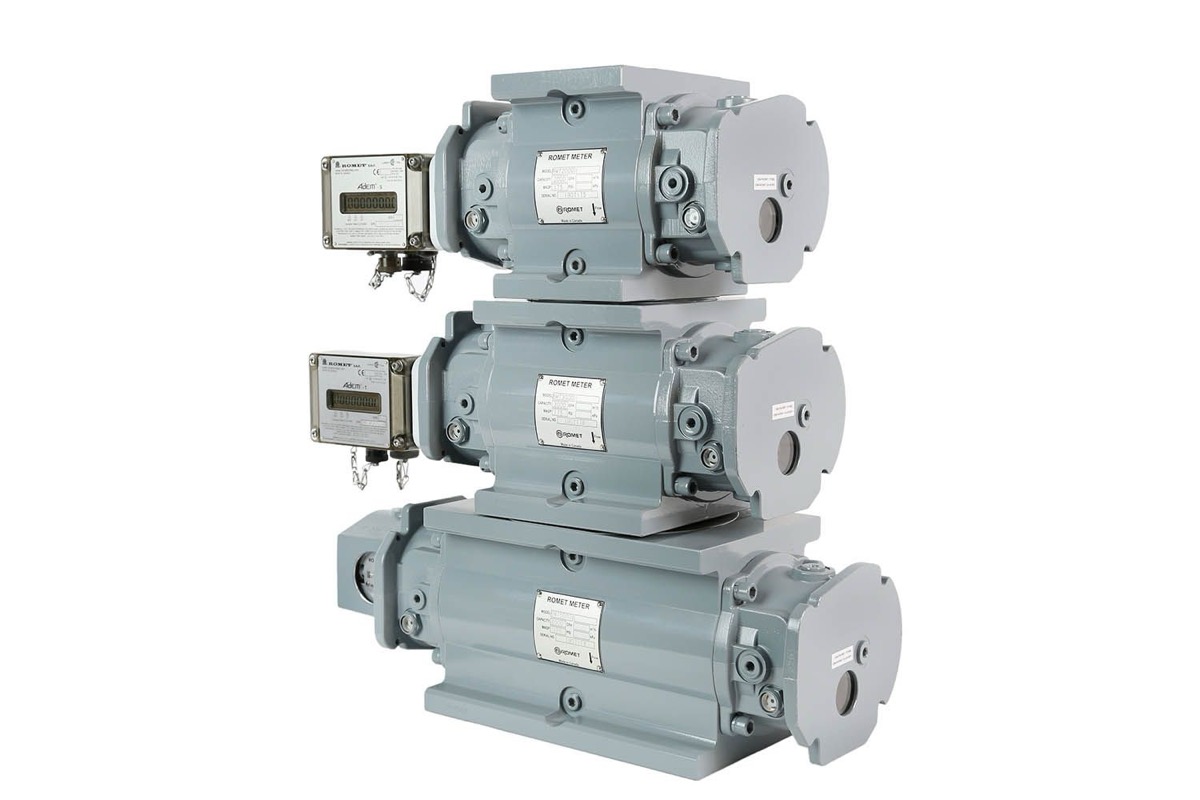
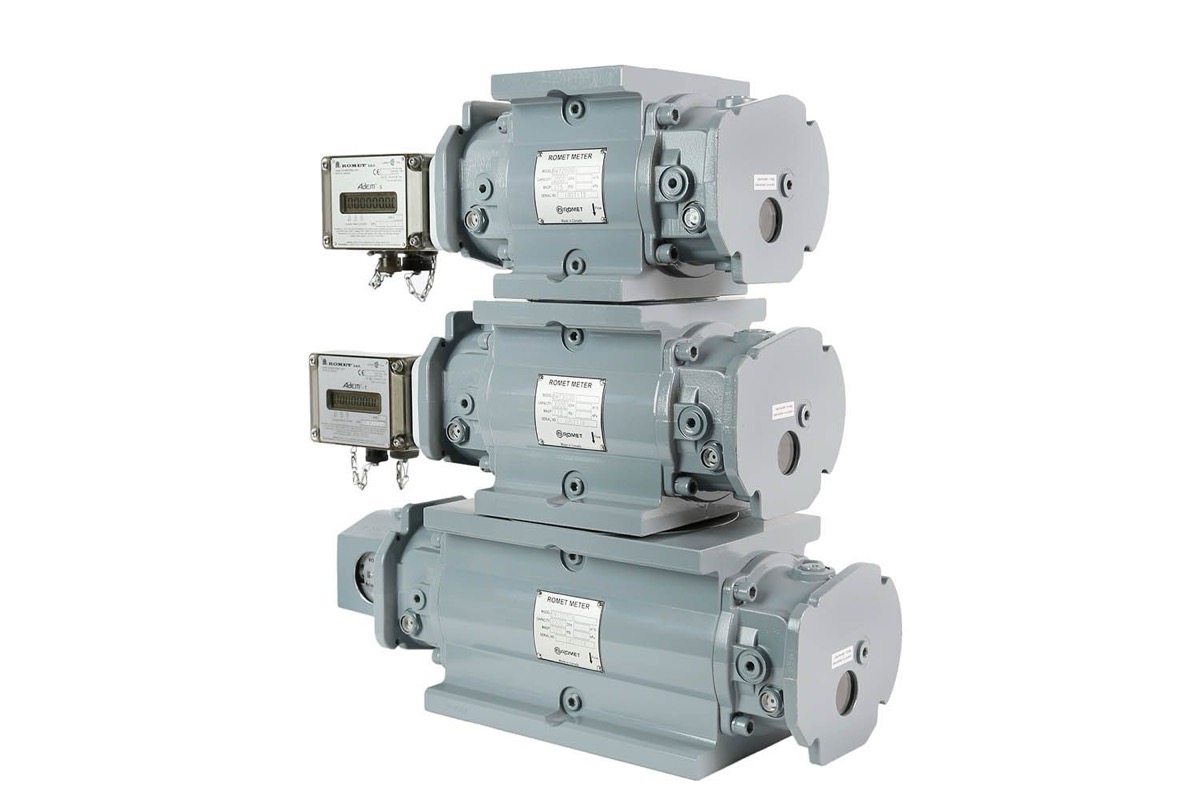
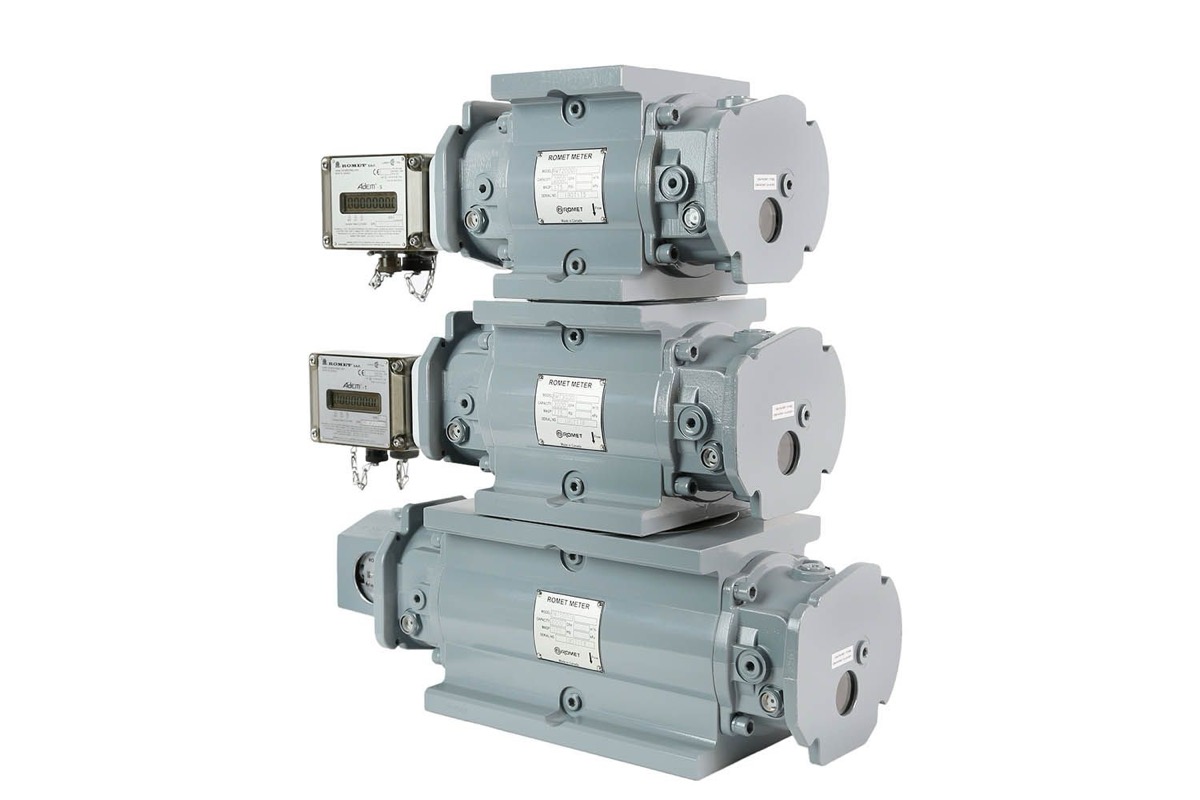
Romet is Canadian-manufactured
Weak at
Meter body typically needs periodic oil top-up (lubricated bearings)
Minimum start-flow below which small loads go unmeasured
Heavier, needs flanged connections at larger sizes
Industry practice (not sourced to a specific manufacturer statement this pass) is to fit an inlet strainer to protect impeller clearances
Capacity600-56,000+ actual ft³/h across sourced classes (Romet RM1000-RM16000; Dresser 8C175-56M175); both lines extend further (Romet to RM56000+, hard-metric G-series)
PressureMAOP 175 psig standard on both lines; Dresser offers a 232 psig option on at least one size (23M232)
Turndown26:1 to 169:1 depending on Dresser model; Romet states up to 1:160 at atmospheric condition
Straight runnot stated
Sensitivityimpeller-to-case clearances can be damaged by pipeline debris (general industry knowledge, not sourced to a specific manufacturer statement this pass); pulsation sensitivity not sourced this pass
Best for
Commercial/industrial loads from roughly 600 CFH up past 50,000 CFH
Applications where diaphragm capacity has run out but turbine's straight-run/low-flow limits don't fit
Avoid when
Load regularly runs below the meter's start rate for long periods
Gas flowing through the meter body spins a rotor whose blades are angled to the flow; rotor speed is proportional to gas velocity, and a gear train or electronic pickup converts revolutions into a volume reading. Because it measures velocity, accuracy depends on the velocity profile across the pipe being even and fully developed when it reaches the rotor, hence the straight-run requirement.
Good at
Compact body for large, steady loads compared with equivalent-capacity rotary
GTX-generation permanently lubricated bearings need no maintenance
AccuTest dual-cartridge design allows in-service proving without a shutdown
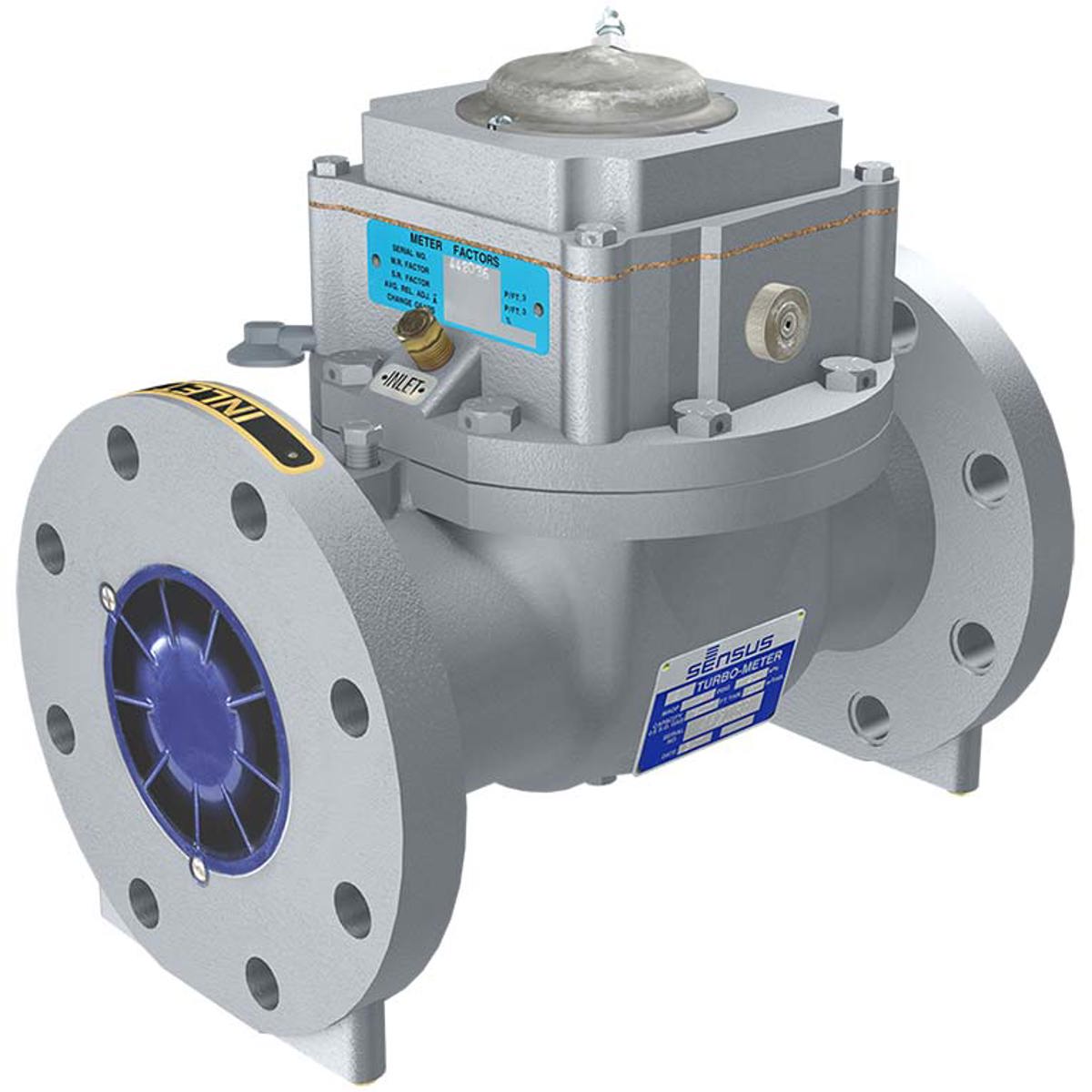
Well suited to transmission and large industrial/commercial custody-transfer-grade metering
Weak at
Needs real straight-run pipe or a flow conditioner
Poorer turndown at low flow vs rotary of similar top capacity
Mechanical bearing wear over long service life on non-GTX designs
Not well suited to pulsating or highly variable flow
Capacity10,000 SCFH (3 in) to 150,000 SCFH (12 in) at 7 in W.C., sizes 3-12 in
PressureMAOP 175-1,480 psig depending on model; inlet pressures up to 1,480 psig
Turndownnot stated
Straight runrequired (velocity meter); specific diameter multiples not stated in source retrieved this pass
Sensitivityrotor bearings can be damaged by debris; pulsating flow can cause rotor overspeed/over-registration (standard turbine-meter behaviour, not sourced to a specific manufacturer statement this pass)
Best for
Large, relatively steady commercial/industrial and transmission loads where piping can provide adequate straight run
Avoid when
Flow is highly variable or pulsating
Turndown needed exceeds what a turbine can hold accurately at the low end
No straight-run pipe available and a flow conditioner is not budgeted
Ultrasonic transducers send sound pulses both with and against gas flow; the meter computes gas velocity from the difference in transit times and multiplies by the known cross-sectional area to get volumetric flow. No moving parts. Two distinct product families exist: residential/light-commercial replacements for diaphragm meters built to ANSI B109.6 (Honeywell NXU, Itron Intelis), and large transit-time custody-transfer meters for transmission built to AGA Report 9 (e.g. Honeywell/Elster Q.Sonic) - these are not the same standard.
Good at
No moving parts, no wear, no lubrication
Residential family integrates a shutoff valve and cellular AMI/leak detection in one unit
Self-diagnostic: some models detect dust/liquid carry-over/gas-composition drift via changes in signal speed/quality
Large family suited to custody-transfer accuracy without an orifice plate's pressure drop
Weak at
Residential family newer to the field than decades-proven diaphragm meters
LCD can appear faint/unreadable below -15C on at least one model (not a fault, a known nuisance-call driver)
Large-transmission family cons not sourced this pass
CapacityResidential family: dual-range 250/425 CFH in a single meter (Honeywell NXU); large transmission family capacity range not sourced this pass
PressureResidential family: MAOP 10 psig (Honeywell NXU); large transmission family not sourced this pass
Turndownnot stated
Straight runnot stated
Sensitivityresidential family: cold-weather (<-15C) LCD readability issue reported; large family sensitivity not sourced this pass
Best for
New-construction and retrofit residential/light-commercial services in the 250-425 CFH class where AMI/leak-detection is wanted (residential family)
Transmission and major industrial custody-transfer points avoiding orifice-plate pressure drop or turbine straight-run demand (large family, details not fully sourced)
Avoid when
A locally field-configurable pulse/Modbus output is required beyond what the utility's AMI stack provides on a utility-owned unit - confirm before assuming Quantify-readable output exists
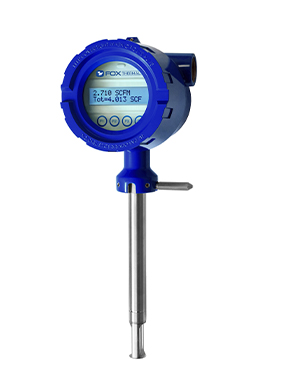
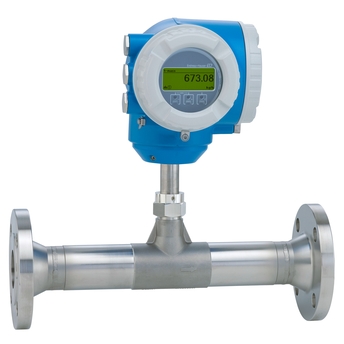
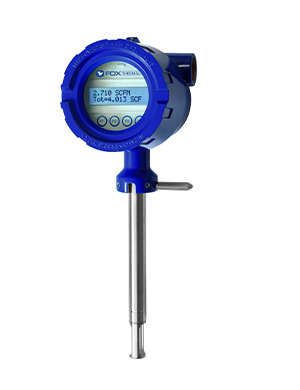
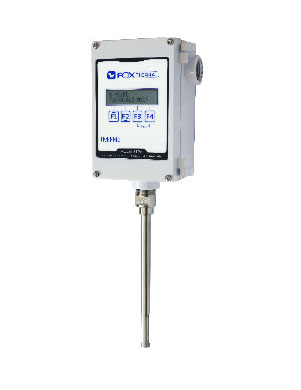
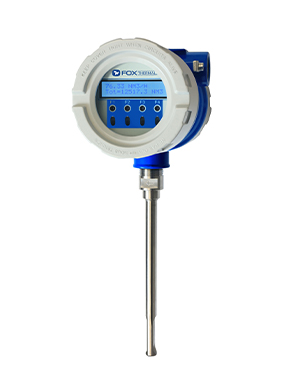
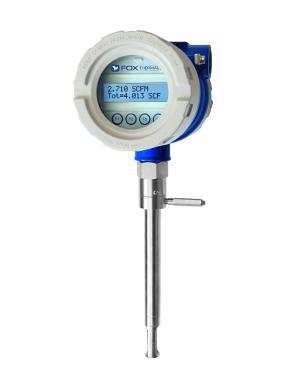
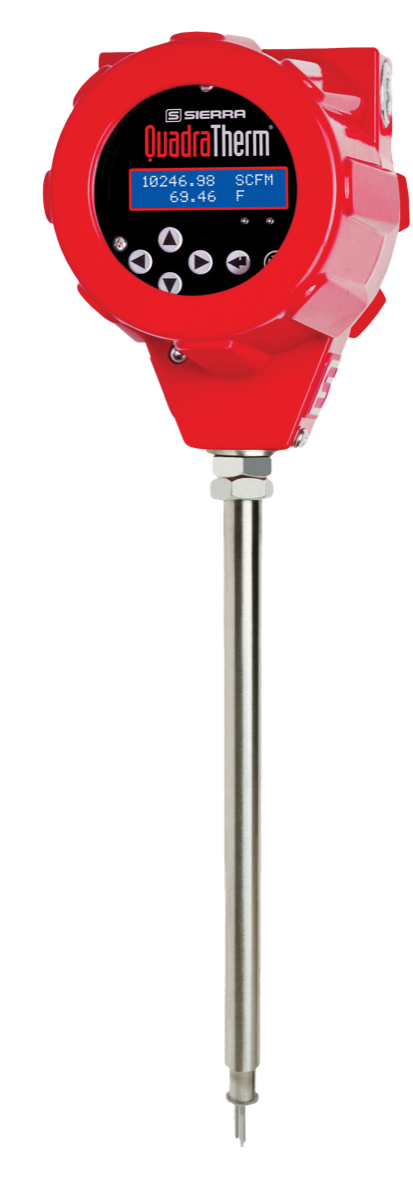
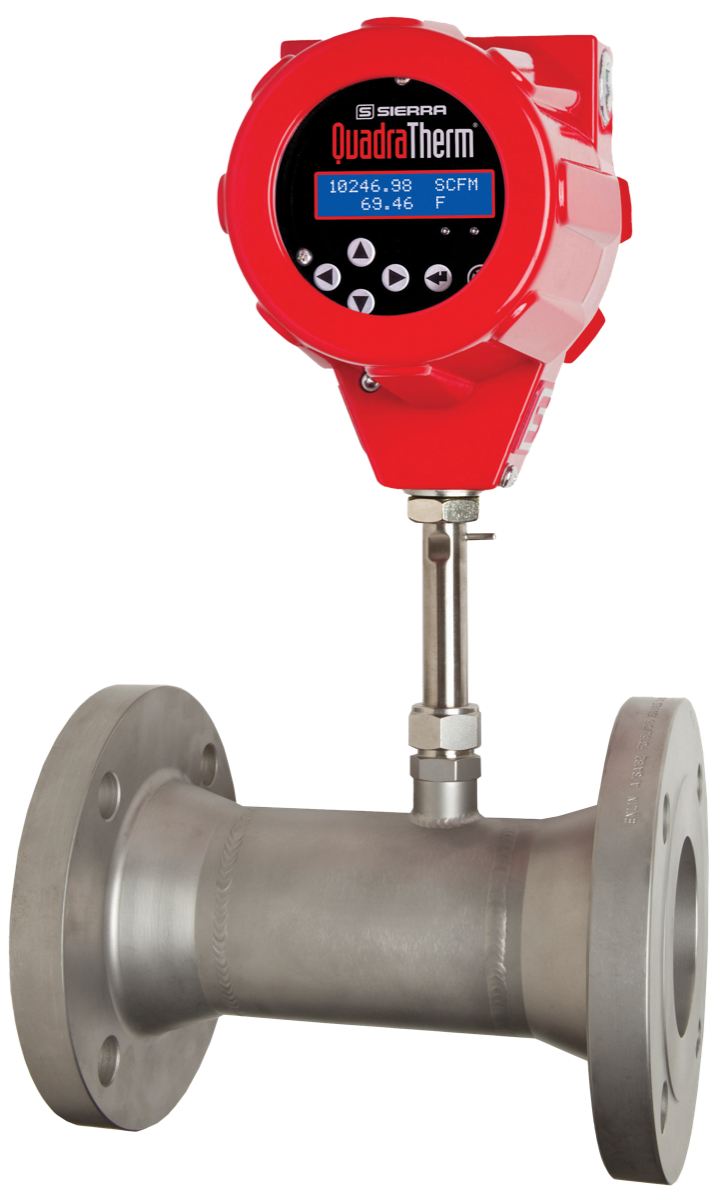
A heated sensor element (paired with a reference temperature sensor) is exposed to gas flow, either inserted through the pipe wall (insertion) or built into a full-bore inline body. Flowing gas carries heat away from the sensor at a rate proportional to mass flow; electronics measure the heat-loss rate and convert it directly to mass flow, reporting standard volumetric flow (SCFM) using known/user-entered gas properties. Because it is a direct mass-flow measurement, no separate pressure or temperature correction is needed the way a volumetric meter's raw reading requires.
Good at
Reports mass/standard flow directly, no separate pressure/temperature correction step
Very wide turndown (100:1 typical, up to 1000:1 on premium models)
No moving parts to wear
Insertion style comparatively cheap to install on an existing line vs cutting in a flanged inline meter
Field-configurable gas composition on premium models (Fox Gas-SelectX, Sierra qMix) avoids factory recalibration
Weak at
Accuracy depends on correctly knowing actual gas composition; a wrong/drifted setting introduces undetectable error
Straight-run requirements still real (5-15 diameters depending on model/flow conditioner)
Insertion meters need correct insertion depth/orientation to sample a representative velocity-profile point
Pressure ratings vary greatly by mounting hardware (retractable fitting derates pressure substantially vs fixed probe)
Capacity0-220 SCFM (0.75 in pipe) to 0-46,600 SCFM (12 in pipe), scaling with pipe size (Fox FT4A/FT2A); Sierra QuadraTherm 640i: 0-60,000 sfpm
PressureFox FT4A: 150-740 psig depending on insertion/inline/flange configuration; other models' pressure ratings not sourced this pass
Turndown100:1 typical, up to 1000:1 on premium models (Fox, Sage); Sierra 640i: 100:1
Straight runFox FT4A/FT2A insertion: 15D upstream/10D downstream standard, 5D/5D with flow conditioner; inline: 8D upstream/4D downstream. Sage Prime: built-in flow conditioning (inline) or Captive Flow Conditioner (insertion) reduces requirement, specific diameters not stated
Sensitivityaccuracy sensitive to gas composition; premium models mitigate via field-adjustable gas-mixture software (Fox Gas-SelectX, Sierra qMix)
Best for
Facility-side sub-meter tapped into a branch at whatever pressure it runs, reporting SCFM without separate pressure/temperature correction hardware
Avoid when
Gas composition is unknown or highly variable and cannot be periodically re-entered/verified
Application needs custody-transfer-grade accuracy at very low flow where diaphragm/rotary would out-perform it
A sharp-edged plate with a precisely sized bore is clamped between flanges; the pressure drop across the plate (measured by a DP transmitter) is proportional to the square of the flow rate, per AGA Report 3 / ISO 5167 orifice-metering principles. A flow computer converts differential pressure, static pressure and temperature into standard volumetric or mass flow with live density/compressibility compensation.
Good at
Well-established custody-transfer standard for large transmission metering
No moving parts in the primary element (the plate)
Weak at
Needs long straight runs on both sides of the plate
Single plate has narrow turndown; wide range needs multiple plates or ranges
Creates a permanent pressure drop
Needs an active flow computer doing real-time density/compressibility compensation rather than reading directly
Capacitynot stated
Pressurenot stated
Turndownnarrow for a single plate (general engineering characteristic, not a specific sourced figure)
Straight runlong, both sides of the plate (general engineering characteristic, not a specific sourced figure)
Sensitivityrequires accurate density/compressibility compensation; not sourced to a specific product this pass
Best for
Large custody-transfer transmission metering with dedicated engineering support
Avoid when
A simple facility natural-gas sub-meter is needed - the straight-run, turndown and flow-computer requirements make it a poor fit versus rotary or thermal-mass
Coriolis (mass flow)
One or two tubes carrying the gas are vibrated; the Coriolis effect twists the vibrating tube in proportion to mass flow, which the meter measures directly, also yielding density as a byproduct - similar in principle to thermal-mass in that no separate pressure/temperature correction is needed to get mass flow.
Good at
Direct mass-flow measurement with density as a byproduct
No separate pressure/temperature correction needed
Weak at
Gas is roughly three orders of magnitude less dense than typical process liquids, so a gas Coriolis meter needs a larger tube (more pressure drop, more cost) or accepts much lower rated flow per pipe size than an equivalent liquid-service meter
Right-sizing onto a typical facility gas branch is a specialty, higher-pressure-drop, higher-cost fit
Capacitynot stated
Pressurenot stated
Turndownnot stated
Straight runnot stated
Sensitivitynot stated
Best for
High-value blending/custody-transfer gas applications
Avoid when
A routine facility BTU sub-meter is needed on a typical branch line - not a drop-in choice at that scale
Volume corrector (electronic volume converter)
A corrector does not measure gas. It takes the volume the meter has already measured at line conditions, measures the pressure and temperature of that gas itself, and multiplies the two together with a compressibility factor to give the volume the same gas would occupy at base conditions, which is the number a bill is built from. Dresser's IMC/W2 states NX-19 or AGA 8 gross or detailed methods for the supercompressibility term. Volume reaches it one of three ways: a high-speed magnetic pickup sitting in the meter's own magnet cup (IMC/W2, and Romet's direct-mount Click Kit), a standard dry-contact pulse from a separate meter (Romet AdEM-PTZ-r), or an instrument drive off a large diaphragm or turbine meter (AdEM-PTZ-MI). Temperature-only units exist alongside the full pressure, temperature and supercompressibility ones.
Good at
Gives a corrected total without a fixed pressure factor negotiated with the utility
Programmable pulse channels, usually with corrected volume on one and uncorrected volume on another
Long battery life: 5 to 10 years on the EC350, 15 years on the IMC/W2 and the AdEM-PTZ family
Intrinsically safe as standard across all four families sourced here, to Class I Division 1 or Zone 0
Romet's AdEM-PTZ carries a Measurement Canada approval, AG-0606, with a 12-year accuracy seal
Weak at
On a billing meter a corrector is normally the utility's, and the Romet datasheets describe a metrological seal that has to be broken to change anything, so what a customer may connect has to be confirmed first
Modbus is not a given: Honeywell's EC350 states it, the IMC/W2 fact sheet reviewed does not, the AdEM's RS485 appears on the nameplate photo but not in the info sheets, and the Corus Evo+ claims it on a product page with no datasheet to confirm
None of the four families sourced here lists a 4-20 mA output, so a rate signal has to be derived from the pulse train
Accuracy, capacity and turndown belong to the host meter; the corrector adds only its own correction accuracy on top
CapacityThe host meter's. A corrector states no capacity of its own.
PressureSet by the host meter and by the corrector's own pressure transducer range, which is stated per order
TurndownThe host meter's
Straight runNone of its own; it mounts on the meter
SensitivityBattery and seal management rather than flow conditions: end-of-life warnings are published, and the metrological seal governs who may change a setting
Best for
Reading the utility's own meter set, which is Quantify's first-choice route
Any point where the total has to be corrected volume rather than the raw index count
A meter set in a classified area, since every family here is rated intrinsically safe
Avoid when
You need a flow rate signal rather than a total
Nobody can confirm who owns the corrector and whether its output may be tapped
The meter is yours, on your own branch, and a sub-meter with a native Modbus or 4-20 mA output would do the same job with less hardware
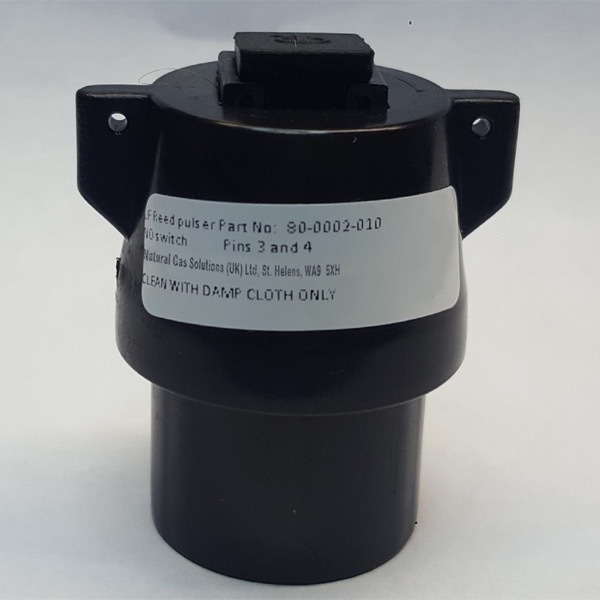
A pulser is a switch in a dedicated port on the meter's index, closed or energised by a magnet fixed to the meter's rotating drive, so it emits one pulse per fixed volume the meter has displaced. Two technologies are sourced here. A reed switch is two ferromagnetic contacts sealed in glass, a normally-open two-wire dry contact that is not polarity sensitive, rated to 10 W, 125 V and 500 mA, with a pulse width over 200 ms that varies with flow and contact bounce under 0.6 ms. A Wiegand pulser is an encapsulated coil that generates its own pulse from the sweeping magnet with no excitation power at all, on a two-wire connection where polarity does matter. Neither is an absolute register: it counts, it does not report a position.
Good at
The cheapest way to make a meter that is already installed and already approved readable, with nothing about the measurement changed
No power at the meter: the reed contact is passive and the Wiegand coil is self-generating
Both sourced products are rated for the meter set. The reed unit is classed as simple apparatus under EN 60079-11 and the Wiegand unit is certified intrinsically safe, Ex ia IIC T4 Ga under Baseefa17ATEX0043X
Both cite IGEM/GM/7A, the wiring standard for electrical installations at gas metering facilities
A two-wire dry contact is what an ordinary pulse counter or LoRaWAN input expects
Weak at
The count is uncorrected line volume, so it only becomes a billable or energy figure through a fixed pressure factor agreed with the utility, or a corrector downstream
No manufacturer source in this research states a single pulse weight for a bare index pulser, so the programmed weight has to be confirmed at commissioning rather than assumed
Nothing is stored: a missed or double-counted pulse is gone, unlike an absolute register that can be re-read
A reed contact is a mechanical part that bounces and eventually wears; the Wiegand alternative is polarity sensitive on installation
No rate output, and no diagnostics
CapacityThe host meter's. A pulser states no capacity of its own.
PressureThe host meter's
TurndownThe host meter's
Straight runNone of its own; it fits the meter's index port
SensitivityPulse rate and contact life: a reed switch has a stated pulse width over 200 ms, which sets the fastest flow it can follow on a given pulse weight
Best for
Getting a total off the utility's meter when no corrector output is available, which is Quantify's second-choice route
A meter set where a passive, unpowered two-wire device is the safest thing to install
Retrofits, since the pulser uses a port the index already has
Avoid when
You need corrected volume and there is no corrector and no agreed fixed factor
You need a flow rate, or an absolute reading you can re-read after an outage
The meter's index has no pulser port, or the utility will not allow one fitted
Getting a number off the meter set and onto a dashboard
On gas the meter usually belongs to the utility, so the signal question is really a question about what is bolted to the index.
Index pulsers
A pulser sits in a dedicated port on the index and closes a contact once per fixed volume, driven by a magnet on the meter's own drive. Dresser sells two of them for the same port on a Roots B-series rotary meter, which makes the trade-off easy to see. The Reed LF transmitter is a normally-open, magnetically actuated dry contact, two-wire and not polarity sensitive, rated to 10 W, 125 V and 500 mA, with a pulse width over 200 ms and contact bounce of 0.6 ms or less, and Dresser classes it as simple apparatus under EN 60079-11.
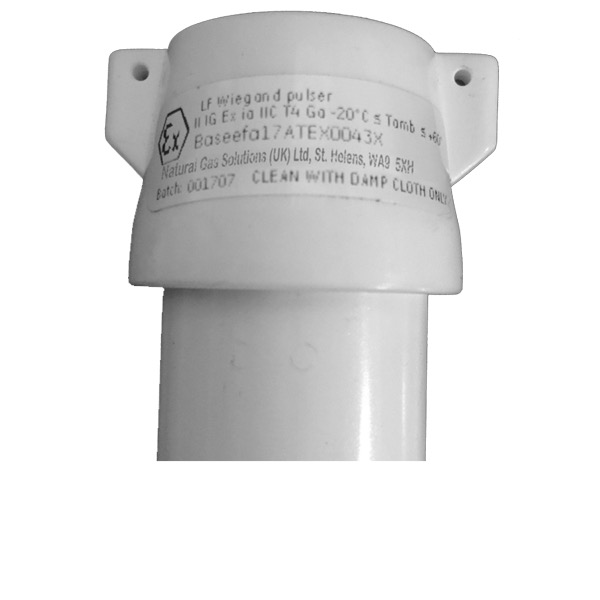
The Wiegand LF transmitter is the same fitment with an encapsulated Wiegand coil that generates its own pulse from the passing magnet, so it needs no excitation power and is certified in its own right as II 1G Ex ia IIC T4 Ga, with published entity parameters of Ui 25 V, Pi 180 mW, Ci 13.5 nF and Li 20 mH. Polarity matters on that one. Hall-effect and optical pulsers exist as a product category, but no gas-specific datasheet for either turned up in this research, so treat their ratings as not stated until a manufacturer sheet confirms them.
Pulse weight on gas is usually set downstream rather than on the pulser itself. Romet's AdEM-PTZ-r and AdEM-PTZ-MI take a configurable pulse input rate of 1, 10, 100 or 1000, and Dresser's IMC/W2 gives three fully programmable pulse output channels with selectable widths of 62.5, 125, 187 or 312 ms. No source in this research gave a single "one pulse equals X ft³" figure for a bare index pulser, so confirm the weight the device is actually programmed to at commissioning instead of trusting a default. A representative industrial LoRaWAN pulse counter accepts up to 2000 Hz with a 250 µs minimum pulse width, so the counter is almost never the limit.
Volume correctors
A corrector takes the volume input straight off the meter drive and applies the corrections the raw index cannot. Temperature-only units, such as Romet's AdEM-T and Honeywell's TCI index, handle the temperature factor alone. Full PTZ units apply pressure, temperature and supercompressibility: Dresser's IMC/W2 uses the NX-19 or AGA 8 methods and reads the drive through a high-speed magnetic pickup in the meter magnet cup, and Honeywell's EC350 holds pressure correction to ±0.1% from -40 °C to 65 °C.
Outputs vary more than the marketing suggests. The EC350 has four opto-coupled channels, three of them programmable pulse outputs plus an alarm, and states Modbus alongside RS232, RS485 and an IrDA port. The IMC/W2 gives three programmable Form A pulse outputs and the fact sheet reviewed listed no Modbus. Romet's AdEM family gives four isolated channels, two corrected, one uncorrected and one programmable, with RS232 in the text and an RS485 marking on the unit's own nameplate that Romet's control drawing should settle before anyone specifies it. Dresser's Corus Evo+ claims Modbus and 4-20 mA on its product page without a datasheet in this research to confirm either.
No manufacturer document in this research states a general policy on who owns or seals a corrector, because that is a tariff and metering-practice question rather than a hardware spec. What the hardware does say is telling: Romet's AdEM carries a 12-year Measurement Canada accuracy seal, and its password and hardware switch protection can only be cleared by breaking a metrological seal. Treat a corrector on a billing meter as sealed custody-transfer equipment and confirm ownership with the utility or the meter shop before anything is wired to it.
Utility AMR modules
Retrofit AMR and AMI modules read the index or a corrector and transmit on the vendor's own network. Itron's 100G, Gen5 500G, Cellular 500G and IMU500T, Sensus's SmartPoint GM and Dresser's AMR Adapter all work this way, and none of them documents a pulse contact, a current loop or a Modbus port for a third party. Itron's remote-mount wiring to a Dresser or Romet rotary meter is a pulse that never leaves the sealed system.
The honest evidence level matters here. On the water side, Neptune publishes an FAQ saying outright that the Signalizer is not compatible with the R900i. Nothing equivalent exists in gas: the vendor pages describe features rather than terminals, and the real datasheets sit behind a customer portal this research could not reach. So the position is that no customer output is documented, not that a manufacturer has confirmed there is none, and the route out is the same either way. Read a corrector or pulser instead, install your own sub-meter, or take the utility's data.
The no-hardware option
Enbridge implemented Green Button on 1 November 2023 under an Ontario Ministry of Energy requirement. A signed-in My Account customer can use "Download my data" to pull up to 24 months of account, billing and usage data as XML, or "Share my data" to authorize a named third party to receive the same categories directly, with a fixed end date or open-ended and revocable. It costs nothing and installs nothing. What it does not do is give you interval resolution on an ordinary account, so treat it as billing-period truth rather than a live feed.
Once the meter is yours rather than the utility's, the signal choice opens up. Fox Thermal's FT4A, FT4X and FT1 offer 4-20 mA, a second selectable channel for pulse or alarm, and Modbus RTU over RS-485 with HART as an option. Sierra's QuadraTherm 640i gives 4-20 mA for flow, temperature and optionally pressure, plus HART, Modbus RTU, RS-232, a user-definable totalizer pulse and an alarm relay. We read Modbus, we never write to it.
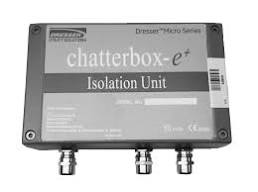
A reed pulser is passive enough to be treated as simple apparatus, but the device on the other end of the wire usually is not, and a LoRaWAN pulse counter carries no intrinsic-safety certification. Dresser's Chatterbox-e LED, Model 123, is the purpose-built answer: a battery-powered pulse isolator that sits in the safe area and provides the certified boundary, with up to four isolated open-drain channels accepting 1.5 to 30 VDC and one 200 ms output pulse per input pulse. It is certified Ex ia Ga IIC under Baseefa 03ATEX0429 and BAS21UKEX0072, runs more than ten years on two Tadiran SL750 cells, and ships in an IP66 cast aluminium box 160 by 120 by 62 mm.
Whether your meter set actually needs one is the part this research could not settle. CSA B149.1 and Section 18 of the Canadian Electrical Code are paywalled standards and neither was retrieved, so no clearance distance or classification radius is published here. What is confirmed is that the whole product category is built for the possibility: the EC350 is CSA Class I Division 1 Groups C and D, the IMC/W2 is Class I Division 1 Groups A through D under CSA approval 1224451, and Romet's AdEM is Class I Zone 0 under ATEX and Division 1 Group D under the NEC. Get the classification for your specific site from a licensed electrician before choosing between an intrinsically safe device, a Division 2 device and a barrier.
Our order of preference, and the hardware behind it.
Gas meter signal, the Quantify device that reads it, what it gives you, and our preference
Meter signal
Our device
What you get
Preference
Corrector output, pulse or Modbus, from a Honeywell EC350, a Dresser IMC/W2, a Corus Evo+ or a Romet AdEM
LoRaWAN pulse counter, or a Modbus node where the corrector offers it
Corrected volume, already scaled to base conditions
Preferred
Index pulser on the utility meter: Dresser Reed LF or Wiegand LF, or a Honeywell TCI index
LoRaWAN pulse counter, behind a Chatterbox-e barrier where the area is classified
Running total at line conditions, pulses times the pulse weight
Second choice
A sub-meter we install on the branch: a Romet rotary, or a Fox, Sierra or Sage thermal-mass meter
Pulse counter for the total, analog node on the 4-20 mA loop for rate, or a Modbus node
Branch-level or equipment-level total and rate, on hardware you own
Third, and the only route to branch detail
No hardware at all: Enbridge Green Button, "Download my data" or "Share my data"
None; the data is authorized to us and pulled
Up to 24 months of account, billing and usage data as XML
Shown, not ranked
The barrier is in cyan because it is the step people forget, and the only one a licensed electrician has to rule in or out.
Sizing
Capacity is a number at a pressure, not just a number
A gas meter is sized from the connected load and the pressure it will actually see. The pipe downstream is a separate calculation, done by somebody else.
Load, then standard flow, then actual flow
Start with the connected load of everything the meter will serve, in BTU/h, MBH or kW, and divide by the heating value of the gas to get a required flow in standard cubic feet per hour. Enbridge publishes the heating value by service area, 39.08 MJ/m³ in the South and 39.04 MJ/m³ in the North effective 1 April 2026, and the figure moves with the supply mix, so use what is on the bill rather than a constant. Then convert that standard flow to what the meter will physically pass at the delivery pressure, which is where the pressure factor comes in.
The pressure factor, from a real table
Dresser's Series B3 meter-sizing table gives the corrected standard capacity for each meter's fixed actual rating across a range of line pressures, and dividing one by the other leaves a clean multiplier. It reads 1.045 at 1 psig, 1.315 at 5 psig, 2.675 at 25 psig, 7.765 at 100 psig and 12.86 at 175 psig, and it is the same number on every body in the line, which is exactly what you would expect from a factor that depends on absolute pressure. Romet's RM1000 confirms it independently: a 1,000 CFH base rating becomes 12,858 SCFH corrected at 175 psig.
Enbridge's GetConnected application defaults to 7 in W.C., which is 0.25 psig, and that is the standard Ontario low-pressure class most diaphragm capacity tables are quoted against. Anything at 2 psig or above has to be requested by changing the default and giving a reason, and for low-rise residential it needs Enbridge's approval on top of that. Higher classes exist as meter MAOP ratings in this research, 5, 10, 25, 100 and 175 psig depending on the body, but no Enbridge document retrieved here names a delivery-pressure tier above 2 psig, so treat those as equipment ratings rather than a service you can assume.
Diaphragm capacities are quoted at a differential across the meter, usually 0.5 in W.C. for the headline number and 2 in W.C. for the bigger one, at a stated line pressure. The AL-425 is 425 SCFH at 0.25 psig and 0.5 in W.C., 898 SCFH at the same pressure and 2 in W.C., and 1,462 SCFH at 25 psig and 2 in W.C. Rotary meters are quoted the other way round, as a base rating in actual ft³/h at a maximum differential, with a separate corrected column per inlet pressure. Two different conventions, and comparing the wrong columns is how a meter ends up half the size somebody thought they bought.
Turndown and start flow
Every displacement meter has a flow below which it stops registering. Dresser's Series B3 start rates run from 1.01 CFH on the 2M175 to 40 CFH on the 56M175, with rangeability from 26:1 to 169:1, and Romet's RM line starts between 1.8 and 7.0 CFH at 1:160. On the temperature-compensated RMT line the numbers are tighter still: the RMT3000 starts at 0.44 CFH and holds 1:160 at ±2%. Romet also warns that the tighter tolerances behind a high rangeability make those meters less forgiving of poor installation, piping stress and settling.
Undersize the meter and the load runs past what the body can pass. Enbridge's Intelis guidance puts the safe operational threshold at 300,000 BTU/h for the 250 class and 600,000 BTU/h for the 425 class, and says exceeding it can trigger meter damage, high-flow alarms, automatic shutoff and service interruption. Above 500,000 BTU/h on the 250 class or 850,000 on the 425 class the internal safety valve closes, and Enbridge states it cannot be reset in the field, so the meter is replaced. Construction heat counts, and so does introducing gas too quickly at commissioning, which trips the same valve.
Oversize it and the load sits below the meter's start rate or under the flow band where its published rangeability applies, so small steady draws go uncounted and the overnight baseline you were trying to see is a flat line. The failure that costs more is usually oversizing, because it is silent.
The piping is a different calculation, by a different party
Enbridge sizes and installs a meter to the load the contractor declares, and says so plainly: the responsibility to ensure there is appropriate gas pressure and volume at each appliance rests solely with the designer or installer, and Enbridge will not be responsible for deficiencies in pressure and volume. Pipe diameter, length, fittings and allowable pressure drop from the meter outlet to the farthest appliance are the designer's job under CSA B149.1. The one number that crosses between the two exercises is the differential across the meter itself, which comes out of the same pressure-drop budget.
This tool needs JavaScript. The capacity classes it checks against are printed below it, so you can do the same comparison by hand.
The default heating value is Enbridge's published figure for the South service area, effective 1 April 2026. The pressure factor is interpolated between Dresser's published rows, and the checker says so on every line it uses.
Dresser Series B3 rotary 'Meter Sizing' table: corrected standard MSCFH / base acfh rating, verified consistent across meter sizes (8C175 through 56M175)
Dresser Series B3 rotary 'Meter Sizing' table; independently corroborated by Romet RM1000 spec sheet (250 base CFH x 12.86 = 3,215 vs actual RM1000 table interpolation - see sizing.md worked example using RM1000's own 175psig corrected value of 12,858 SCFH / 1,000 base CFH = 12.858)
What Measurement Canada and Ontario actually require
Gas is the opposite of water here, and the trigger is not ownership. It is whether the reading is used to charge somebody.
Measurement Canada does regulate gas meters
Under the Electricity and Gas Inspection Act, section 9(1), a meter cannot be put into service until it has been verified and sealed where a contractor or purchaser intends to use it "for the purpose of obtaining the basis of a charge for electricity or gas supplied by or to him". Section 9(4) adds that the meter's type has to have been approved before it can even be verified. Water meters are exempt from that regime outright; gas meters are not, and the condition that pulls a sub-meter into it is billing.
A meter whose reading nobody is charged for is not obtaining the basis of a charge, so a sub-meter feeding a dashboard for the facility's own optimization sits outside that trigger as the statute reads. A sub-meter that invoices a tenant, a sub-tenant or a separate legal entity is squarely inside it and needs an approved type, verification and sealing, and reverification on schedule. That is our reading of the text rather than a Measurement Canada ruling on any particular installation, so put an edge case to Measurement Canada directly instead of assuming.
Approval, verification and who is allowed to touch a seal
Approval of type runs through Measurement Canada's S-G specification series, with S-G-03 covering gas meters and ancillary devices, S-G-07 covering devices that convert to base volume or energy, and S-G-08 covering electronic volume conversion devices. Section 15(1) of the Act limits verifying, sealing, reverifying and resealing to a Measurement Canada inspector or an accredited meter verifier, and 15(2) puts a meter with a broken seal out of service until it has been reverified and resealed. Putting an unverified meter into billing service is a specific offence under section 33(1)(c).
Bulletin G-18, revision 4, effective 24 February 2017, sets the initial reverification period by device type. The spread is wide enough to change which technology you specify.
Diaphragm, 240 ft³/hr and above 7 years.
Diaphragm, under 240 ft³/hr 7 years, or 10 where the model is separately qualified.
Rotary 20 years, the longest on the list.
Turbine 6 years.
Orifice 6 years.
Ultrasonic 6 years, or 10 where separately qualified.
Coriolis 6 years, and 1 year on vehicle-refuelling duty.
Mechanical volume-conversion device 7 years.
Electronic volume conversion device 7 years, or 12 where separately qualified.
Flow computer 6 years.
Bulletin G-03 lists the specific manufacturer models that have qualified for a lengthened initial period, and it is worth checking before you assume the standard number. The Itron Intelis 250 appears there as conditionally qualified, pending interim sampling under S-S-05 by 30 June 2028. Subsequent reverification periods are set separately and were not extracted per device type in this research, so pull those from G-18 itself rather than from this page.
An accredited meter verifier is where the sealing and reverification work actually happens. M&RS Controls holds Measurement Canada accreditation A-0081 for sealing diaphragm and rotary gas meters and for electronic volume-correction services, with a branch at 36 Regan Road in Brampton alongside Edmonton, Calgary and Regina. Measurement Canada's own service-provider search is the way to confirm any shop's current standing before you send a meter to it.
Ontario Regulation 212/01, section 8, gives the distributor a standing right of access for placing, protecting, setting, shutting off, removing, repairing or altering any meter or regulator it owns. Enbridge's own safety copy draws the same line for customers: the gas line past the meter and the appliances on it are the owner's responsibility, and the meter, regulator and relief vent are Enbridge's. A Quantify sub-meter always goes downstream of that boundary, on the customer's own piping.
What a customer can request at the meter set is less clear than it should be. No public Enbridge page in this research documents a process for asking for a pulse output, or for a delivery pressure above 2 psig, and the large-volume pages carry rate classes rather than metering specifications. For a commercial or industrial account that conversation runs through an Enbridge account manager, so start there rather than with a form.
Section 57(c.1) of the Ontario Energy Board Act and the OEB's Unit Sub-Metering Code apply to electricity, and the OEB's own scope statement says it does not regulate other services such as billing for natural gas or water. So no OEB licence is needed to sub-meter gas. That is not the same as gas sub-metering being unregulated, because Measurement Canada's Act still applies the moment the reading becomes the basis of a charge. Sub-billing gas to a residential tenant also runs into the Residential Tenancies Act, and that one is worth a lawyer rather than a meter catalog.
O. Reg. 212/01, section 6(1), says nobody may install, alter, purge, activate, repair, service or remove anything used in the handling or use of gas without holding a certificate for that purpose, with a narrow exception for working in the physical presence of a certificate holder. The certificate categories themselves come from O. Reg. 215/01, and CSA B149.1 becomes binding in Ontario through the Gaseous Fuels Code Adoption Document under O. Reg. 223/01. Tying a sub-meter into gas piping is certificate work, and it is not work Quantify's own staff perform.
TSSA's ladder is worth knowing when you are scheduling. G3 is entry level and works under the supervision of a G1, G2 or DA holder. G2 requires a valid G3 plus either accredited training or 450 documented supervised hours. G1 requires a valid G2 plus two years, 4,000 hours, of field experience as a G2, of which at least 500 hours must be on systems with an input over 400,000 BTU/h under a G1's direct supervision, which is the certificate that covers most commercial and industrial meter-set work.
Hazardous locations: what is confirmed and what is not
Confirmed: every Enbridge meter installation includes a regulator and a pressure relief vent, and every pulser, corrector and barrier reviewed for this page carries a Class I Division or Zone rating as standard. Dresser's UK documentation repeatedly cites IGEM/GM/7A, the Institution of Gas Engineers and Managers standard for electrical installations at gas metering facilities, which is the closest published wiring guidance this research found.
Not confirmed: whether any particular outdoor Ontario meter set is a classified location. CSA B149.1's clearance tables and Section 18 of the Canadian Electrical Code are paywalled standards, and neither was retrieved here, so this page publishes no clearance distance and no classification radius. Get that determination from a licensed electrician for the specific site, then choose between intrinsically safe equipment, a Division 2 device and a barrier on the basis of the answer.
No CRN is needed, and the reason is cleaner than for water
Ontario Regulation 220/01 requires design registration for boilers, pressure vessels, fittings and piping in its jurisdiction, but section 2(2)(u)(iii) excludes piping, pressure vessels and fittings regulated under O. Reg. 212/01, the Gaseous Fuels regulation, with no temperature or pressure ceiling attached. Gas piping and anything installed on it is already regulated there by definition, so a Canadian Registration Number does not apply regardless of the pressure class. That is a broader exemption than the water side gets, where the carve-out depends on staying under 65 °C and 250 psi.
Ontario's Ministry of Energy required most regulated electricity and gas utilities to offer Green Button as of 1 November 2023. Enbridge's implementation has two features and they are named precisely: "Download my data" pulls up to 24 months of account, billing and usage data as XML, and "Share my data" authorizes a named third party to receive the same categories directly, for a fixed period or open-ended and revocable. Enbridge checks that the third party can accept the data securely, and only releases identifying details such as the account number and service address if the customer authorizes that separately.
The cubic foot and the cubic metre are the same physical volume everywhere. What changes between a standard cubic foot and a standard cubic metre is the base pressure and temperature the volume was corrected to, which is the next table.
Standard conditions are two base points, not one
The Electricity and Gas Inspection Regulations define standard temperature as 15 °C in SI or 60 °F in Imperial, and standard pressure as 101.325 kPa absolute in SI or 14.73 psia in Imperial. Those two temperatures are not the same physical temperature, because 60 °F is 15.56 °C. The regulation is defining two internally consistent pairs, one for each measurement system, so an American figure in standard cubic feet and a Canadian figure in standard cubic metres cannot simply be converted with the volume factor without checking which base each was corrected to. Measurement Canada's S-G-03 repeats the identical figures.
Corrected volume is the uncorrected index reading multiplied by a pressure factor and a temperature factor. The pressure factor compares the absolute flowing pressure to the base pressure, so a meter running above base pressure passes more standard volume than its index shows. The temperature factor compares the base absolute temperature to the flowing absolute temperature, because colder gas is denser. Custody-transfer work adds a compressibility factor on top, which is what Dresser's IMC/W2 is doing when it offers the NX-19 or AGA 8 methods. The structure is settled industry practice, but no single citable formula was pinned down here, so check the notation against the specific corrector's manual before you publish a worked number.
Heating value, and how the invoice is built
Enbridge bills in cubic metres and converts to energy with a heating value published by service area, most recently 39.08 MJ/m³ in the South and 39.04 MJ/m³ in the North, effective 1 April 2026. Before that conversion it applies a Pressure Elevation Factor for the site's elevation, which is an atmospheric-pressure correction across Ontario and not a correction for a customer's delivery pressure. The two get confused constantly. Billed energy is metered volume times the elevation factor times the current heating value, and any platform doing the same arithmetic should track the published figure rather than hard-coding one.
A therm is 100,000 BTU by definition, but the joule value depends on which BTU convention is behind it, which is why the US and UK therms differ slightly. MBTU is the genuinely dangerous one. In SI the M prefix means million, while oil and gas usage inherited the Roman numeral where M means one thousand, so MBTU on a spec sheet can mean either. The industry increasingly writes MMBtu to mean one million BTU without ambiguity. Ask which convention a document is using rather than inferring it, especially when the number is going into a billing calculation.
TC indexes, multipliers and rollover
A temperature-compensated index applies the temperature correction mechanically inside the index and does nothing about pressure, which is why Measurement Canada's S-G-03 allows temperature-compensated meters a maximum permissible error of ±2.0% away from reference conditions. Honeywell's TCI is the electronic version of the same idea, with three pulse output channels and an infrared communications port, and Dresser's mechanical TC index on the B3 works from -29 °C to +49 °C. Above that sits the full electronic volume corrector, which handles pressure and temperature continuously and reports a corrected total.
Index multipliers are a printed factor that puts the displayed number in tens or hundreds of units, and rollover is the digit limit at which the index returns to zero. No manufacturer manual in this research gave either value for a specific catalog model, so both are recorded as not stated. Read them off the model's own documentation and off the faceplate at commissioning, and write down what you found.
Power at the meter set
Power options across gas meters, correctors and sub-meters
Option
What it means
Where you meet it
None
A mechanical index accumulates and displays with no power at all. Anything added afterwards, a pulser, a corrector or an AMR module, brings its own supply.
Diaphragm and rotary meter bodies, and a reed pulser, which is a passive dry contact
Battery
A sealed or replaceable lithium pack rated for a multi-year design life, usually with an end-of-life warning. Read the figure per model, not per family.
Honeywell EC350 at 5 to 7 years on alkaline and up to 10 on lithium; Dresser IMC/W2 at 15 years; Romet AdEM-T at 20 years and AdEM-PTZ at 15; Chatterbox-e barrier at more than 10
Loop-powered
A 4-20 mA device draws its supply from the same pair that carries the signal, so no separate power run is needed.
Thermal-mass transmitters on a current loop
Line power
24 VDC or 120 VAC at the instrument. Standard on process-grade sub-meters and the reason a remote branch tap needs a power plan before a meter plan.
Fox Thermal, Sierra and Sage transmitters, and flow computers on an orifice run
Decision tree
Eight questions, in the order that saves the most time
Answer these in order and the shortlist writes itself. Print this page and the tree fits on one sheet.
The same eight questions the picker asks, in the same order.
The decision tree in words
Purpose. Do you need a running total, an instantaneous rate, or both? A total means a pulse from a corrector or an index pulser. A rate means 4-20 mA or read-only Modbus from a sub-meter that offers one.
Route. Are you tapping the utility meter set, or installing your own sub-meter on a branch? The utility set gives you the whole site through a corrector or an index pulser. Your own sub-meter is the only way to see one process, one building or one piece of equipment.
Billing. Will the reading be used to charge somebody? If yes, the Electricity and Gas Inspection Act applies and the meter needs an approved type, verification and sealing by an inspector or an accredited meter verifier. If it feeds your own dashboard only, that trigger does not fire.
Load and pressure. Total the connected load in BTU per hour, convert it to standard flow with the heating value from your bill, then apply the pressure factor for the delivery pressure. Enbridge defaults to 7 in W.C., and 2 psig or above has to be requested and approved.
Correction. Do you need corrected volume, or is the raw index enough? Corrected means a corrector or a temperature-compensated index. Uncorrected means agreeing a fixed pressure factor in writing with whoever reads the number.
Output signal. A corrector's pulse or Modbus first, an index pulser into a pulse counter second, your own sub-meter's pulse, 4-20 mA or Modbus third. If a sealed AMR module is the only thing on the meter, take Enbridge's Green Button data instead.
Units and index. Match the index unit to what you report in, cubic metres for a Canadian bill, and confirm the multiplier and the rollover on the model's own documentation rather than the faceplate alone.
Power. Nothing at the meter set means a battery corrector or a passive pulser. Line power or a current loop opens up thermal-mass sub-meters and flow computers.
Shortlist. Run the picker below with those answers, then send the distributor checklist with your request for a quote.
Picker
Answer the same eight questions and get a shortlist
This runs entirely in your browser and sends nothing anywhere. It returns a requirements sheet you can paste into an email and a ranked list of meters, correctors and pulsers from the catalog below, with the reason each one made or missed the cut.
This tool needs JavaScript. Without it, every question below is still readable, and the catalog and the decision tree do the same job by hand.
Meters ruled out and why
Catalog
Real meters and correctors, with the datasheet behind every number
Filter with the rails, open Specs on any row for the full sheet, and tick up to three to compare. Where a datasheet did not state something, the row says not stated rather than filling the gap.
Four things are worth knowing before you read a row. The Category rail separates a utility billing meter from a sub-meter you would own, from a corrector, from an accessory such as a pulser or a barrier, and those four buy very differently. The Capacity rail bands entries by their highest rated CFH, under 500, 500 to 1,000, 1,000 to 3,000, 3,000 to 10,000 and above 10,000, and the Max inlet rail bands them by the pressure the body can tolerate, up to 5, 25 and 100 psig and beyond.
The MC approved chip means Measurement Canada has issued a notice of approval for that model, which matters only when the reading bills somebody. Most rows say unknown, because this research confirmed approval numbers for very few models and would rather say so than imply one exists. Price bands are comparative judgements by product class rather than quoted figures, because none of these manufacturers publish list prices for this equipment.
49 meters, correctors and accessories
Compare
Manufacturer
Model
Technology
Category
Capacity
Max inlet
Outputs
MC approved
Price
Quantify fit
Details
Dresser
AMR Adapter AccessorySeries B3 AMR Adapter kit
Other
Accessory
not stated
not stated
none on the meter
Not stated
$
total: no route; rate: no route
A direct-drive mechanical adapter kit, field- or factory-installed, that lets a separately purchased third-party residential ERT or Cellnet AMR transmitter be mounted on a Series B3 Roots meter index.
Capacity classesnot stated
Accuracynot stated
Temperature rangenot stated
Indexnot stated
Index notePurely mechanical drive coupling; carries no index or electronics of its own.
Correctionno correction of its own
Hazardous locationnone stated
Standardsnot stated
Measurement CanadaNot stated
Powernone (mechanical only; power depends on whichever third-party ERT/AMR module is mounted)
Display showsnot stated
Installnot stated
Quantify fittotal: no route; rate: no route
Fit noteThis is the trap case explicitly flagged for this domain: the adapter itself is a mechanical coupling, not a signal source. It exists only to accept a third-party ERT/AMR module (e.g. an Itron 100G/500G), and that module transmits proprietary RF to the gas utility's own AMR/AMI network only, there is no open pulse, Modbus, or 4-20 mA output Quantify can read from this path. For a usable signal off a Roots meter, use the IMC/W2 corrector or a Series 3 solid-state pulser instead.
Available as a field conversion kit or factory-installed on new Series B3 CTR/TC meters.
Output signals
No wired output on the base meter. This is the trap case explicitly flagged for this domain: the adapter itself is a mechanical coupling, not a signal source. It exists only to accept a third-party ERT/AMR module (e.g. an Itron 100G/500G), and that module transmits proprietary RF to the gas utility's own AMR/AMI network only, there is no open pulse, Modbus, or 4-20 mA output Quantify can read from this path. For a usable signal off a Roots meter, use the IMC/W2 corrector or a Series 3 solid-state pulser instead.
Chatterbox-e LED (Model 123) AccessoryDresser Chatterbox-e Pulse Isolation Unit
Other
Accessory
not stated
not stated
Pulse
Not stated
$$
total: pulse; rate: no route
Battery-powered intrinsically-safe pulse isolator/barrier that sits in the SAFE area and provides the certified isolation boundary between a hazardous-area gas meter/corrector pulse and non-intrinsically-safe equipment (a logger, BMS or AMR device): this is Quantify's IS barrier example for a gas pulser installation.
Capacity classesnot stated
Accuracynot stated
Temperature rangenot stated
Indexnot stated
Correctionno correction of its own
Hazardous locationEx ia Ga IIC: Baseefa 03ATEX0429, BAS21UKEX0072; must be installed in the SAFE area, suitable for connection to equipment in hazardous Zone 0, 1 or 2
StandardsATEX, UKEX, IGEM/GM/7A, NEC Article 500 (ANSI/NFPA-70)
Measurement CanadaNot stated
Power2 × Tadiran SL750 (1/2 AA) lithium cells; >10 years typical at all 4 channels active <1 Hz (up to ~12.7 years at 1 active channel per the manufacturer's battery-life chart)
Display showsprogrammable
Installwall or panel mount, safe area only, no filter stated
Quantify fittotal: pulse; rate: no route
Fit noteNot a metering device: it relays whatever pulse it receives. This is the piece that lets Quantify's own (non-IS) LoRaWAN pulse counter connect downstream of a hazardous-area pulser/corrector without itself needing hazardous-location certification, PROVIDED the meter set location is in fact classified, see research/signals.md §a for the open question on whether a given outdoor meter set is classified at all.
Weatherproof cast-aluminium enclosure IP66 (~NEMA 4X), 160 x 120 x 62 mm; opto-isolation; push-to-test LED confirms channel wiring; no corrector or meter setting required.
Output signals
Type
Protocol
Pulse weights
Switch
Max Hz
Detail
Pulse
not stated
not stated
Solid state
not stated
Up to 4 isolated open-drain output channels, each accepting 1.5–30 VDC from a third-party logger/BMS/AMR; 200 ms isolated output pulse per input pulse; single input can drive up to 4 selectable output circuits
Price band $$ (hundreds to about $1,500)
Where to buy not stated
Dresser Utility Solutions (Natural Gas Solutions UK Ltd.).
total: corrected volume over Modbus; rate: 4-20 mA
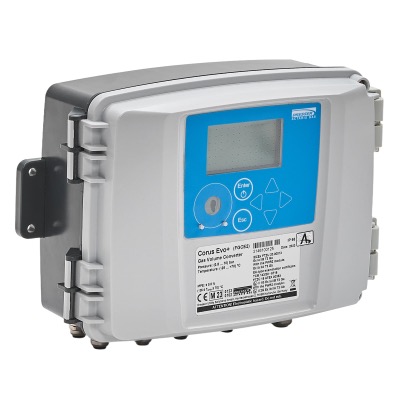
Electronic gas volume converter for commercial and industrial rotary-meter installations; measures pressure and temperature at the meter to output corrected consumption, with a modular I/O bay for expansion.
Capacity classesnot stated
Accuracy0.3% (optional/certified accuracy class stated on product page)
Temperature rangenot stated
Indexnot stated
Correctionno correction of its own
Hazardous locationATEX certified; IECEx certified (product & factory certificates listed on the product page; specific zone/group code not captured in this pass)
StandardsATEX, IECEx, MID
Measurement CanadaNot stated
Powernot stated
Display showstotal, programmable
Installdirect-mount on rotary meter, no filter stated
Quantify fittotal: corrected volume over Modbus; rate: 4-20 mA
Fit notePage claims both Modbus and 4-20 mA; treat as unconfirmed until a full datasheet with a register map is obtained: flagged as a gap in research/signals.md.
Modular design with up to 6 expansion slots for external power supplies and communication ports; anti-tamper and encrypted-communication features advertised.
Output signals
Type
Protocol
Pulse weights
Switch
Max Hz
Detail
Modbus
Modbus RTU
not stated
not stated
not stated
Modbus User Guide published separately by Dresser; register map not obtained in this pass
4-20 mA
not stated
not stated
not stated
not stated
4-20 mA output referenced on the product page; not independently datasheet-confirmed in this pass
Pulse
not stated
not stated
not stated
not stated
Pulse output implied by gas-meter integration; exact pulse weight/channel count not confirmed in this pass
Price band $$$ (about $1,500 to $5,000)
Where to buy not stated
Sold through Dresser Utility Solutions; this product line traces back to Actaris/Schlumberger's Corus brand (also referenced under Itron after Itron acquired Actaris): current Corus ownership/support channel not fully reconciled in this pass.
total: corrected volume as pulses; rate: derived from pulses
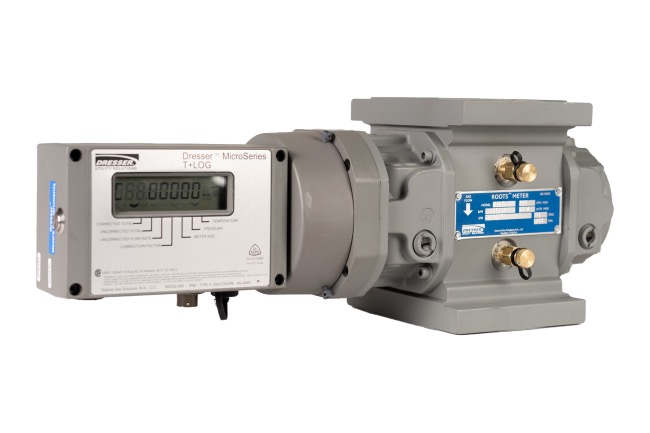
An integral electronic gas volume corrector (temperature, pressure and/or supercompressibility) that mounts to a Dresser Series-A (LMMA), Series-B, or Romet rotary meter body, sold factory-integral or as a retrofit kit.
Capacity classesnot stated
AccuracyMeter (pickup) accuracy error less than ±1.0%; volume-correction accuracy 0.5% (PTZ), 0.45% (P), 0.2% (T) of corrected volume across the operating temperature range
Temperature range-40 to 60 °C
Indexelectronic, reads in ft³, m³
Index pulse weightsconfigurable pulse width: 62.5, 125, 187 or 312 ms per pulse
Installintegral direct-mount (magnetic pickup in meter magnet cup) or retrofit kit, no filter stated
Quantify fittotal: corrected volume as pulses; rate: derived from pulses
Fit noteThis is exactly Quantify's top-preference route for gas: corrector output (corrected volume) on pulse, read by a LoRaWAN pulse counter. No Modbus on this base IMC/W2, Dresser's newer Corus Evo+ corrector adds Modbus RTU/TCP but is a European, MID-certified product with no Measurement Canada or CSA approval found; treat it as not currently confirmed for the Canadian market.
Ordered as an integral part of a new meter or as a field-conversion kit for existing Series-A (LMMA), Series-B (TQM), or Romet meters. Series-A meters and the 23M-56M/high-pressure sizes require an external pressure sensor connection; optional stainless piping kits are sold for this.
Output signals
Type
Protocol
Pulse weights
Switch
Max Hz
Detail
Pulse
not stated
not stated
Solid state
not stated
Three fully programmable Form-A solid-state pulse outputs: corrected volume, uncorrected volume, and alarm/fault.
Price band $$$ (about $1,500 to $5,000)
Where to buy not stated
Same as the parent Series B3 meter: no dedicated Canadian office or distributor found on Dresser Utility Solutions' own site (checked 2026-09-03).
Our pick Quantify's first-choice route in one box: three fully programmable solid-state pulse channels, one of them corrected volume straight to a pulse counter, with pulse widths selectable at 62.5, 125, 187 or 312 ms so the signal can be matched to the logger. It picks the volume off the meter's own drive magnet and retrofits to Dresser Series-A, Series-B and Romet rotary bodies, on a sealed lithium pack rated for 15 years, with Class I Division 1 Groups A to D under CSA approval 1224451. There is no Modbus on this unit, the fact sheet we read states none, and Measurement Canada approval is not stated, so confirm both before you specify it for a billing point.
total: an index pulser on the meter; rate: derived from pulses
Encapsulated reed-switch pulser that fits a dedicated port in a Roots® rotary Series B gas meter index, giving a normally-open, magnetically-actuated dry contact for a corrector or logger.
Hazardous locationPassive design, classed as simple apparatus per EN 60079-11; meets UK IGEM/GM/7A (IGEM guidance: 2.5–5 V, ≤1 mA)
StandardsEN 60079-11, IGEM/GM/7A
Measurement CanadaNot stated
PowerNone: passive dry contact, powered by the reading device
Display showsnot stated
Installfits left or right dedicated port in the Roots® Rotary Displacement B Series meter index counter, held by a set screw, no filter stated
Quantify fittotal: an index pulser on the meter; rate: derived from pulses
Fit noteBecause it's certified 'simple apparatus' per EN 60079-11, it can be wired into a hazardous area without its own IS barrier as long as everything downstream to the safe area is a certified IS circuit (e.g. through a Chatterbox-e-type isolator): the barrier requirement moves to the boundary crossing, not this device itself.
Two-wire, non-polarity-sensitive connection; drill holes for lock-wire sealing.
Output signals
Type
Protocol
Pulse weights
Switch
Max Hz
Detail
Pulse
not stated
not stated
Reed switch
not stated
Volt-free reed contact, NO (normally open), magnetically activated by the meter index; pulse width >200 ms (flow-rate dependent); contact bounce ≤ 0.6 ms; switch rated ≤10 W, ≤125 V, ≤500 mA; closed resistance ≤200 mΩ; ~100 million operations rated life
Price band $ (under a few hundred dollars)
Where to buy not stated
Dresser Utility Solutions (Natural Gas Solutions UK Ltd. is the listed manufacturer entity).
total: corrected volume as pulses; rate: derived from pulses
Dresser's current line-mount positive-displacement rotary meter for commercial and industrial gas measurement, 13 sizes from 800 to 56,000 ACFH sharing a common ANSI-flanged, oil-free Series 3 accessory platform.
Capacity classes8C175 800 CFH (22.6 m³/h), rated at fixed actual (index) rating, max inlet 175 psig, start flow 2.8 CFH, accuracy floor 30.77 CFH, turndown 26:1, 2, ANSI 150# FF flanged SourceDresser's Series B3 catalogue publishes this class as acfh - the meter's fixed actual (index) capacity, the same number at any pressure. The 0.5 in W.C. figure beside it is the pressure DROP across the meter at that flow, not the pressure it is fed at. 11C175 1100 CFH (31 m³/h), rated at fixed actual (index) rating, max inlet 175 psig, start flow 2.3 CFH, accuracy floor 35.48 CFH, turndown 31:1, 2, ANSI 150# FF flanged SourceDresser's Series B3 catalogue publishes this class as acfh - the meter's fixed actual (index) capacity, the same number at any pressure. The 0.6 in W.C. figure beside it is the pressure DROP across the meter at that flow, not the pressure it is fed at. 15C175 1500 CFH (42.5 m³/h), rated at fixed actual (index) rating, max inlet 175 psig, start flow 1.9 CFH, accuracy floor 37.5 CFH, turndown 40:1, 2, ANSI 150# FF flanged SourceDresser's Series B3 catalogue publishes this class as acfh - the meter's fixed actual (index) capacity, the same number at any pressure. The 0.8 in W.C. figure beside it is the pressure DROP across the meter at that flow, not the pressure it is fed at. 2M175 2000 CFH (56.6 m³/h), rated at fixed actual (index) rating, max inlet 175 psig, start flow 1.01 CFH, accuracy floor 29.41 CFH, turndown 68:1, 2, ANSI 150# FF flanged SourceDresser's Series B3 catalogue publishes this class as acfh - the meter's fixed actual (index) capacity, the same number at any pressure. The 0.7 in W.C. figure beside it is the pressure DROP across the meter at that flow, not the pressure it is fed at. 3M175 3000 CFH (85 m³/h), rated at fixed actual (index) rating, max inlet 175 psig, start flow 2.1 CFH, accuracy floor 39.47 CFH, turndown 76:1, 2, ANSI 150# FF flanged SourceDresser's Series B3 catalogue publishes this class as acfh - the meter's fixed actual (index) capacity, the same number at any pressure. The 1.1 in W.C. figure beside it is the pressure DROP across the meter at that flow, not the pressure it is fed at. 5M175 5000 CFH (141.5 m³/h), rated at fixed actual (index) rating, max inlet 175 psig, start flow 1.2 CFH, accuracy floor 41.67 CFH, turndown 120:1, 3, ANSI 150# FF flanged SourceDresser's Series B3 catalogue publishes this class as acfh - the meter's fixed actual (index) capacity, the same number at any pressure. The 1.1 in W.C. figure beside it is the pressure DROP across the meter at that flow, not the pressure it is fed at. 7M175 7000 CFH (200 m³/h), rated at fixed actual (index) rating, max inlet 175 psig, start flow 5.3 CFH, accuracy floor 104.48 CFH, turndown 67:1, 3, ANSI 150# FF flanged SourceDresser's Series B3 catalogue publishes this class as acfh - the meter's fixed actual (index) capacity, the same number at any pressure. The 1.6 in W.C. figure beside it is the pressure DROP across the meter at that flow, not the pressure it is fed at. 11M175 11000 CFH (310 m³/h), rated at fixed actual (index) rating, max inlet 175 psig, start flow 3.9 CFH, accuracy floor 88.71 CFH, turndown 124:1, 4, ANSI 150# FF flanged SourceDresser's Series B3 catalogue publishes this class as acfh - the meter's fixed actual (index) capacity, the same number at any pressure. The 1.6 in W.C. figure beside it is the pressure DROP across the meter at that flow, not the pressure it is fed at. 16M175 16000 CFH (450 m³/h), rated at fixed actual (index) rating, max inlet 175 psig, start flow 3.2 CFH, accuracy floor 137.93 CFH, turndown 116:1, 4, ANSI 150# FF flanged SourceDresser's Series B3 catalogue publishes this class as acfh - the meter's fixed actual (index) capacity, the same number at any pressure. The 2.1 in W.C. figure beside it is the pressure DROP across the meter at that flow, not the pressure it is fed at. 23M175 23000 CFH (650 m³/h), rated at fixed actual (index) rating, max inlet 175 psig, start flow 23 CFH, accuracy floor 575 CFH, turndown 40:1, 6, ANSI 150# FF flanged SourceDresser's Series B3 catalogue publishes this class as acfh - the meter's fixed actual (index) capacity, the same number at any pressure. The 1.3 in W.C. figure beside it is the pressure DROP across the meter at that flow, not the pressure it is fed at. 23M232 23000 CFH (650 m³/h), rated at fixed actual (index) rating, max inlet 232 psig, start flow 10.33 CFH, accuracy floor 136.09 CFH, turndown 169:1, 4, ANSI 150# FF flanged SourceDresser's Series B3 catalogue publishes this class as acfh - the meter's fixed actual (index) capacity, the same number at any pressure. The 2.08 in W.C. figure beside it is the pressure DROP across the meter at that flow, not the pressure it is fed at. 38M175 38000 CFH (1050 m³/h), rated at fixed actual (index) rating, max inlet 175 psig, start flow 27 CFH, accuracy floor 422.22 CFH, turndown 90:1, 6, ANSI 150# FF flanged SourceDresser's Series B3 catalogue publishes this class as acfh - the meter's fixed actual (index) capacity, the same number at any pressure. The 1.9 in W.C. figure beside it is the pressure DROP across the meter at that flow, not the pressure it is fed at. 56M175 56000 CFH (1575 m³/h), rated at fixed actual (index) rating, max inlet 175 psig, start flow 40 CFH, accuracy floor 1056.6 CFH, turndown 53:1, 8, ANSI 150# FF flanged SourceDresser's Series B3 catalogue publishes this class as acfh - the meter's fixed actual (index) capacity, the same number at any pressure. The 2.2 in W.C. figure beside it is the pressure DROP across the meter at that flow, not the pressure it is fed at.
Accuracy±1% maintained across the stated rangeability (turndown) ratio for each size
Temperature range-40 to 60 °C
Indexmechanical, reads in ft³, m³, multiplier x1 (CTR/CD: 10 or 100 cf/rev by size; TC/TD variants use a higher drive rate)
Index noteBase index is a non-compensated (CTR) or temperature-compensated (TC) mechanical counter; drive rate 10 cf/rev (8C-3M), 100 cf/rev (5M-16M), 100-1000 cf/rev on larger sizes per the Series B3 brochure.
Correctionno correction of its own, works with Dresser IMC/W2
Hazardous locationnone stated for the base mechanical meter body; see dresser-imcw2 for the hazardous-location rating of the electronic corrector accessory
StandardsANSI B109.3
Measurement CanadaNot stated
Powernone required for the mechanical meter body; electronic accessories (pulser, IMC/W2) are separately battery-powered
Display showstotal
Installside inlet or top inlet (oil capacity differs by orientation, per datasheet)
Quantify fittotal: corrected volume as pulses; rate: derived from pulses
Fit noteBase mechanical index gives no signal on its own. Add the IMC/W2 corrector (pulse output) or a Series 3 solid-state pulser to get a signal Quantify can read; do not confuse the AMR Adapter option with a usable output: it only feeds a proprietary utility AMR module.
Sizes 8C through 3M share a 2" ANSI 150# flange and 6-3/4" flange-to-flange dimension, allowing meter exchange without re-piping as load changes. Not stated: strainer/filter requirement.
Output signals
Type
Protocol
Pulse weights
Switch
Max Hz
Detail
Pulse
not stated
not stated
Solid state
not stated
Optional Series 3 low-frequency solid-state pulser (ICPWX non-compensated or ITPWX temperature-compensated) for volume accumulation.
Pulse
not stated
not stated
Solid state
not stated
Optional ICEX (Counter with Electronic Transmitter) high-frequency non-compensated pulse output for rate applications.
Other
not stated
not stated
not stated
not stated
Optional AMR Adapter kit is a direct-drive mechanical coupling only: it accepts a separately purchased third-party residential ERT or Cellnet AMR transmitter mounted on the index. The adapter itself has no electronics and produces no output Quantify (or anyone outside the utility's AMR network) can read.
Price band $$$ (about $1,500 to $5,000)
Where to buy not stated
No Canadian office, subsidiary or distributor is listed on Dresser Utility Solutions' own contact page (checked 2026-09-03); the company's listed offices are all in the US, Germany, France, the UK, the UAE and China. Canadian buyers likely source through general industrial/utility-supply distributors rather than a dedicated Dresser Canada channel: not confirmed.
total: an index pulser on the meter; rate: derived from pulses
Self-generating Wiegand-effect pulser that fits a dedicated port in a Roots® rotary Series B gas meter index; the Wiegand coil produces its own electrical pulse from the sweeping magnet, needing no external excitation power.
PowerNone: self-generating (Wiegand effect); no battery or external excitation required
Display showsnot stated
Installfits left or right dedicated port in the Roots® Rotary Displacement B Series meter index counter, finger-tight set screw, no filter stated
Quantify fittotal: an index pulser on the meter; rate: derived from pulses
Fit noteThis is the clean, sourced example of a pulser that IS intrinsically safe and IS certified for hazardous-area circuits, with published entity parameters (Ui/Pi/Ci/Li): confirms the charter should say pulsers CAN be IS-rated, not that they're all simple apparatus like the Reed version.
Two-wire connection, correct polarity required (unlike the Reed version); drill holes for lock-wire sealing.
Output signals
Type
Protocol
Pulse weights
Switch
Max Hz
Detail
Pulse
not stated
not stated
Wiegand pulser
not stated
Encapsulated Wiegand coil sensor, magnetically activated solid-state switch; simple two-wire DC connection; pulse duration 200 ms (meter-speed dependent); open resistance >120 MΩ, closed resistance <120 Ω; switch life 'indefinite' (no mechanical contact)
Price band $ (under a few hundred dollars)
Where to buy not stated
Dresser Utility Solutions (Natural Gas Solutions UK Ltd. is the listed manufacturer entity).
GEN / HAZ seriesEPI inline & insertion thermal mass, general-location (GEN) and hazardous-location (HAZ) variants
Thermal mass
Sub-meter, customer installed
not stated
not stated
none on the meter
Not stated
not stated
total: not established; rate: not established
Eldridge Products (EPI) builds customer-configured thermal mass flow meters in GEN (ordinary/general-location) and HAZ (explosion-proof) families, each available inline or insertion, with optional remote electronics (R) or Flow Averaging Tube (FAT) probes. EPI's site is a JavaScript configurator/quote tool -- flow-range tables, accuracy, pressure ratings and outputs are not exposed as static page content, so most numeric fields below are null pending a direct spec sheet from EPI or a rep.
Capacity classesinline, 1/4in-4in line size capacity not stated, 1/4 to 4, inline SourceLine-size range is the only hard number the site's fetched content exposed; no flow/accuracy/pressure table was retrievable. insertion, 1.5in minimum capacity not stated, 1.5 and up, insertion SourceMinimum insertion line size stated; no further specs retrievable from the site's fetched content.
Accuracynot stated
Temperature rangenot stated
Indexnot stated
Correctionno correction of its own
Hazardous locationHAZ series: CSA/CUS Class 2252-03 & 2252-80; ATEX, IECEx, KOSHA mentioned on the site (specific zone/division codes not exposed to the fetch tool). GEN series: ordinary/general locations, corrosion-resistant watertight enclosure.
Standardsnot stated
Measurement CanadaNot stated
Powernot stated
Display showsnot stated
Installnot stated
Quantify fittotal: not established; rate: not established
Fit noteEPI's meter customizer implies configurable 4-20mA/pulse/Modbus outputs typical of this instrument class, but nothing was confirmed on the pages the fetch tool could read -- do not quote outputs to a client without a spec sheet in hand.
Stainless steel wetted materials standard, optional Hastelloy C-276. FAT (Flow Averaging Tube) variant available for limited-straight-run installs. Full install/straight-run guidance not retrievable from the site's fetched content this pass.
Output signals
No wired output on the base meter. EPI's meter customizer implies configurable 4-20mA/pulse/Modbus outputs typical of this instrument class, but nothing was confirmed on the pages the fetch tool could read -- do not quote outputs to a client without a spec sheet in hand.
Price band not stated
Where to buy not stated
EPI's site has a 'Find A Rep' tool; no Canadian rep name was returned to the fetch tool this pass. Recommend a direct call/email to EPI to confirm Canadian distribution before quoting a client.
Emerson's Micro Motion Coriolis meters measure true mass flow directly (no separate density/composition correction needed) and are marketed across liquids, gases and slurries -- but the product families found (ELITE, F-Series, G-Series, H-Series, T-Series) are general process meters, not natural-gas-specific submeters. Coriolis sensors carry meaningfully higher pressure drop and unit cost than a thermal-mass or turbine meter of the same line size, which is why they show up in custody-transfer and high-value fiscal gas measurement far more often than as a simple facility branch sub-meter -- for a plant's internal gas sub-metering, a thermal-mass unit (Fox/Sierra/Sage/E+H above) or a rotary/turbine meter is almost always the more economical fit.
Capacity classesnot stated
Accuracynot stated
Temperature rangenot stated
Indexnot stated
Correctionno correction of its own
Hazardous locationnot stated
Standardsnot stated
Measurement CanadaNot stated
Powernot stated
Display showsnot stated
Installnot stated
Quantify fittotal: not established; rate: not established
Fit noteNot recommended as Quantify's default gas sub-meter pick given cost and pressure drop for a typical branch-line application; include on the page mainly to explain WHY it's usually not the answer, per Tom's brief.
No straight-run requirement in the usual sense (Coriolis tubes don't need it the way inferential meters do), but the sensor housing itself is bulkier and heavier than an inline thermal-mass body of the same size, and pressure drop through the folded/curved tube geometry is materially higher -- both drive up installed cost on a low-pressure branch line.
Output signals
No wired output on the base meter. Not recommended as Quantify's default gas sub-meter pick given cost and pressure drop for a typical branch-line application; include on the page mainly to explain WHY it's usually not the answer, per Tom's brief.
Price band $$$$ ($5,000 and up)
Where to buy not stated
Emerson/Micro Motion is a large multinational with Canadian sales offices; a specific Canadian rep contact was not retrieved this pass (the product page fetched did not carry distributor information).
Proline t-mass F 300t-mass F 300 inline thermal mass
Thermal mass
Sub-meter, customer installed
not stated
40 barg
4-20 mA, HART, Modbus, Pulse
Not approved
$$$$
total: pulse; rate: 4-20 mA
Inline thermal mass flow meter, DN15-DN100 (1/2in-4in), with a compact dual-compartment transmitter and a library of 21 preset gases; the datasheet reports flow in kg/h (mass units) rather than SCFM/m³/h, worth flagging since every other meter in this guide is specified volumetrically.
Capacity classesDN15-DN100 (1/2in-4in) capacity not stated, max inlet 40 barg, 1/2 to 4, flanged or threaded SourceDatasheet states the measuring range as 0.5 to 3750 kg/h (1.1 to 8250 lb/h) -- a MASS flow figure, not SCFM/m³/h. Converting to a volumetric SCFM figure needs the specific gas density and was not attempted (would require an assumption not in the source); ratedCFH/ratedM3h left null. This is a genuine difference from the Fox/Sierra/Sage lines above, which all report SCFM/NM3/hr. Flange rating PN40 / Class 300 / 20K.
Fit note4-20mA/HART for rate, pulse or Modbus RS485 for total, same as the rest of the guide -- but remember E+H specifies flow in kg/h, so any comparison to the SCFM/m3h meters needs a density conversion, ideally sourced from the same datasheet's gas table rather than assumed.
Straight-run distances not stated on the product overview page (in the TI01500DEN datasheet, not fetched in full this pass). SIL 2 rated, bidirectional with reverse-flow detection, Heartbeat Technology self-verification.
Output signals
Type
Protocol
Pulse weights
Switch
Max Hz
Detail
4-20 mA
not stated
not stated
not stated
not stated
4-20mA HART (active/passive) or plain 4-20mA (active/passive)
HART
HART
not stated
not stated
not stated
not stated
Modbus
Modbus RS485
not stated
not stated
not stated
not stated
Pulse
not stated
not stated
not stated
not stated
Pulse/frequency/switch output (active/passive); relay output also available; up to 3 configurable I/Os
Price band $$$$ ($5,000 and up)
Where to buy endress-hauser-canada
Endress+Hauser Canada Ltd. head office: 1244 International Blvd., Burlington, ON L7L 0K2; branches in Montreal QC, Calgary AB, Edmonton AB (source: E+H Canada 'at a glance' page, retrieved 2026-09-03). Public list pricing not shown; 'price on request', login required for E+H's own customer portal pricing.
Proline t-mass I 500t-mass I 500 insertion thermal mass, remote
Thermal mass
Sub-meter, customer installed
not stated
20 barg
4-20 mA, HART, Modbus, Pulse
Not approved
$$$$
total: pulse; rate: 4-20 mA
Insertion thermal mass flow meter, DN80 up to DN1500 (3in-60in), remote transmitter version with up to 4 I/Os; sized more for a plant main or large branch than a small 1-2in sub-meter tap.
Capacity classesDN80-DN1500 (3in-60in) capacity not stated, max inlet 20 barg, 3 to 60, insertion, circular pipe or rectangular duct SourceDatasheet states 20 to 733,501 kg/h -- again a MASS flow figure; no SCFM/m3h table on this page, so ratedCFH/ratedM3h left null rather than converted without a stated gas density. Stated range -0.5 to 20 barg.
Installinsertion, perpendicular to pipe/duct axis, no filter stated
Quantify fittotal: pulse; rate: 4-20 mA
Fit noteSame read routes as F300; pick I500 only when the branch is 3in or larger -- undersized for most 1-2in customer sub-meter taps.
SIL 2 rated, bidirectional with reverse-flow detection; sized for pipe/duct 3in and up, i.e. a plant main or large branch rather than a 1-2in sub-meter tap.
Output signals
Type
Protocol
Pulse weights
Switch
Max Hz
Detail
4-20 mA
not stated
not stated
not stated
not stated
4-20mA HART (active/passive) or plain 4-20mA (active/passive)
HART
HART
not stated
not stated
not stated
not stated
Modbus
Modbus RS485
not stated
not stated
not stated
not stated
Pulse
not stated
not stated
not stated
not stated
Pulse/frequency/switch (active/passive); relay output; up to 4 I/Os on the remote version
Price band $$$$ ($5,000 and up)
Where to buy endress-hauser-canada
Same Canadian organization as t-mass F300 (Burlington ON head office).
Entry-level single-point insertion thermal mass flow meter with field-selectable gas library (Gas-SelectX); sized for customer-installed branch monitoring rather than utility billing.
Capacity classes1.5" insertion 21240 CFH (558 m³/h), rated at standard (already corrected) flow, max inlet 740 psig, accuracy floor 21.24 CFH · 212.4 CFH, turndown up to 1000:1; 100:1 typical, 1-1/2, compression, 3/4" female coupling Source0-354 SCFM stated for this pipe size; pressure/temperature basis not restated on this page (Fox Thermal's other FT-series pages state 'air at 70F & 1 ATM' for the same SFPM velocity range -- unconfirmed for FT1 specifically). SCFM is a STANDARD (corrected) flow by definition and a thermal-mass meter reads mass directly, so this rating is compared against the standard flow a load needs, with no delivery-pressure factor applied to it. 3" insertion 76800 CFH (2020 m³/h), rated at standard (already corrected) flow, max inlet 740 psig, accuracy floor 76.8 CFH · 768 CFH, turndown up to 1000:1; 100:1 typical, 3, compression, 3/4" female coupling Source0-1,280 SCFM stated for this pipe size. SCFM is a STANDARD (corrected) flow by definition and a thermal-mass meter reads mass directly, so this rating is compared against the standard flow a load needs, with no delivery-pressure factor applied to it. 6" insertion 300600 CFH (7910 m³/h), rated at standard (already corrected) flow, max inlet 740 psig, accuracy floor 300.6 CFH · 3006 CFH, turndown up to 1000:1; 100:1 typical, 6, compression, 3/4" female coupling Source0-5,010 SCFM stated for this pipe size. SCFM is a STANDARD (corrected) flow by definition and a thermal-mass meter reads mass directly, so this rating is compared against the standard flow a load needs, with no delivery-pressure factor applied to it.
AccuracyAir: ±1% of reading ±0.2% of full scale; other gases: ±1.5% of reading ±0.5% of full scale; repeatability ±0.2% of full scale
Temperature range-40 to 121 °C
Indexnot stated
Correctionno correction of its own
Hazardous locationFM/FMc Class I Div 1 Groups B,C,D; Class II Div 1 Groups E,F,G; Class III Div 1; ATEX/IECEx II 2 G Ex db IIB+H2 T4, Ta -40 to 70C, IP66/67
Standardsnot stated
Measurement CanadaNot approved
Power12 to 24 VDC (10-30VDC range), 6W; recommended 20W+ supply
Display showsrate, total, programmable
Installinsertion probe perpendicular to pipe axis, straight run 15 D upstream, 10 D downstream, no filter stated
Quantify fittotal: pulse; rate: 4-20 mA
Fit note4-20mA for rate plus pulse or Modbus RTU for totalized volume; entry-level of the Fox family, still needs a hazloc-rated install for natural gas service.
8D up / 4D down for inline-style connection variant; hazardous-area (natural gas) install requires a licensed gas technician per local code.
Output signals
Type
Protocol
Pulse weights
Switch
Max Hz
Detail
4-20 mA
not stated
not stated
not stated
not stated
Primary output proportional to flow rate
Pulse
not stated
not stated
Solid state
100
5-24VDC, 20mA max, 0-100Hz, open collector
Modbus
Modbus RTU (RS485)
not stated
not stated
not stated
Secondary/optional output
Other
BACnet MS/TP
not stated
not stated
not stated
Optional secondary output
Other
HART
not stated
not stated
not stated
Optional
Price band $$$ (about $1,500 to $5,000)
Where to buy not stated
No Canadian distributor confirmed on the manufacturer site during this pass; Fox Thermal sells via a rep-locator network (rep-locator tool did not return names to the fetch tool).
Mid-range insertion (and inline-connectable) thermal mass flow meter with a wider digital-communications option set than the FT1; good candidate for a branch sub-meter feeding a BMS or data logger.
Capacity classes1.5" insertion 50400 CFH (1325 m³/h), rated at standard (already corrected) flow, max inlet 500 psig, accuracy floor 50.4 CFH · 504 CFH, turndown up to 1000:1; 100:1 typical, 1-1/2, compression, 3/4" female coupling Source0-840 SCFM at pipe ID, air at 70F & 1 ATM per datasheet. SCFM is a STANDARD (corrected) flow by definition and a thermal-mass meter reads mass directly, so this rating is compared against the standard flow a load needs, with no delivery-pressure factor applied to it. 3" insertion 186000 CFH (4890 m³/h), rated at standard (already corrected) flow, max inlet 500 psig, accuracy floor 186 CFH · 1860 CFH, turndown up to 1000:1; 100:1 typical, 3, compression, 3/4" female coupling Source0-3,100 SCFM, air at 70F & 1 ATM. SCFM is a STANDARD (corrected) flow by definition and a thermal-mass meter reads mass directly, so this rating is compared against the standard flow a load needs, with no delivery-pressure factor applied to it. 6" insertion 720000 CFH (18930 m³/h), rated at standard (already corrected) flow, max inlet 500 psig, accuracy floor 720 CFH · 7200 CFH, turndown up to 1000:1; 100:1 typical, 6, compression, 3/4" female coupling Source0-12,000 SCFM, air at 70F & 1 ATM. SCFM is a STANDARD (corrected) flow by definition and a thermal-mass meter reads mass directly, so this rating is compared against the standard flow a load needs, with no delivery-pressure factor applied to it. 12" insertion 2796000 CFH (73500 m³/h), rated at standard (already corrected) flow, max inlet 500 psig, accuracy floor 2796 CFH · 27960 CFH, turndown up to 1000:1; 100:1 typical, 12, compression, 3/4" female coupling Source0-46,600 SCFM, air at 70F & 1 ATM; larger than a typical branch-line install. SCFM is a STANDARD (corrected) flow by definition and a thermal-mass meter reads mass directly, so this rating is compared against the standard flow a load needs, with no delivery-pressure factor applied to it.
Accuracy±1% of reading ±0.2% of full scale (repeatability ±0.2% of full scale)
Temperature range-40 to 343 °C
Indexnot stated
Correctionno correction of its own
Hazardous locationFM/FMc Class I, II, III Div 2, Groups A-G, T4A
Standardsnot stated
Measurement CanadaNot approved
Power24VDC ±10% (0.4-0.7A) or 100-240VAC 50-60Hz (0.2A)
Display showsrate, total, programmable
Installinsertion perpendicular to pipe / inline in run, straight run 15 D upstream, 10 D downstream, no filter stated
Quantify fittotal: pulse; rate: 4-20 mA
Fit noteSame read routes as FT1 with more fieldbus options (BACnet, Modbus TCP via gateway) if the site already has a building network.
Inline connection style needs 8D up / 4D down; Div 2 (not Div 1) hazloc rating -- check against the specific hazardous-area classification of the meter room before ordering.
Output signals
Type
Protocol
Pulse weights
Switch
Max Hz
Detail
4-20 mA
not stated
not stated
not stated
not stated
Two isolated 4-20mA channels
Pulse
not stated
not stated
Solid state
100
0-100 Hz
Modbus
Modbus RTU (RS485)
not stated
not stated
not stated
Optional
Other
BACnet MS/TP
not stated
not stated
not stated
Optional
Other
Profibus-DP / DeviceNet / Ethernet Modbus TCP
not stated
not stated
not stated
Optional via Anybus gateway
Price band $$$ (about $1,500 to $5,000)
Where to buy not stated
Not confirmed; contact Fox Thermal (sales@foxthermal.com) for a Canadian rep.
Fox Thermal's mid-tier meter with a high-temperature sensor option (ST/HT); flow range and accuracy match the FT2A/FT4 platform but the product page does not publish a per-pipe-size SCFM table.
Capacity classesinsertion, 3/4" female coupling capacity not stated, rated at 60000 SFPM velocity limit, not a flow, max inlet 500 psig, turndown up to 1000:1; 100:1 typical, compression, 3/4" female coupling SourceVelocity range 15-60,000 SFPM (0.07-280 NMPS), air at 70F(20C) & 1 ATM. No per-pipe-size SCFM table published on this page; SCFM depends on the customer's pipe ID and was not stated, so ratedCFH/ratedM3h are left null rather than calculated.
Accuracy±1% of reading ±0.2% of full scale; repeatability ±0.2% of full scale
Temperature range-40 to 343 °C
Indexnot stated
Correctionno correction of its own
Hazardous locationFM/FMc Class I Div 1 Groups B,C,D; Class II Div 1 Groups E,F,G; Class III Div 1; ATEX II 2 G Ex db IIB+H2 / II 2 D Ex tb IIIC; IECEx certified
Standardsnot stated
Measurement CanadaNot approved
Power24VDC ±10%, 0.7A, or 100-240VAC 50-60Hz, 0.2A
Display showsrate, total, programmable
Installinsertion perpendicular to pipe / inline in run, straight run 15 D upstream, 10 D downstream, no filter stated
Quantify fittotal: pulse; rate: 4-20 mA
Fit noteSame output routes as the rest of the FT family; pick FT3 over FT2A only if the HT (650F) sensor is needed.
8D up / 4D down for inline style. HT sensor option extends process temperature to 650F (343C) for hot process gas lines.
Base electronics of Fox Thermal's current-generation FT4 platform (DDC-Sensor); insertion probes to 70" or inline NPT/flanged bodies to 6", positioned for a branch-line sub-meter with HART or Modbus available.
Capacity classesinsertion probe, 1.5"-70" pipe capacity not stated, rated at 60000 SFPM velocity limit, not a flow, max inlet 740 psig, turndown up to 1000:1; 100:1 typical, insertion, compression fitting Source15-60,000 SFPM (0.07-283 NMPS) velocity range stated; no per-pipe-size SCFM table on this page so ratedCFH/ratedM3h left null (depends on installed pipe ID). inline NPT, 3/4"-3" capacity not stated, max inlet 500 psig, turndown up to 1000:1; 100:1 typical, 3/4 to 3, NPT SourceInline NPT-ended body; flow figure depends on pipe size, not tabulated on this page. inline flanged, 3/4"-6" capacity not stated, max inlet 600 psig, turndown up to 1000:1; 100:1 typical, 3/4 to 6, 150# or 300# flange Source300 lb flange, 316SS body rated 600 psig; 150 lb flange rated 230 psig.
AccuracyAir: ±1% of reading ±0.2% of full scale; other gases: ±1.5% of reading ±0.5% of full scale
Temperature range-40 to 121 °C
Indexnot stated
Correctionno correction of its own
Hazardous locationFM Class I, II, III Div 1; Class I Zone 1; ATEX II 2 G Ex db IIB+H2 T4, II 2 D Ex tb IIIC T135C; IECEx equivalent
Standardsnot stated
Measurement CanadaNot approved
Power12-24VDC (10-30VDC full range), 6W, 20W+ recommended supply
Display showsrate, total, programmable
Installinsertion perpendicular to pipe / inline in run, straight run 15 D upstream, 10 D downstream, no filter stated
Quantify fittotal: pulse; rate: 4-20 mA
Fit note4-20mA rate + pulse/Modbus total is the standard Quantify read; HART available if a HART-capable input card is on hand.
5D up / 5D down with the FC20 flow conditioner; 8D up / 4D down for inline style. Natural gas hazloc install requires a licensed gas technician.
Our pick The Fox Thermal model to ask for on a 1 to 2 inch branch: it is the only one in the FT line with a stated inline NPT body, 3/4 to 3 inch, so it threads into a small branch without flanges, and it is rated FM Class I, II and III Division 1. Being thermal mass it reports standard-condition flow directly, with no separate pressure and temperature correction step, and it offers 4-20 mA for rate plus pulse or Modbus RTU for the total, which is exactly how we read a sub-meter. Two cautions: an inline install still wants 8 diameters upstream and 4 downstream, and a thermal-mass meter is calibrated to a gas, so the reading drifts if the gas library is set wrong or the supply composition moves; it is not Measurement Canada approved, so it is a monitoring meter, not a billing one.
Explosion-proof (FM/ATEX Div 1) version of the FT4 platform; the natural choice on the FT4 line when the branch sub-meter sits in a Division 1 area rather than Division 2.
Capacity classesinsertion, 0.75"-12" pipe (no retractor) 73500 m³/h, rated at standard (already corrected) flow, max inlet 740 psig, accuracy floor 2595.63 CFH · 25956.28 CFH, turndown up to 1000:1; 100:1 typical, 0.75 to 12, insertion, compression fitting SourceUp to 73,500 NM3/hr stated for a 12in pipe; pressure/temperature basis for that figure not restated on this page beyond 'factory calibration to NIST-traceable standards' (calibration traceability, not the flow condition). NM3/hr is a NORMAL (standard, corrected) flow, so this rating is compared against the standard flow a load needs, with no delivery-pressure factor applied to it. insertion, with retractor capacity not stated, max inlet 150 psig, turndown up to 1000:1; 100:1 typical, hot-tap retractor SourcePressure rating drops to 150 psig with a hot-tap retractor fitted. inline flanged, 0.75"-6" capacity not stated, max inlet 600 psig, turndown up to 1000:1; 100:1 typical, 0.75 to 6, 300# flange, 316SS Source300# flange 316SS body 600 psig; carbon-steel 300# body rated 740 psig; 150# flange rated 230 psig.
AccuracyAir: ±1% of reading ±0.2% of full scale; other gases: ±1.5% of reading ±0.5% of full scale
Temperature range-40 to 121 °C
Indexnot stated
Correctionno correction of its own
Hazardous locationFM/FMc Class I Div 1 Groups B,C,D (explosion-proof); ATEX II 2 G Ex db IIB+H2 T6/T4 Gb; IECEx, UKEX equivalent
Installinsertion perpendicular to pipe / inline in run, straight run 15 D upstream, 10 D downstream, no filter stated
Quantify fittotal: pulse; rate: 4-20 mA
Fit noteSame read routes as FT4A; choose FT4X specifically for Division 1 explosion-proof requirements.
5D up / 5D down with FC20 flow conditioner; 8D up / 4D down for inline style. Explosion-proof rating is the reason to pick FT4X over FT4A -- confirm the area classification (Div 1 vs Div 2) with the site's electrical classification drawing before ordering.
Output signals
Type
Protocol
Pulse weights
Switch
Max Hz
Detail
4-20 mA
not stated
not stated
not stated
not stated
Two isolated channels (flow, and flow or temperature)
Pulse
not stated
not stated
Solid state
100
5-24VDC, 20mA max, 0-100Hz, isolated open collector; can be configured as an alarm output
Residential/small-commercial diaphragm meter, 5 PSI MAOP, rated 250 CFH at 1/2-inch W.C. differential. Legacy American Meter Company / Elster / Honeywell design; not listed on Honeywell's current gas-distribution catalog (Elster-Instromet RABO/IRM/BK lines have replaced it there) but still encountered in the field on older utility-owned services.
Capacity classesAC-250 rated capacity 250 CFH (7.1 m³/h), rated at 0.5 in W.C. differential across the meter, at a delivery pressure of 0.25 psig, max inlet 5 psig, 10 LT / 20 LT / 30 LT / #1 Sprague threaded bushing connections (specific pipe size not stated in sources reviewed) SourceThe 250 CFH figure is the flow at 0.5 in W.C. differential ACROSS the meter, at the 0.25 psig (7 in W.C.) base delivery pressure. The differential and the delivery pressure are two different measurements and are stated separately.
Accuracynot stated
Temperature range-34 to 60 °C
Indexmechanical, reads in ft³
Index notePointer or odometer index option, per manufacturer feature sheet.
Correctionno correction of its own
Hazardous locationnone stated (bare mechanical meter body)
Quantify fittotal: not established; rate: no route
Fit noteBare diaphragm meter exposes no signal on its own. Needs an add-on AMR/pulser index or a corrector such as the EC 350 (honeywell-ec350) or the TCI temperature-compensating index (honeywell-tci), both already catalogued, to get any pulse or Modbus output.
Temperature compensation available, -30°F to +140°F (-34°C to 60°C), per manufacturer feature sheet.
Output signals
Type
Protocol
Pulse weights
Switch
Max Hz
Detail
Pulse
not stated
not stated
not stated
not stated
Described as "automatic meter reader compatible" on the manufacturer feature sheet; no pulse weight, switch type or add-on module named in the sources reviewed this pass.
Price band $$ (hundreds to about $1,500)
Where to buy not stated
No independently confirmed Canadian/Ontario third-party distributor for this legacy line; likely encountered only as pre-existing utility-owned stock rather than a current new-build spec item.
Small-commercial diaphragm meter, 25 PSI MAOP, rated 1320 CFH at 2-inch W.C. differential. Legacy American Meter Company / Elster / Honeywell design; not listed on Honeywell's current gas-distribution catalog (Elster-Instromet RABO/IRM/BK lines have replaced it there) but still encountered in the field on older utility-owned services.
Capacity classesAC-630 rated capacity 1320 CFH (37.4 m³/h), rated at 0.5 in W.C. differential across the meter, at a delivery pressure of 0.25 psig, max inlet 25 psig, 20 LT / 30 LT / 45 LT / #3-4 Sprague threaded bushing connections (specific pipe size not stated in sources reviewed) SourceThe 1320 CFH figure is the flow at 0.5 in W.C. differential ACROSS the meter, at the 0.25 psig (7 in W.C.) base delivery pressure. The differential and the delivery pressure are two different measurements and are stated separately.
Accuracynot stated
Temperature rangenot stated
Indexmechanical, reads in ft³
Index notePointer or odometer index option, per manufacturer feature sheet.
Correctionno correction of its own
Hazardous locationnone stated (bare mechanical meter body)
Quantify fittotal: not established; rate: no route
Fit noteBare diaphragm meter exposes no signal on its own. Needs an add-on AMR/pulser index or a corrector such as the EC 350 (honeywell-ec350) or the TCI temperature-compensating index (honeywell-tci), both already catalogued, to get any pulse or Modbus output.
Output signals
Type
Protocol
Pulse weights
Switch
Max Hz
Detail
Pulse
not stated
not stated
not stated
not stated
Described as "automatic meter reader compatible" on the manufacturer feature sheet; no pulse weight, switch type or add-on module named in the sources reviewed this pass.
Price band $$ (hundreds to about $1,500)
Where to buy not stated
No independently confirmed Canadian/Ontario third-party distributor for this legacy line; likely encountered only as pre-existing utility-owned stock rather than a current new-build spec item.
Commercial diaphragm meter, nominal 1000 CFH (28.3 m³/h) at 0.5-in W.C. differential (2200 CFH / 62.3 m³/h at 2-in W.C.). Offered in a lower-MAWP (25 PSIG) threaded-bushing model and a 100 PSIG model with straight NPT/flanged connections. Legacy American Meter Company / Elster / Honeywell design; not on Honeywell's current gas-distribution catalog. (Photo shown is the AL-800 case design; AL-series meters share the same bellows/case styling scaled by size: a size-specific photo was not found this pass.)
Capacity classesAL-1000 @ 0.5in W.C. differential 1000 CFH (28.3 m³/h), rated at 0.5 in W.C. differential across the meter, at a delivery pressure of 0.25 psig, max inlet 100 psig, 1, 1" NPT (F) (100 PSIG model) SourceThe 1000 CFH figure is the flow at 0.5 in W.C. differential ACROSS the meter, at the 0.25 psig (7 in W.C.) base delivery pressure. The differential and the delivery pressure are two different measurements and are stated separately. AL-1000 @ 2in W.C. differential 2200 CFH (62.3 m³/h), rated at 2 in W.C. differential across the meter, at a delivery pressure of 0.25 psig, max inlet 100 psig, 1, 1" NPT (F) (100 PSIG model) SourceThe 2200 CFH figure is the flow at 2.0 in W.C. differential ACROSS the meter, at the 0.25 psig (7 in W.C.) base delivery pressure. The differential and the delivery pressure are two different measurements and are stated separately.
Accuracynot stated
Temperature rangenot stated
Indexmechanical, reads in ft³
Index noteMechanical odometer index; AMR adaptor compatibility not itemized in the source reviewed.
Correctionno correction of its own
Hazardous locationnone stated (bare mechanical meter body)
Standardsnot stated
Measurement CanadaNot stated
Powernone (mechanical meter)
Display showstotal
Installnot stated
Quantify fittotal: not established; rate: no route
Fit noteBare diaphragm meter exposes no signal on its own. Needs an add-on AMR/pulser index or a corrector such as the EC 350 (honeywell-ec350) or Mini-Max (not separately catalogued; see research note) to get any pulse or Modbus output.
No pulse output confirmed for the bare meter in the sources reviewed this pass; add-on AMR module would be required.
Price band $$$ (about $1,500 to $5,000)
Where to buy not stated
No independently confirmed Canadian/Ontario third-party distributor for this legacy line; likely encountered only as pre-existing utility-owned stock rather than a current new-build spec item.
Commercial diaphragm meter, nominal 1400 CFH (39.6 m³/h) at 0.5-in W.C. differential (3000 CFH / 85.0 m³/h at 2-in W.C.). Offered in a lower-MAWP (100 PSIG) threaded-bushing model and a 100 PSIG model with straight NPT/flanged connections. Legacy American Meter Company / Elster / Honeywell design; not on Honeywell's current gas-distribution catalog. (Photo shown is the AL-800 case design; AL-series meters share the same bellows/case styling scaled by size: a size-specific photo was not found this pass.)
Capacity classesAL-1400 @ 0.5in W.C. differential 1400 CFH (39.6 m³/h), rated at 0.5 in W.C. differential across the meter, at a delivery pressure of 0.25 psig, max inlet 100 psig, 2 or 3, 2" NPT (F), 3" NPT (F) or 3" Flanged SourceThe 1400 CFH figure is the flow at 0.5 in W.C. differential ACROSS the meter, at the 0.25 psig (7 in W.C.) base delivery pressure. The differential and the delivery pressure are two different measurements and are stated separately. AL-1400 @ 2in W.C. differential 3000 CFH (85 m³/h), rated at 2 in W.C. differential across the meter, at a delivery pressure of 0.25 psig, max inlet 100 psig, 2 or 3, 2" NPT (F), 3" NPT (F) or 3" Flanged SourceThe 3000 CFH figure is the flow at 2.0 in W.C. differential ACROSS the meter, at the 0.25 psig (7 in W.C.) base delivery pressure. The differential and the delivery pressure are two different measurements and are stated separately.
Accuracynot stated
Temperature rangenot stated
Indexmechanical, reads in ft³
Index noteMechanical odometer index; AMR adaptor compatibility not itemized in the source reviewed.
Correctionno correction of its own
Hazardous locationnone stated (bare mechanical meter body)
Standardsnot stated
Measurement CanadaNot stated
Powernone (mechanical meter)
Display showstotal
Installnot stated
Quantify fittotal: not established; rate: no route
Fit noteBare diaphragm meter exposes no signal on its own. Needs an add-on AMR/pulser index or a corrector such as the EC 350 (honeywell-ec350) or Mini-Max (not separately catalogued; see research note) to get any pulse or Modbus output.
No pulse output confirmed for the bare meter in the sources reviewed this pass; add-on AMR module would be required.
Price band $$$ (about $1,500 to $5,000)
Where to buy not stated
No independently confirmed Canadian/Ontario third-party distributor for this legacy line; likely encountered only as pre-existing utility-owned stock rather than a current new-build spec item.
Commercial diaphragm meter, nominal 2300 CFH (65.1 m³/h) at 0.5-in W.C. differential (5000 CFH / 141.6 m³/h at 2-in W.C.). Offered in a lower-MAWP (100 PSIG) threaded-bushing model and a 100 PSIG model with straight NPT/flanged connections. Legacy American Meter Company / Elster / Honeywell design; not on Honeywell's current gas-distribution catalog. (Photo shown is the AL-800 case design; AL-series meters share the same bellows/case styling scaled by size: a size-specific photo was not found this pass.)
Capacity classesAL-2300 @ 0.5in W.C. differential 2300 CFH (65.1 m³/h), rated at 0.5 in W.C. differential across the meter, at a delivery pressure of 0.25 psig, max inlet 100 psig, 4, 4" NPT (F) or 4" Flanged SourceThe 2300 CFH figure is the flow at 0.5 in W.C. differential ACROSS the meter, at the 0.25 psig (7 in W.C.) base delivery pressure. The differential and the delivery pressure are two different measurements and are stated separately. AL-2300 @ 2in W.C. differential 5000 CFH (141.6 m³/h), rated at 2 in W.C. differential across the meter, at a delivery pressure of 0.25 psig, max inlet 100 psig, 4, 4" NPT (F) or 4" Flanged SourceThe 5000 CFH figure is the flow at 2.0 in W.C. differential ACROSS the meter, at the 0.25 psig (7 in W.C.) base delivery pressure. The differential and the delivery pressure are two different measurements and are stated separately.
Accuracynot stated
Temperature rangenot stated
Indexmechanical, reads in ft³
Index noteMechanical odometer index; AMR adaptor compatibility not itemized in the source reviewed.
Correctionno correction of its own
Hazardous locationnone stated (bare mechanical meter body)
Standardsnot stated
Measurement CanadaNot stated
Powernone (mechanical meter)
Display showstotal
Installnot stated
Quantify fittotal: not established; rate: no route
Fit noteBare diaphragm meter exposes no signal on its own. Needs an add-on AMR/pulser index or a corrector such as the EC 350 (honeywell-ec350) or Mini-Max (not separately catalogued; see research note) to get any pulse or Modbus output.
No pulse output confirmed for the bare meter in the sources reviewed this pass; add-on AMR module would be required.
Price band $$$ (about $1,500 to $5,000)
Where to buy not stated
No independently confirmed Canadian/Ontario third-party distributor for this legacy line; likely encountered only as pre-existing utility-owned stock rather than a current new-build spec item.
Residential/small-commercial diaphragm meter, 25 PSI MAOP, rated 425 CFH at 1/2-inch W.C. differential. Legacy American Meter Company / Elster / Honeywell design; not listed on Honeywell's current gas-distribution catalog (Elster-Instromet RABO/IRM/BK lines have replaced it there) but still encountered in the field on older utility-owned services.
Capacity classesAL-425 rated capacity 425 CFH (12 m³/h), rated at 0.5 in W.C. differential across the meter, at a delivery pressure of 0.25 psig, max inlet 25 psig, 20 LT / 30 LT / 45 LT / #3-4 Sprague threaded bushing connections (specific pipe size not stated in sources reviewed) SourceThe 425 CFH figure is the flow at 0.5 in W.C. differential ACROSS the meter, at the 0.25 psig (7 in W.C.) base delivery pressure. The differential and the delivery pressure are two different measurements and are stated separately.
Accuracynot stated
Temperature range-34 to 60 °C
Indexmechanical, reads in ft³
Index notePointer or odometer index option, per manufacturer feature sheet.
Correctionno correction of its own
Hazardous locationnone stated (bare mechanical meter body)
Quantify fittotal: not established; rate: no route
Fit noteBare diaphragm meter exposes no signal on its own. Needs an add-on AMR/pulser index or a corrector such as the EC 350 (honeywell-ec350) or the TCI temperature-compensating index (honeywell-tci), both already catalogued, to get any pulse or Modbus output.
Temperature compensation available, -30°F to +140°F (-34°C to 60°C), per manufacturer feature sheet.
Output signals
Type
Protocol
Pulse weights
Switch
Max Hz
Detail
Pulse
not stated
not stated
not stated
not stated
Described as "automatic meter reader compatible" on the manufacturer feature sheet; no pulse weight, switch type or add-on module named in the sources reviewed this pass.
Price band $$ (hundreds to about $1,500)
Where to buy not stated
No independently confirmed Canadian/Ontario third-party distributor for this legacy line; likely encountered only as pre-existing utility-owned stock rather than a current new-build spec item.
Commercial diaphragm meter, nominal 5000 CFH (141.6 m³/h) at 0.5-in W.C. differential (11000 CFH / 311.5 m³/h at 2-in W.C.). Offered in a lower-MAWP (100 PSIG) threaded-bushing model and a 100 PSIG model with straight NPT/flanged connections. Legacy American Meter Company / Elster / Honeywell design; not on Honeywell's current gas-distribution catalog. (Photo shown is the AL-800 case design; AL-series meters share the same bellows/case styling scaled by size: a size-specific photo was not found this pass.)
Capacity classesAL-5000 @ 0.5in W.C. differential 5000 CFH (141.6 m³/h), rated at 0.5 in W.C. differential across the meter, at a delivery pressure of 0.25 psig, max inlet 100 psig, 4, 4" NPT (F) or 4" Flanged SourceThe 5000 CFH figure is the flow at 0.5 in W.C. differential ACROSS the meter, at the 0.25 psig (7 in W.C.) base delivery pressure. The differential and the delivery pressure are two different measurements and are stated separately. AL-5000 @ 2in W.C. differential 11000 CFH (311.5 m³/h), rated at 2 in W.C. differential across the meter, at a delivery pressure of 0.25 psig, max inlet 100 psig, 4, 4" NPT (F) or 4" Flanged SourceThe 11000 CFH figure is the flow at 2.0 in W.C. differential ACROSS the meter, at the 0.25 psig (7 in W.C.) base delivery pressure. The differential and the delivery pressure are two different measurements and are stated separately.
Accuracynot stated
Temperature rangenot stated
Indexmechanical, reads in ft³
Index noteMechanical odometer index; AMR adaptor compatibility not itemized in the source reviewed.
Correctionno correction of its own
Hazardous locationnone stated (bare mechanical meter body)
Standardsnot stated
Measurement CanadaNot stated
Powernone (mechanical meter)
Display showstotal
Installnot stated
Quantify fittotal: not established; rate: no route
Fit noteBare diaphragm meter exposes no signal on its own. Needs an add-on AMR/pulser index or a corrector such as the EC 350 (honeywell-ec350) or Mini-Max (not separately catalogued; see research note) to get any pulse or Modbus output.
No pulse output confirmed for the bare meter in the sources reviewed this pass; add-on AMR module would be required.
Price band $$$ (about $1,500 to $5,000)
Where to buy not stated
No independently confirmed Canadian/Ontario third-party distributor for this legacy line; likely encountered only as pre-existing utility-owned stock rather than a current new-build spec item.
Commercial diaphragm meter, nominal 800 CFH (22.7 m³/h) at 0.5-in W.C. differential (1700 CFH / 48.1 m³/h at 2-in W.C.). Offered in a lower-MAWP (20 PSIG) threaded-bushing model and a 100 PSIG model with straight NPT/flanged connections. Legacy American Meter Company / Elster / Honeywell design; not on Honeywell's current gas-distribution catalog.
Capacity classesAL-800 @ 0.5in W.C. differential 800 CFH (22.7 m³/h), rated at 0.5 in W.C. differential across the meter, at a delivery pressure of 0.25 psig, max inlet 100 psig, 1, 1" NPT (F) or #3-4 Sprague (100 PSIG model) SourceThe 800 CFH figure is the flow at 0.5 in W.C. differential ACROSS the meter, at the 0.25 psig (7 in W.C.) base delivery pressure. The differential and the delivery pressure are two different measurements and are stated separately. AL-800 @ 2in W.C. differential 1700 CFH (48.1 m³/h), rated at 2 in W.C. differential across the meter, at a delivery pressure of 0.25 psig, max inlet 100 psig, 1, 1" NPT (F) or #3-4 Sprague (100 PSIG model) SourceThe 1700 CFH figure is the flow at 2.0 in W.C. differential ACROSS the meter, at the 0.25 psig (7 in W.C.) base delivery pressure. The differential and the delivery pressure are two different measurements and are stated separately.
Accuracynot stated
Temperature rangenot stated
Indexmechanical, reads in ft³
Index noteMechanical odometer index; AMR adaptor compatibility not itemized in the source reviewed.
Correctionno correction of its own
Hazardous locationnone stated (bare mechanical meter body)
Standardsnot stated
Measurement CanadaNot stated
Powernone (mechanical meter)
Display showstotal
Installnot stated
Quantify fittotal: not established; rate: no route
Fit noteBare diaphragm meter exposes no signal on its own. Needs an add-on AMR/pulser index or a corrector such as the EC 350 (honeywell-ec350) or Mini-Max (not separately catalogued; see research note) to get any pulse or Modbus output.
No pulse output confirmed for the bare meter in the sources reviewed this pass; add-on AMR module would be required.
Price band $$$ (about $1,500 to $5,000)
Where to buy not stated
No independently confirmed Canadian/Ontario third-party distributor for this legacy line; likely encountered only as pre-existing utility-owned stock rather than a current new-build spec item.
total: corrected volume over Modbus; rate: no route
Flexible PTZ (pressure/temperature/supercompressibility) volume corrector for standard diaphragm and rotary gas meters; converts metered volume at line conditions to a corrected volume at base conditions.
Capacity classesnot stated
AccuracyPressure correction ±0.1% (-40 to 65°C ambient), ±0.04% at reference conditions; temperature correction ±0.1% (Honeywell EC350 product page)
Temperature range-40 to 65 °C
Indexnot stated
Correctionno correction of its own
Hazardous locationCSA C/US Class I, Div 1, Groups C and D; Class I, Zone 0, AEx ia IIB T4 Ga; IECEx Ex ia IIB T4 Ga
StandardsCSA, ATEX, IECEx, MID, EN 12405
Measurement CanadaNot stated
PowerAlkaline battery (5–7 years) or lithium battery (up to 10 years); DC power option available
Display showstotal, programmable, pulse divider
Installdirect-mount or remote, no filter stated
Quantify fittotal: corrected volume over Modbus; rate: no route
Fit noteBest signal on the page: read the EC350's corrected-volume Modbus register directly, or take its programmable pulse output if a Modbus gateway isn't available. Correctors are usually utility-owned and sealed, confirm ownership and what a customer may tap before wiring in.
Mounts on a standard meter drive/index; also available as a remote unit reading a pulse or encoder input.
Our pick The one corrector in this catalogue whose Modbus output Honeywell states outright, alongside three programmable opto-coupled pulse channels you can assign to corrected or uncorrected volume, so the corrected total reaches us whichever way the site is wired. It corrects for pressure, temperature and supercompressibility, runs 5 to 7 years on alkaline cells or up to 10 on lithium, and carries CSA Class I Division 1 Groups C and D with Ex ia to Zone 0, so the electronics are rated for the meter set. Measurement Canada approval is not stated for it, and a corrector on a billing meter is normally utility owned and sealed, so confirm ownership and what you may tap before anyone connects to it.
total: an index pulser on the meter; rate: no route
Electronic temperature-compensating index that direct-mounts on rotary meters (Dresser LMMA/B3, Romet RM1000–RM38,000, Elster American Meter C-body), giving pulse outputs for AMR without a separate corrector.
Capacity classesnot stated
AccuracyTemperature accuracy ±0.25% across full range (-40 to 170°F)
Temperature range-40 to 77 °C
Indexelectronic, reads in ft³
Index noteTwo insulated-arm pulse output channels plus an integrated infrared communications port; three pulse output channels total for AMR connections (per Honeywell's product summary).
Correctioncorrection built in, works with dresser-lmma, dresser-b3, romet-rm-series, elster-american-meter-c-body
Hazardous locationCSA Class 1, Division 1 & 2, Group D certification (per Honeywell's product summary; full classification text not independently verified against the datasheet PDF in this pass)
StandardsCSA
Measurement CanadaNot stated
Power20-year battery life
Display showstotal, programmable, pulse divider
Installdirect-mount on rotary meter body, no filter stated
Quantify fittotal: an index pulser on the meter; rate: no route
Fit noteA temperature-only index/pulser combination: simpler than a full PTZ corrector but still gives a temperature-corrected pulse, ranking above a bare uncompensated index pulse and below a full PTZ corrector.
Submersible design; LCD with configuration icons.
Output signals
Type
Protocol
Pulse weights
Switch
Max Hz
Detail
Pulse
not stated
not stated
not stated
not stated
Three pulse output channels for AMR connections; exact pulse weight (volume/pulse) not confirmed in this pass
Elster/Instromet (now Honeywell) turbine gas meter, DN50-DN150 (2in-6in), rated to 100 barg; the smallest turbine meter in Honeywell's current lineup (the next size up, SM-RI-X, starts at DN200/8in). Turbine technology does not scale down to a 1in branch tap -- this is at the small end of what's available.
Capacity classesDN50-DN150 (2in-6in), G65-G1000 56500 CFH (1600 m³/h), rated at fixed actual (index) rating, max inlet 100 barg, accuracy floor 2825 CFH · 1883.33 CFH, turndown 1:20 standard (1:30 available on request), 2 to 6, flanged Source5 to 1600 m³/h stated as the meter's overall range across the DN50-150 sizes (G65-G1000); not broken out per individual size on this page. Qmax stated at line conditions. Qmax is stated at LINE conditions, so the figure is an actual volumetric flow through the rotor rather than a standard/corrected volume; the '0 barg' the earlier pass recorded was not an inlet-pressure basis and has been removed rather than read as one.
Accuracy±1% (0.2 Qmax to Qmax); ±2% (Qmin to 0.2 Qmax)
Temperature range-25 to 70 °C
Indexmechanical, reads in m³
Index noteMechanical roller-drum index integral to the meter body; low-frequency pulse output is the standard electronic tap.
Hazardous locationATEX, IECEx (not a traditional Class/Division hazloc listing on this page)
StandardsMID, EN 12261, PED, ASME
Measurement CanadaNot stated
PowerNone stated (mechanical meter; pulse output electronics may need a separate low-power supply, not specified on this page)
Display showstotal
Installhorizontal or vertical, straight run 2 D upstream, ? D downstream, inlet strainer or filter needed
Quantify fittotal: pulse; rate: derived from pulses
Fit noteOnly a pulse output is documented (reed LF standard, inductive HF optional) -- no native 4-20mA or Modbus on the meter itself; a rate signal has to be derived from the pulse train. No exposed corrector/AMR output shown, so this needs an external pulse counter (e.g. the LoRaWAN pulse-counter route) rather than the corrector-Modbus route Tom ranked first.
Inlet straight run >= 2 DN per the product page; an upstream strainer/filter is standard practice on turbine meters even though not explicitly restated here. IP67 (S1 index head). MID-compliant (EU); Measurement Canada approval status not stated on this page -- worth confirming directly with Honeywell if a billing-grade application is ever considered, though for Quantify's use case (internal sub-metering downstream of the Enbridge meter) this does not apply.
Output signals
Type
Protocol
Pulse weights
Switch
Max Hz
Detail
Pulse
not stated
not stated
Reed switch
not stated
2x LF standard (reed contact); up to 4x HF optional (inductive)
Price band $$$ (about $1,500 to $5,000)
Where to buy not stated
Sold through Honeywell Process Solutions / Elster-Instromet channels; no Canada-specific distributor page was reachable this pass.
A retrofit Encoder Receiver Transmitter module that direct-mounts to read an existing mechanical diaphragm meter's index, or remote-mounts to read a rotary meter's or corrector's pulse output, and transmits it over Itron's proprietary 900 MHz ERT network.
Capacity classesnot stated
Accuracy99.999% claimed agreement between the meter's own index and the transmitted value: this is an encoding-fidelity spec, not a gas-measurement accuracy spec; the module doesn't measure gas.
Temperature rangenot stated
Indexnot stated
Correctionno correction of its own, works with Mercury Instruments EC-AT / Mini-P / Mini-AT / Mini-Max / TCI (remote-mount), Dresser IMC/W2 & MC2 (remote-mount), Eagle MPplus (remote-mount)
Hazardous locationnone stated
Standardsnot stated
Measurement CanadaNot stated
Powernot stated on the current product page
Display showsnot stated
Installnot stated
Quantify fittotal: no route; rate: no route
Fit noteThis is one of the domain's trap cases: the module reads the mechanical index and transmits by proprietary 900 MHz RF to Itron's own ERT network / the utility's handheld or fixed-network reader. No pulse contact, 4-20 mA loop, or Modbus port exists on the module. It looks like smart retrofit hardware and is often mistaken for an available signal source, it is not one for a third party.
Direct-mount compatible with Elster American AC250, National 250, Itron I-250/1000A, Sensus/Rockwell R275/750, and the legacy Sprague/Actaris/Schlumberger model list (175, 175RM, 175WC, 210, 240, 250, 250WC, 1A, 305, 400, 400A, 675A, 800A, 1000A). Remote-mount wires to Dresser LMMA/B3 and Romet rotary meters via a Dresser- or Romet-supplied adapter: that pulse never leaves the sealed system. FCC/IC license-exempt bubble-up RF, 900 MHz ISM band. Manufactured in Waseca, Minnesota.
Output signals
No wired output on the base meter. This is one of the domain's trap cases: the module reads the mechanical index and transmits by proprietary 900 MHz RF to Itron's own ERT network / the utility's handheld or fixed-network reader. No pulse contact, 4-20 mA loop, or Modbus port exists on the module. It looks like smart retrofit hardware and is often mistaken for an available signal source, it is not one for a third party.
Price band $ (under a few hundred dollars)
Where to buy not stated
No Canadian distributor found; direct utility AMI/AMR program contracts only.
500G ERT Module (Gen5 / OpenWay Riva) Accessory500G ERT Module, including the Cellular 500G backhaul variant
Other
Accessory
not stated
not stated
none on the meter
Not stated
$
total: no route; rate: no route
Itron's newer-platform retrofit ERT module, built on IPv6 for the OpenWay Riva/Gen5 industrial-IoT network and backward-compatible to legacy 100G/ChoiceConnect readers. Also sold as a cellular-backhaul variant (Itron Cellular 500G Module) for sites without ERT mesh coverage. Itron also lists a Cellular 500G Module: the same retrofit idea as an IPv4 endpoint with cellular backhaul into Itron's IIoT network, with no open output either.
Capacity classesnot stated
Accuracynot stated
Temperature rangenot stated
Indexnot stated
Correctionno correction of its own, works with Mercury Instruments EC-AT / Mini-P / Mini-AT / Mini-Max / TCI (remote-mount), Dresser IMC/W2 & MC2 (remote-mount), Eagle MPplus / XARTU-1 (remote-mount), Romet AdEM (remote-mount)
Hazardous locationUL Class I, Division 1, Group D
StandardsFCC Part 15.247, FCC Part 15.249
Measurement CanadaNot stated
Powernot stated
Display showsnot stated
Installnot stated
Quantify fittotal: no route; rate: no route
Fit noteSame trap as the 100G: 'IPv6 open standards' in Itron's 500G marketing describes the protocol inside Itron's own closed network, not an open door for third parties. No pulse, 4-20 mA, or Modbus output exists on this module, in either the RF-mesh or cellular-backhaul variant.
Compatibility footprint: residential diaphragm 75-630 CFH range (Elster American Meter, Sensus/Rockwell, Itron/Sprague, National), commercial diaphragm with top-mount drives, Dresser/Romet rotary meters via adapter, and third-party correctors. One module per uncorrected reading; a second module can be added for corrected consumption. Two site listings found for what is functionally the same hardware family: /products/gen5-500g-ert-module and /products/openway-riva-500g-ert-module. The base-module spec-sheet PDF found on Itron's live site is dated 2017 (footer '101510SP-02 08/17') and states 'Measurement Canada pending' for that hardware revision, the product itself is current on the site today under the 'Gen5' name, but current MC status is not confirmed. The Cellular 500G variant swaps the RF mesh for cellular/mesh/mobile backhaul and reports as an IPv4 endpoint to Itron's own UtilityIQ platform, same trap, described only as having 'industry-leading battery life' with no figure stated.
Output signals
No wired output on the base meter. Same trap as the 100G: 'IPv6 open standards' in Itron's 500G marketing describes the protocol inside Itron's own closed network, not an open door for third parties. No pulse, 4-20 mA, or Modbus output exists on this module, in either the RF-mesh or cellular-backhaul variant.
Price band $ (under a few hundred dollars)
Where to buy not stated
No Canadian distributor found; direct utility AMI/AMR program contracts only.
A SeriesA Series commercial diaphragm meters (400A/675A/800A/1000A)
Diaphragm
Utility, billing grade
not stated
not stated
none on the meter
Not stated
$
total: not established; rate: not established
Itron's current commercial positive-displacement diaphragm gas meter family, 400 to 1000 ft³/hr. Its residential companion, the I-250, is marked 'Product no longer available for order' by Itron itself: still found in the field but not specced new.
Capacity classes400A capacity not stated, 1A/Sprague-standard or #4 Sprague hub SourceItron's product page names the class 400A but states no rated capacity with the differential and base pressure it is quoted at, so no CFH figure is carried: a capacity with no stated basis is not comparable with anything. 675A capacity not stated Source 800A capacity not stated Source 1000A capacity not stated Source
Accuracynot stated
Temperature rangenot stated
Indexmechanical, reads in ft³
Index noteItron's current site gives only the family range '675 to 1000 ft³/hr' for 675A/800A/1000A, not individual per-model capacities: left null rather than guessed. No differential-pressure basis, connection size, or accuracy figure is published for this line; these are thin listing pages with no linked datasheet PDF.
Correctionno correction of its own
Hazardous locationnone stated
Standardsnot stated
Measurement CanadaNot stated
Powernone (mechanical meter)
Display showstotal
Installnot stated
Quantify fittotal: not established; rate: not established
Fit noteNo pulse, encoder or AMR output is documented on this meter body itself. Fitting a 100G or 500G ERT module only gives Itron's own proprietary network a reading: not a signal Quantify can read (see the ERT entries below).
The residential I-250 (a separate, smaller model) is explicitly discontinued on Itron's own site: a client may still encounter one in the field but it should not be specced new. No output of any kind on the base meter; a 100G/500G ERT retrofit reads the index but only reports to Itron's own network (see itron-100g-ert / itron-500g-ert).
Output signals
No wired output on the base meter. No pulse, encoder or AMR output is documented on this meter body itself. Fitting a 100G or 500G ERT module only gives Itron's own proprietary network a reading: not a signal Quantify can read (see the ERT entries below).
Price band $ (under a few hundred dollars)
Where to buy not stated
No Canadian distributor found; Itron's gas hardware goes to market via direct utility AMI/AMR program contracts and a login-gated partner portal, not open wholesale distribution.
Utility-grade gas AMR/AMI endpoint module that mounts to a residential/commercial diaphragm meter index and reports consumption over Itron's own Industrial IoT radio network: the gas-metering equivalent of the water guide's Neptune R900i trap: a sealed module with no customer-accessible pulse, Modbus or 4-20 mA output.
Capacity classesnot stated
Accuracynot stated
Temperature rangenot stated
Indexnot stated
Correctionno correction of its own
Hazardous locationnot stated
Standardsnot stated
Measurement CanadaNot stated
Powernot stated
Display showsnot stated
Installmounts to the meter index, no filter stated
Quantify fittotal: no route; rate: no route
Fit noteThis is the 'sealed-module trap' example: no exposed pulse, Modbus or 4-20 mA terminal for a customer to tap, by design (Itron markets it as reading over its own proprietary IIoT/RF network only). If a client is stuck behind a sealed AMR module, the options mirror the water guide's R900i case, read the utility's portal/Green Button data instead (no hardware), or install a customer-owned corrector/pulser/sub-meter upstream or downstream of the utility meter where the utility allows it.
Itron's product page describes 'automated meter reading, high flow alarms, interval data and remote firmware download' over Itron's Gen5 Industrial IoT network. No datasheet, battery-life figure, hazardous-location rating or sensing-mechanism detail was accessible without an Itron customer-portal login from the sources we could reach: documented as a gap, not invented.
Output signals
No wired output on the base meter. This is the 'sealed-module trap' example: no exposed pulse, Modbus or 4-20 mA terminal for a customer to tap, by design (Itron markets it as reading over its own proprietary IIoT/RF network only). If a client is stuck behind a sealed AMR module, the options mirror the water guide's R900i case, read the utility's portal/Green Button data instead (no hardware), or install a customer-owned corrector/pulser/sub-meter upstream or downstream of the utility meter where the utility allows it.
Price band $$ (hundreds to about $1,500)
Where to buy not stated
Sold to utilities, not end customers; a Canadian gas utility such as Enbridge Gas would specify and own the AMR endpoint fleet, though the sources we could reach could not independently confirm which AMR/AMI vendor(s) Enbridge Gas currently deploys.
A communications module that connects a third-party electronic volume corrector to a utility network, backhauling temperature/pressure telemetry, events/alarms, corrected and uncorrected consumption, and interval reads. Itron does not make its own gas volume corrector: this is the closest thing to one in Itron's current lineup, and it directly resolves the brief's 'Corus corrector' assumption: no such Itron product exists.
Capacity classesnot stated
Accuracynot stated
Temperature rangenot stated
Indexnot stated
Correctionno correction of its own, works with Honeywell/Mercury Instruments EC-AT, Mini-P, Mini-AT, Mini-Max, TCI, Dresser IMC/W2, MC2, Eagle MPplus, XARTU-1, Romet AdEM, Honeywell/Elster EC-350
Hazardous locationnone stated
Standardsnot stated
Measurement CanadaNot stated
Powernot stated
Display showsnot stated
Installnot stated
Quantify fittotal: no route; rate: no route
Fit noteThe IMU500T only talks to someone else's corrector and backhauls that data over Itron's own proprietary network to the utility: not to Quantify. If the underlying corrector itself has a pulse or Modbus output (e.g. Dresser IMC/W2), read that directly instead of expecting anything from this module.
Thin product page only; no datasheet PDF found, so accuracy/power/temperature are left null rather than guessed. Cross-checked against Itron's 90-page Gas Module Compatibility Matrix (rev. 005, dated 2026-08-27) for any 'Corus' reference: zero hits, confirming Itron has no branded gas volume corrector.
Output signals
No wired output on the base meter. The IMU500T only talks to someone else's corrector and backhauls that data over Itron's own proprietary network to the utility: not to Quantify. If the underlying corrector itself has a pulse or Modbus output (e.g. Dresser IMC/W2), read that directly instead of expecting anything from this module.
Price band $ (under a few hundred dollars)
Where to buy not stated
No Canadian distributor found; direct utility AMI/AMR program contracts only.
IntelisIntelis 250 / Intelis 425 ultrasonic gas meters
Ultrasonic
Utility, billing grade
600 CFH (16.99 m³/h)
10 psig
none on the meter
Not stated
$$
total: no route; rate: no route
Itron's solid-state ultrasonic residential/light-commercial gas meter, sold in two capacity classes, with an integral autonomous safety shutoff valve. Over one million units shipped in North America as of March 2023. Confirmed sold in Canada: na.itron.com lists Canada as a selectable region, and both spec sheets cite Measurement Canada PS-G-06 as a design target.
Capacity classesIntelis 250 300 CFH (8.5 m³/h), rated at 0.5 in W.C. differential across the meter, max inlet 10 psig, 1A/Sprague-standard or #4 Sprague hub Source Intelis 425 600 CFH (16.99 m³/h), rated at 0.5 in W.C. differential across the meter, max inlet 10 psig, 1A/Sprague-standard or #4 Sprague hub Source
AccuracyClass 1: ±1% across the rated flow range; ±0.5% at room temperature
Temperature rangenot stated
Indexelectronic
Index noteUp to 20% hydrogen-blend compatible; autonomous high-flow/high-pressure/high-temperature safety shutoff; reverse-flow and tamper alarms; onboard self-diagnostics. Measurement Canada PS-G-06 is cited on the spec sheets as a design target/standard, not a granted approval number: no approval number was found.
Correctionno correction of its own
Hazardous locationUL Class I, Division 1 intrinsic safety
StandardsANSI B109.6, ANSI B109.1, ANSI B109.2
Measurement CanadaNot stated
Power4x replaceable 'A'-cell lithium batteries, 20-year design life
Display showsnot stated
Installnot stated
Quantify fittotal: no route; rate: no route
Fit noteCommunications are embedded RF only (ChoiceConnect/OpenWay Riva/Gen5): no wired pulse, Modbus, or 4-20 mA output exists on the meter. This is a closed, utility-network-only device; do not assume Quantify can read it.
4.35 lb (Intelis 250) / 6.95 lb (Intelis 425). Integral autonomous shutoff valve triggers on non-payment, move-out, line maintenance, or a hazardous condition.
Output signals
No wired output on the base meter. Communications are embedded RF only (ChoiceConnect/OpenWay Riva/Gen5): no wired pulse, Modbus, or 4-20 mA output exists on the meter. This is a closed, utility-network-only device; do not assume Quantify can read it.
Price band $$ (hundreds to about $1,500)
Where to buy not stated
Confirmed sold in Canada (Canada is a selectable region on na.itron.com; both spec sheets cite Measurement Canada PS-G-06), but no named Canadian distributor was found: Itron's gas AMI go-to-market is direct utility contracts, not open distribution.
Romet's one-size-fits-all electronic volume corrector line: AdEM-T corrects temperature only, AdEM-PTZ adds pressure and supercompressibility; direct-mount (Click Kit) on Romet or Dresser (B3/LMMA) rotary meters, or remote-mount (AdEM-PTZ-r) from any meter with a standard dry-contact pulse, or instrument-drive (AdEM-PTZ-MI) for large diaphragm and turbine meters.
Capacity classesnot stated
Accuracy±0.3% nominal (% of reading), total accuracy
Temperature range-40 to 65 °C
Indexnot stated
Correctionno correction of its own, works with romet-rm-series, dresser-b3, dresser-lmma
Hazardous locationIntrinsically safe: Class I, Zone 0 (ATEX), Class I, Div 1, Group D (NEC); CSA Approval 80190057; CSA Model Designation AdEM EVC-02-P; IECEx Certification of Conformity
Power15-year nominal battery life (AdEM-PTZ family; AdEM-T is 20-year), replaceable, with end-of-life warning
Display showstotal, programmable, pulse divider
Installdirect-mount (Click Kit) or remote/instrument-drive per model variant, no filter stated
Quantify fittotal: corrected volume as pulses; rate: no route
Fit noteConfirms the charter's preference order for correctors: take a corrected-volume pulse channel. The module is itself Ex ia intrinsically safe, which answers part of the charter's IS question directly, see research/signals.md §a.
12-year Measurement Canada accuracy seal; non-volatile EEPROM logs 2088 interval logs (348 days), 1536 daily logs, 204 alarm logs, 512 event logs; compatible with Itron, Sensus, Aclara and other AMI/AMR endpoints riding alongside the pulse output.
Output signals
Type
Protocol
Pulse weights
Switch
Max Hz
Detail
Pulse
not stated
not stated
Solid state
not stated
Four isolated output pulses: two corrected-volume channels, one uncorrected-volume channel, one programmable channel (corrected/uncorrected/alarm); customizable pulse width and spacing
Other
RS232 (serial)
not stated
not stated
not stated
Datasheet text lists an RS232 serial communication port; the product's own nameplate photo additionally prints "IO: RS232 / RS485 / IO, see control drawing", suggesting RS485 (and likely Modbus) is available on some builds, not confirmed in the PDF info sheets reviewed
Price band $$$ (about $1,500 to $5,000)
Where to buy romet-direct
Romet Limited, Mississauga, Ontario: Canadian manufacturer, direct sales/support at 1-800-387-3201.
Our pick The only corrector here with a Measurement Canada approval number on record, AG-0606, a 12-year accuracy seal, and a Canadian manufacturer in Mississauga behind it. Four isolated pulse channels give you two corrected-volume outputs, an uncorrected one and a programmable one, and the direct-mount, remote-mount and instrument-drive variants cover rotary, large diaphragm and turbine bodies from a single electronics package on a 15-year battery. Plan the read as RS232 and pulse: the info sheets state RS232 only while the unit's own nameplate photo prints RS485, which this research could not reconcile, so ask Romet for the control drawing before you count on a serial or Modbus read.
RMT1000RMT series (temperature-compensated) rotary gas meter
Rotary
Utility, billing grade
1000 CFH (28.3 m³/h)
175 psig
Pulse
Not stated
$$$
total: an index pulser on the meter; rate: no route
Temperature-compensated rotary displacement meter rated 1000 CFH (28.3 m³/h) at low pressure; ANSI 125 FF flanged, 2 in connection. Mechanical body only: pairs with Romet's AdEM electronic module (see romet-adem-ptz) for a corrected-volume pulse output. (Photo shown is a representative Romet rotary-meter product photo, not size-specific, Romet's site does not publish distinct per-capacity photos, only line-drawing dimension sheets.)
Capacity classesRMT1000 rated capacity 1000 CFH (28.3 m³/h), rated at 0.25 psig inlet pressure, at a delivery pressure of 0.25 psig, max inlet 175 psig, start flow 0.48 CFH, accuracy floor 15.38 CFH at ±2% · 28.57 CFH at ±1%, turndown 1:65 (±2%) / 1:35 (±1%), 2 in, ANSI 125 FF flange SourceRomet publishes this class's capacity at 0.25 psig (7 in W.C.) and a full corrected-capacity curve from 2 to 175 psig on the same sheet; only the 0.25 psig figure is carried here. The stated 0.48 CFH is the START RATE, not the accuracy floor: the 1:65 (±2%) / 1:35 (±1%) bands put the accuracy floor at 15.38 CFH (±2%) and 28.57 CFH (±1%).
Accuracy±1% within 1:35 (±1%) turndown; ±2% across full 1:65 (±2%) rangeability (per capacity/differential guide)
Temperature rangenot stated
Indexmechanical, reads in ft³, multiplier 10
Index pulse weights10 ft³
Index noteStandard centre (end or side) mechanical odometer index (STD CTR); STDID/DCID electronic-ready drive option shown on the meter's instrument drive.
Correctionno correction of its own, works with Romet AdEM-PTZ
Hazardous locationnone stated (bare mechanical meter body; hazloc rating applies to the AdEM electronic module, see romet-adem-ptz)
Standardsnot stated
Measurement CanadaNot stated
Powernone (mechanical meter; electronic index/corrector accessories are separately powered)
Display showstotal
Installinlet strainer or filter needed
Quantify fittotal: an index pulser on the meter; rate: no route
Fit noteBare RMT body with the optional LF pulser gives a raw, uncorrected volume pulse (index-pulse tier). Add Romet's AdEM-PTZ module (romet-adem-ptz, already catalogued) to reach the charter's top-preference corrector-pulse tier.
Romet specifies inlet strainer/filter protection for rotary meters in its installation bulletin; consult Installation Bulletin 603 for orientation and strainer requirements (not itemized numerically in the two-page model spec sheet reviewed).
Output signals
Type
Protocol
Pulse weights
Switch
Max Hz
Detail
Pulse
not stated
10 ft³
not stated
not stated
Optional low-frequency (LF) mechanical pulser, matching the 10 cf/rev instrument drive rate; raw uncorrected volume only.
Canadian manufacturer, Mississauga ON; direct sales (1-800-387-3201) or via M&RS Controls, Romet's exclusive third-party distributor and a Measurement Canada accredited meter shop (#A-0081) with ON/AB/SK branches.
RMT2000RMT series (temperature-compensated) rotary gas meter
Rotary
Utility, billing grade
2000 CFH (56.6 m³/h)
175 psig
Pulse
Not stated
$$$
total: an index pulser on the meter; rate: no route
Temperature-compensated rotary displacement meter rated 2000 CFH (56.6 m³/h) at low pressure; ANSI 125 FF flanged, 2 in connection. Mechanical body only: pairs with Romet's AdEM electronic module (see romet-adem-ptz) for a corrected-volume pulse output. (Photo shown is a representative Romet rotary-meter product photo, not size-specific, Romet's site does not publish distinct per-capacity photos, only line-drawing dimension sheets.)
Capacity classesRMT2000 rated capacity 2000 CFH (56.6 m³/h), rated at 0.25 psig inlet pressure, at a delivery pressure of 0.25 psig, max inlet 175 psig, start flow 0.42 CFH, accuracy floor 13.79 CFH at ±2% · 20 CFH at ±1%, turndown 1:145 (±2%) / 1:100 (±1%), 2 in, ANSI 125 FF flange SourceRomet publishes this class's capacity at 0.25 psig (7 in W.C.) and a full corrected-capacity curve from 2 to 175 psig on the same sheet; only the 0.25 psig figure is carried here. The stated 0.42 CFH is the START RATE, not the accuracy floor: the 1:145 (±2%) / 1:100 (±1%) bands put the accuracy floor at 13.79 CFH (±2%) and 20.0 CFH (±1%).
Accuracy±1% within 1:100 (±1%) turndown; ±2% across full 1:145 (±2%) rangeability (per capacity/differential guide)
Temperature rangenot stated
Indexmechanical, reads in ft³, multiplier 10 or 100
Index pulse weights10 ft³, 100 ft³
Index noteStandard centre (end or side) mechanical odometer index (STD CTR); STDID/DCID electronic-ready drive option shown on the meter's instrument drive.
Correctionno correction of its own, works with Romet AdEM-PTZ
Hazardous locationnone stated (bare mechanical meter body; hazloc rating applies to the AdEM electronic module, see romet-adem-ptz)
Standardsnot stated
Measurement CanadaNot stated
Powernone (mechanical meter; electronic index/corrector accessories are separately powered)
Display showstotal
Installinlet strainer or filter needed
Quantify fittotal: an index pulser on the meter; rate: no route
Fit noteBare RMT body with the optional LF pulser gives a raw, uncorrected volume pulse (index-pulse tier). Add Romet's AdEM-PTZ module (romet-adem-ptz, already catalogued) to reach the charter's top-preference corrector-pulse tier.
Romet specifies inlet strainer/filter protection for rotary meters in its installation bulletin; consult Installation Bulletin 603 for orientation and strainer requirements (not itemized numerically in the two-page model spec sheet reviewed).
Output signals
Type
Protocol
Pulse weights
Switch
Max Hz
Detail
Pulse
not stated
10 ft³, 100 ft³
not stated
not stated
Optional low-frequency (LF) mechanical pulser, matching the 10 or 100 cf/rev instrument drive rate; raw uncorrected volume only.
Canadian manufacturer, Mississauga ON; direct sales (1-800-387-3201) or via M&RS Controls, Romet's exclusive third-party distributor and a Measurement Canada accredited meter shop (#A-0081) with ON/AB/SK branches.
RMT3000RMT series (temperature-compensated) rotary gas meter
Rotary
Utility, billing grade
3000 CFH (85 m³/h)
175 psig
Pulse
Not stated
$$$
total: an index pulser on the meter; rate: no route
Temperature-compensated rotary displacement meter rated 3000 CFH (85.0 m³/h) at low pressure; ANSI 125 FF flanged, 2 in connection. Mechanical body only: pairs with Romet's AdEM electronic module (see romet-adem-ptz) for a corrected-volume pulse output. (Photo shown is a representative Romet rotary-meter product photo, not size-specific, Romet's site does not publish distinct per-capacity photos, only line-drawing dimension sheets.)
Capacity classesRMT3000 rated capacity 3000 CFH (85 m³/h), rated at 0.25 psig inlet pressure, at a delivery pressure of 0.25 psig, max inlet 175 psig, start flow 0.44 CFH, accuracy floor 18.75 CFH at ±2% · 35.29 CFH at ±1%, turndown 1:160 (±2%) / 1:85 (±1%), 2 in, ANSI 125 FF flange SourceRomet publishes this class's capacity at 0.25 psig (7 in W.C.) and a full corrected-capacity curve from 2 to 175 psig on the same sheet; only the 0.25 psig figure is carried here. The stated 0.44 CFH is the START RATE, not the accuracy floor: the 1:160 (±2%) / 1:85 (±1%) bands put the accuracy floor at 18.75 CFH (±2%) and 35.29 CFH (±1%).
Accuracy±1% within 1:85 (±1%) turndown; ±2% across full 1:160 (±2%) rangeability (per capacity/differential guide)
Temperature rangenot stated
Indexmechanical, reads in ft³, multiplier 10 or 100
Index pulse weights10 ft³, 100 ft³
Index noteStandard centre (end or side) mechanical odometer index (STD CTR); STDID/DCID electronic-ready drive option shown on the meter's instrument drive.
Correctionno correction of its own, works with Romet AdEM-PTZ
Hazardous locationnone stated (bare mechanical meter body; hazloc rating applies to the AdEM electronic module, see romet-adem-ptz)
Standardsnot stated
Measurement CanadaNot stated
Powernone (mechanical meter; electronic index/corrector accessories are separately powered)
Display showstotal
Installinlet strainer or filter needed
Quantify fittotal: an index pulser on the meter; rate: no route
Fit noteBare RMT body with the optional LF pulser gives a raw, uncorrected volume pulse (index-pulse tier). Add Romet's AdEM-PTZ module (romet-adem-ptz, already catalogued) to reach the charter's top-preference corrector-pulse tier.
Romet specifies inlet strainer/filter protection for rotary meters in its installation bulletin; consult Installation Bulletin 603 for orientation and strainer requirements (not itemized numerically in the two-page model spec sheet reviewed).
Output signals
Type
Protocol
Pulse weights
Switch
Max Hz
Detail
Pulse
not stated
10 ft³, 100 ft³
not stated
not stated
Optional low-frequency (LF) mechanical pulser, matching the 10 or 100 cf/rev instrument drive rate; raw uncorrected volume only.
Canadian manufacturer, Mississauga ON; direct sales (1-800-387-3201) or via M&RS Controls, Romet's exclusive third-party distributor and a Measurement Canada accredited meter shop (#A-0081) with ON/AB/SK branches.
Our pick Best turndown-to-capacity balance of the RMT line for a mid-size 2 in facility service: 1:160 (±2%) rangeability down to a 0.44 CFH start rate while still covering 3000 CFH (85.0 m³/h) at 0.25 psig, wide enough to hold accuracy through a facility's normal load swings without stepping up to the 3 in RMT7000 body. Source: manufacturer spec sheet (RMT3000, retrieved 2026-09-03).
RMT5000RMT series (temperature-compensated) rotary gas meter
Rotary
Utility, billing grade
5000 CFH (141.6 m³/h)
175 psig
Pulse
Not stated
$$$
total: an index pulser on the meter; rate: no route
Temperature-compensated rotary displacement meter rated 5000 CFH (141.6 m³/h) at low pressure; ANSI 125 FF flanged, 2 in (3 in flange variant also offered, not independently sourced this pass) connection. Mechanical body only: pairs with Romet's AdEM electronic module (see romet-adem-ptz) for a corrected-volume pulse output. (Photo shown is a representative Romet rotary-meter product photo, not size-specific, Romet's site does not publish distinct per-capacity photos, only line-drawing dimension sheets.)
Capacity classesRMT5000 rated capacity 5000 CFH (141.6 m³/h), rated at 0.25 psig inlet pressure, at a delivery pressure of 0.25 psig, max inlet 175 psig, start flow 1.2 CFH, accuracy floor 20 CFH at ±2% · 25 CFH at ±1%, turndown 1:250 (±2%) / 1:200 (±1%), 2 in (3 in flange variant also offered, not independently sourced this pass), ANSI 125 FF flange SourceRomet publishes this class's capacity at 0.25 psig (7 in W.C.) and a full corrected-capacity curve from 2 to 175 psig on the same sheet; only the 0.25 psig figure is carried here. The stated 1.2 CFH is the START RATE, not the accuracy floor: the 1:250 (±2%) / 1:200 (±1%) bands put the accuracy floor at 20.0 CFH (±2%) and 25.0 CFH (±1%).
Accuracy±1% within 1:200 (±1%) turndown; ±2% across full 1:250 (±2%) rangeability (per capacity/differential guide)
Temperature rangenot stated
Indexmechanical, reads in ft³, multiplier 10 or 100
Index pulse weights10 ft³, 100 ft³
Index noteStandard centre (end or side) mechanical odometer index (STD CTR); STDID/DCID electronic-ready drive option shown on the meter's instrument drive.
Correctionno correction of its own, works with Romet AdEM-PTZ
Hazardous locationnone stated (bare mechanical meter body; hazloc rating applies to the AdEM electronic module, see romet-adem-ptz)
Standardsnot stated
Measurement CanadaNot stated
Powernone (mechanical meter; electronic index/corrector accessories are separately powered)
Display showstotal
Installinlet strainer or filter needed
Quantify fittotal: an index pulser on the meter; rate: no route
Fit noteBare RMT body with the optional LF pulser gives a raw, uncorrected volume pulse (index-pulse tier). Add Romet's AdEM-PTZ module (romet-adem-ptz, already catalogued) to reach the charter's top-preference corrector-pulse tier.
Romet specifies inlet strainer/filter protection for rotary meters in its installation bulletin; consult Installation Bulletin 603 for orientation and strainer requirements (not itemized numerically in the two-page model spec sheet reviewed).
Output signals
Type
Protocol
Pulse weights
Switch
Max Hz
Detail
Pulse
not stated
10 ft³, 100 ft³
not stated
not stated
Optional low-frequency (LF) mechanical pulser, matching the 10 or 100 cf/rev instrument drive rate; raw uncorrected volume only.
Canadian manufacturer, Mississauga ON; direct sales (1-800-387-3201) or via M&RS Controls, Romet's exclusive third-party distributor and a Measurement Canada accredited meter shop (#A-0081) with ON/AB/SK branches.
RMT7000RMT series (temperature-compensated) rotary gas meter
Rotary
Utility, billing grade
7000 CFH (198.2 m³/h)
175 psig
Pulse
Not stated
$$$
total: an index pulser on the meter; rate: no route
Temperature-compensated rotary displacement meter rated 7000 CFH (198.2 m³/h) at low pressure; ANSI 125 FF flanged, 3 in connection. Mechanical body only: pairs with Romet's AdEM electronic module (see romet-adem-ptz) for a corrected-volume pulse output. (Photo shown is a representative Romet rotary-meter product photo, not size-specific, Romet's site does not publish distinct per-capacity photos, only line-drawing dimension sheets.)
Capacity classesRMT7000 rated capacity 7000 CFH (198.2 m³/h), rated at 0.25 psig inlet pressure, at a delivery pressure of 0.25 psig, max inlet 175 psig, start flow 0.8 CFH, accuracy floor 38.89 CFH at ±2% · 82.35 CFH at ±1%, turndown 1:180 (±2%) / 1:85 (±1%), 3 in, ANSI 125 FF flange SourceRomet publishes this class's capacity at 0.25 psig (7 in W.C.) and a full corrected-capacity curve from 2 to 175 psig on the same sheet; only the 0.25 psig figure is carried here. The stated 0.8 CFH is the START RATE, not the accuracy floor: the 1:180 (±2%) / 1:85 (±1%) bands put the accuracy floor at 38.89 CFH (±2%) and 82.35 CFH (±1%).
Accuracy±1% within 1:85 (±1%) turndown; ±2% across full 1:180 (±2%) rangeability (per capacity/differential guide)
Temperature rangenot stated
Indexmechanical, reads in ft³, multiplier 10 or 100
Index pulse weights10 ft³, 100 ft³
Index noteStandard centre (end or side) mechanical odometer index (STD CTR); STDID/DCID electronic-ready drive option shown on the meter's instrument drive.
Correctionno correction of its own, works with Romet AdEM-PTZ
Hazardous locationnone stated (bare mechanical meter body; hazloc rating applies to the AdEM electronic module, see romet-adem-ptz)
Standardsnot stated
Measurement CanadaNot stated
Powernone (mechanical meter; electronic index/corrector accessories are separately powered)
Display showstotal
Installinlet strainer or filter needed
Quantify fittotal: an index pulser on the meter; rate: no route
Fit noteBare RMT body with the optional LF pulser gives a raw, uncorrected volume pulse (index-pulse tier). Add Romet's AdEM-PTZ module (romet-adem-ptz, already catalogued) to reach the charter's top-preference corrector-pulse tier.
Romet specifies inlet strainer/filter protection for rotary meters in its installation bulletin; consult Installation Bulletin 603 for orientation and strainer requirements (not itemized numerically in the two-page model spec sheet reviewed).
Output signals
Type
Protocol
Pulse weights
Switch
Max Hz
Detail
Pulse
not stated
10 ft³, 100 ft³
not stated
not stated
Optional low-frequency (LF) mechanical pulser, matching the 10 or 100 cf/rev instrument drive rate; raw uncorrected volume only.
Canadian manufacturer, Mississauga ON; direct sales (1-800-387-3201) or via M&RS Controls, Romet's exclusive third-party distributor and a Measurement Canada accredited meter shop (#A-0081) with ON/AB/SK branches.
Sage's newer industrial line; the headline spec is a very short 3D upstream straight-run requirement on the inline body and roughly 10% of the power draw Sage says other thermal meter makers need -- a low-power, tight-install branch sub-meter.
Capacity classesinsertion/inline, general capacity not stated, start flow 300 CFH, turndown 100:1 (1000:1 resolution) SourcePage states 'ultra-low flow sensitivity down to 5 SFPM' but no pipe-size SCFM/m3h table or pressure rating published on this page.
Accuracy±1.0% of reading ±0.5% of full scale (all gases)
Temperature rangenot stated
Indexnot stated
Correctionno correction of its own
Hazardous locationClass I Div 2 (Div 1 optional); NEMA 4X enclosure
Standardsnot stated
Measurement CanadaNot approved
Power24VDC, under 3W (about 100mA)
Display showsrate, total, programmable
Installinline, straight run 3 D upstream, ? D downstream, no filter stated
Quantify fittotal: pulse; rate: 4-20 mA
Fit noteSame 4-20/pulse/Modbus read routes; Div 1 optional if the branch happens to sit in a Div 1 room.
Inline models need only 3D upstream per the product page; optional Bluetooth setup on this model only.
Sage Metering's flagship insertion thermal mass meter (Digital Hybrid Circuit sensor); built-in flow conditioning on the inline body cuts straight-run needs, and it is one of the few lines here with EPA/GHG-reporting language on the product page.
Capacity classesinsertion, general capacity not stated, start flow 300 CFH, turndown 100:1 (1000:1 resolution), 1/2in standard probe, 3/4in rugged optional SourcePage states sensitivity down to 5 SFPM (about 1 SCFM in a 6in pipe as a worked example); no pipe-size-by-pipe-size SCFM/m3h table or pressure rating published on this page. minFlowCFH is the worked-example figure (1 SCFM = 60 CFH), not a spec table entry.
Accuracy±0.5% of full scale + ±1.0% of reading
Temperature rangenot stated
Indexnot stated
Correctionno correction of its own
Hazardous locationCL I Div 2 (standard); NEMA 4 enclosure
Standardsnot stated
Measurement CanadaNot approved
Power24VDC, AC115 or AC230 (configuration-dependent); under 100mA at 24VDC
Display showsrate, total, programmable
Installinsertion (remote electronics option, lead length to 1000ft) or inline, no filter stated
Quantify fittotal: pulse; rate: 4-20 mA
Fit noteStandard 4-20 rate + pulse/Modbus total read; CL I Div 2 only (not Div 1) so check the area classification first.
Inline version has built-in flow conditioning per the product page, reducing straight-run needs versus a raw insertion probe; specific diameters not stated on this page.
Output signals
Type
Protocol
Pulse weights
Switch
Max Hz
Detail
4-20 mA
not stated
not stated
not stated
not stated
Isolated output
Pulse
not stated
not stated
not stated
not stated
Totalized flow pulse output
Modbus
Modbus RTU (RS485)
not stated
not stated
not stated
not stated
Price band $$$ (about $1,500 to $5,000)
Where to buy not stated
Not confirmed; Sage Metering lists a distributor page but names were not returned to the fetch tool.
High-volume gas turbine ('turbo') meter for commercial/industrial and larger custody-transfer loads. Dual sensing rotors and a self-checking algorithm compensate in real time for jetting, pulsation, swirl and rotor drag; the top-entry measuring module can be swapped/recalibrated without cutting the meter out of the line.
Capacity classesAAT-18 (G250/DN100) capacity not stated, 4 in, flanged Source AAT-27 (G400/DN100) capacity not stated, 4 in, flanged Source AAT-35 (G650/DN150) capacity not stated, 6 in, flanged Source AAT-57 (G1000/DN150) capacity not stated, 6 in, flanged Source AAT-60 (G1000/DN200) capacity not stated, 8 in, flanged Source AAT-90 (G1600/DN200) capacity not stated, 8 in, flanged Source AAT-140 (G2500/DN300) capacity not stated, 12 in, flanged Source AAT-230 (G4000/DN300) capacity not stated, 12 in, flanged Source
Accuracy±1.0% over the entire operating range of the meter (per manufacturer)
Temperature rangenot stated
Indexnot stated
Index noteRemovable, top-entry measuring module. Manufacturer copy references 'remote totalization of adjusted and corrected volumes,' which implies some onboard temperature/pressure handling, but Sensus does not name a separate 'corrector' product for this meter (see research notes).
Correctionnot stated
Hazardous locationnone stated on the product page
Standardsnot stated
Measurement CanadaNot stated
Powernot stated
Display showsnot stated
Installnot stated
Quantify fittotal: not established; rate: not established
Fit noteNo output signal (pulse/Modbus/encoder) is documented on the marketing page. The full data sheet exists only as an image-format PDF (not machine-readable in this pass) and likely carries the real output/IO options: pull it directly from Sensus before quoting a turndown/output for this meter.
Worn measuring modules can be factory-refurbished and returned rather than replacing the whole meter body.
Output signals
No wired output on the base meter. No output signal (pulse/Modbus/encoder) is documented on the marketing page. The full data sheet exists only as an image-format PDF (not machine-readable in this pass) and likely carries the real output/IO options: pull it directly from Sensus before quoting a turndown/output for this meter.
A Class 250-equivalent residential diaphragm gas meter using Sensus's patented accuWAVE diaphragm design, for standard residential natural gas, butane, propane or air metering.
Capacity classesR-275 (natural gas) capacity not stated, max inlet 10 psig, 10, 20 or 30 Lt.; 1 1/4", 1A or #2 Spg., screw/spud connections SourceXylem's page names the R-275 class but states no differential or base pressure for the 275 figure, so no rated capacity is carried: a capacity with no stated basis is not comparable with anything.
Accuracynot stated
Temperature range-34 to 66 °C
Indexmechanical, reads in ft³, multiplier 8 ft³/revolution
Index noteRated capacity varies by gas: 275 CFH natural gas, 215 CFH air, 175 CFH propane, 150 CFH butane, all at the same MAOP of 5-10 psi. The differential/pressure basis for the CFH rating is not stated on the product page.
Correctionno correction of its own
Hazardous locationnone stated
Standardsnot stated
Measurement CanadaNot stated
Powernone (mechanical meter)
Display showstotal
Installnot stated
Quantify fittotal: not established; rate: not established
Fit noteNo pulse, encoder or AMR output is described for this base mechanical meter on Sensus/Xylem's own page. A third-party index pulser retrofit may be physically possible but was not confirmed from the sources we could reach: do not assume a signal is available without checking with Sensus directly.
14 lb (6.4 kg) meter body; no pulse or AMR output option is described on Sensus's own current product page. A related '415 Diaphragm Meter' (Class 400) at a legacy URL is explicitly marked discontinued on the page itself: treat any 'R-415' reference as not current.
Output signals
No wired output on the base meter. No pulse, encoder or AMR output is described for this base mechanical meter on Sensus/Xylem's own page. A third-party index pulser retrofit may be physically possible but was not confirmed from the sources we could reach: do not assume a signal is available without checking with Sensus directly.
Price band $ (under a few hundred dollars)
Where to buy not stated
Xylem's Sensus brand page explicitly offers a Canada English/Canada Français locale, confirming Canadian sales presence, but no dedicated distributor list was found for this specific model.
A battery-powered, two-way FlexNet radio transceiver that retrofits onto ultrasonic, rotary or turbine gas meters (Sensus and non-Sensus) for utility AMI reading.
Powerlithium thionyl chloride battery with hybrid layer capacitor, 20-year warranty
Display showsnot stated
Installnot stated
Quantify fittotal: no route; rate: no route
Fit noteThis is the domain's trap case for Sensus: the transceiver's product page describes only proprietary 896-960 MHz FlexNet communication to the utility's own fixed network, no open pulse, Modbus or 4-20 mA output is documented. Quantify cannot read this device directly. It is often mistaken for a usable signal source because it looks like a smart module; it isn't one for third parties.
Seven models covering a range of Sensus and non-Sensus meters.
Output signals
No wired output on the base meter. This is the domain's trap case for Sensus: the transceiver's product page describes only proprietary 896-960 MHz FlexNet communication to the utility's own fixed network, no open pulse, Modbus or 4-20 mA output is documented. Quantify cannot read this device directly. It is often mistaken for a usable signal source because it looks like a smart module; it isn't one for third parties.
Price band $$ (hundreds to about $1,500)
Where to buy not stated
Radio operation is Industry Canada RSS-certified (RSS-GEN, RSS-119, RSS-210), confirming it is legal to operate in Canada, but that is a radio-spectrum certification, not evidence of Measurement Canada metrology approval or of a named Canadian distributor.
Sensus's earlier solid-state ultrasonic gas meter line, still listed on Xylem's catalogue alongside the newer Sonix IQ. It is the one Sensus gas meter with a documented two-wire Form A pulse output, and it carries a Measurement Canada approval number on its own product page.
Capacity classesSonix 600-880 capacity not stated Source Sonix 2000 capacity not stated Source
Accuracynot stated
Temperature rangenot stated
Indexelectronic
Index noteElectronic register with 60 days of hourly interval storage per the product page. Display units, resolution and pulse weight are not published.
Correctionnot stated
Hazardous locationCSA C22.2 No. 213 listed on the product page; division and group not stated
StandardsOIML R6:1989, ANSI B109.2, UL 1604 (3rd ed.), CSA C22.2 No. 213, BS EN 61107:1996, Measurement Canada PS-G-06
PowerBattery powered; 10-year battery warranty and 15-year meter warranty per the product page
Display showstotal
Installnot stated
Quantify fittotal: pulse; rate: derived from pulses
Fit noteThe Form A pulse output can feed a LoRaWAN pulse counter for consumption; rate is derived from pulse timing. Confirm the pulse weight, and whether the utility will connect the output on a billing meter, before relying on it. The approval number AG-0514 is as stated on the Sensus page and was not independently confirmed in the Measurement Canada database.
Residential and light-commercial meter set. Installation details are not stated on the current product page.
Output signals
Type
Protocol
Pulse weights
Switch
Max Hz
Detail
Pulse
not stated
not stated
not stated
not stated
Two-wire pulse output described as compatible with Form A pulse-accumulation (AMR) hardware. Pulse weight, switch type and maximum rate are not published.
Price band $$ (hundreds to about $1,500)
Where to buy not stated
Listed on Xylem's Canadian Sensus catalogue; no Canadian distributor or stock status found (retrieved 2026-09-03).
Sensus's current residential/light-commercial ultrasonic gas meter: solid-state (no moving parts), dual-class 250/425 CFH metrology, integrated two-way FlexNet AMI radio option, pressure monitoring and remote shut-off. Distinct from and newer than the legacy 'Sonix' (Sonix 2000 / Sonix 600-880) line.
Capacity classes250 CFH class 250 CFH, rated at 0.5 in W.C. differential across the meter, 6 in centre-to-centre (all connections), other Source 425 CFH class 425 CFH, rated at 0.5 in W.C. differential across the meter, 6 in centre-to-centre (all connections), other Source
Accuracynot stated
Temperature rangenot stated
Indexelectronic, reads in ft³
Index note90-day hourly interval data logs stored onboard; dual-class metrology selectable at 250 CFH or 425 CFH (both at 1/2 in differential, per manufacturer).
Correctionno correction of its own
Hazardous locationClass I Division 2, Group D, T4 (per manufacturer; CSA C22.2 No. 213 also referenced on the same page, worded ambiguously as 'Class 1 Division 1' in one clause: confirm exact division/group with Sensus before specifying for a hazardous location)
Installany (recommended mounting with connections up)
Quantify fittotal: pulse; rate: no route
Fit notePulse output exists as a listed option, but Sensus's marketing frames this meter primarily as a FlexNet AMI endpoint, not a site-telemetry source. Confirm the pulse option is actually enabled on the specific units ordered before assuming a signal is available; FlexNet-only data goes to the utility's head-end, not to Quantify, unless the utility shares interval data separately.
9.94 in L x 4.38 in W x 7.89 in H (252.5 x 111.3 x 200.4 mm); 6.3 lb (2.86 kg). About half the size and weight of a mechanical diaphragm meter plus a bolt-on AMR radio, at what Sensus describes as a comparable installed cost.
Output signals
Type
Protocol
Pulse weights
Switch
Max Hz
Detail
Pulse
not stated
not stated
not stated
not stated
Pulse output listed as an available option on the meter (Sensus does not publish the pulse weight on this page).
Other
Sensus FlexNet (optional); meter is also stated as compatible with third-party AMI radios: Itron 100G/500G/550G, Landis+Gyr Gridstream M110/M120, Aclara RF3500 STAR
not stated
not stated
not stated
Two-way AMI communications module is optional, not built-in to every unit ordered; enables remote configuration and remote shut-off when paired with a Sensus FlexNet network.
SSM-iCON 250 (with Sensus SSM-COM FlexNet Module)Pietro Fiorentini Smart Gas Meter with FlexNet Communications Module
Ultrasonic
Utility, billing grade
not stated
not stated
Other
Not stated
$$
total: no route; rate: no route
An ultrasonic residential gas meter manufactured by Pietro Fiorentini and sold through Sensus/Xylem's own catalog with a Sensus SSM-COM FlexNet module fitted, positioned by Sensus as a secondary/backup source for 200- and 400-class residential meter applications alongside its own R-275/Sonix IQ lines.
Capacity classes200 class (per manufacturer marketing; no CFH/differential published) capacity not stated Source 400 class (per manufacturer marketing; no CFH/differential published) capacity not stated Source
Accuracynot stated
Temperature rangenot stated
Indexelectronic
Correctionno correction of its own
Hazardous locationnone stated on the product page
Standardsnot stated
Measurement CanadaNot stated
Powerbattery, up to 20 years per manufacturer
Display showsnot stated
Installnot stated
Quantify fittotal: no route; rate: no route
Fit noteFlexNet-only per Sensus's own description; treat the same as the SmartPoint GM 'trap case': no open signal documented for a third party to read directly.
Includes built-in emergency shut-off for seismic events and overpressure conditions. Rated compatible with biomethane and hydrogen blends up to 20% by manufacturer claim.
Output signals
Type
Protocol
Pulse weights
Switch
Max Hz
Detail
Other
Sensus FlexNet (via Sensus SSM-COM module)
not stated
not stated
not stated
Sold specifically with FlexNet integration; no third-party pulse/Modbus output documented on this page.
QuadraTherm 640iQuadraTherm 640i insertion thermal mass
Thermal mass
Sub-meter, customer installed
not stated
not stated
4-20 mA, HART, Modbus, Pulse
Not approved
$$$$
total: pulse; rate: 4-20 mA
Insertion thermal mass flow meter with Sierra's patented 4-sensor (QuadraTherm) technology; good branch sub-meter where a higher-accuracy read than the entry Fox/Sage lines is wanted and 15D/10D straight run is available.
Capacity classesinsertion, up to 72" duct/pipe capacity not stated, rated at 60000 SFPM velocity limit, not a flow, turndown 100:1, 3/4in (19.1mm) insertion probe SourceSierra states 0-60,000 SFPM (0-305 SMPS) as a VELOCITY range, not a capacity. The volumetric flow that becomes depends entirely on the installed pipe inside diameter and is not tabulated on this page, so no ratedCFH is carried: 60,000 SFPM x 60 is not a flow, and publishing it as one would invent a capacity nobody stated.
Accuracy+/-0.75% of reading above 50% of full scale (independently verified by NIST/NVLAP-accredited lab); repeatability +/-0.15% of full scale
Temperature range-40 to 200 °C
Indexnot stated
Correctionno correction of its own
Hazardous locationcFMus explosion-proof Class I Div 1 Groups B,C,D; ATEX, IECEx, GOST R, Chinese Pattern, CE; IP66 enclosure
Standardsnot stated
Measurement CanadaNot approved
Power100-240VAC (0.4A RMS @230VAC) or 24VDC ±10%, 1A
Display showsrate, total, programmable
Installinsertion perpendicular to pipe axis, no filter stated
Quantify fittotal: pulse; rate: 4-20 mA
Fit note4-20mA rate is the simplest Quantify read; Modbus RTU is available if a serial gateway is on the panel already.
Straight-run distances not stated in the fetched product-page content (contrast with the 780i's stated 1D up/0D down flow-conditioned design); confirm from the 640i/780i instruction manual before sizing an install.
Our pick The accuracy leader among the sub-meters here: plus or minus 0.75 % of reading above half of full scale, independently verified by a NIST and NVLAP accredited lab, on Sierra's four-sensor QuadraTherm platform. Modbus RTU and HART are standard on both the AC and DC versions, alongside 4-20 mA for rate and temperature and a user-definable totalizer pulse, so it fits whichever read route the panel already has. It is an insertion probe for pipe or duct up to 72 inches rather than a small branch tap, its straight run is not stated on the product page the way the inline 780i's 1 up and 0 down is, and it is not Measurement Canada approved, so pull the 640i/780i manual before choosing a location and keep it off billing duty.
QuadraTherm 780iQuadraTherm 780i inline thermal mass
Thermal mass
Sub-meter, customer installed
not stated
not stated
4-20 mA, HART, Modbus, Pulse, Other
Not approved
$$$$
total: pulse; rate: 4-20 mA
Inline, flanged version of the QuadraTherm platform with built-in flow conditioning; the pitch is a much shorter straight-run requirement (1D up / 0D down) than almost any other sub-meter in this guide, useful in a tight mechanical room.
Capacity classes1"-8" inline flanged capacity not stated, rated at 60000 SFPM velocity limit, not a flow, turndown 100:1, 1 to 8, flanged, 316SS body SourceSierra states 0-60,000 SFPM (0-305 SMPS) as a VELOCITY range, not a capacity. The volumetric flow that becomes depends entirely on the installed pipe inside diameter and is not tabulated on this page, so no ratedCFH is carried: 60,000 SFPM x 60 is not a flow, and publishing it as one would invent a capacity nobody stated.
Accuracy+/-0.5% of reading above 50% of full scale (independently verified by NIST/NVLAP-accredited lab); repeatability +/-0.15% of full scale
Temperature range-40 to 200 °C
Indexnot stated
Correctionno correction of its own
Hazardous locationcFMus explosion-proof Class I Div 1 Groups B,C,D; ATEX, IECEx; IP66 enclosure
Standardsnot stated
Measurement CanadaNot approved
Power100-240VAC (0.4A RMS @230VAC) or 24VDC ±10%, 1A
Display showsrate, total, programmable
Installinline, any, straight run 1 D upstream, 0 D downstream, no filter stated
Quantify fittotal: pulse; rate: 4-20 mA
Fit noteBest pick on this page when straight run is scarce; same 4-20/pulse/Modbus read routes as the 640i.
Built-in flow conditioning gives a 1D upstream / 0D downstream requirement, the shortest in this guide.
These are the meters and correctors we specify most often. Every one of them has a caveat that turned up while checking the datasheets, and the caveat is the useful part.
Romet's RMT3000 is the pick for a mid-size two-inch facility service, because it holds 1:160 rangeability at ±2% down to a 0.44 CFH start rate while still passing 3,000 CFH at 0.25 psig, on a two-inch flange. That is a wider load swing than the RMT1000 or RMT2000 without stepping up to the three-inch RMT7000 body. The bare meter has no signal of its own, so budget for an AdEM module or a low-frequency pulser in the same order, and remember Romet is a Mississauga manufacturer, which shortens both the lead time and the Measurement Canada paperwork.
Two corrections to what people expect. Honeywell's AC and AL diaphragm line traces to American Meter through Elster, and none of those models appear in Honeywell's current gas-distribution catalog, which is now Elster-Instromet and metric. Treat them as meters you may already have installed rather than meters you can order new, and note that the surviving documentation is archived pages, some of which carry a copy-and-paste bug that repeats the AC-250 capacity table under other model numbers. Itron has no volume corrector at all: the IMU500T that gets mistaken for one is a telemetry module that backhauls other makers' correctors to a utility head end.
Two model names in circulation need narrowing down. Sierra's gas thermal-mass line here is the QuadraTherm 640i and 780i; the SteelMass 640S and BoilerTrak 620S-BT are separate Sierra product lines that were not researched for this page. Sage's line is Prime, Paramount, 200 and 300; no current Sage model named Rio was found. Turbine also does not reach down to a branch tap: Honeywell's TRZ2 starts at DN50, which is two inches, and the next size in that family starts at DN200, so a one-inch branch is a thermal-mass or small rotary job.
Romet
RMT3000
Temperature-compensated rotary displacement meter rated 3000 CFH (85.0 m³/h) at low pressure; ANSI 125 FF flanged, 2 in connection. Mechanical body only: pairs with Romet's AdEM electronic module (see romet-adem-ptz) for a corrected-volume pulse output. (Photo shown is a representative Romet rotary-meter product photo, not size-specific, Romet's site does not publish distinct per-capacity photos, only line-drawing dimension sheets.)
Why we like it Best turndown-to-capacity balance of the RMT line for a mid-size 2 in facility service: 1:160 (±2%) rangeability down to a 0.44 CFH start rate while still covering 3000 CFH (85.0 m³/h) at 0.25 psig, wide enough to hold accuracy through a facility's normal load swings without stepping up to the 3 in RMT7000 body. Source: manufacturer spec sheet (RMT3000, retrieved 2026-09-03).
Capacity3000 CFH (85 m³/h)
TechnologyRotary
Quantify fittotal: an index pulser on the meter; rate: no route
Flexible PTZ (pressure/temperature/supercompressibility) volume corrector for standard diaphragm and rotary gas meters; converts metered volume at line conditions to a corrected volume at base conditions.
Why we like it The one corrector in this catalogue whose Modbus output Honeywell states outright, alongside three programmable opto-coupled pulse channels you can assign to corrected or uncorrected volume, so the corrected total reaches us whichever way the site is wired. It corrects for pressure, temperature and supercompressibility, runs 5 to 7 years on alkaline cells or up to 10 on lithium, and carries CSA Class I Division 1 Groups C and D with Ex ia to Zone 0, so the electronics are rated for the meter set. Measurement Canada approval is not stated for it, and a corrector on a billing meter is normally utility owned and sealed, so confirm ownership and what you may tap before anyone connects to it.
Capacitynot stated
TechnologyVolume corrector
Quantify fittotal: corrected volume over Modbus; rate: no route
An integral electronic gas volume corrector (temperature, pressure and/or supercompressibility) that mounts to a Dresser Series-A (LMMA), Series-B, or Romet rotary meter body, sold factory-integral or as a retrofit kit.
Why we like it Quantify's first-choice route in one box: three fully programmable solid-state pulse channels, one of them corrected volume straight to a pulse counter, with pulse widths selectable at 62.5, 125, 187 or 312 ms so the signal can be matched to the logger. It picks the volume off the meter's own drive magnet and retrofits to Dresser Series-A, Series-B and Romet rotary bodies, on a sealed lithium pack rated for 15 years, with Class I Division 1 Groups A to D under CSA approval 1224451. There is no Modbus on this unit, the fact sheet we read states none, and Measurement Canada approval is not stated, so confirm both before you specify it for a billing point.
Capacitynot stated
TechnologyVolume corrector
Quantify fittotal: corrected volume as pulses; rate: derived from pulses
Romet's one-size-fits-all electronic volume corrector line: AdEM-T corrects temperature only, AdEM-PTZ adds pressure and supercompressibility; direct-mount (Click Kit) on Romet or Dresser (B3/LMMA) rotary meters, or remote-mount (AdEM-PTZ-r) from any meter with a standard dry-contact pulse, or instrument-drive (AdEM-PTZ-MI) for large diaphragm and turbine meters.
Why we like it The only corrector here with a Measurement Canada approval number on record, AG-0606, a 12-year accuracy seal, and a Canadian manufacturer in Mississauga behind it. Four isolated pulse channels give you two corrected-volume outputs, an uncorrected one and a programmable one, and the direct-mount, remote-mount and instrument-drive variants cover rotary, large diaphragm and turbine bodies from a single electronics package on a 15-year battery. Plan the read as RS232 and pulse: the info sheets state RS232 only while the unit's own nameplate photo prints RS485, which this research could not reconcile, so ask Romet for the control drawing before you count on a serial or Modbus read.
Capacitynot stated
TechnologyVolume corrector
Quantify fittotal: corrected volume as pulses; rate: no route
Base electronics of Fox Thermal's current-generation FT4 platform (DDC-Sensor); insertion probes to 70" or inline NPT/flanged bodies to 6", positioned for a branch-line sub-meter with HART or Modbus available.
Why we like it The Fox Thermal model to ask for on a 1 to 2 inch branch: it is the only one in the FT line with a stated inline NPT body, 3/4 to 3 inch, so it threads into a small branch without flanges, and it is rated FM Class I, II and III Division 1. Being thermal mass it reports standard-condition flow directly, with no separate pressure and temperature correction step, and it offers 4-20 mA for rate plus pulse or Modbus RTU for the total, which is exactly how we read a sub-meter. Two cautions: an inline install still wants 8 diameters upstream and 4 downstream, and a thermal-mass meter is calibrated to a gas, so the reading drifts if the gas library is set wrong or the supply composition moves; it is not Measurement Canada approved, so it is a monitoring meter, not a billing one.
Insertion thermal mass flow meter with Sierra's patented 4-sensor (QuadraTherm) technology; good branch sub-meter where a higher-accuracy read than the entry Fox/Sage lines is wanted and 15D/10D straight run is available.
Why we like it The accuracy leader among the sub-meters here: plus or minus 0.75 % of reading above half of full scale, independently verified by a NIST and NVLAP accredited lab, on Sierra's four-sensor QuadraTherm platform. Modbus RTU and HART are standard on both the AC and DC versions, alongside 4-20 mA for rate and temperature and a user-definable totalizer pulse, so it fits whichever read route the panel already has. It is an insertion probe for pipe or duct up to 72 inches rather than a small branch tap, its straight run is not stated on the product page the way the inline 780i's 1 up and 0 down is, and it is not Measurement Canada approved, so pull the 640i/780i manual before choosing a location and keep it off billing duty.
Utility metering does not sell like process instrumentation. Most of it moves through a small number of meter shops and utility-supply distributors, and one of them is in Brampton.
Romet manufactures in Mississauga at 5030 Timberlea Boulevard and sells direct, and M&RS Controls describes itself as Romet's exclusive third-party distributor. M&RS is the most useful single number on this page: a Measurement Canada accredited meter shop under accreditation A-0081, sealing and reverifying diaphragm and rotary meters and doing electronic volume-correction work, with a branch at 36 Regan Road in Brampton and others in Edmonton, Calgary and Regina. It also carries Itron and Dresser Roots, which covers three of the five brands in this catalog through one relationship.
Sensus gas meters have one confirmed Ontario route, KTI Limited at 33 Isaacson Crescent in Aurora, which lists Sensus diaphragm gas meters on its own product pages. Dresser's own distributor page names only two Canadian distributors, M&RS nationally and Norgas Controls in Quebec, and Dresser itself has no Canadian office.
The thermal-mass side is thinner than the rotary side. Sierra runs through Jadler Industries in Calgary, Sage through Merlin Instrumentation and Tundra Process Solutions in Western Canada, and no Canadian representative for Fox Thermal could be confirmed here because the rep locator needs a live query. Endress+Hauser is the exception, with a full Canadian subsidiary at 1244 International Boulevard in Burlington and branches in Montreal, Calgary and Edmonton. For Honeywell, Elster and American Meter equipment, no Ontario route is confirmed at all: the Canadian-reachable wholesalers found here are AF Brock and Hydrowest Products in Coquitlam, and M&RS does not list the brand.
No Canadian office, subsidiary or distributor is listed on Dresser Utility Solutions' own site as of 2026-09-03; listed offices are Houston/Bradford/Olean/Pasadena (US), Karlsruhe (Germany), Argenteuil (France), St Helens/Tamworth (UK), Dubai and Shanghai. Canadian availability is not confirmed from primary sources: likely routed through general industrial/utility-supply distributors rather than a dedicated Dresser Canada channel.
sells direct, no Canadian distributor found
Rotary (ROOTS), diaphragm and turbine gas meters, electronic volume correctors (IMC/W2, Corus, MC3), regulators and related gas-measurement infrastructure
EPI's site has a 'Find A Rep' tool; no Canadian rep name was retrievable this pass. Recommend a direct sales inquiry before quoting a client on EPI hardware.
sells direct, no Canadian distributor found
Configurable inline and insertion thermal mass flow meters in GEN (general-location) and HAZ (hazardous-location, explosion-proof) families, with R (remote electronics) and FAT (Flow Averaging Tube) variants. EPI's website is a JavaScript quote-builder/configurator; most numeric specs (flow ranges, accuracy, pressure ratings, outputs) are generated inside the tool and were not exposed as fetchable static content from the sources we could reach -- flagged as a gap, not invented.
Large multinational vendor; Canadian sales presence exists but a specific Canadian office/rep was not retrieved from the pages fetched this pass.
sells direct, no Canadian distributor found
Coriolis mass flow and density meters (ELITE, F-Series, G-Series, H-Series, T-Series, TA-Series) across liquids, gases and slurries. Included in this guide as a brief 'why not' entry: Coriolis technology is usually reserved for custody-transfer/fiscal gas measurement rather than a facility's internal branch sub-metering, owing to higher pressure drop and unit cost versus a thermal-mass or turbine meter at the same line size.
This is a Tier-1 process instrumentation vendor with a full Canadian subsidiary (not just a rep) -- straightforward Canadian availability compared to the smaller US thermal-mass specialists above.
Endress+Hauser Canada Ltd. (head office)ON1244 International Blvd., Burlington, ON L7L 0K2. Branch offices: Montreal QC, Calgary AB, Edmonton AB. Phone +1-905-681-9292 / toll-free +1-800-668-3199, info.ca@endress.com.
Proline t-mass F 300 / F 500 (inline) and I 300 / I 500 (insertion) thermal mass flow meters for gas, part of a full industrial instrumentation line (level, pressure, analytical, etc). Datasheets for t-mass report flow in mass units (kg/h), not SCFM/m³/h -- a real difference from the Fox/Sierra/Sage catalog entries.
Fox Thermal sells through a rep-locator network (foxthermal.com/rep-locator/); the tool's results were not exposed as static content to the fetch tool, so no named Canadian rep could be confirmed this pass. Direct contact: sales@foxthermal.com, +1 (831) 384-4300.
sells direct, no Canadian distributor found
Insertion and inline thermal mass flow meters for gas (FT1/FT2A/FT3/FT4A/FT4X families), Gas-SelectX multi-gas library, CAL-V in-situ calibration verification.
No independently confirmed Canadian or Ontario third-party distributor for the legacy AC/AL diaphragm line or the current Elster-Instromet catalog was found this pass (a separate research pass on this project reached the same conclusion for Elster-Instromet: 'No Canada-specific distributor page was reachable'). M&RS Controls, a Canadian multi-brand meter-shop distributor otherwise carrying Romet, Itron and Dresser, does not list Honeywell, Elster or American Meter on its site (checked 2026-09-03). Given Enbridge Gas's historical use of American Meter equipment at scale, utility-direct/OEM supply is plausible but unconfirmed. Honeywell Process Solutions typically sells through regional representatives and system integrators.
sells direct, no Canadian distributor found
Two distinct product generations found this pass. (1) Legacy American Meter / Elster AC- and AL-series mechanical diaphragm meters (AC-250, AC-630, AL-425, AL-800, AL-1000, AL-1400, AL-2300, AL-5000) plus the Mini-Max and EC 350 electronic volume correctors: these no longer appear in Honeywell's current online gas-distribution catalog and were reconstructed from Internet Archive captures of americanmeter.com (2000–2003) and honeywellprocess.com (2010–2021). (2) Honeywell's current, actively marketed gas-distribution catalog at process.honeywell.com/us/en/products/gas/distribution is Elster-Instromet branded and Europe/metric-focused: RABO/IRM rotary meters (DN-sized), BK diaphragm meters, TRZ2/SM-RI-X turbine meters, and the EC 350 / TCI volume converters (both already catalogued elsewhere in this project, see honeywell-ec350 and honeywell-tci). Elster-Instromet turbine meters run TRZ2 (DN50-150 / 2-6 in) and SM-RI-X (DN200-600 / 8-24 in and up) plus quantometers; TRZ2 is the smallest current turbine offering and still starts at 2 in, so turbine technology does not scale down to a 1 in branch tap.
No public Canadian distributor or reseller list for Itron gas metering hardware was found (searched 2026-09-03 via na.itron.com site search, sitemap, and general web search). Itron's North America regional site (na.itron.com) lists Canada as a selectable region/country, confirming NA product availability extends to Canada, but gives no Canadian office address, sales-rep contact or stocking distributor. Itron's go-to-market is direct utility AMI/AMR program contracts plus its own Sales Channel Partner / Technology Partner portal (na.itron.com partner locator, login-gated) rather than open distribution. Itron manufactures its ERT modules in Waseca, Minnesota. Confirm current Canadian gas-utility deployments (e.g. whether Enbridge Gas uses Itron AMR) and any Canadian sales contact directly with Itron before specifying Itron hardware for a Quantify project.
sells direct, no Canadian distributor found
AMI/AMR metering and grid-edge intelligence for electricity, gas and water utilities. In gas: retrofit ERT/AMR modules (100G, 500G/Gen5, 2.4GZ OpenWay, Cellular 500G), the Intelis solid-state ultrasonic gas meter, legacy A-Series/I-250 diaphragm meters (inherited from the pre-2007 Sprague/Actaris/Schlumberger acquisitions), and the IMU500T corrector-telemetry module. Itron sells to gas utilities under direct contract as part of a full AMI program, not through an open wholesale/retail channel the way Romet or Honeywell Elster do.
Landis+Gyr has a long-established Canadian presence as an electricity AMI/smart-meter supplier, but the sources we could reach gave no Canada-specific gas-metering office, Canadian distributor, Canadian utility case study, or Measurement Canada approval for any Landis+Gyr gas product. Their North America web catalog (landisgyr.com/us/en/, offered in English/Spanish/French) does list current gas products with 'Availability: North America' stated on the product page itself, so a Canadian gas offering cannot be ruled out, but it is not independently confirmed as actively sold/approved in Canada as of the retrieval date.
No distinct Canada URL path was found on landisgyr.com (tried /ca/en/, /na/en/, /canada/en/: all 404). Contact routes through the North America portal's 'Find a Distributor' / 'Site Locator' tools or the global site.
sells direct, no Canadian distributor found
Global electricity, water and gas metering + AMI (Gridstream Connect network). Confirmed current North America gas products: Surent G480 ultrasonic smart gas meter, and M125 (residential) / M225 (commercial & industrial) gas communications modules. Landis+Gyr's clearly documented Canadian metering business is electricity AMI, not gas, do not create a Landis+Gyr gas catalog entry from this research; treat the G480/M125/M225 finding as 'exists, North-America-labelled, Canadian availability unconfirmed' rather than a verified Canadian product.
Phone 1-800-387-3201 (also 905-624-1591); email romet@rometlimited.com. Gas metering technology covered by US Patent 4,910,519 and 6,453,721 and Canadian Patent 1,293,568 (per product datasheet footers).
Romet Limited (direct)national: Mississauga, ON HQManufacturer-direct sales/support, 1-800-387-3201 / 905-624-1591. No dealer network described on Romet's own site.
M&RS Controls (M. & R. S. Controls)Canada-wide: branches in Brampton ON, Edmonton AB, Calgary AB, Regina SKDescribes itself as Romet's exclusive third-party distributor (including BrightLync). Measurement Canada accredited meter shop (#A-0081) that seals diaphragm and rotary gas meters and performs electronic volume-correction services. Cross-verified against the project's manufacturer-distributors.json (mrs-controls entry, sonnet-g? pass, 2026-09-03).
Rotary gas meters (RM/RMT series), AdEM electronic volume correctors (temperature-only through full PTZ), and the BrightLync AMI/telemetry platform. Canadian-made; branded 'gas utilities' as the core customer base.
Sage Metering lists a distributors page (sagemetering.com/distributors/) that returned a 404 to the fetch tool this pass; no Canadian rep confirmed. Direct contact: +1 (831) 242-2030, 8 Harris Court Building D1, Monterey, CA.
sells direct, no Canadian distributor found
Digital Hybrid Circuit insertion/inline thermal mass flow meters for gas: Sage Prime, Paramount, Sage 200, Sage 300, Model 51 (HVAC). Note: 'Rio' named in the research brief does not exist in Sage's current product line (checked the products listing and a direct /products/rio/ URL, both came back without a Rio product) -- likely a mistaken/outdated model name; Sage Prime and Paramount are the two flagship lines actually offered.
Xylem acquired Sensus USA Inc. in 2016 (announced August 2016, closed 31 Oct 2016): not 2020. Products are quoted through Xylem Canada or Sensus's US ordering portal (order.sensus.com); no named Canadian wholesale distributor was found in this pass.
sells direct, no Canadian distributor found
Utility metering and AMI for water, gas and electricity: gas diaphragm meters (R-275; the 415 diaphragm meter is now discontinued), gas turbine 'Turbo' meters (Auto-Adjust II, Mark II, T-10, TPL-9), ultrasonic gas meters (Sonix legacy line; Sonix IQ current flagship), gas AMI transceivers (SmartPoint GM) and the FlexNet two-way AMI network. Sensus does not currently market a standalone electronic gas volume corrector under its own name (see research notes).
Sierra sells through a 'Find Local Flow Expert' rep network; no Canadian rep names were exposed to the fetch tool this pass. Main NA line: 1-800-866-0200.
sells direct, no Canadian distributor found
QuadraTherm insertion (640i) and inline flow-conditioned (780i) thermal mass flow meters for gas, plus liquid/steam flow product lines. Note: the '620S/640S' models named in the research brief could not be found on Sierra's current product catalog or its discontinued-products list -- they do not appear to be an active or recently-discontinued Sierra product; treat that reference as unverified/likely mistaken.
What to send a distributor
Quantify's own checklist, not a manufacturer or standards document. Send all eight and the quote comes back right the first time.
Load. Maximum expected demand in BTU/h or m³/h, plus typical and minimum if you have them.
Delivery pressure. The actual gauge pressure at the meter set, in in W.C. or psig, because it drives both the capacity class and whether correction is needed at all.
Meter class or capacity rating. The manufacturer's model or class sized to that load at that pressure, such as AC-250, RM-1000 or 7M, rather than a pipe size.
Index units. ft³ or m³, and whether the billing or monitoring system fixes it. Ask for the multiplier in writing rather than assuming.
Output signal and pulse weight. Pulse and the weight, read-only Modbus, 4-20 mA, or none. Confirm the weight the device is actually programmed to, not the factory default.
Area classification. Class I Division 1, Division 2 or unclassified, since that decides whether an intrinsically safe barrier belongs on the pulse or comms line.
Corrector. Yes or no, and if yes whether it is pressure only, temperature only or full PTZ, and whether it needs its own Measurement Canada approval.
Measurement Canada approval status. Required when the reading bills somebody, not required for internal monitoring. Check the model against the notice-of-approval search before you order.
Glossary
Every term on this page, defined once
Alphabetical, and each entry links to the others it depends on.
4-20 mA output
An analog current-loop signal, common on flow-rate instruments (including some thermal-mass sub-meters), where 4 mA and 20 mA represent the calibrated low and high ends of a measured range.
See also thermal mass flow meter, modbus
4–20 mA loop
An analog current-loop signal reporting instantaneous flow rate (4 mA = zero flow, 20 mA = the transmitter's scaled maximum): common on thermal-mass and other process sub-meters, not on utility billing meters. A running total has to be integrated downstream from the rate signal.
See also Modbus RTU
Accredited meter verifier
A person accredited by Measurement Canada's director, under section 10 of the Electricity and Gas Inspection Act, to verify, seal, reverify and reseal gas (or electricity) meters. Only an accredited meter verifier or a Measurement Canada inspector may legally verify, seal, reverify or reseal a meter.
See also Verification, Reverification, Seal
AGA Report No. 7 / No. 9
American Gas Association measurement reports covering turbine meters (No. 7) and multipath ultrasonic meters (No. 9): commonly cited standards for these meter technologies in North America. (Not independently content-verified this pass; confirm exact scope before publishing detail.)
See also turbine meter, ultrasonic gas meter
AMR / AMI
Automatic Meter Reading (one-way, typically drive-by or walk-by radio read) and Advanced Metering Infrastructure (two-way, networked, often supporting interval data). Utility gas AMR/AMI endpoints (Itron ERT, Sensus, Landis+Gyr) mount to the meter and report to the utility's own head-end system: not to a customer's equipment.
See also Sealed module, ERT (Encoder Receiver Transmitter)
ANSI B109 series
A series of American National Standards Institute standards commonly cited for gas displacement meter (diaphragm and rotary) performance in North America. (Not independently content-verified this pass; confirm the exact current part numbering and scope before publishing detail.)
See also diaphragm meter, rotary meter
Approval of type
Measurement Canada's process (under specification S-G-03 and related S-G specifications) for approving a specific design or model of gas metering device before any unit of that design can be verified and put into service for billing. A precondition to verification, not a substitute for it.
See also Verification (Measurement Canada), S-G specifications
Authorized Service Provider (accredited meter shop)
A business accredited by Measurement Canada to seal, verify or reverify gas meters and correctors: for example, M&RS Controls (accreditation #A-0081). Searchable through Measurement Canada's Authorized Service Provider tool.
See also measurement canada, notice of approval
Base (standard) conditions
The fixed reference pressure and temperature (commonly 101.325 kPa and 15°C in Canada, though the exact reference is set by contract/tariff) that a corrector normalizes volume to, so that a cubic metre means the same thing regardless of the gas's actual line pressure or temperature on a given day.
See also Corrected vs. uncorrected volume, Heating value (calorific value)
Class I / Division / Zone
North American (Class I, Division 1 or 2, or the newer Class I, Zone 0/1/2) and IEC/ATEX (Zone 0/1/2) systems for classifying how likely a flammable gas atmosphere is to be present at a given location, which sets what electrical equipment is allowed there. Manufacturer certifications on gas pulsers and correctors (e.g. "Class I, Div 1, Group D") describe the harshest environment the device is approved for: they do not by themselves establish whether a specific meter set is actually a classified location; that determination is a site/code question (CSA B149.1, the Canadian Electrical Code) outside what the sources we could reach confirm from manufacturer literature alone.
See also Intrinsically safe (IS)
Class I, Division 1 / Division 2
North American hazardous-location categories for flammable gas/vapour atmospheres. Division 1 sites have flammable concentrations present under normal operation; Division 2 sites have them present only under abnormal conditions (e.g., a leak or equipment failure). Determines whether a meter's pulse or comms output needs an IS barrier.
See also hazloc, intrinsically safe barrier
Corrected volume
The uncorrected (index) volume multiplied by a pressure factor and a temperature factor (and, for high-accuracy applications, a supercompressibility factor) to express it at standard conditions. This is the number used for billing on higher-pressure or larger-volume accounts.
See also uncorrected volume, pressure factor, temperature factor, electronic volume corrector, standard conditions
Corrected vs. uncorrected volume
Uncorrected volume is exactly what the meter's mechanical drive counted at line pressure and temperature. Corrected volume is that count adjusted to base (standard) conditions. Correctors typically expose both as separate pulse channels or register values: billing and most engineering comparisons use corrected volume.
See also Volume corrector, Base (standard) conditions
CRN exemption for gas piping
Ontario Regulation 220/01 (Boilers and Pressure Vessels) exempts all piping, pressure vessels and fittings regulated under Ontario Regulation 212/01 (Gaseous Fuels) from CRN design-registration requirements entirely, with no temperature or pressure ceiling: a broader exemption than the one that applies to water piping.
See also Ontario Regulation 212/01 (Gaseous Fuels)
CSA B149.1
The Natural Gas and Propane Installation Code, adopted into Ontario law by reference through Ontario Regulation 223/01's Gaseous Fuels Code Adoption Document. It sets installation requirements including clearances for meters, regulators and relief vents from ignition sources, and venting rules. It is a paywalled CSA Group standard, available for purchase at csagroup.org.
See also Ontario Regulation 212/01
Delivery pressure
The actual gauge pressure of the gas at the meter set (e.g., low pressure ~2 psig for residential service, up through higher pressures for larger commercial/industrial regulator stations). Drives both meter class selection and whether a pressure-factor correction is significant.
See also pressure factor, meter class
Diaphragm meter
A positive-displacement gas meter that measures volume by filling and emptying a set of flexible chambers (bellows/diaphragms) a fixed number of times per unit volume. The dominant technology for residential and small-commercial gas billing (e.g., the AC-250/AL-425/AL-800 class).
See also rotary meter, index, index multiplier
Distributor (gas)
Under Ontario Regulation 212/01 (Gaseous Fuels), a person who supplies gas to an end user: in Ontario, principally Enbridge Gas. The distributor owns the meter and regulator at a customer's premises and holds a statutory right of access to examine, place, protect, set, shut off, remove, repair or alter them.
See also Meter set
Electronic volume conversion device (EVC)
An electronic corrector that converts a gas meter's raw indicated volume to base conditions (temperature, pressure and, in some designs, supercompressibility) so that billed volume reflects a consistent reference state rather than the varying conditions at the meter. Regulated under Measurement Canada specifications S-G-07 and S-G-08.
See also S-G specifications, Pressure Elevation Factor (PEF)
Electronic volume corrector (EVC)
An electronic device, either integral to a meter or mounted separately, that continuously measures pressure and temperature (and sometimes applies a supercompressibility factor) and outputs a corrected, standard-conditions volume: typically as a pulse, Modbus, or an updated register total.
See also corrected volume, pressure factor, temperature factor, modbus
ERT (Encoder Receiver Transmitter)
Itron's family name for its AMR/AMI radio endpoint modules (the 100G/500G series for gas). "Encoder" here refers to reading the meter's index, not to the water-metering "absolute encoder register" sense: a gas ERT typically has its own sealed, magnetically-coupled reading mechanism.
See also AMR / AMI, Sealed module
G1 / G2 / G3 (Gas Technician certificates)
TSSA certificate classes for gas technicians, established under Ontario Regulation 215/01 (Fuels Industry Certificates). G3 is entry-level and works under supervision; G2 permits independent work on most gas equipment; G1 additionally permits independent work on systems with an input over 400,000 BTU/hr, reached only after two years (4,000 hours) as a G2 including 500 hours of supervised work above that threshold.
See also Gas Piping Fitter (GP)
Gas Piping Fitter (GP)
A TSSA certificate class, under Ontario Regulation 215/01, authorizing gas piping installation work specifically, distinct from the G1/G2/G3 appliance-focused ladder.
See also G1 / G2 / G3 (Gas Technician certificates)
Gigajoule (GJ)
The energy unit Canadian gas utilities bill in: 1 GJ = 1,000 MJ = 1,000,000,000 J ≈ 277.778 kWh. Obtained by multiplying a corrected gas volume by the current heating value.
See also heating value, kwh equivalent, therm
GJ (gigajoule)
The energy unit Canadian gas utilities bill in. 1 GJ = 1,000 MJ = 1,000,000 kJ. Roughly, 1 GJ ≈ 0.948 million BTU ≈ 277.8 kWh (generic SI/BTU/kWh conversion, not specific to any one utility's heating value).
See also Heating value (calorific value)
Green Button
A North American standard (and, for Enbridge Gas customers in Ontario, a feature of the My Account portal) for downloading a customer's own energy usage data as a structured file, and for authorizing a third party to receive it directly. It is a no-hardware way to get usage data, not a live interval feed.
See also Sealed module
Green Button (Enbridge)
Ontario's mandated energy-data-access standard (required of most regulated electricity and gas utilities as of November 1, 2023). On Enbridge Gas, implemented as "Download my data" (up to 24 months of account/billing/usage data as XML, via My Account) and "Share my data" (authorizing a named third party to retrieve the same data).
Hall-effect sensor
A solid-state pulser technology that detects a passing magnet electronically rather than mechanically; needs a small supply voltage but has no moving parts to wear out and tolerates higher pulse rates than a reed switch.
See also Pulser
Hazardous location classification
The Canadian Electrical Code (CE Code) Section 18 framework for classifying areas where flammable gas may be present (Class I, Division 1 or 2, by gas group and temperature code), which determines what electrical equipment: general purpose, non-incendive, or intrinsically safe (IS), may be installed at a given distance from a release source such as a meter set's relief vent.
See also Intrinsically safe (IS), Pressure relief vent
HazLoc (hazardous location classification)
A site's classification for the presence of flammable gas or vapour, which determines what electrical equipment (including meter signal wiring) is permitted there without extra protection such as an IS barrier.
See also intrinsically safe barrier, class I division
Heating value (calorific value)
The energy released by burning a unit volume of gas, published by the utility periodically (Enbridge Gas publishes it by service area: e.g. MJ per cubic metre) because natural gas composition, and therefore its energy content, varies over time and by supply source. Billing multiplies metered (and pressure/elevation-corrected) volume by the heating value in effect to arrive at billed energy.
See also Base (standard) conditions, GJ (gigajoule)
Index (register)
The dial or digital display on a meter that accumulates and shows total volume passed. May be mechanical (odometer-style), temperature-compensated, or electronic; may show uncorrected or corrected volume depending on the meter and any attached corrector.
See also index multiplier, rollover, uncorrected volume, corrected volume
Index multiplier
A factor (commonly ×1, ×10 or ×100) printed on a specific meter model's index face that must be applied to the raw displayed number to get the true volume. Model-specific: always confirm from that model's own nameplate or manual rather than assuming.
See also index, rollover
Interval meter / interval data
A meter (or corrector) that records and can report consumption in time-stamped intervals (e.g., hourly) rather than only a running total: typically required for larger commercial/industrial accounts and accessed through a utility's large-volume customer portal.
See also electronic volume corrector, pulse output, modbus
Intrinsically safe (IS)
An equipment/circuit design (using a barrier or inherently low energy) that limits electrical and thermal energy so a device can be installed inside a classified hazardous area without becoming an ignition source. One of three tiers of hazloc rating a pulse counter, corrector or radio mounted near a gas meter set may need, alongside non-incendive and general-purpose ratings.
See also Hazardous location classification
Intrinsically safe (IS) barrier
An electrical device (from a manufacturer such as MTL, R. Stahl or Pepperl+Fuchs) installed between a hazardous-location field signal (like a meter pulse output) and non-hazardous-location equipment, limiting the energy that can reach the hazardous area to prevent it from becoming an ignition source. Required whenever a pulse or comms line crosses into a classified area. (Not researched to a specific Canadian supplier this pass: see buying-in-canada.md.)
See also hazloc, pulse output, class I division
IS barrier (galvanic isolator)
A device installed in the SAFE area that limits voltage/current into a hazardous-area circuit and provides certified isolation, so non-IS equipment (a logger, a radio, a PLC input) can be connected downstream of an intrinsically-safe field device. Dresser's Chatterbox-e is a purpose-built example for gas meter pulses.
See also Intrinsically safe (IS), Pulser
kWh equivalent (of a GJ)
Since 1 kWh is exactly 3.6 MJ, 1 GJ = 1,000 MJ ÷ 3.6 MJ/kWh = 277.778 kWh exactly: useful for comparing metered gas energy to metered electrical energy on the same site.
See also gigajoule, heating value
Lengthened initial reverification period (LIRP)
An extended first reverification interval, beyond the standard G-18 table, granted to specific manufacturer models of gas meters and electronic volume-conversion devices that Measurement Canada has separately qualified under bulletin G-03.
See also Reverification period
MBTU / MMBtu
A genuinely ambiguous abbreviation. In SI convention "M" means mega- (one million), but oil-and-gas usage has historically also used the Roman-numeral "M" for one thousand: so "MBTU" can mean either 1,000 or 1,000,000 BTU depending on the author. "MMBtu" is the increasingly preferred, unambiguous way to write one million BTU (≈1.0551 GJ).
See also therm, gigajoule
Measurement Canada
The federal body (within Innovation, Science and Economic Development Canada) that approves and inspects natural gas meters, correctors and other trade devices under the Electricity and Gas Inspection Act: natural gas meters are regulated trade devices in Canada, unlike water meters.
See also type approval, notice of approval, authorized service provider
Meter class (capacity rating)
A meter model's rated maximum flow capacity at a stated pressure/differential (e.g., diaphragm meters rated in CFH, rotary/turbine meters in CFH or m³/h at a given differential). Always sized against actual load and delivery pressure, not just pipe size.
See also delivery pressure, load
Meter set
The utility-owned assembly at a customer's premises comprising the gas meter, regulator and pressure relief vent. Everything downstream of the meter set (customer piping and appliances) is the property owner's responsibility to maintain.
See also Distributor (gas), Pressure relief vent
Modbus
A serial/network communication protocol some correctors and electronic meters expose for reading data (typically corrected volume, pressure, temperature and status). Always described by Quantify as read-only when integrating.
See also electronic volume corrector, pulse output, 4-20 mA output
Modbus RTU
A serial master/slave polling protocol, commonly run over RS-485, that some volume correctors and thermal-mass sub-meters expose as a register-readable output (totalizer, rate, sometimes temperature/pressure/alarm bits). Quantify treats every Modbus connection as read-only.
See also Volume corrector
Notice of approval
The document Measurement Canada issues confirming a specific meter, corrector or ancillary device model may legally be used in trade (billing) applications in Canada. Searchable through Measurement Canada's public notice-of-approval tool.
See also type approval, measurement canada
Ontario Regulation 212/01 (Gaseous Fuels)
Ontario's operative gas installation and use regulation under the Technical Standards and Safety Act, 2000. Requires certification (TSSA G1/G2/G3/GP etc.) for hands-on gas work, requires distributor inspection before first use, and gives the distributor ownership and access rights over the meter and regulator.
See also CSA B149.1, Distributor (gas)
Pressure Elevation Factor (PEF)
Enbridge Gas's own defined correction factor, shown on the customer's bill, that adjusts billed volume for the effect of a service address's elevation on atmospheric pressure (gas expands at lower atmospheric pressure and contracts at higher). It is not a correction for an individual customer's gas delivery pressure.
See also Electronic volume conversion device (EVC)
Pressure factor (Fp)
The multiplier applied during volume correction that scales a meter's raw reading up or down based on how the actual (absolute) delivery pressure compares to base/standard pressure: higher delivery pressure packs more gas through the same swept volume, so it increases the corrected total relative to the uncorrected total.
See also corrected volume, temperature factor, delivery pressure, electronic volume corrector
Pressure relief vent
A vent, part of every gas meter installation, that discharges gas if the regulator fails to control downstream pressure. A relief-vent discharge point is treated as a potential source of release for hazardous-area electrical classification purposes near the meter set.
See also Meter set, Hazardous location classification
Pulse output
A signal type where the meter or corrector emits one electrical pulse (via a reed, Hall-effect, or solid-state switch) per fixed increment of volume: the increment is the pulse weight. Quantify's preferred signal for the index-pulser and sub-meter routes.
See also pulse weight, index, intrinsically safe barrier
Pulse weight
The volume represented by one pulse on a pulse output (e.g., 1 pulse per ft³, or 1 pulse per m³): a configuration setting, not a fixed property of the meter. Must be confirmed as-programmed before wiring into a counter or PLC.
See also pulse output, index multiplier
Pulser (pulse output device)
A small accessory that clips onto or into a meter's index and produces one electrical pulse per fixed increment of volume, using a reed switch, a Wiegand coil, a Hall-effect sensor or an opto-interrupter. It turns a mechanical reading into a signal a corrector, logger or radio endpoint can count.
See also Reed switch, Wiegand pulser, Hall-effect sensor, Index (register)
Reed switch
A pulser technology using two ferromagnetic contacts sealed in glass that close when a magnet on the meter's rotating element sweeps past. Passive: it needs no power of its own, and commonly certified as "simple apparatus" for hazardous-area wiring because it can't store or generate enough energy to be an ignition source on its own.
See also Pulser, Simple apparatus
Reverification period
The maximum interval, set by Measurement Canada bulletin G-18, before an in-service gas meter or ancillary device must be re-tested and re-sealed. Periods vary by device type: diaphragm meters are generally 7 years, rotary meters 20 years, turbine and orifice meters 6 years, ultrasonic meters 6 years (10 if separately qualified), and electronic volume-conversion devices 7 years (12 if qualified).
See also Lengthened initial reverification period (LIRP), Accredited meter verifier
Rollover
The point at which a digit-limited index (mechanical or electronic) exceeds its maximum displayable count and resets to zero. The rollover value is specific to each meter model and must be confirmed from its own manual.
See also index, index multiplier
Rotary meter
A positive-displacement gas meter using two rotating lobed impellers to measure volume, typically used for larger commercial/industrial loads than a diaphragm meter can handle (e.g., Romet's rotary line, Dresser's Roots line).
See also diaphragm meter, turbine meter, corrector
S-G specifications
Measurement Canada's series of technical specifications for gas metering devices: S-G-02 (diaphragm meter verification/reverification), S-G-03 (approval of type), S-G-04 (flow conditioners), S-G-05 (in-situ verification of flow computers/transmitters), S-G-06 (cone differential-pressure meters), S-G-07 (electronic mass-to-base-volume/energy conversion devices), and S-G-08 (electronic volume conversion devices and functions).
See also Approval of type, Electronic volume conversion device (EVC)
Sealed module (the AMR trap)
A utility AMR/AMI endpoint with no exposed pulse, Modbus or 4-20 mA terminal for a customer to connect to: by design, since it exists to serve the utility's own billing/reading network, not third-party monitoring. The gas-metering equivalent of the water guide's Neptune R900i case: if a meter is fitted with one, a customer generally cannot tap it directly and instead needs the utility's portal data, a separate corrector/pulser, or a customer-owned sub-meter.
See also AMR / AMI, ERT (Encoder Receiver Transmitter)
Simple apparatus
A category under IS wiring rules (e.g. EN/IEC 60079-11) for passive devices: a switch, a thermocouple, an LED, that cannot generate, store or dissipate enough energy to be an ignition source. A certified simple-apparatus device (like Dresser's Reed LF pulse transmitter) can be wired into a hazardous area without needing its own individual IS certificate, though the rest of the circuit still has to be a properly designed IS loop.
See also Intrinsically safe (IS), Reed switch
Standard conditions
The reference temperature and pressure a gas volume is corrected to before it is called "standard." Legally defined in Canada as 15 °C/101.325 kPa (SI) or 60 °F/14.73 psia (Imperial), per the Electricity and Gas Inspection Regulations.
See also standard cubic foot, standard cubic metre, pressure factor, temperature factor
Standard cubic foot (scf)
A volume of natural gas expressed in cubic feet after being corrected to Canada's legal Imperial standard conditions: 60 °F and 14.73 psia. Not the same as a raw (uncorrected) cubic foot read straight off a meter's index.
See also standard conditions, standard cubic metre, corrected volume, pressure factor, temperature factor
Standard cubic metre (Sm³)
A volume of natural gas expressed in cubic metres after being corrected to Canada's legal SI standard conditions: 15 °C and 101.325 kPa. 60 °F (the Imperial base) is not the same temperature as 15 °C (the SI base), they are two separate, internally consistent reference points, not interchangeable.
See also standard conditions, standard cubic foot, corrected volume
Sub-meter
A meter Quantify or a customer installs on a branch line downstream of the utility's billing meter, to monitor consumption of a specific piece of equipment or process rather than the whole site. Romet rotary and thermal-mass units are the sub-meter candidates in this catalogue.
See also thermal mass flow meter, rotary meter
Supercompressibility (Fpv / Z factor)
A correction factor accounting for the fact that real natural gas does not behave exactly like an ideal gas, especially at higher pressure. "PTZ" correctors compute it live (via NX-19 or AGA 8 gross/detailed methods) alongside pressure (P) and temperature (T); temperature-only correctors skip it.
See also Volume corrector
Supercompressibility factor (Fpv)
An additional correction factor used in higher-accuracy or custody-transfer-grade gas measurement that accounts for a real gas's deviation from ideal-gas behaviour at elevated pressure. Not typically applied on simple customer-side sub-metering.
See also pressure factor, corrected volume
Temperature factor (Ft)
The multiplier applied during volume correction that scales a meter's raw reading based on how the actual (absolute) flowing temperature compares to the base/standard temperature: colder gas is denser, which increases the corrected total relative to the uncorrected total.
See also corrected volume, pressure factor, temperature-compensated index
Temperature-compensated (TC) index
A mechanical meter index with a built-in bimetallic or bellows element that automatically adjusts the displayed reading for gas temperature, without electronics. Applies only the temperature correction, not the pressure correction. Measurement Canada's S-G-03 specification caps TC-meter error at ±2.0% under non-reference conditions.
See also temperature factor, electronic volume corrector, index
Therm
A gas-energy unit equal to 100,000 BTU by definition, though the exact joule value differs slightly by convention: the US therm (based on the 59 °F BTU) is 105,480,400 J (≈29.3001 kWh); the UK therm is 105,505,585.257348 J (≈29.3071 kWh). Rare on Canadian utility bills, common on US ones.
See also gigajoule, mbtu / mmbtu
Thermal mass flow meter
A flow meter that infers mass flow from the cooling effect (or the power needed to maintain a temperature difference) of gas passing a heated sensing element. Used as a customer-installed sub-meter option on branch lines (Fox Thermal, Sierra Instruments, Sage Metering).
See also ultrasonic gas meter, sub-meter
TSSA
The Technical Standards and Safety Authority: Ontario's public safety regulator for fuels (among other regulated industries), responsible for licensing gas contractors and fuels-industry professionals.
See also csa b149.1
Turbine meter
An inferential gas meter that measures volume from the rotational speed of a turbine rotor spun by the gas flow, generally used at higher flow rates than displacement meters. Governed in North America by AGA Report No. 7.
See also rotary meter, ultrasonic gas meter
Type approval
The Measurement Canada process by which a manufacturer gets a specific gas meter, corrector or device model evaluated and approved for trade use before it can legally be billed against in Canada.
See also notice of approval, measurement canada
Ultrasonic gas meter
An inferential gas meter that infers flow rate from the transit time of ultrasonic pulses travelling with and against the gas flow along one or more acoustic paths, used from custody-transfer-grade transmission down to some commercial applications. Multipath ultrasonic meters are governed in North America by AGA Report No. 9.
See also turbine meter, thermal mass flow meter
Uncorrected volume
The raw volume total accumulated by a meter's index, reflecting the actual pressure and temperature of the gas as it passed through the meter: not adjusted to standard conditions. Also called the "actual" or "at-meter-conditions" volume.
See also corrected volume, index, electronic volume corrector
Unit Sub-Meter Provider (USMP)
An OEB-licensed category that applies to electricity sub-metering only. The OEB does not regulate natural gas or water sub-metering/billing under this or any equivalent licence.
Verification (Measurement Canada)
The process of testing a gas meter (or a meter's approved type/design) and sealing it before it can lawfully be put into service to obtain the basis of a charge for gas supplied to someone. Required under section 9(1) of the Electricity and Gas Inspection Act whenever a meter reading determines a bill.
See also Accredited meter verifier, Reverification, Approval of type
Volume corrector
An electronic device (Honeywell EC350, Dresser IMC/W2, Romet AdEM, Corus Evo+ and similar) that takes an uncorrected pulse straight off the meter's drive and applies live pressure, temperature and: on PTZ models, supercompressibility (Z) to output a corrected volume at base conditions. Sits above a bare index pulser in Quantify's preference order because it removes the pressure/temperature error automatically.
See also Supercompressibility (Fpv/Z), Corrected vs. uncorrected volume, Base (standard) conditions
Wiegand pulser
A pulser technology using a specially heat-treated wire (the Wiegand effect) that snaps its own magnetic domains and generates a genuine electrical pulse from the meter's passing magnet: no external power needed. Unlike a reed switch it is a real (if tiny) power source, so it is typically certified as intrinsically safe (Ex ia) with published entity parameters rather than treated as simple apparatus.
See also Pulser, Intrinsically safe (IS)
Questions we get
Frequently asked, honestly answered
Each answer carries the source it came from. Where the answer is that nobody has published one, it says so.
Why does a gas meter reading need to be "corrected," and what is it corrected from and to?
A meter's index accumulates the actual (uncorrected) volume of gas at whatever pressure and temperature existed at the meter itself. Correcting that reading means multiplying it by a pressure factor and a temperature factor to express it at standard conditions (15 °C/101.325 kPa or 60 °F/14.73 psia, depending on which unit system is in use): the reference point Canadian gas measurement law is built on. Low-pressure residential service is often billed on the uncorrected read because the deviation from standard conditions is small; larger loads at higher delivery pressure generally need the corrected number.
What's the exact difference between a "standard cubic foot" and a "standard cubic metre"?
Both are the same physical unit of volume (a cubic foot is a cubic foot, a cubic metre is a cubic metre) corrected to a legally defined reference temperature and pressure: but the reference points differ by measurement system. Canada's Electricity and Gas Inspection Regulations define standard temperature as 15 °C (SI) or 60 °F (Imperial), and standard pressure as 101.325 kPa (SI) or 14.73 psia (Imperial). 60 °F is not the same temperature as 15 °C (it converts to 15.56 °C), these are two separate, internally consistent base points, not interchangeable versions of the same number.
How many cubic feet are in a cubic metre of natural gas?
1 cubic metre = 35.3146667 cubic feet (Natural Resources Canada's own conversion factor), the inverse of the internationally agreed exact foot (1 ft = 0.3048 m, cubed). This is a pure unit-of-volume conversion: it does not itself account for any difference in the base temperature/pressure a "standard" figure was corrected to.
How is a gigajoule (GJ) on my gas bill related to the cubic metres my meter measured?
The utility multiplies the corrected volume (in m³) by the current heating value (energy content per m³, published periodically because it varies with the gas supply mix) to get billed energy in GJ. A commonly cited illustrative conversion factor is about 0.0373 GJ per m³ (≈37.3 MJ/m³): but this is a rounded, non-utility-sourced figure for estimation only, not any specific utility's live monthly heating value. Confirm the actual current figure from the customer's own bill or rate order before using it in a calculation.
1 GJ = 277.778 kWh exactly, because 1 kWh is defined as exactly 3.6 MJ (1,000 W x 3,600 s), and 1 GJ = 1,000 MJ. This lets you compare metered gas energy directly to metered electrical energy on the same site.
What's the difference between a therm and an MBTU/MMBtu, and why is "MBTU" confusing?
A therm is defined as exactly 100,000 BTU (about 105.5 MJ, with a small difference between the US and UK therm depending on which BTU convention is used). "MBTU" is genuinely ambiguous: SI convention uses "M" for mega- (one million), but oil-and-gas usage has historically also used the Roman-numeral "M" for one thousand, so "MBTU" can mean either 1,000 or 1,000,000 BTU depending on who wrote it. The industry increasingly writes "MMBtu" to unambiguously mean one million BTU. Always confirm which convention a specific spec sheet or bill is using rather than assuming.
Does a temperature-compensated (TC) index fully correct my gas meter's reading?
No: a TC index (a mechanical bimetallic/bellows mechanism built into the meter's register) corrects only for temperature, not for pressure, and Measurement Canada's own gas-meter specification (S-G-03) caps its maximum permissible error at ±2.0% under non-reference conditions. A full electronic volume corrector applies both a pressure factor and a temperature factor (and sometimes a supercompressibility factor), continuously.
Are natural gas meters regulated the same way as water meters in Canada?
No: this is a real difference between the two guides. Natural gas meters are regulated trade devices under the federal Electricity and Gas Inspection Act, administered by Measurement Canada, which approves specific meter/corrector models (searchable via its notice-of-approval tool) and accredits the service providers allowed to seal and verify them. Water meters, by contrast, are currently exempt from Measurement Canada approval and inspection requirements.
Romet Limited is itself a Canadian manufacturer (Mississauga, ON) that engages customers directly, and its site does not describe a public distributor network. Separately, M&RS Controls: a Measurement Canada accredited meter shop with an Ontario branch in Brampton, describes itself as Romet's exclusive third-party distributor, including for the BrightLync IoT product.
Can I get Honeywell Elster (American Meter) diaphragm meters shipped to Ontario?
Yes, confirmed through two independent gas-equipment wholesalers this pass: AF Brock Co. (lists the AC-250, AL-425, AL-800 and the RABO rotary line, plus correctors and regulators) and Hydrowest Products (Coquitlam, BC, explicitly states it ships across Canada, wholesale-to-trade only). No dedicated Ontario branch or a distinct "Honeywell Elster Canada" entity was confirmed.
Does Enbridge Gas run its own meter shop or publish an approved-equipment list?
This could not be confirmed either way from Enbridge's own public pages from the sources we could reach: the pages checked (Meter Maintenance, Large Volume Services & Rates, Enerline/EnTRAC) referenced a Meter Exchange Program and Safety Inspections but did not state meter ownership, in-house testing/calibration detail, or a published approved-equipment list, and the large-volume Enerline/EnTRAC portals that most likely hold that detail sit behind a customer login. Treat this as an open question pending a follow-up that can reach Enbridge's large-volume metering documentation directly, not as a confirmed "no."
What information should I send a distributor to get a gas meter, corrector or pulser quoted correctly?
Send: the load in BTU/h (or m³/h); the actual delivery pressure at the meter set; the meter class/capacity needed at that load and pressure; the index units required (ft³ or m³, and any multiplier your billing/monitoring system expects); the output signal needed (pulse, with its pulse weight; Modbus, read-only; 4-20 mA; or none) and its pulse weight; whether the install site is a classified hazardous location (Class I Division 1 or 2) requiring an intrinsically safe barrier; whether a corrector is needed and, if so, whether it's pressure-only, temperature-only, or full pressure+temperature; and whether Measurement Canada trade-approval status is required for the application. This is Quantify's own operating checklist, not sourced to a manufacturer or standards page.
Why does a pulse output on a gas meter need an intrinsically safe (IS) barrier?
If the meter (or its pulser) sits in a classified hazardous location: a Class I Division 1 or 2 area where flammable gas may be present, its electrical pulse or comms wiring must not be able to release enough energy to act as an ignition source. An intrinsically safe barrier, installed between the field wiring and non-hazardous-location equipment, limits that energy. No source we could reach confirmed a specific Canadian electrical-distributor route for IS barrier hardware (search access was exhausted before results loaded), treat the supplier question as open, not answered.
Is Modbus a read/write connection into a gas corrector?
Quantify treats and describes Modbus as read-only wherever it appears in this catalogue: pulling corrected volume, pressure, temperature or status data from a corrector or electronic meter, never writing configuration or control values back to trade-metering equipment.
Is a Fox Thermal, Sierra Instruments, or Sage Metering thermal-mass sub-meter easy to source in Ontario?
Not confirmed this pass. Sierra Instruments has a confirmed Alberta distributor (Jadler Industries, Calgary) and Sage Metering has two confirmed Western Canada names (Merlin Instrumentation, Tundra Process Solutions): none Ontario-specific. Fox Thermal had no Canadian representative confirmed at all; its own Rep Locator tool would need to be run live. Expect to order these direct from the manufacturer or through a Western Canada/US channel until a closer Ontario route is confirmed.
Do I need Measurement Canada approval to sub-meter gas to a tenant?
Yes, if the sub-meter's reading is used to determine a charge to the tenant. Section 9(1) of the Electricity and Gas Inspection Act requires that any meter used "for the purpose of obtaining the basis of a charge for … gas supplied … to" someone be of an approved type, verified and sealed by a Measurement Canada inspector or an accredited meter verifier, before it is put into that use. This is the opposite of the rule for water, where meters are exempt from Measurement Canada approval outright. A gas sub-meter used only for the facility's own internal monitoring, with no charge passed on to anyone based on its reading, is not caught by this trigger.
Can Quantify install a gas meter or tie a sensor into gas piping?
No. Under Ontario Regulation 212/01 (Gaseous Fuels), section 6(1), installing, altering or connecting to any equipment used in the handling of gas requires a valid TSSA certificate (G1, G2 or GP, depending on scope): or working in the physical presence of a certificate holder. Quantify should partner with a TSSA-certified gas contractor for any physical work on the gas side of a meter set or sub-meter installation; Quantify's own role is the monitoring hardware and data, not the gas-piping connection itself.
The utility (Enbridge Gas, for most of Ontario) owns the meter and the regulator. Ontario Regulation 212/01, section 8, gives the distributor a standing legal right of access to place, protect, set, shut off, remove, repair or alter "any meter or regulator owned by the distributor." Everything downstream of the meter: the customer's own piping and appliances, is the property owner's responsibility to maintain. Any sub-meter Quantify or a client installs sits on that downstream, customer-owned piping.
What is the Pressure Elevation Factor (PEF) on my Enbridge bill?
It's Enbridge's own correction factor for how a service address's elevation affects atmospheric pressure, which in turn affects the volume of gas the meter measures. It is not a correction for an individual customer's own gas delivery pressure. Enbridge's own example: a Toronto household using 2,400 m³ a year has a PEF of 1.0057 (adds about 14 m³ to billed consumption); the same usage in Barrie carries a PEF of 0.9904 (subtracts about 23 m³). Your account's PEF appears on the lower-right corner of page one of your bill, or in My Account next to "Charges for Natural Gas."
It depends on the meter type. Measurement Canada bulletin G-18 sets initial reverification periods of 7 years for most diaphragm meters (10 years if separately qualified), 20 years for rotary meters, 6 years for turbine, orifice and standard ultrasonic meters (10 years for separately qualified ultrasonic), 6 years for Coriolis meters (1 year for vehicle-refuelling duty), and 7 years for electronic volume-conversion devices (12 years if qualified). Some specific manufacturer models qualify for an even longer first interval under bulletin G-03.
Only two kinds of people, by law: a Measurement Canada inspector, or a person Measurement Canada's director has specifically accredited as an "accredited meter verifier" under section 10 of the Electricity and Gas Inspection Act. Once a meter's seal is broken, it legally cannot go back into service until one of those two people reverifies and reseals it.
Does the Ontario Energy Board regulate gas sub-metering, like it does for electricity?
No. The OEB's Unit Sub-Meter Provider (USMP) licensing regime applies to electricity only; the OEB's own scope statement says it does not regulate "other services that may be offered, such as billing for natural gas or water." That doesn't mean gas sub-metering is unregulated the way water sub-metering is, though: Measurement Canada's Electricity and Gas Inspection Act still applies whenever a gas sub-meter's reading is used to bill someone.
Does a customer-installed gas sub-meter need a CRN (pressure equipment registration)?
No. Ontario Regulation 220/01 (Boilers and Pressure Vessels) exempts all piping, pressure vessels and fittings that are regulated under Ontario Regulation 212/01 (Gaseous Fuels) from its scope entirely: with no temperature or pressure ceiling attached. Since gas piping and any meter installed on it are already regulated under O. Reg. 212/01, they fall outside the CRN requirement regardless of pressure class or temperature.
Can I pull interval or usage data from Enbridge without installing my own meter?
Yes, through Enbridge's Green Button implementation. A signed-in My Account customer can use "Download my data" to get up to 24 months of account, billing and usage data as XML files, or "Share my data" to authorize a named third party (such as Quantify) to retrieve the same data directly. This is the no-hardware option: it doesn't give you a live pulse or Modbus feed, and Quantify's own device-based routes are ranked ahead of it for anything needing near-real-time data.
What TSSA licence does a technician need to work on a large commercial or industrial gas meter set?
A G1 (Gas Technician 1) certificate is the one that permits independent work on systems with an input over 400,000 BTU/hr, which covers most commercial and industrial meter-set work. Reaching a G1 requires holding a valid G2 certificate first, then two years (4,000 hours) of field experience as a G2, including at least 500 hours of supervised work on equipment above that 400,000 BTU/hr threshold. Piping-specific work may instead call for a Gas Piping Fitter (GP) certificate.
Is a hazardous-area (Class I Division 2 or intrinsically safe) rating needed for electronics mounted at a gas meter set?
It depends on how close the device is to the meter set's pressure relief vent, which is treated as a potential source of gas release for hazardous-area classification under the Canadian Electrical Code (CE Code) Section 18. CSA B149.1 sets the actual clearance distances that determine the classified zone around a relief vent, but that standard is paywalled and we could not confirm specific distances from the sources we could reach. As a general rule, a pulse counter, corrector or radio mounted close to a relief vent should carry an appropriate hazardous-area rating (intrinsically safe, or non-incendive); one mounted well clear of the vent, outside any classified zone, can be general purpose. Confirm the actual clearance against the current CSA B149.1 edition or a TSSA interpretation bulletin before specifying equipment.
How is my monthly heating value or gigajoule (GJ) conversion shown on my Enbridge bill?
We were not able to confirm this from Enbridge's public website from the sources we could reach: the technical bill-calculation detail likely sits in a rate schedule or bill-insert PDF we couldn't locate, or behind My Account sign-in. What is confirmed is the regulatory mechanism behind it: Measurement Canada specifications S-G-07 and S-G-08 govern the electronic volume-conversion devices (EVCs) that correct metered volume for temperature, pressure and heating value on custody-transfer gas meters. If this detail matters for a specific project, the most reliable path is a real Enbridge bill sample or a direct request to Enbridge for the filed rate schedule.
Can we take a pulse straight off our Enbridge meter?
Not if it's fitted with a sealed AMR/AMI endpoint (an Itron ERT or similar): no customer-accessible output is documented in the sources we could reach for those modules, the vendor pages describe reading capability rather than terminals and the datasheets sit behind a customer portal, so treat that as strongly indicated rather than proven, and confirm with Enbridge or the module vendor. What is clear is that they are built to report to the utility's own network. If your meter instead has an exposed index pulser or a volume corrector with a pulse/Modbus output, that IS available to tap, but confirm ownership and sealing with the utility first, correctors and pulsers on a utility-owned meter are often utility property even when physically exposed.
Do we need an intrinsically safe (IS) barrier to read a gas meter pulse?
It depends on the device and the location. Some pulsers (Dresser's Reed LF transmitter) are certified "simple apparatus" and can go straight into a hazardous-area circuit without their own IS certificate. Others (Dresser's Wiegand LF transmitter, Romet's AdEM corrector modules) are themselves intrinsically safe (Ex ia) with published entity parameters. Either way, if your own reading hardware (a standard LoRaWAN pulse counter, for instance) is NOT itself IS-rated, you need a certified barrier: like Dresser's Chatterbox-e, sitting in the safe area at the boundary. Whether the boundary applies at all depends on whether your specific meter set location is a classified hazardous location, which is a site/code question the sources we could reach could not resolve generically, check with the installing electrician against CSA B149.1 and the Canadian Electrical Code for that specific installation.
Corrected, almost always. A volume corrector adjusts the meter's raw (uncorrected) count for actual line pressure and temperature: and, on a full PTZ model, supercompressibility, so that a cubic metre means the same thing regardless of that day's operating conditions. Uncorrected volume is only useful for cross-checking the corrector itself or where no correction is being applied at all.
What's the difference between a reed pulser and a Wiegand pulser?
Both are magnetically triggered by the meter's own drive. A reed switch is a passive dry contact: it needs an external supply from the reading device and is commonly certified as "simple apparatus." A Wiegand pulser generates its own tiny electrical pulse from the passing magnet (the Wiegand effect) and needs no external power, but because it genuinely produces energy it is normally IS-certified in its own right rather than treated as simple apparatus.
Is our outdoor gas meter set a hazardous (classified) electrical location?
We could not find a single generic answer in manufacturer literature: this is a code question (CSA B149.1, the Canadian Electrical Code) that depends on the specific installation: proximity to the relief vent outlet, ventilation, and local inspection practice. What IS consistent across manufacturers is that pulser, corrector and barrier products aimed at gas meter sets are routinely sold with Class I/Division/Zone and ATEX/IECEx certifications, which tells you the industry designs for the possibility of a classified area at or near the meter even where a specific site might not require it. Confirm the classification for your specific meter set with the installing electrician before assuming either way.
Not established generically from the sources we could reach; manufacturer datasheets describe the hardware, not ownership/sealing policy, which is set by the utility's tariff and metering practice. Treat any corrector or pulser found on a utility billing meter as utility property and sealed for Measurement Canada / custody-transfer purposes until confirmed otherwise: the same caution the water guide applies to utility water meters.
Can we get Enbridge's usage data without installing any hardware?
Yes: Enbridge Gas's My Account portal offers Green Button data export ("Share My Data"), giving up to 24 months of account, billing and usage data as XML files, and lets you authorize a third party to receive it directly. This is the no-hardware option; the data's exact granularity (daily/billing-period vs. true hourly interval) was not stated on the pages reviewed, and Enbridge's own site notes residential meters are typically read only "every other month" by the utility, so treat this as billing-grade data rather than a live interval feed unless your account is specifically on an interval-metered rate class.
What is a "sealed module" and why can't we just wire into it?
It's the gas-metering equivalent of the water guide's Neptune R900i trap: a utility AMR/AMI radio endpoint (e.g. an Itron Gen5 500G ERT) built as one sealed unit for the utility's own reading network rather than for third-party monitoring. No customer-accessible pulse, Modbus or 4-20 mA output is documented in the sources we could reach, and the datasheets that would settle it sit behind a customer portal, so confirm with Enbridge or the module vendor rather than treating the absence as a manufacturer's statement. If you're stuck behind one, your options are the utility's portal/Green Button data, a separate corrector or pulser installed where the utility permits it, or your own sub-meter.
How does a cubic metre on the meter become a gigajoule on our bill or dashboard?
The utility multiplies metered volume (after a Pressure Elevation Factor correction for site elevation) by a periodically-published heating value. Enbridge Gas publishes this by service area: its most recent published figures (effective April 1, 2026) are 39.08 MJ/m³ for the South service area and 39.04 MJ/m³ for the North service area, i.e. roughly 39 GJ per 1,000 m³. A monitoring platform reproduces this the same way: multiply metered/corrected m³ by the current heating value to get GJ, then convert to kWh if needed (1 GJ ≈ 277.8 kWh), using the utility's current published heating value, not a fixed constant, since it changes periodically with gas supply composition.
What if we'd rather install our own sub-meter than tap the utility meter at all?
That's the third option in Quantify's preference order, after a corrector and an index pulser: a customer-owned rotary (e.g. Romet) or thermal-mass (Fox Thermal, Sierra, Sage) meter on the branch, with its own pulse, 4-20 mA or Modbus output that you fully own and control. Thermal-mass meters in particular commonly offer both 4-20 mA and Modbus RTU on the same unit (Fox Thermal's FT-series, Sierra's QuadraTherm 640i), which simplifies getting both rate and totalized signals from one device.
Does reading a corrector's Modbus output need special hardware?
You need a Modbus RTU master (a gateway or PLC that can poll RS-485 holding registers): a generic pulse counter cannot read Modbus. No manufacturer datasheet reviewed in this pass published a full register map for the correctors covered here (address/data-type/scaling), so confirm the exact registers with the specific corrector's Modbus user guide before wiring in; Quantify always treats a Modbus connection as read-only regardless.
What voltage and wiring does a typical gas index pulser need?
Both pulser types documented in this research are simple two-wire DC connections. A reed pulser is a passive dry contact rated well under 125 V / 500 mA (actual reading-device wiring is typically far lower voltage, e.g. IGEM guidance of 2.5–5 V, ≤1 mA, in a hazardous area) and is not polarity-sensitive. A Wiegand pulser generates its own small pulse (entity parameters as low as Ui = 25 V, Pi = 180 mW on one documented example) and does need correct polarity.
The acts, bulletins, codes, datasheets and utility guidance this page was built from.
Standards
AGA Report No. 7 and No. 9 (turbine and ultrasonic gas meter measurement)American Gas Association (sold via Accuris/Techstreet)Industry-standard measurement reports for turbine (7) and multipath ultrasonic (9) gas meters; the storefront blocked automated fetch this pass (403): verify report scope directly before publishing a description.
ANSI B109 series: gas displacement meters (diaphragm, rotary)American National Standards Institute (ANSI webstore)US standard series commonly referenced alongside AGA reports for diaphragm and rotary gas meter performance; ANSI's storefront blocked automated fetch this pass (403): search 'B109' manually to confirm the current part numbering before publishing.
CSA B149.1: Natural Gas and Propane Installation CodeCSA GroupThe code adopted by reference into Ontario law (via O. Reg. 223/01) for meter, regulator and relief-vent clearances and venting; purchase required for full text.
CSA B149.1: Natural gas and propane installation codeCSA GroupThe Canadian installation code referenced across gas metering and piping work; CSA Group's storefront blocked automated fetch this pass (403): link is the real storefront, verify the exact B149.1 product page manually before publishing.
Dresser: ROOTS / Regulators Canadian distributorsDresser Utility SolutionsManufacturer's own published list of Canadian distributors for Roots meters and regulators (M&RS Controls, Norgas Controls).
Dresser Utility SolutionsDresser Utility Solutions (a Baker Hughes company)Manufacturer of Roots rotary gas meters and electronic volume correctors; parent-company and product-line context.
Enbridge Gas: Large Volume Services & RatesEnbridge Gas Inc.Rate classes and service types for large-volume commercial/industrial gas customers: the segment most likely to need a corrector or interval meter.
Enbridge Gas: OntarioEnbridge Gas Inc.Default Ontario utility for this page; entry point for rates, business/industrial services, and meter maintenance.
Fox Thermal InstrumentsFox Thermal InstrumentsThermal-mass flow meter manufacturer for the sub-meter route Tom favours; use its Rep Locator tool to find the current Canadian contact.
Measurement Canada: Natural gas metersInnovation, Science and Economic Development Canada (Measurement Canada)The federal regulator's home page; confirms natural gas meters are regulated trade devices in Canada, unlike water meters.
Sensor Spotlight: the pulse counterQuantify EnvironmentalQuantify's own explainer on reading pulse outputs (the preferred signal for a utility index pulser or a Quantify-installed sub-meter).
Romet LimitedRomet LimitedCanadian (Mississauga, ON) manufacturer of rotary gas meters, Adem electronic correctors and BrightLync IoT telemetry: Tom's favourite-candidate brand.
TSSA: Fuels safety (Ontario)Technical Standards and Safety AuthorityOntario's public safety regulator for fuels: licensing of gas contractors and fuels-industry professionals who install and work on gas metering equipment.
Enbridge Gas: Enerline & EnTRACEnbridge Gas Inc.Self-serve portals large-volume customers use to manage contracts and pull consumption data; the likely (but not confirmed this pass) home of any published interval-metering or corrector spec.
Quantify ROI / energy cost calculatorQuantify EnvironmentalQuantify's own calculator for turning metered gas consumption into a cost figure: natural companion tool to this page's GJ/therm/MBTU conversions.
Not sure? Send us a photo of the meter set and your last gas bill.
The photo tells us what is already bolted to the index and whether there is anything to read, and the bill tells us the heating value, the elevation factor and what the site actually burns. We will tell you what we would put in, what it reads in, and what it takes to get it onto a dashboard.