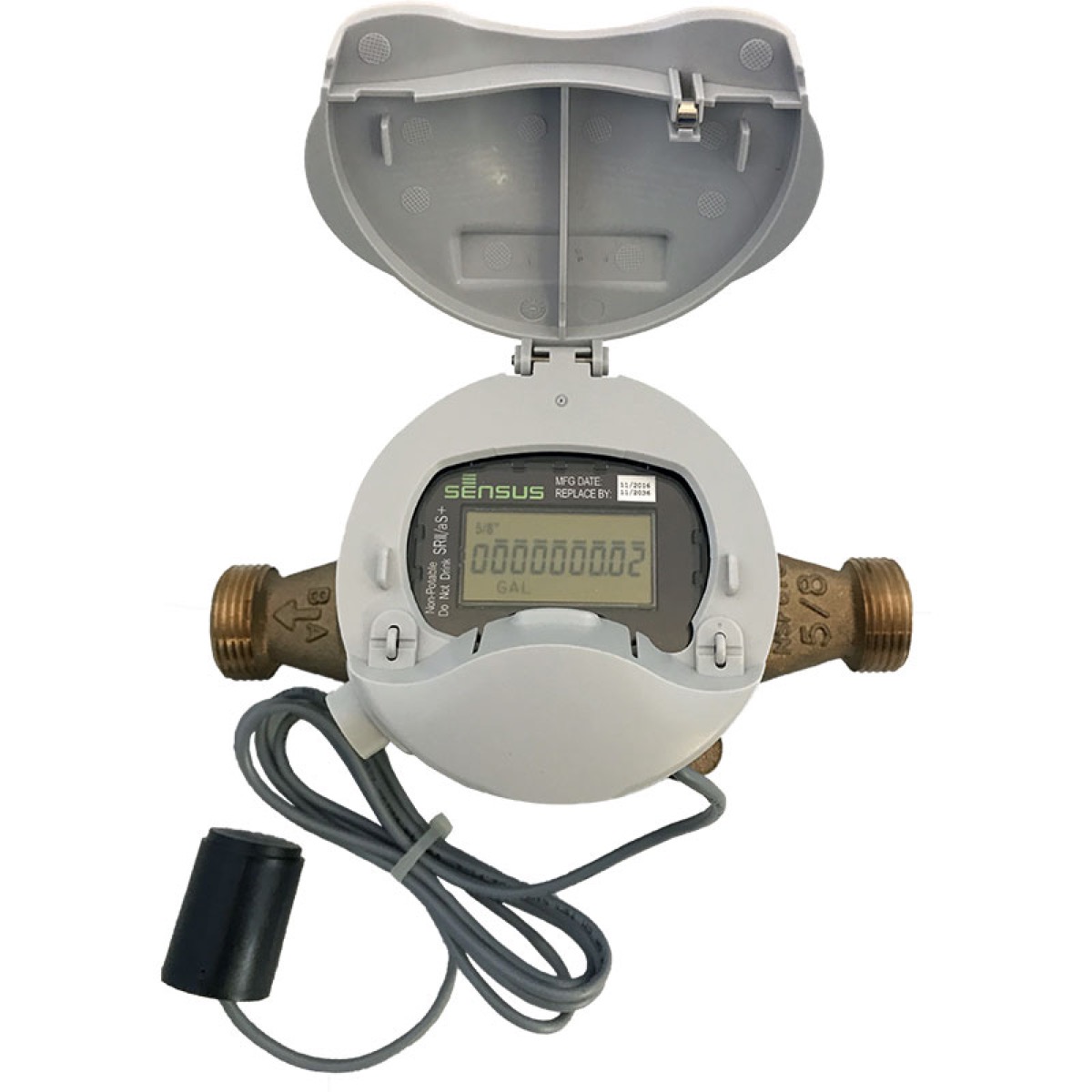
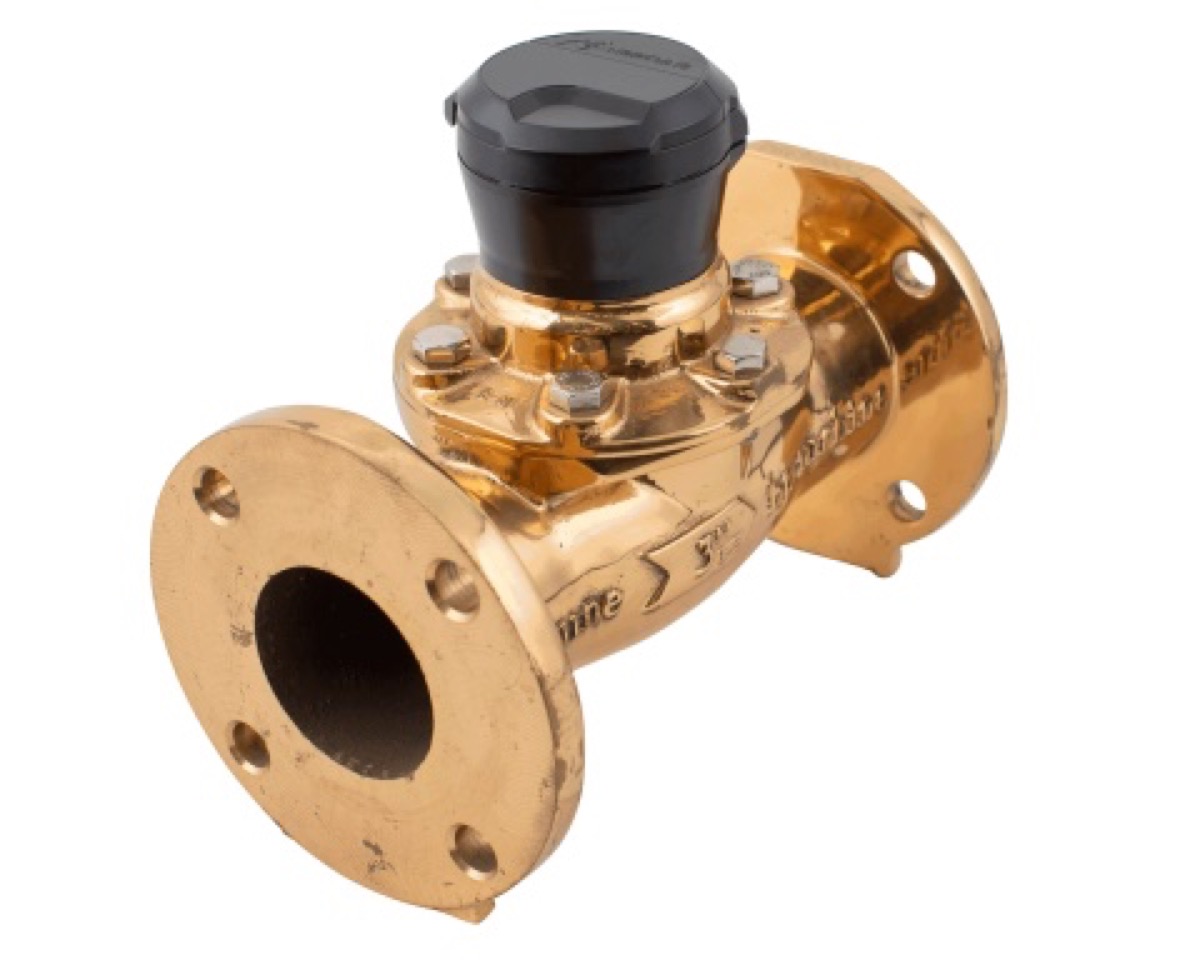
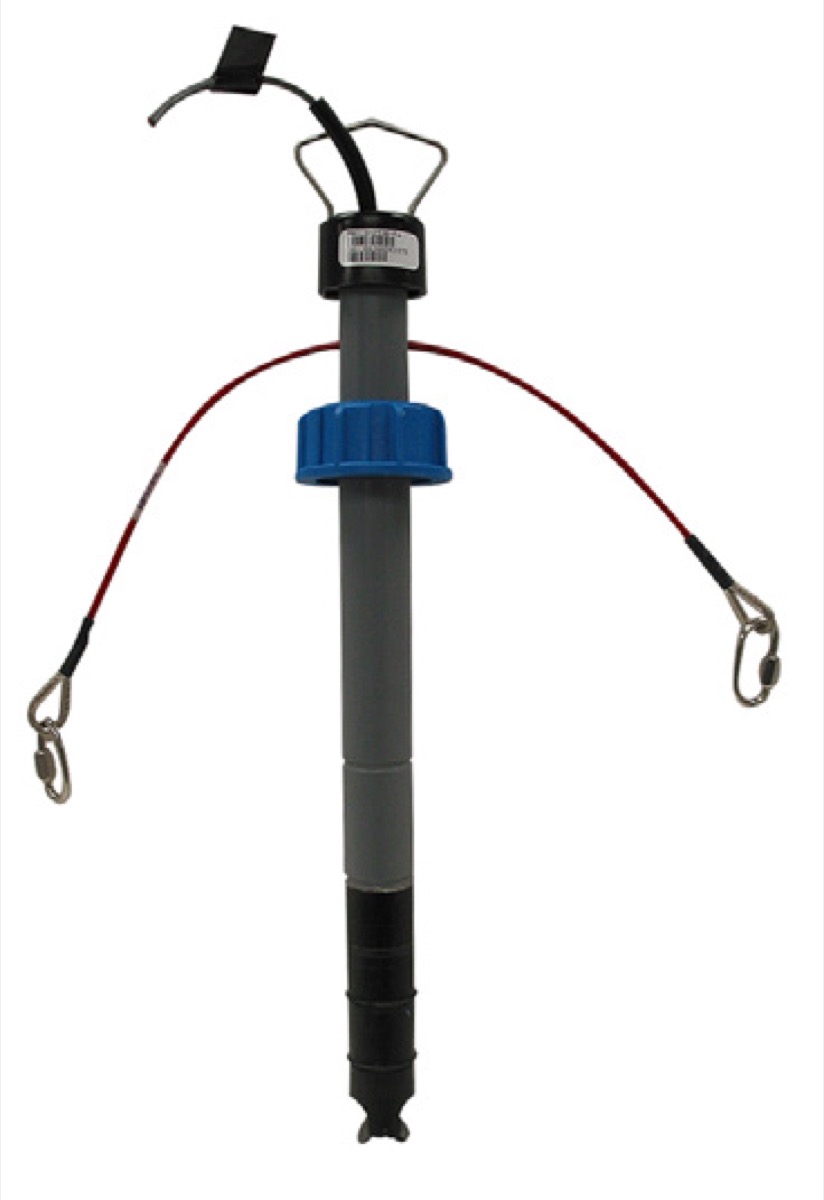
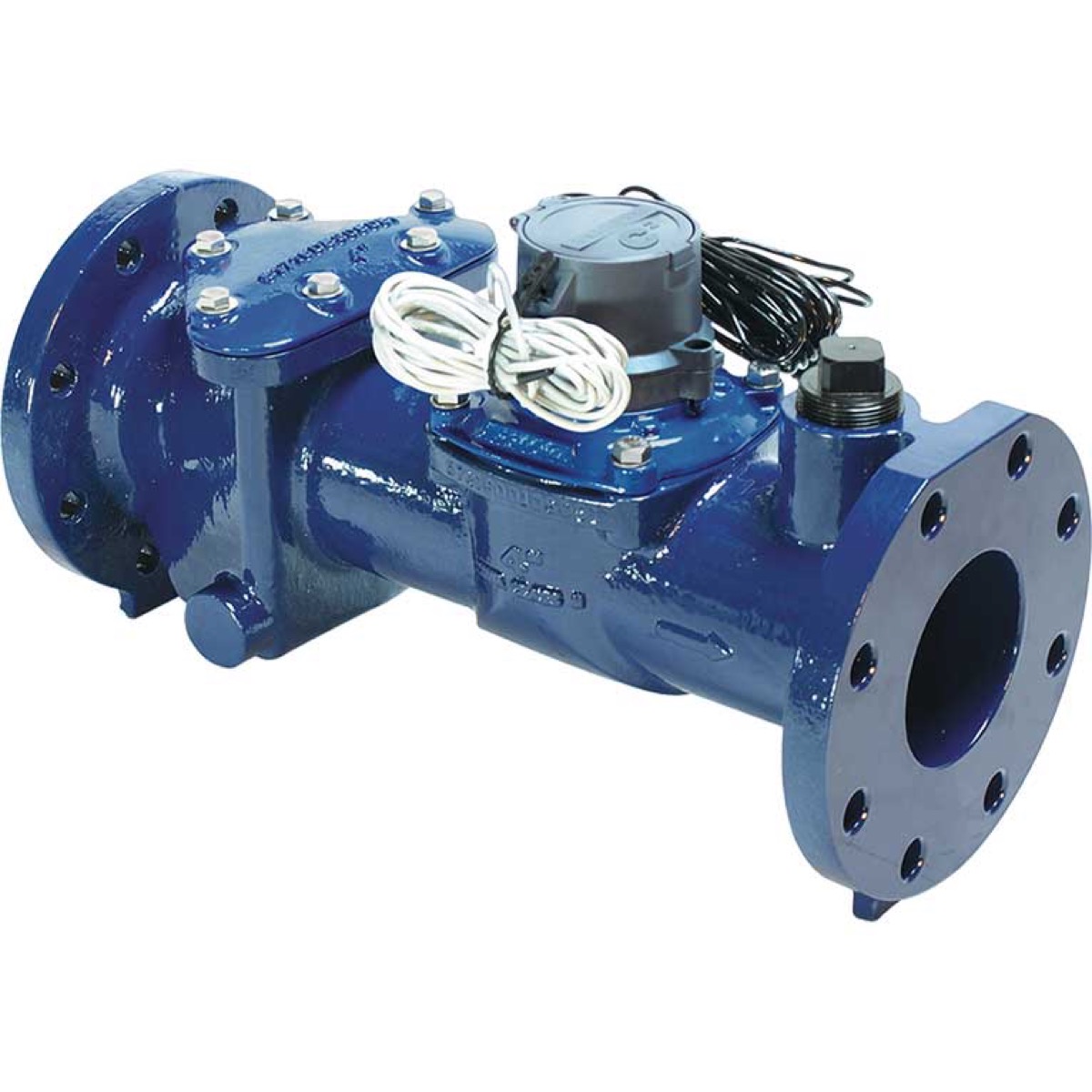
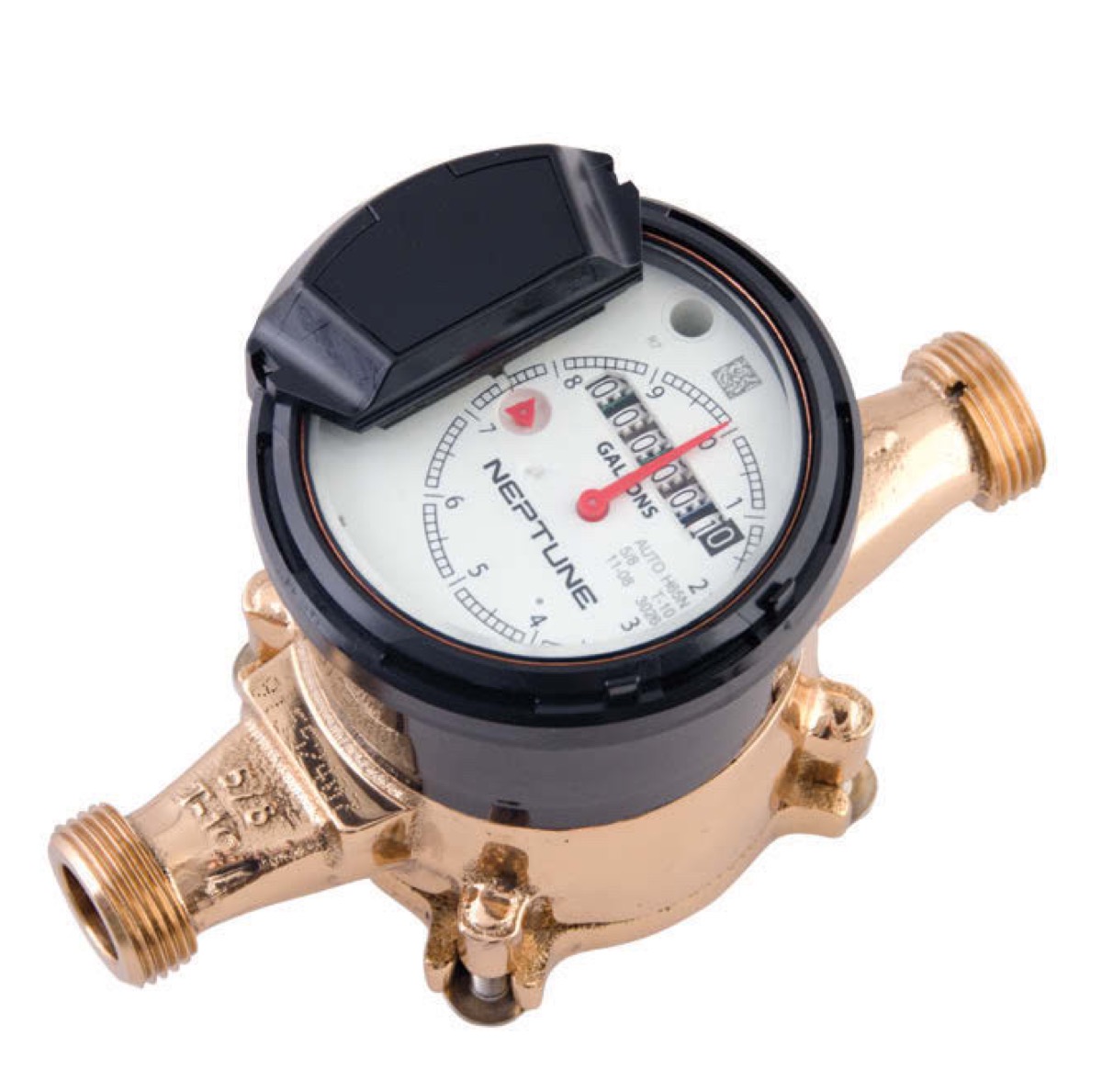
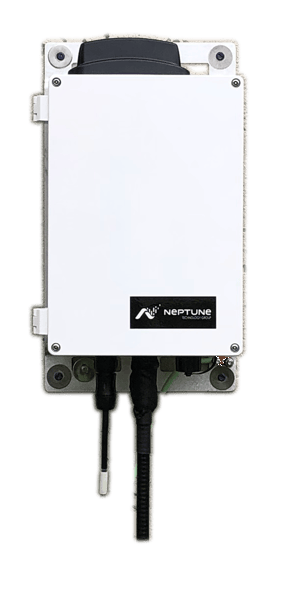
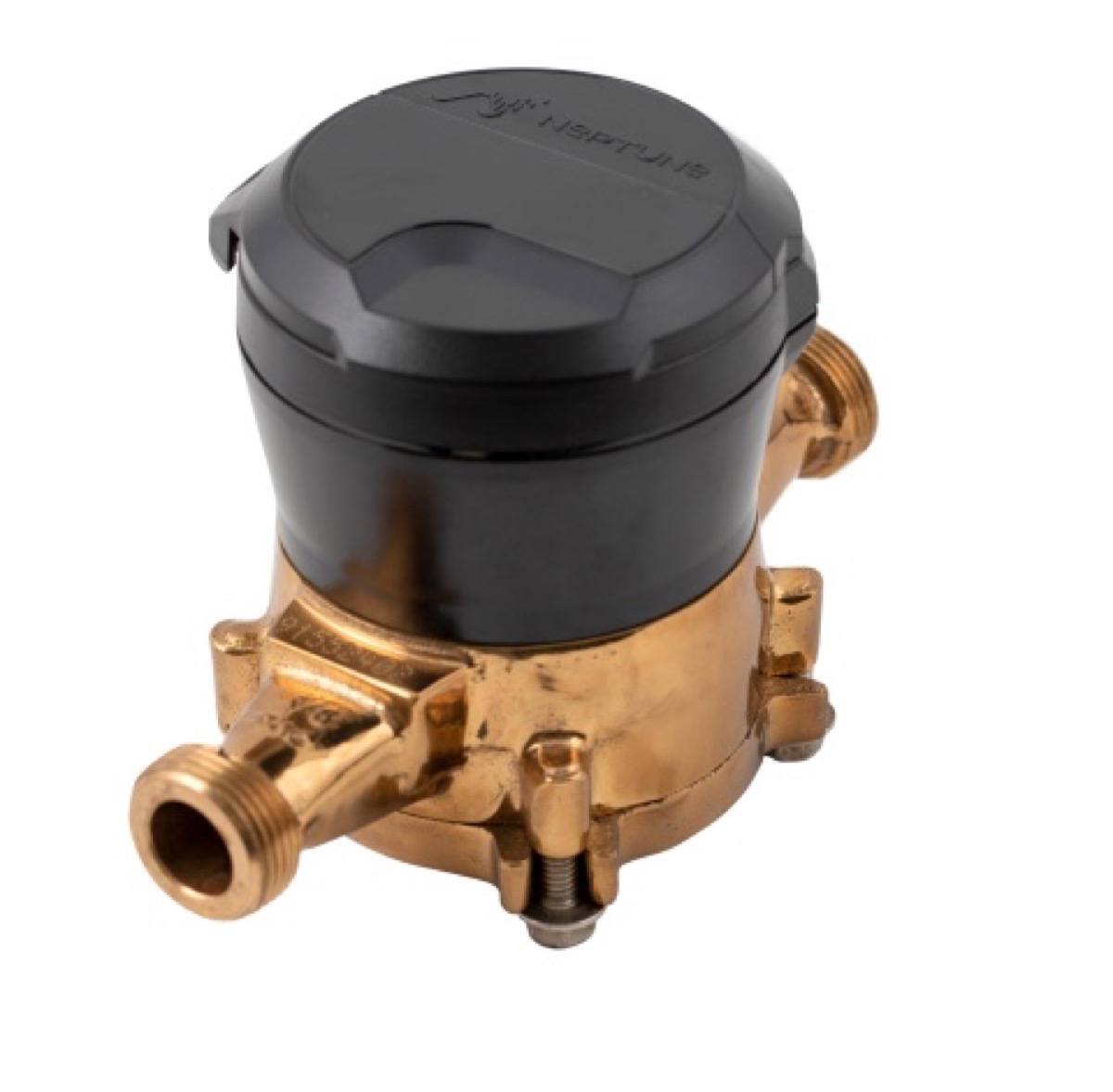
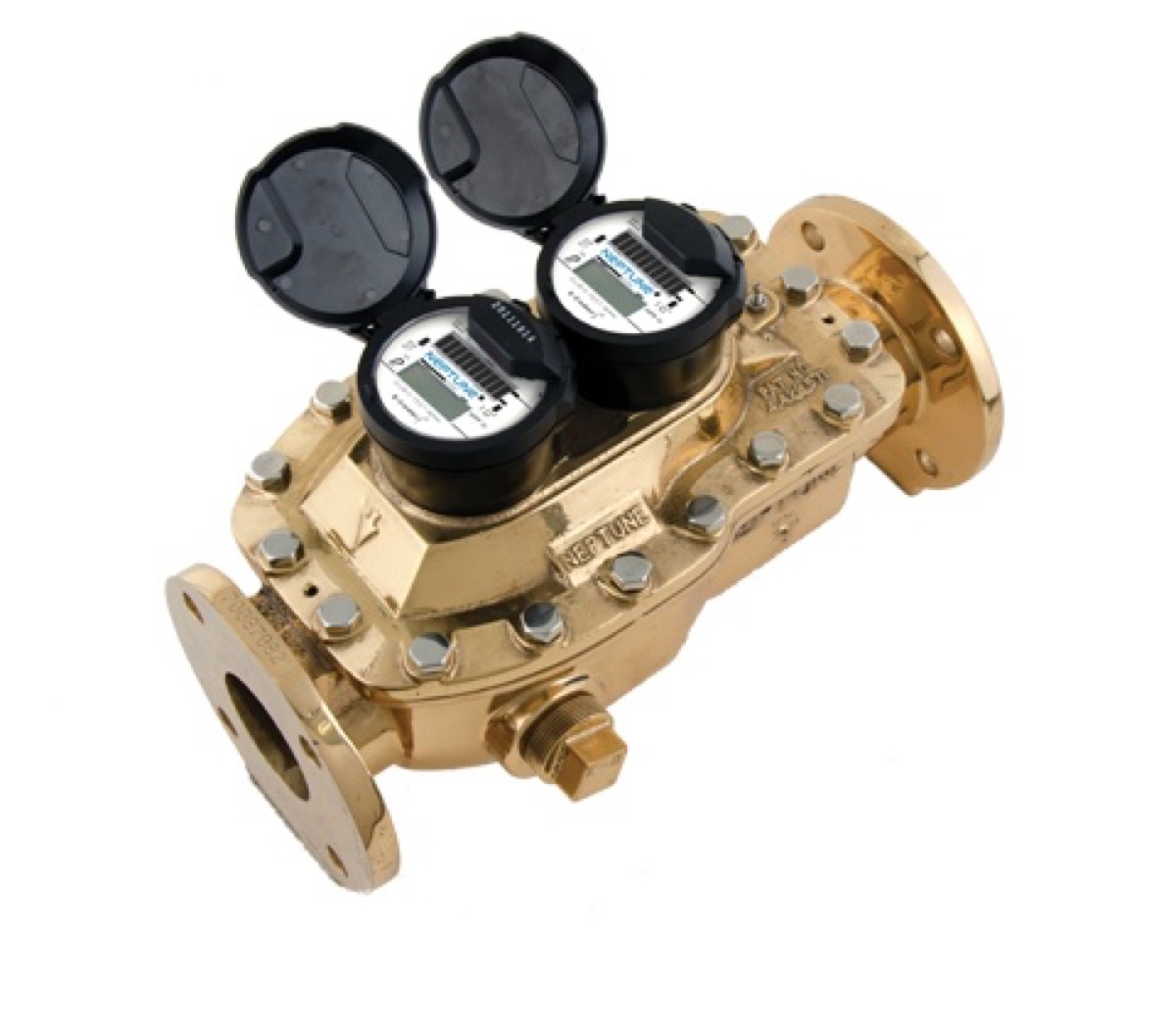
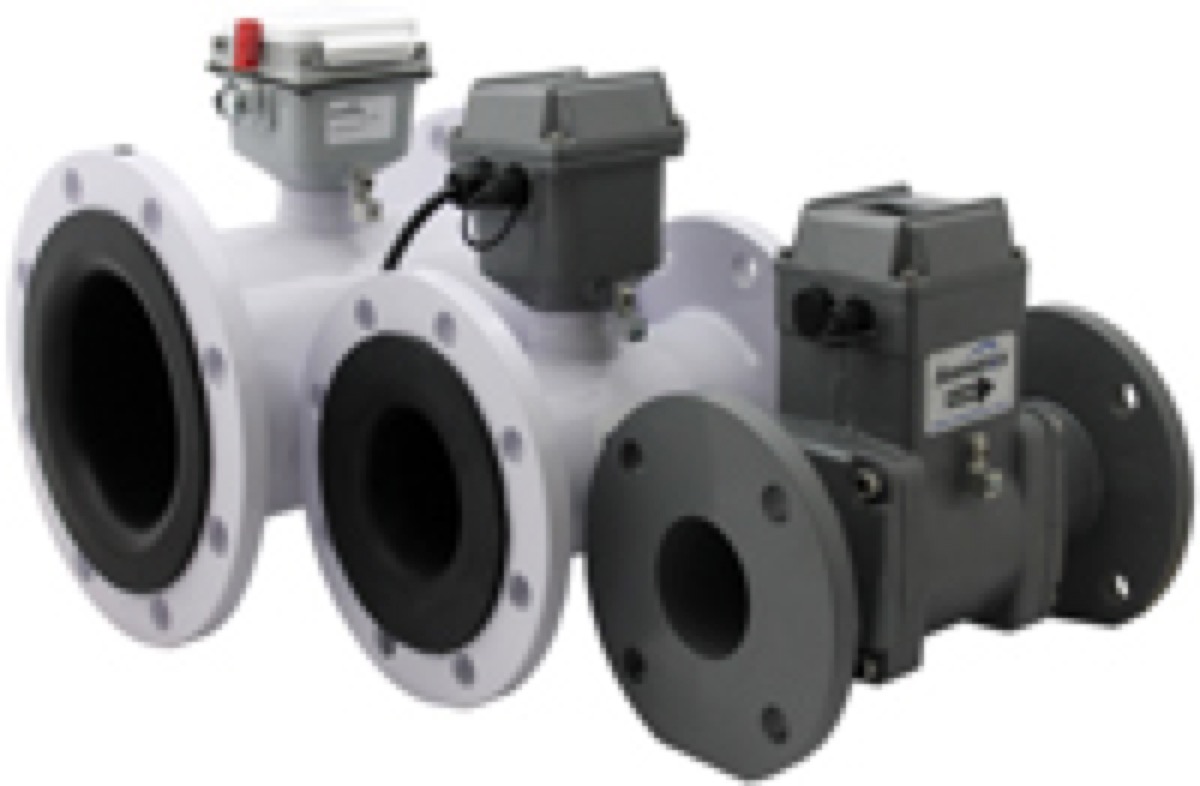
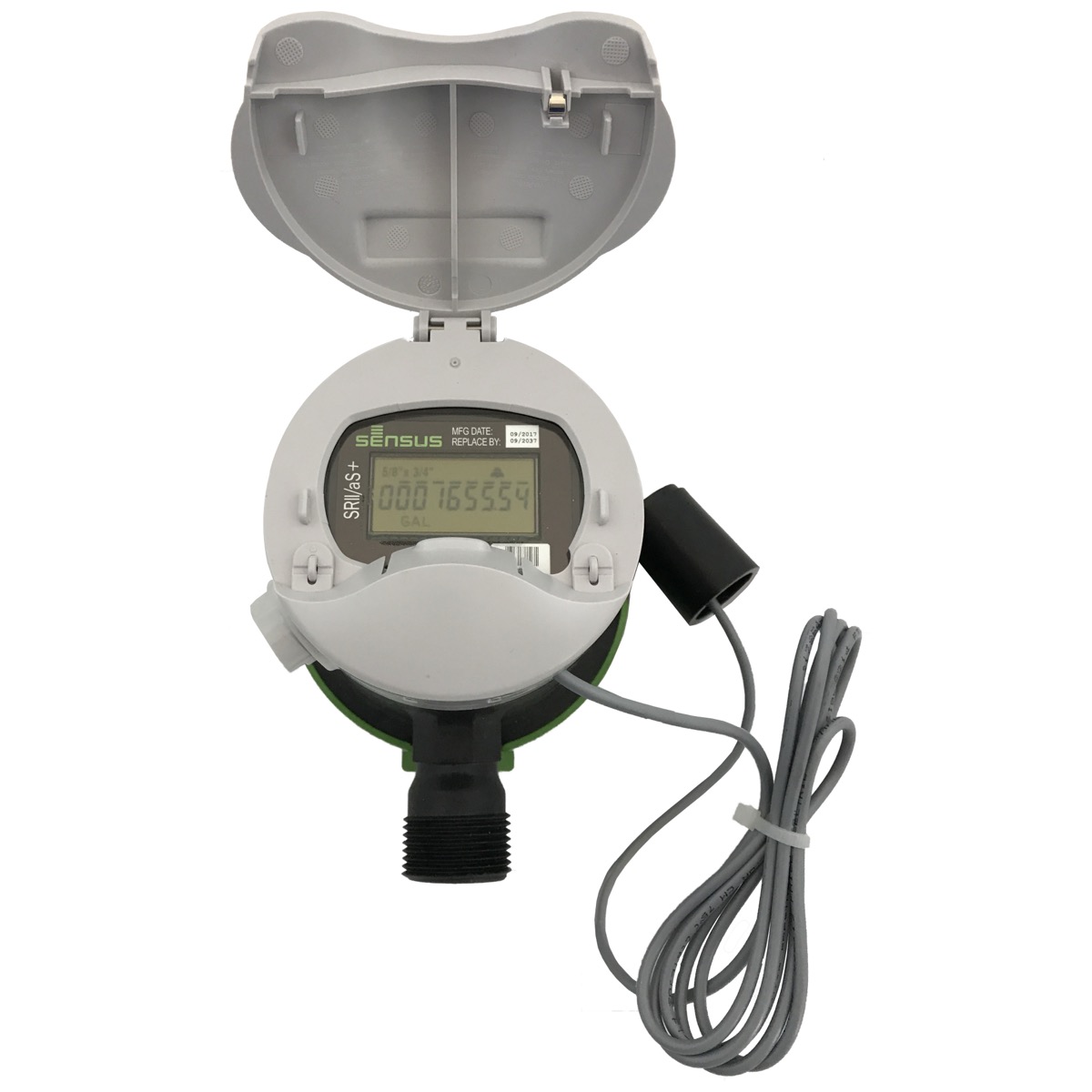
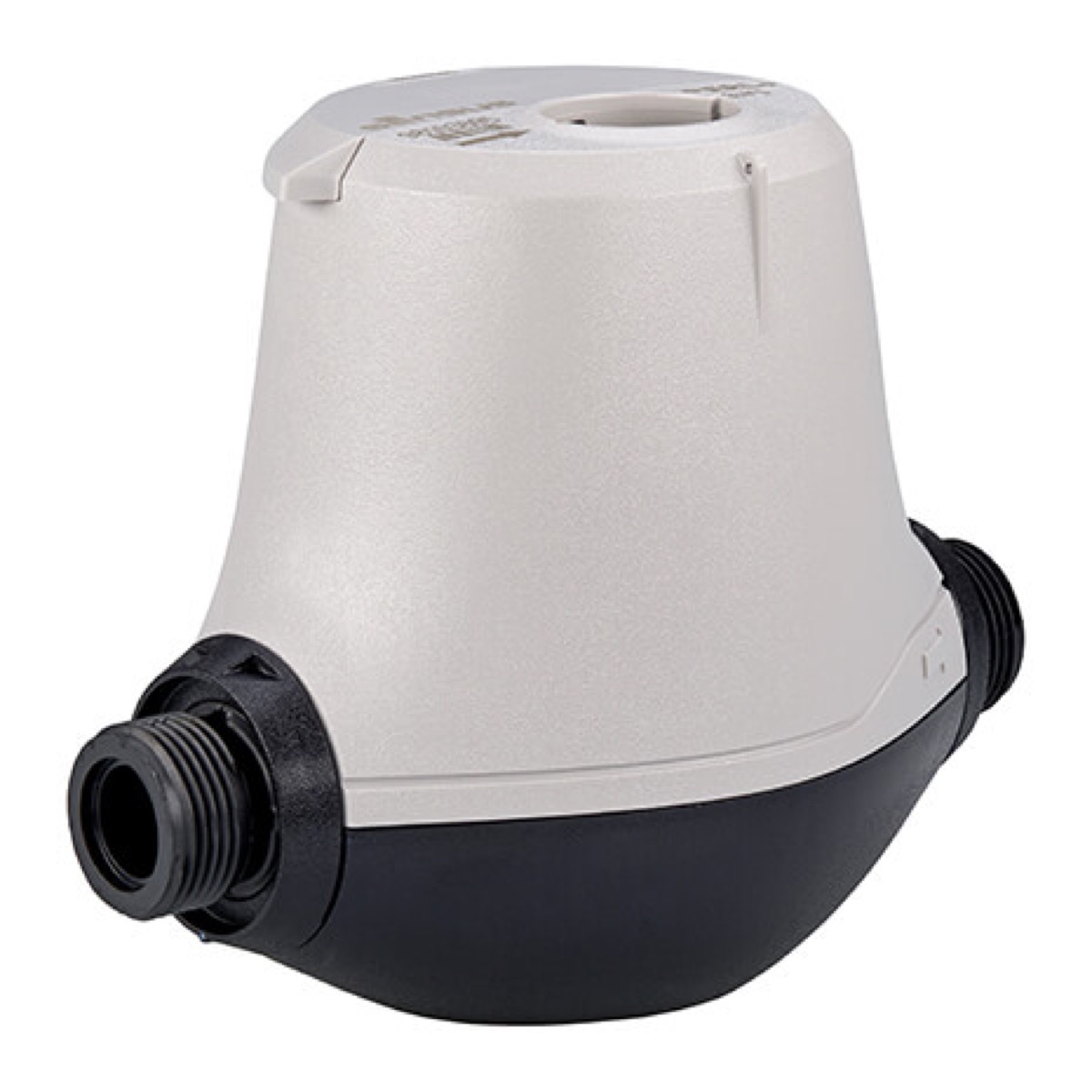
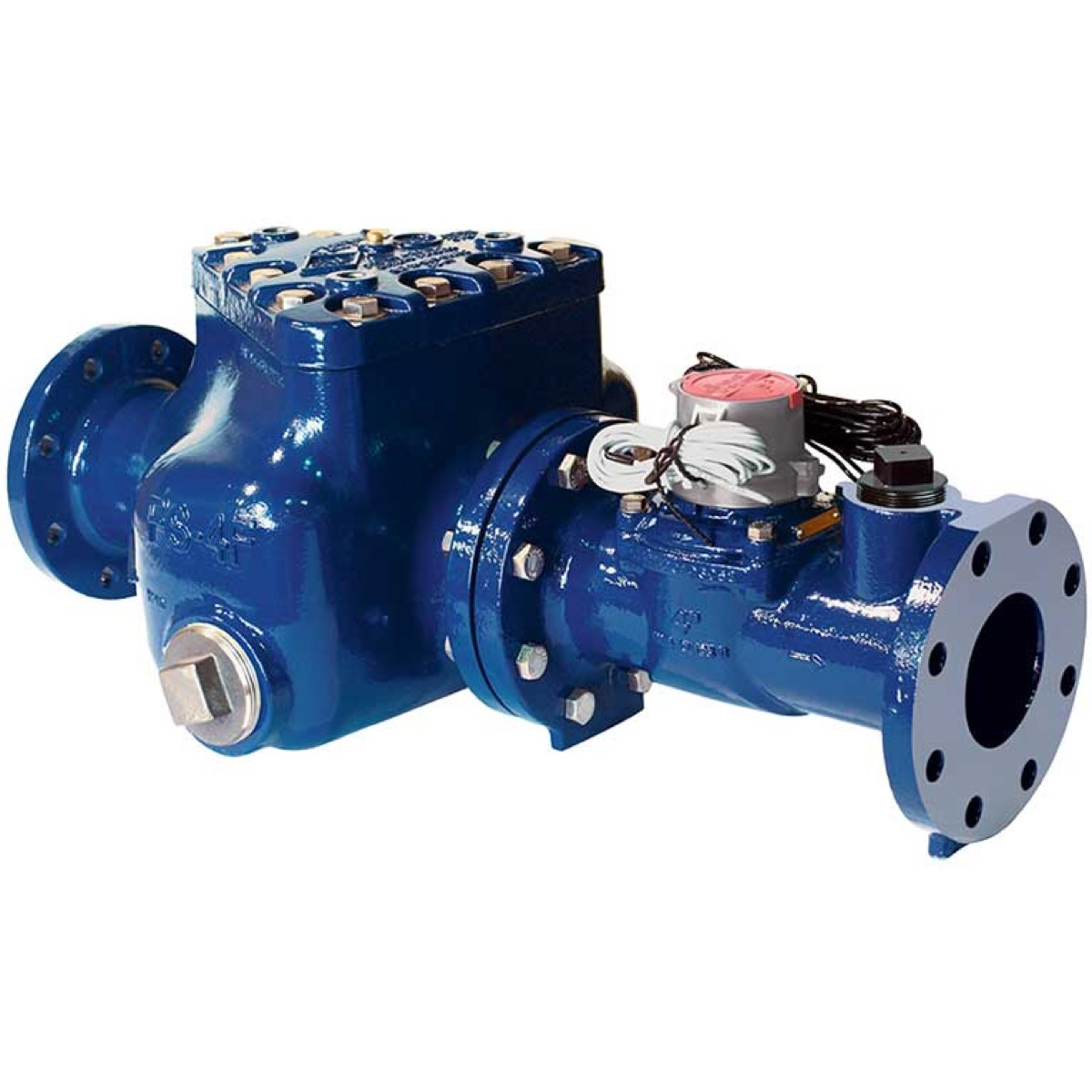
Clients get told to buy and install a compatible water meter, and then the argument starts about units, output signals, sizes, flow rates, who stocks it and what it costs. This page holds what we know about picking the right one, so that argument can finish on the first phone call.
Updated 3 September 2026. Every spec on this page carries the link it was read from.
Start here
What a water meter actually tells you
Two different numbers come off a meter, and most ordering mistakes begin by confusing them.
Total consumption and flow rate are different measurements
A totalizer counts volume that has already gone past: cubic metres since the meter was installed, the same running number your utility bills from. A rate signal reports how fast water is moving right now, in litres per minute or m³/h, and it keeps no memory of what came before. A meter can report one, the other or both, and which you get depends on the register and the output you order rather than on how the meter measures.
Why a factory wants both
Consumption is what pays for the project: overnight baseline, weekend flow through an empty building, litres per unit produced, the line on the bill. Rate is what you watch while somebody turns a valve, and it is the number that shows a pump running dry or a line letting go. On a water main our default is a pulse output for consumption and a 4-20 mA loop for rate wherever the meter offers one, both landing on the same centralized dashboard.
Five ways to buy the wrong meter
Sized to the pipe instead of the flow
A 2" service line does not mean a 2" meter. Neptune's 2" T-10 holds ±1.5% from 2.5 to 160 USGPM, so a building drawing 15 to 20 USGPM sits inside the accurate range rather than below it. What oversizing really costs you is the low end: the same sheet puts 95% accuracy at 1 USGPM, so an overnight trickle or a slow leak under that never registers, and the meter runs far under the 80 USGPM of continuous duty a 2" is sized for. Size the meter to the minimum, typical and maximum flow, and let the pipe be its own calculation.
The measuring element and the output are separate purchases. A Neptune or Badger meter body ships with a mechanical odometer and no wired signal at all, and the encoder register is a line item somebody has to remember to add. Confirm the output on the purchase order, not on the morning of the install.
Most North American registers ship reading US gallons or cubic feet, because the big manufacturers build primarily for the US market and nothing in Canadian law forces a metric register. Canadian utilities bill in cubic metres. Ask for the register unit in writing and check it against the faceplate when the meter lands.
Display resolution and pulse weight are two different settings. A register can read to three decimals and still be programmed to close its contact once per 100 US gallons, which turns an overnight leak into a flat line. Pick the pulse weight for the leak you want to catch, then confirm what the register is actually set to at commissioning.
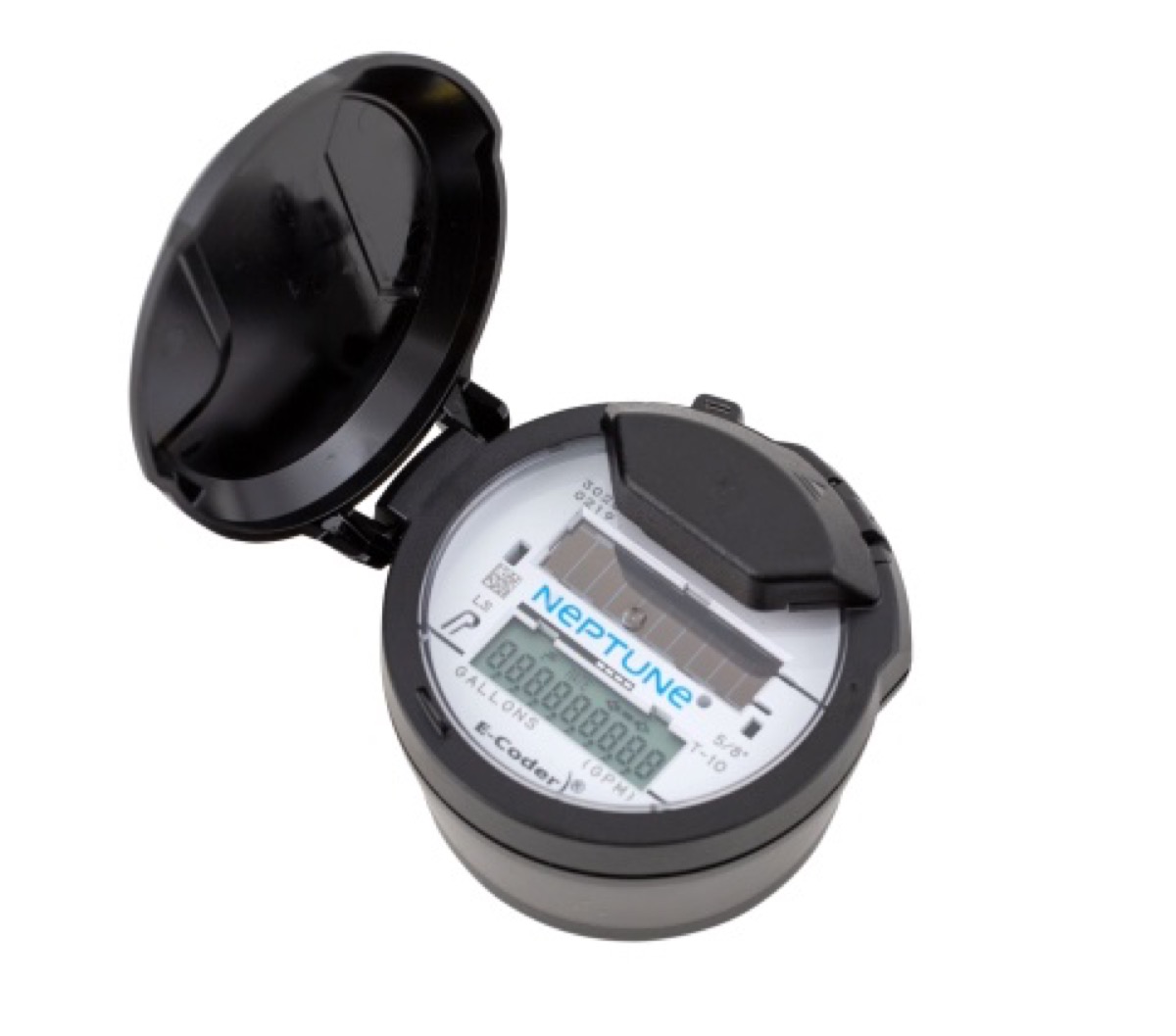
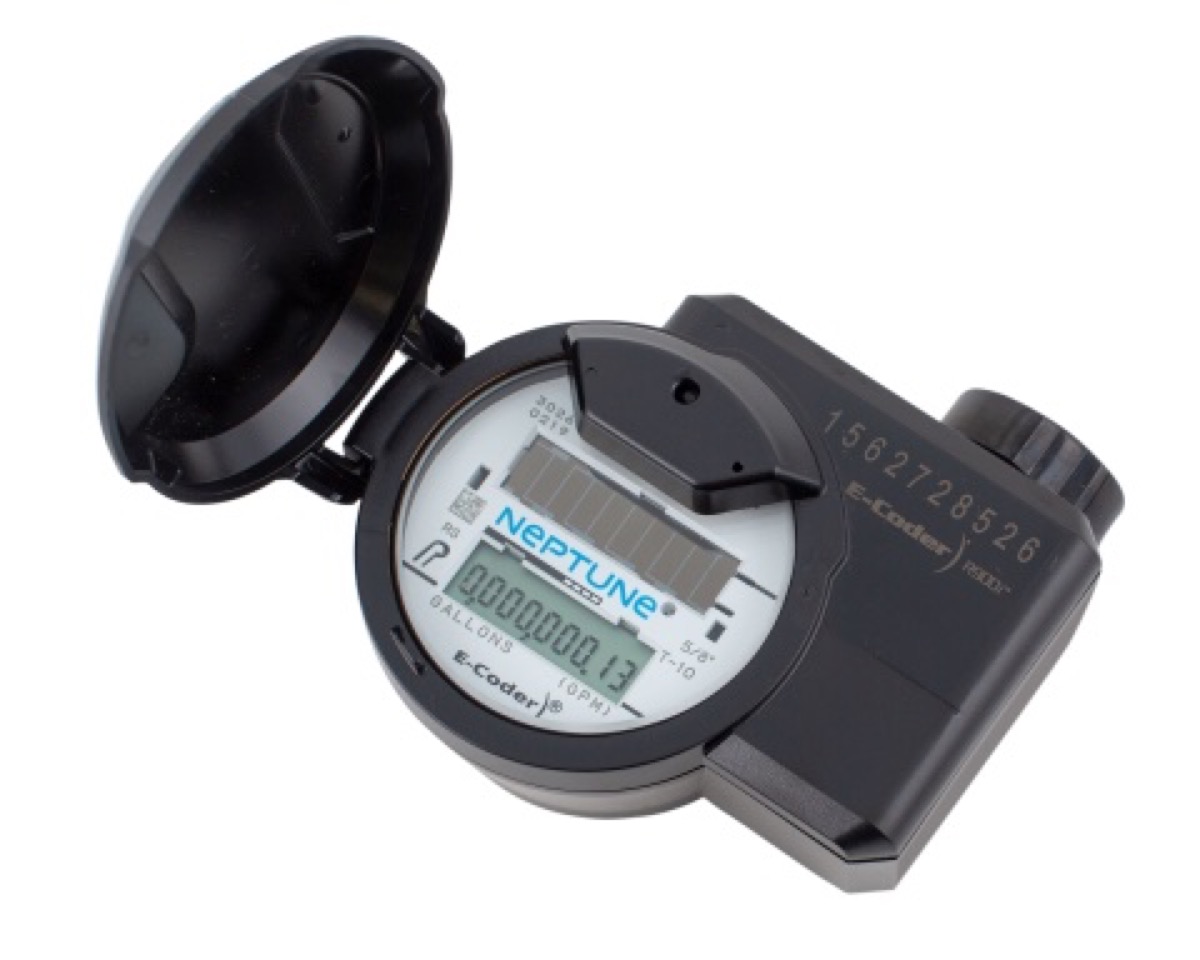
Neptune's R900i puts the encoder and the radio on one board inside one sealed housing, so there is no three-wire pigtail to tap. ScadaMetrics says it outright: the Signalizer is not compatible with the R900i versions of these registers. A standalone R900 wired to a separate register is fine, because those three wires are still exposed.
Two families, and choosing between them comes down to wear, power and how dirty the water is.
Inferential meters count physical motion. A nutating disc, an oscillating piston, a jet wheel, a turbine rotor or an insertion paddlewheel moves with the water, and the register counts the movement. They need no power to register a total and they are cheap at small sizes, but they wear, they jam on grit, and they read low as they age.
The other family has nothing moving in the bore. An electromagnetic meter reads the voltage a conductive liquid induces as it crosses a magnetic field; an ultrasonic meter times sound pulses running with and against the flow. Neither wears, both need power, and both cost more at 5/8" than a disc meter does. The revenue standard covering them is AWWA C715, not C750, which is a separate standard for transit-time process flowmeters.
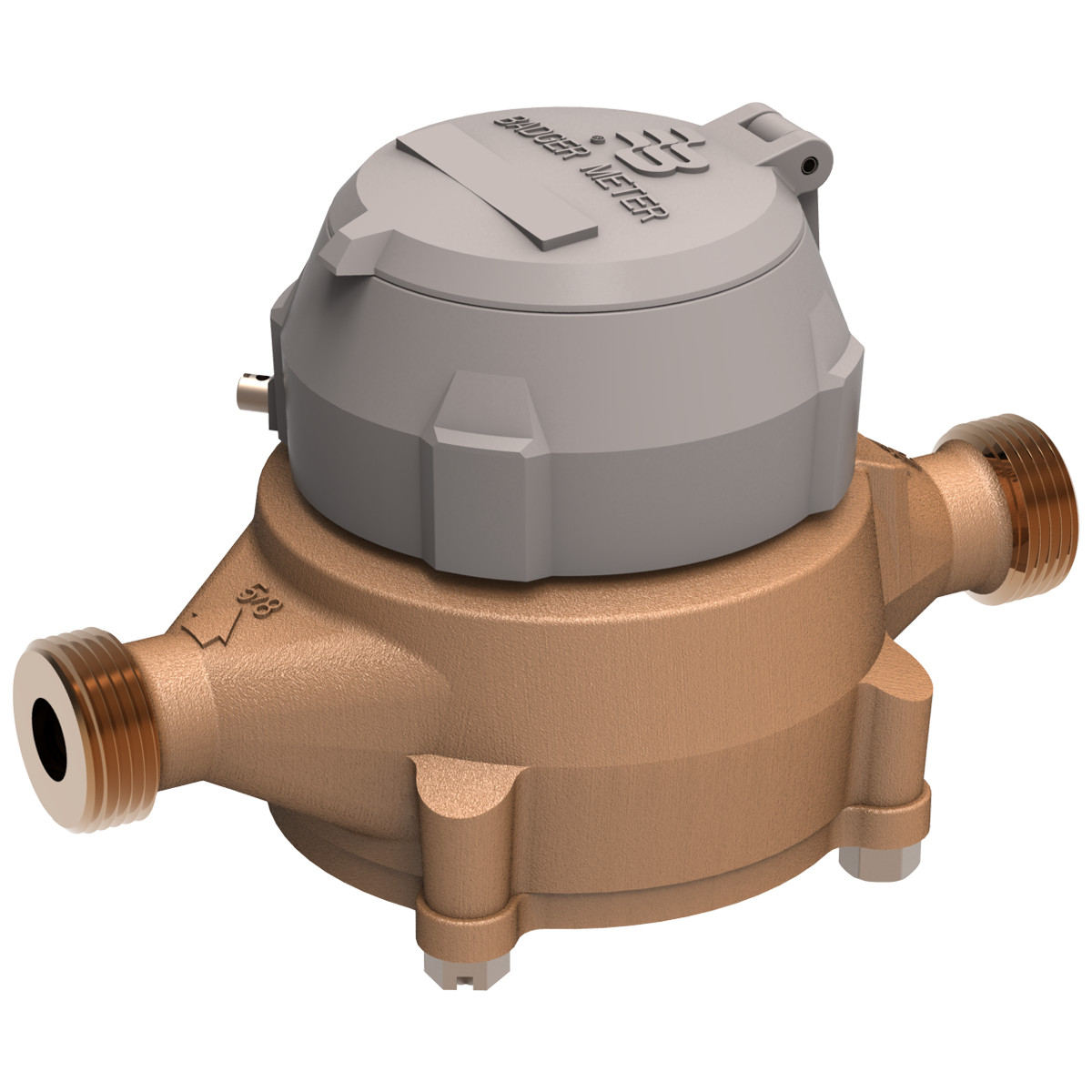
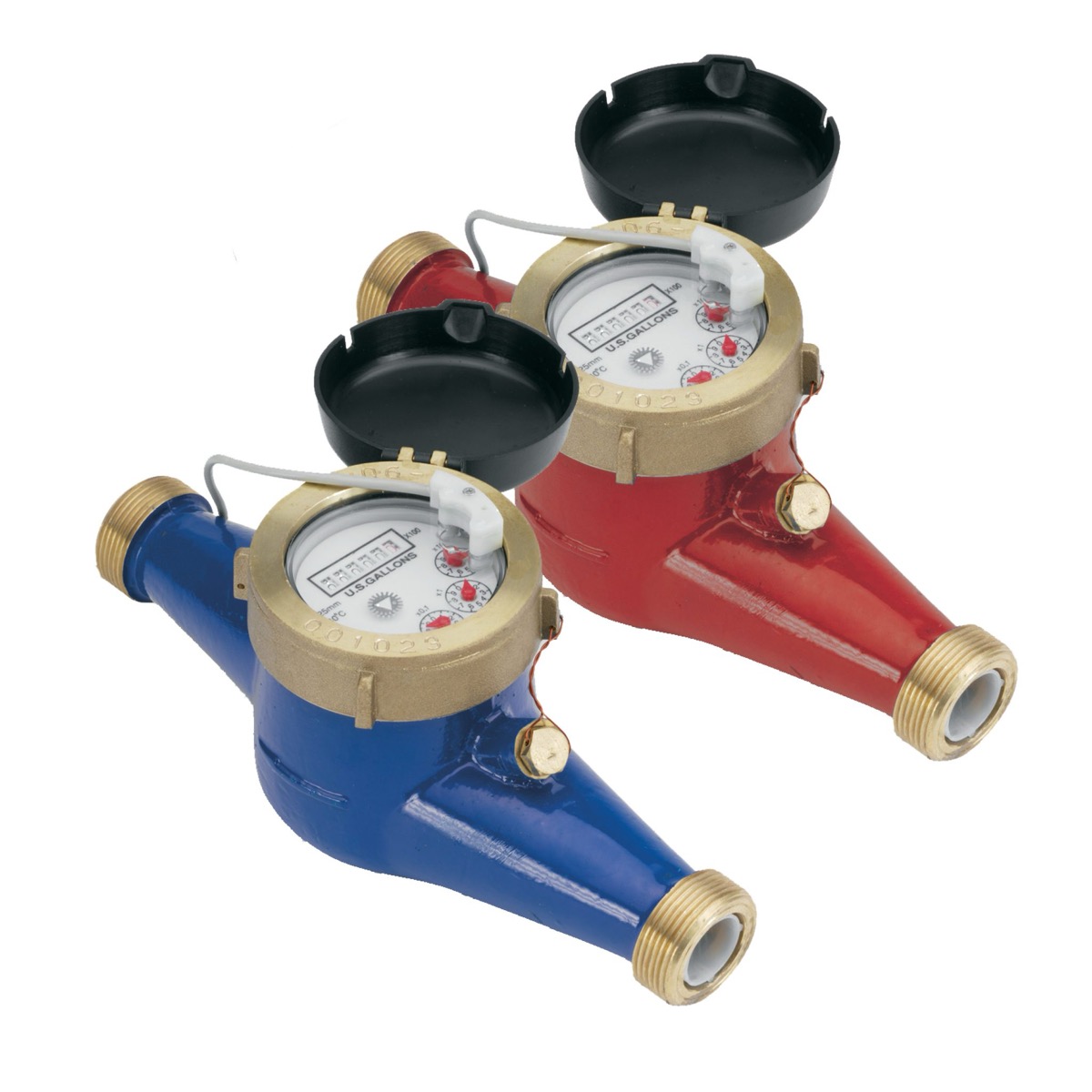
The metering chamber is a fixed internal volume. In a nutating-disc meter, water pressure makes a disc wobble (nutate) rather than spin freely, sweeping one fixed volume of water from inlet to outlet per wobble. In an oscillating-piston meter, a cylindrical piston is constrained to an off-centre, oscillating motion in a precision chamber, sweeping a fixed volume per cycle. Either way the motion drives a magnetic coupling to a mechanical register or electronic pulse output, so the meter directly counts discrete volumes rather than inferring flow from velocity.
Good at
Best low-flow/leak-detection sensitivity of the common mechanical types
Low first cost
No straight-run requirement
Mature, well-understood design
Weak at
Highest pressure loss of the common mechanical types at a given flow
Wears with grit/sand/debris
Accuracy degrades with age/wear
Not practical much past 2" (housing size and torque limits)
Cold-water standards only
Sizes5/8" to 2" (AWWA C700, metal main case); 5/8" to 1" (AWWA C710, plastic main case)
Accuracy±1.5% of actual throughput within the AWWA normal flow range (Sensus SR II, Sensus PMM-class literature; Badger Model 25 quoted the same figure)
Turndownnot stated
Straight runNone required. It measures volumetric displacement, not a velocity profile.
Pressure lossSensus SR II (oscillating piston): max 7.0 psi @ 20 USgpm (5/8"), 9.0 psi @ 30 USgpm (3/4"), 7.3 psi @ 50 USgpm (1")
Dirty waterPoor. Grit and debris jam or wear the disc or piston and its bearings.
Hot waterNo. AWWA C700 and C710 are cold-water meter standards, and the Sensus SR II states a water operating range of 0.55–26.7°C (33–80°F).
Best for
Residential and small-commercial potable billing, 5/8"–2"
Applications where low-flow/leak sensitivity and low first cost matter most
Avoid when
Water carries grit or sediment
Size needed is above 2"
Water is hot
You need decades of wear-free accuracy without periodic testing
Upstream pipework opens directly into the measuring chamber through a single offset injector/nozzle. That one jet strikes the vanes of a small turbine, spinning it; rotation is geared or magnetically coupled to a register. The single, one-sided jet load gives simple, inexpensive construction but uneven bearing loading and weaker low-flow sensitivity than a multi-jet meter of the same size.
Good at
Simple, mechanically robust
Inexpensive
Widely available at small pulse-output sizes
Weak at
Lower low-flow sensitivity than multi-jet
One-sided jet loading increases bearing wear vs. multi-jet
Still has moving parts, so it stays grit-sensitive
Sizes5/8" to 6" (AWWA C712)
Accuracy±1.5% of actual throughput within normal flow, per manufacturer claim (DAE AS-series); not independently confirmed against AWWA C712 text itself
Turndownnot stated
Straight runnot stated
Pressure lossnot stated
Dirty waterPoor. It has a moving turbine and bearing, like other mechanical meters.
Hot waternot stated
Best for
Very low-cost sub-metering and budget applications
Avoid when
Low-flow leak detection or long service life without recalibration is the priority; prefer multi-jet or positive displacement
The inlet pipework opens into an annular feed chamber surrounding the measuring chamber. A cylindrical wall pierced with multiple symmetric orifices separates the two, so the turbine is driven by several jets arranged around its circumference instead of one. Balanced, symmetric loading reduces bearing wear and improves low-flow accuracy compared with single-jet, at higher manufacturing cost.
Good at
Better low-flow accuracy and longer bearing life than single-jet
Lower head loss at high flow than positive-displacement meters of the same size
Mature, well-understood mechanical design
Weak at
More complex/costly than single-jet
Still a moving-part meter, so it wears, jams on debris and needs periodic testing
Sizes5/8" to 2" (AWWA C708)
Accuracy±1.5% of actual throughput in normal flow range (Sensus PMM)
Turndownnot stated
Straight runnot stated
Pressure lossSensus PMM, 3/4" size: 14.0 psi at 30 USgpm (0.6 bar at 7.0 m³/h)
Dirty waterPoor. A moving turbine brings the same weaknesses as other mechanical meters.
Hot waterNot stated. AWWA C708 is a cold-water standard, so treat it as cold-water unless a model says otherwise.
Best for
Residential/small-commercial billing needing better low-flow performance than single-jet without moving to positive displacement or ultrasonic cost
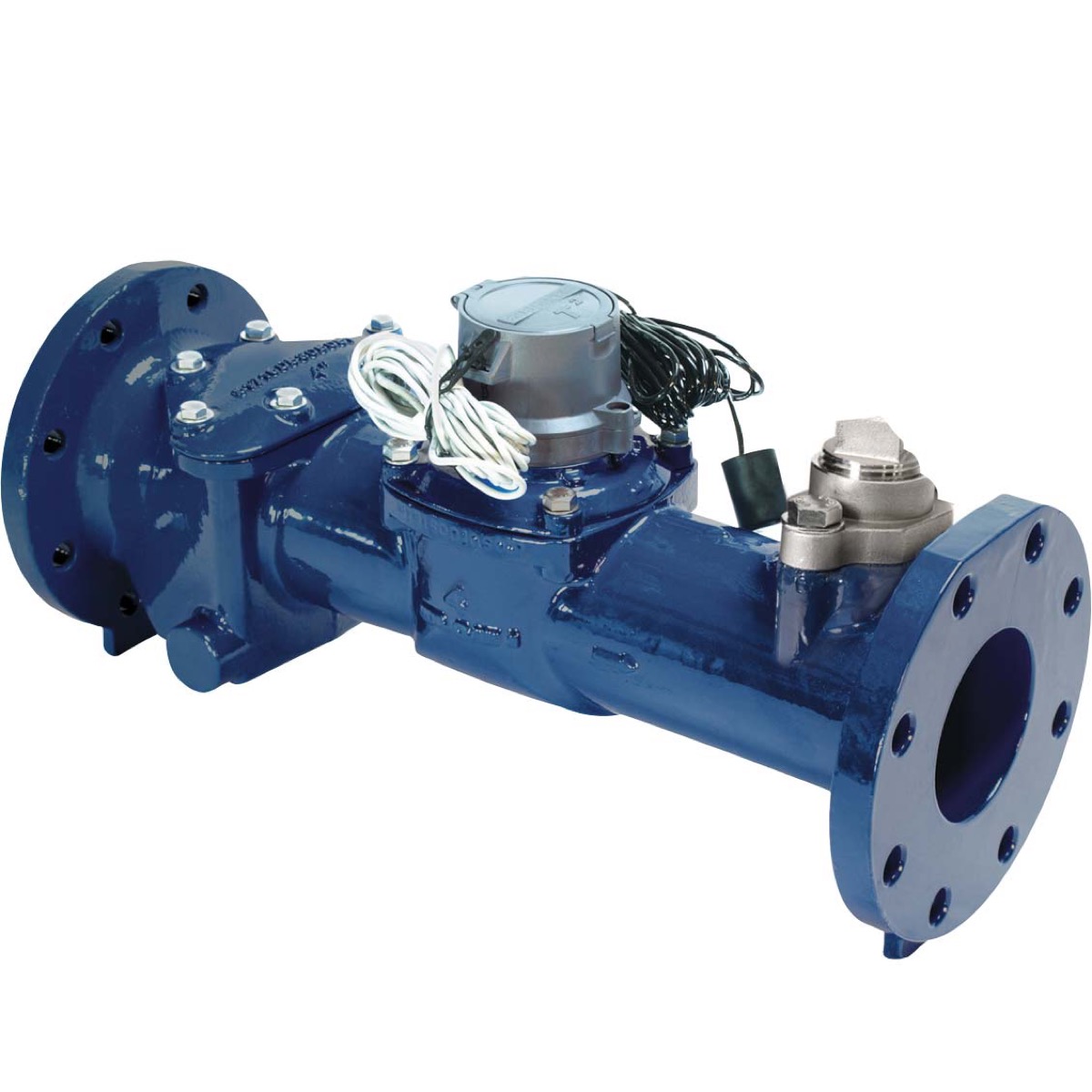
A rotor is suspended in the flow stream on a shaft; moving water striking the rotor's blades spins it at a rate proportional to velocity, and rotation is geared or coupled to a register. AWWA C701 splits cold-water turbine meters into Class I (vertical-shaft) and Class II (in-line, horizontal-axis, high-velocity, with lower head loss and a wider operating range than Class I). Nearly every modern C701 meter sold today is Class II.
Good at
Wide flow range and relatively low pressure loss for a mechanical meter at larger sizes
Field-serviceable, often a replaceable measuring-element cartridge
Good accuracy retention when properly sized and screened
Weak at
Needs a minimum velocity to spin the rotor reliably, so it is poor at very low flow
Sensitive to debris fouling/damaging the rotor (strainer recommended)
Accuracy falls off with wear over time
Sizes3/4" to 20" (AWWA C701)
Accuracynot stated
Turndownnot stated
Straight runnot stated
Pressure lossnot stated
Dirty waterModerate. With a strainer it beats positive displacement, but a fouled or damaged rotor under-registers or jams.
Hot waternot stated
Best for
Larger commercial/institutional/mainline billing (1.5" and up)
Avoid when
Flows are frequently very low relative to the meter's size (oversizing risk)
A Woltmann (helix) meter is a turbine meter with a helical-bladed rotor, historically the European and ISO name for this design and common at larger sizes; both horizontal- and vertical-axis Woltmann meters exist. Operation follows the same principle as any turbine meter: flowing water spins the helical rotor at a rate proportional to velocity. In North America these meters are marketed and rated as AWWA C701 turbine meters.
Good at
Same turbine advantages (wide range, moderate pressure loss) applied at larger/bulk sizes
Available from 2.5" upward per manufacturer ratings reviewed
Weak at
Same turbine weaknesses: it needs a minimum velocity, it is debris-sensitive, and it wears over time
Sizes2.5" and up (manufacturer-rated; overlaps AWWA C701's 3/4"–20" turbine scope at larger sizes)
Accuracynot stated
Turndownnot stated
Straight runnot stated
Pressure lossnot stated
Dirty waterModerate, as for turbine meters generally
Hot waternot stated
Best for
Bulk/mainline metering at larger diameters where a helical-rotor turbine design is offered
Avoid when
Flows are frequently very low relative to the meter's size
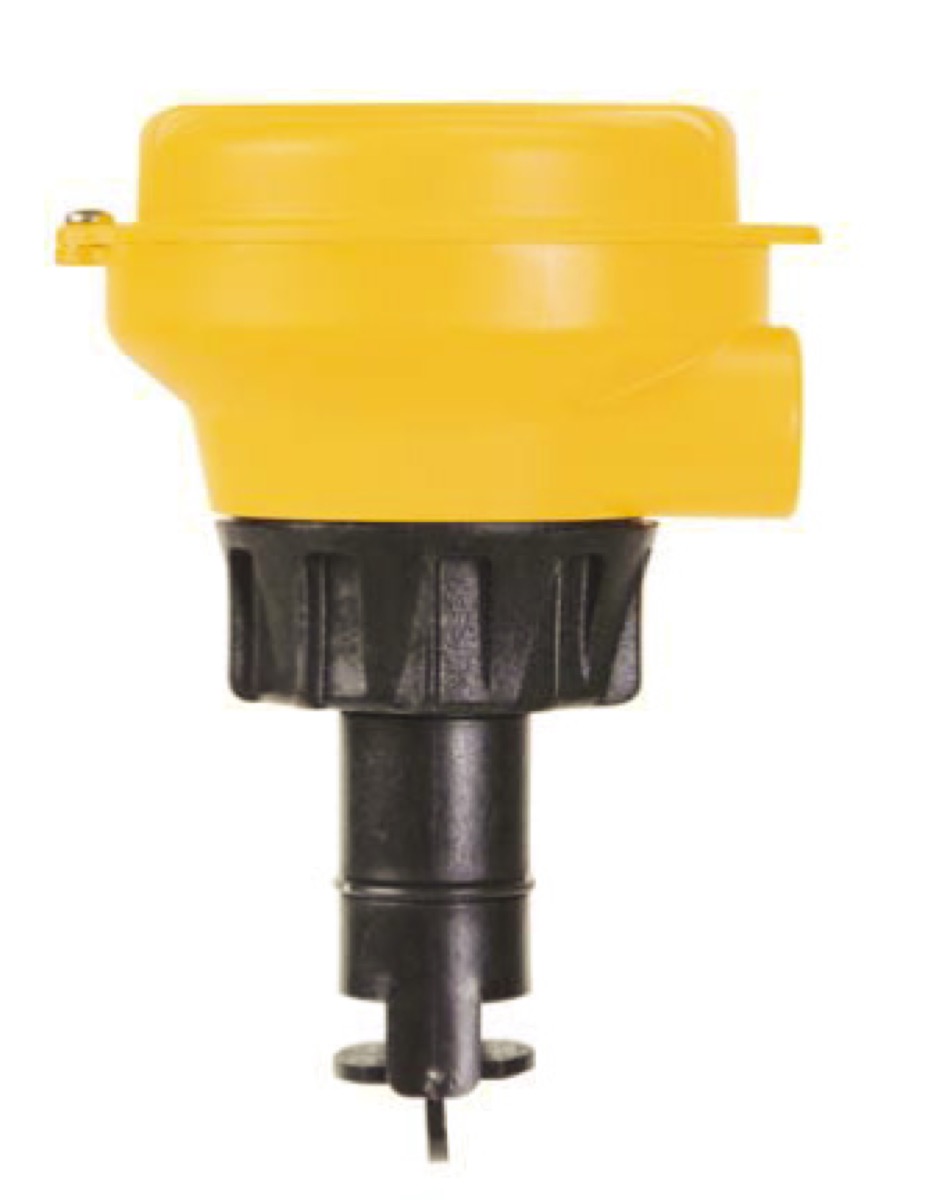
A small paddlewheel mounted on a probe is inserted radially into the pipe, typically through a saddle, tee or hot-tap fitting, so its blades sit in the flow stream. Moving water spins the paddlewheel at a rate proportional to local velocity at that point; a magnetic or optical pickup converts rotation to a frequency/pulse output, and the instrument converts that point velocity to a flow rate using the known internal pipe diameter.
Good at
Inexpensive relative to inline meters at larger sizes
Can be inserted into an existing pipe via saddle/tee without cutting the line
Very wide serviceable size range from one basic sensor design
Simple frequency/open-collector output
Weak at
Point-velocity measurement, so accuracy depends on correct insertion depth and orientation and on a developed velocity profile
Not a legal-for-trade billing meter the way AWWA C700-series meters are
Has a moving rotor that can foul or wear
SizesType 2536: DN15 to DN900 (½" to 36"), with the PVC body limited to DN15–DN100 (½"–4"). Type 2537: DN15 to DN200 (½" to 8").
AccuracyLinearity ±1% of max. range, repeatability ±0.5% of max. range, both at 25°C (GF Signet 2536 and 2537)
Turndown66:1 (GF Signet 2536, 0.1–6 m/s operating range)
Straight runnot stated
Pressure lossNegligible. The paddlewheel occupies only a small fraction of the bore.
Dirty waterPoor to moderate. The rotor sits directly in the stream, and heavy solids can foul it.
Hot waterType 2536: PP/PVDF bodies −18 to 85°C (0–185°F), PVC body 0–50°C (32–122°F). Type 2537: 0–65°C (32–149°F)
Best for
Retrofitting flow monitoring onto an existing process or utility line without cutting it, where legal-for-trade billing accuracy is not required
Avoid when
Application is revenue billing requiring AWWA/ISO 4064 accuracy classes
Pipe carries heavy solids that will foul the rotor
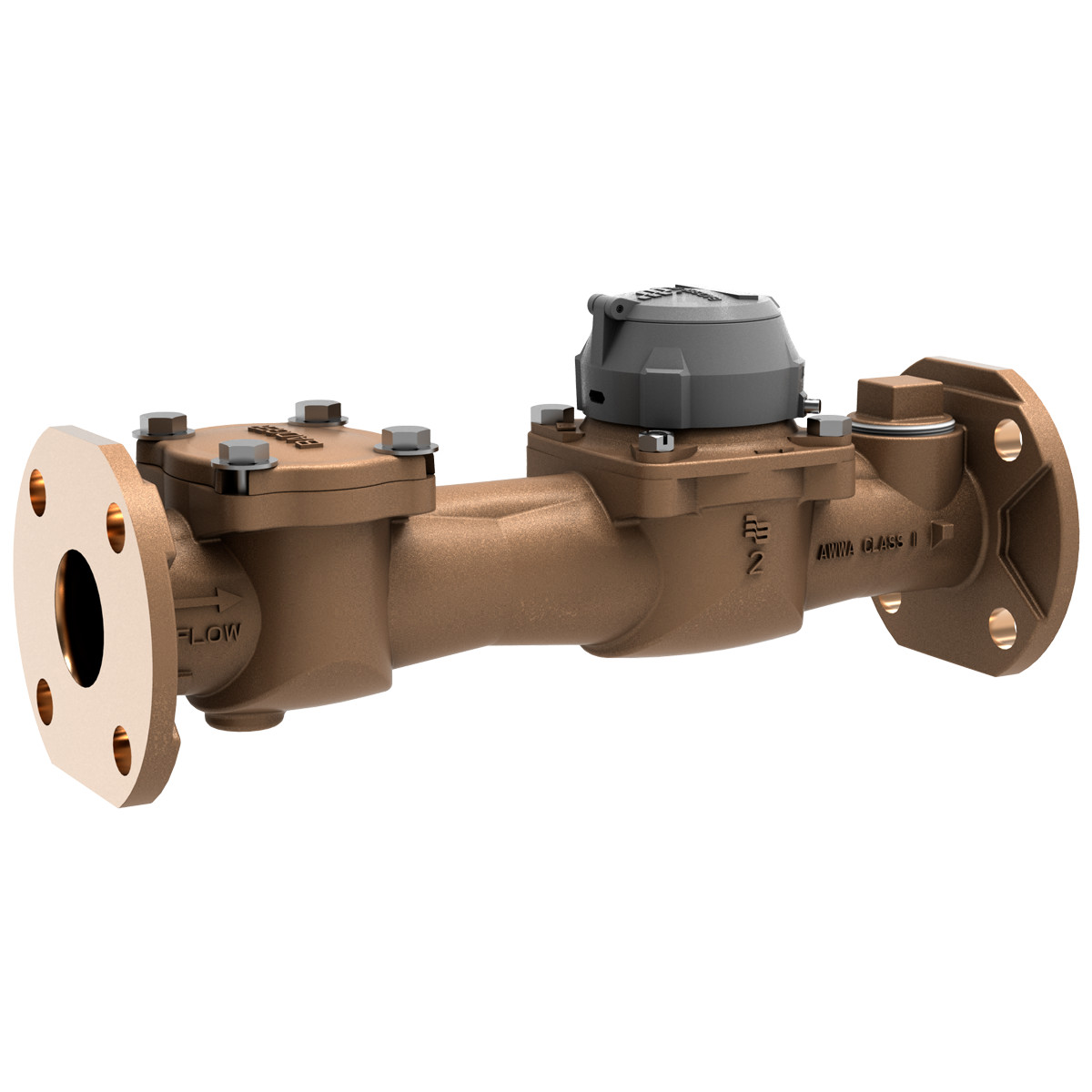
A compound meter combines two measuring elements in one body: a turbine-type mainline element sized for high flow, and a smaller positive-displacement bypass element sized for low flow, joined by a valve (or, in newer designs, hydraulic geometry that removes the need for a mechanical valve) that routes low flows through the sensitive PD element and high flows through the turbine element as demand rises. This lets one meter body cover both a building's firefighting max flow and its everyday trickle flow.
Good at
Wide effective range in one body, capturing both very low continuous or leak flow and high peak or fire flow
Standard solution for buildings with combined domestic + fire-protection service
Weak at
More complex/expensive than a single-element meter of either type
Inherits wear and debris sensitivity from both parent technologies
Larger, heavier installation than a single inline meter
Sizes2" to 8" (AWWA C702)
Accuracynot stated
Turndownnot stated
Straight runnot stated
Pressure lossnot stated
Dirty waterPoor to moderate. It inherits the positive-displacement bypass element's grit sensitivity at low flow, and a valve mechanism, where fitted, adds another wear and jam point.
Hot waternot stated
Best for
Mixed-use buildings and services combining domestic and fire-protection flow through one connection, 2"–8"
Avoid when
Service is single-purpose, domestic-only or fire-only, where a correctly sized turbine or positive-displacement meter is cheaper and simpler
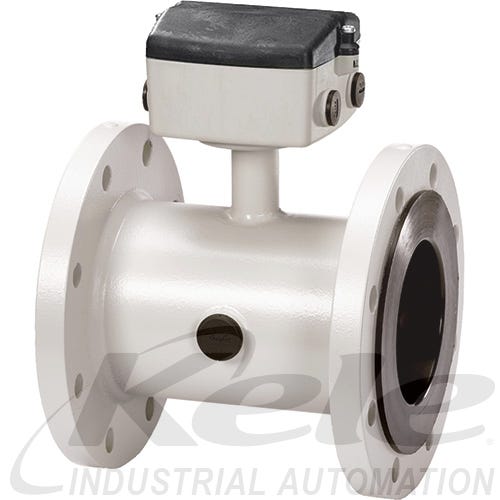
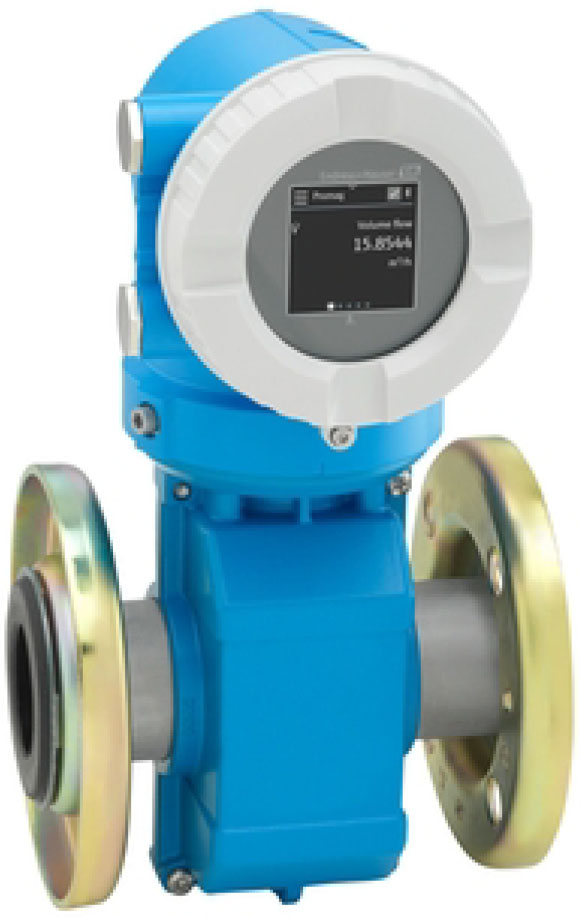
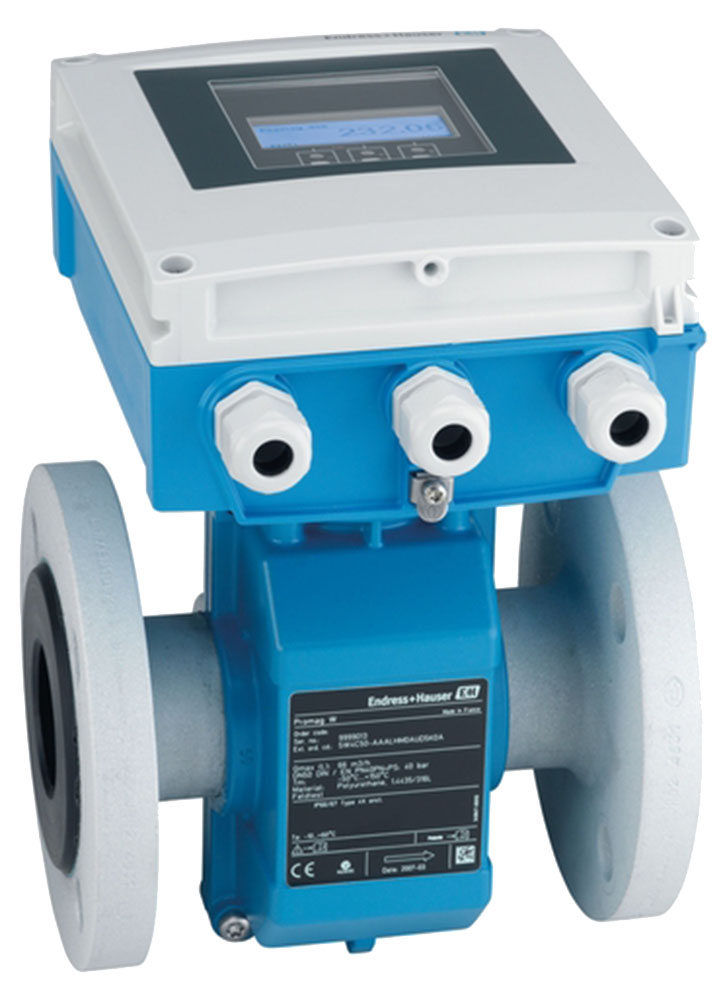
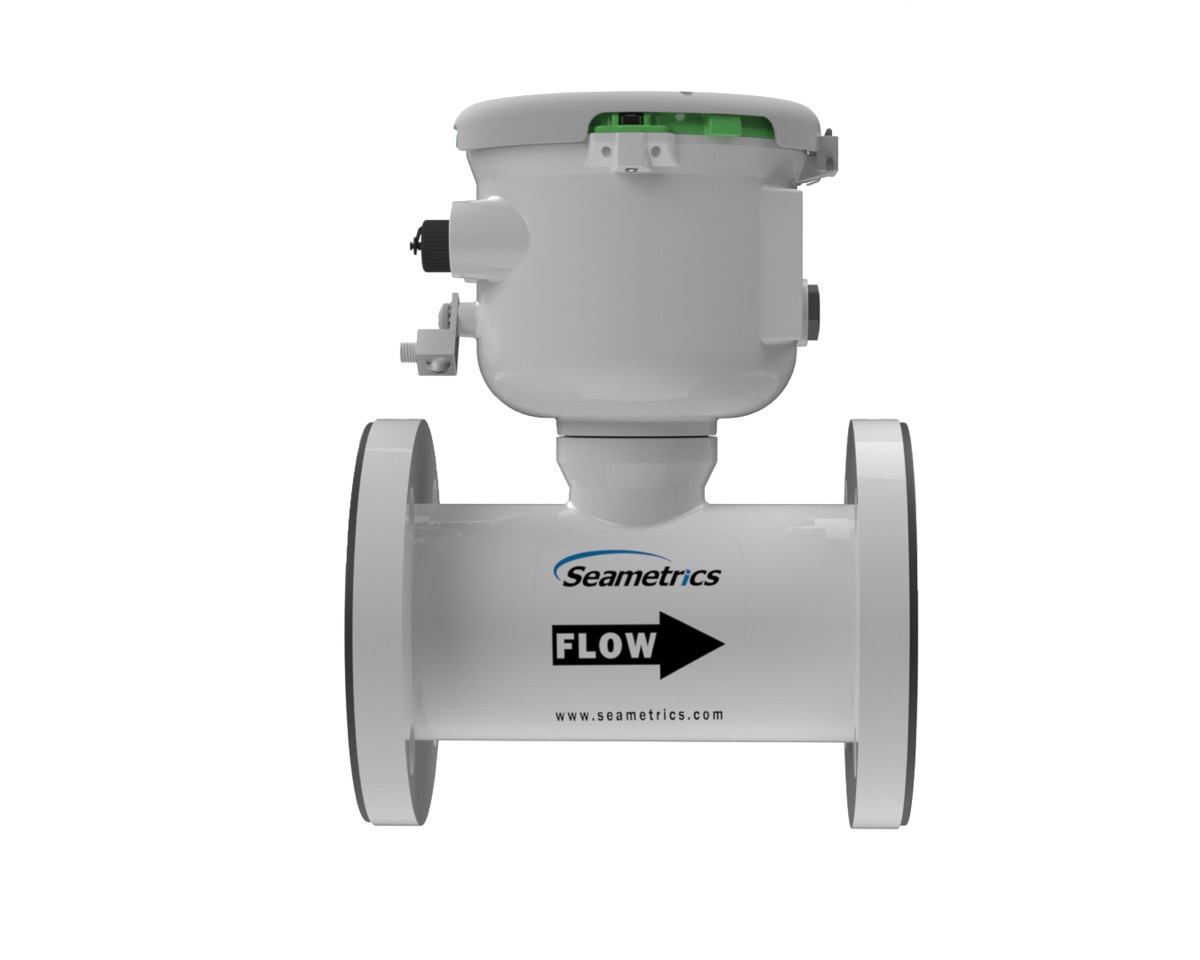
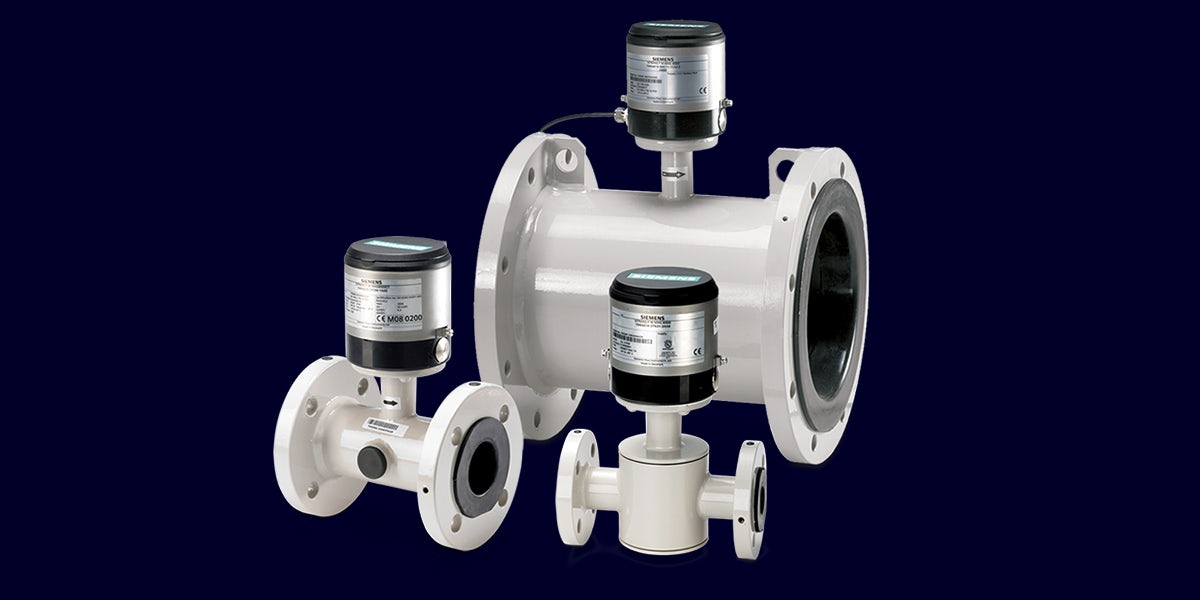
A coil around (or built into) a non-magnetic-lined pipe section generates a magnetic field across the bore. Conductive liquid flowing through that field generates a small voltage across two electrodes in contact with the liquid, proportional to velocity (Faraday's law of electromagnetic induction). There is no obstruction and no moving part in the wetted path, so the meter has effectively no minimum-flow floor from mechanical wear and adds no head loss beyond the pipe's own friction. Battery-powered mag meters run the same sensing principle on an internal or external battery pack instead of mains/loop power, for un-powered pits, remote sites and irrigation.
Good at
No moving parts, so no wear-driven accuracy loss
Wide turndown
Effectively no added pressure loss
Tolerates dirty/solids-bearing water far better than mechanical meters
Bidirectional by nature
Weak at
Needs power, either mains, loop or a battery, and batteries need periodic replacement
Needs a conductive liquid and a full pipe (empty-pipe detection often added)
Full-bore versions need a lined pipe spool sized to the meter, costly at very large diameters
SizesDN15 to DN2000 depending on model (Siemens SITRANS MAG 5100W, coned/full-bore sensor options); DN25 to DN1200 / 1"–48" for battery-powered (Siemens SITRANS MAG 8000)
Accuracy0.2% ± 2 mm/s and 0.4% ± 2 mm/s depending on calibration/configuration (Siemens SITRANS MAG 8000, as stated by manufacturer)
Turndownnot stated
Straight runDown to 0D inlet/0D outlet, verified per OIML R49 MI-001 test conditions on sizes up to DN400 (SITRANS MAG 5100W); SITRANS MAG 8000 stated as suitable for 0D in/outlet conditions
Pressure lossSITRANS MAG 5100W: DN15/DN25 max 20 mbar (0.29 psi); DN40–DN300 max 25 mbar (0.36 psi); DN350 and up 'insignificant'
Dirty waterGood, because there are no moving parts in the flow path, provided the water stays conductive and the pipe stays full
Hot waternot stated
Best for
Dirty/turbid raw or process water
Irrigation and remote sites with no mains power (battery mag)
Large-diameter utility mains where a mag spool is affordable and straight run is tight
Avoid when
No power source is practical and a battery-service interval is unacceptable
Liquid isn't reliably conductive
Budget doesn't support a lined spool at very large diameters
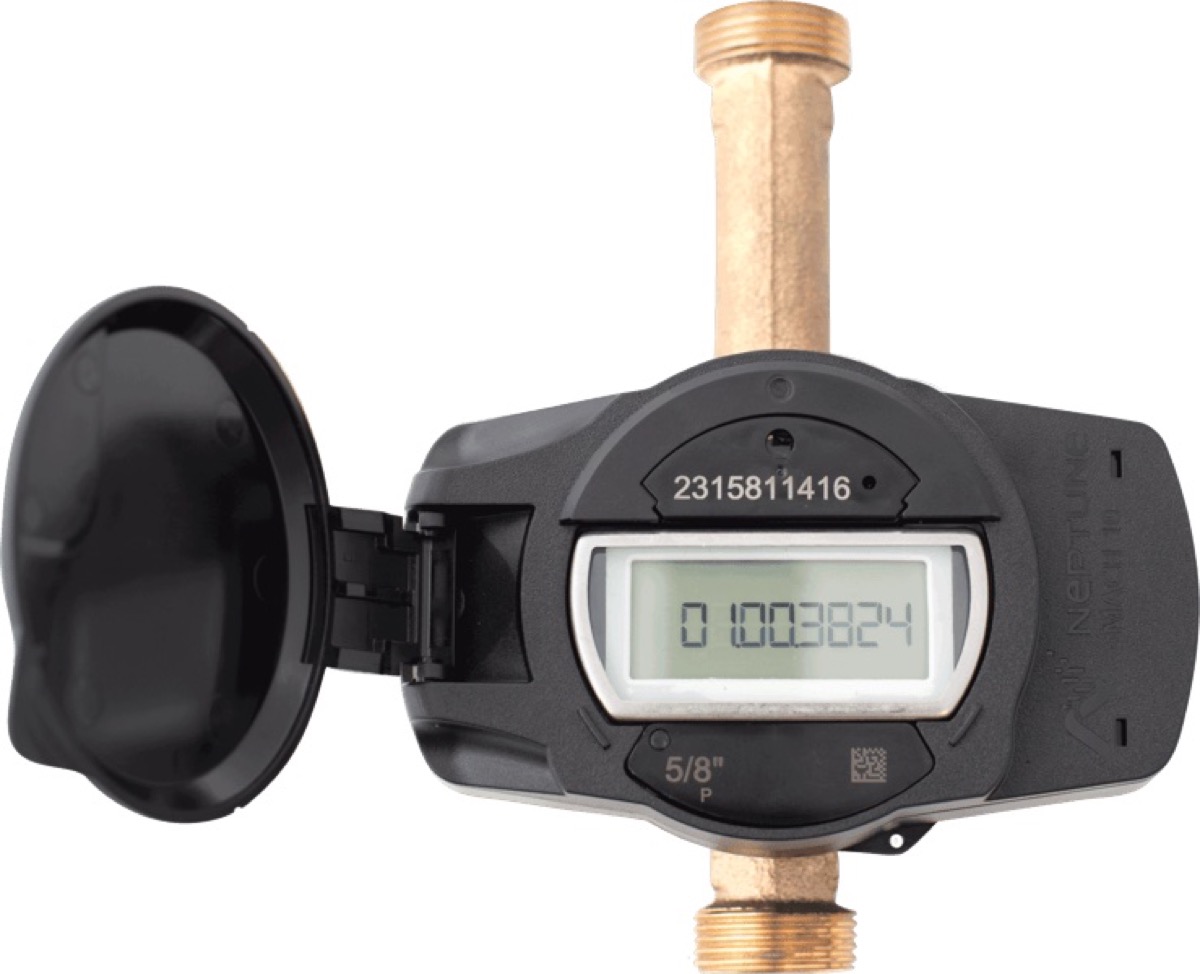
Two ultrasonic transducers are mounted in or on the meter body along a diagonal path across the bore. Each fires a sound pulse toward the other; the pulse travelling with the flow arrives faster than the pulse travelling against it, and that time difference is directly proportional to average velocity along the path. With known internal geometry the meter converts velocity to volumetric flow. Like mag meters there is no obstruction and no moving part, so solid-state ultrasonic meters do not wear the way mechanical meters do.
Good at
No moving parts, so no wear-driven accuracy loss over the meter's life
Wide operating/turndown range including very low flows (good for leak detection)
Effectively no added pressure loss
Can add temperature/pressure sensing and diagnostics (empty-pipe, reverse-flow, leak alarms) in the same body
Weak at
Needs power (typically a long-life internal battery)
Electronics cost more than comparable positive-displacement/multi-jet meters at the smallest sizes
Performance can be affected by entrained air or heavy scale/fouling on transducer faces
Sizes1/2" to 20" (AWWA C715); Neptune MACH 10 specifically offered 5/8" through at least 2" for residential/intermediate service, with larger commercial/industrial sizes in the same product line
Accuracy±1.5% at AWWA C715 Standard Type 1 normal operating range; ±3% on an extended low-flow option (Neptune MACH 10)
TurndownRoughly 250:1 derivable from the MACH 10 5/8" flow range (0.10–25 USgpm at stated accuracy)
Straight runNo straight pipe required to meet AWWA C715 accuracy per Neptune; 5 diameters upstream recommended to meet Neptune's own tighter internal standard
Pressure lossnot stated
Dirty waterNeptune MACH 10 includes empty-pipe, reverse-flow and leak indicators, implying built-in detection of these conditions rather than simple failure
Hot waterNo. The Neptune MACH 10 operating water temperature range is 0.5–50°C (33–122°F).
Best for
New utility billing installs at any size 5/8" and up where turndown, leak-detection sensitivity and zero wear-driven drift matter
Avoid when
No power/battery servicing is acceptable at all
Budget strongly favours the lowest possible first cost at 5/8"–1" (positive displacement/multi-jet remain cheaper there)
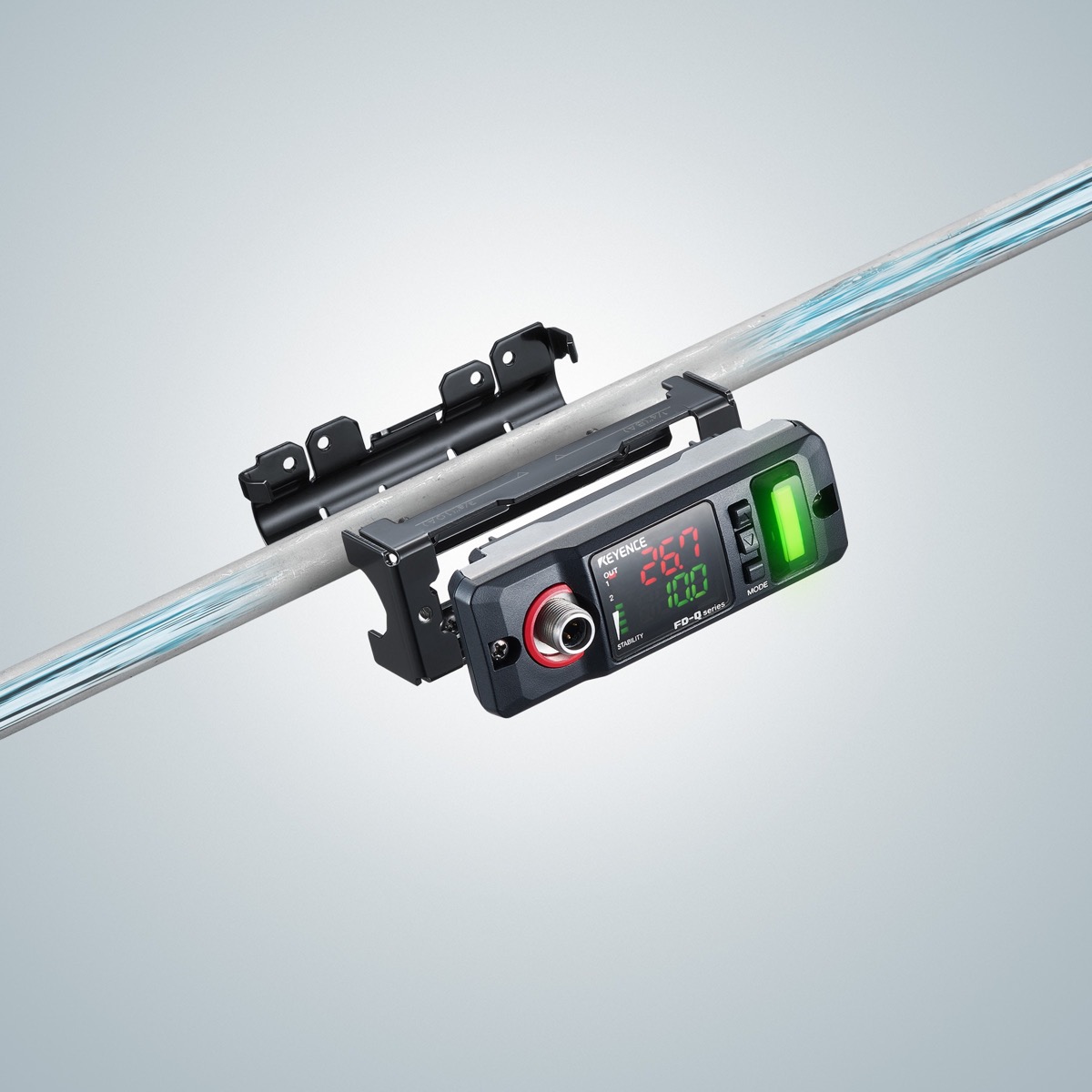
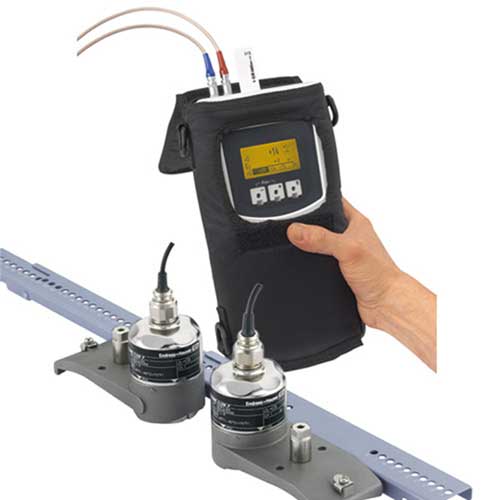
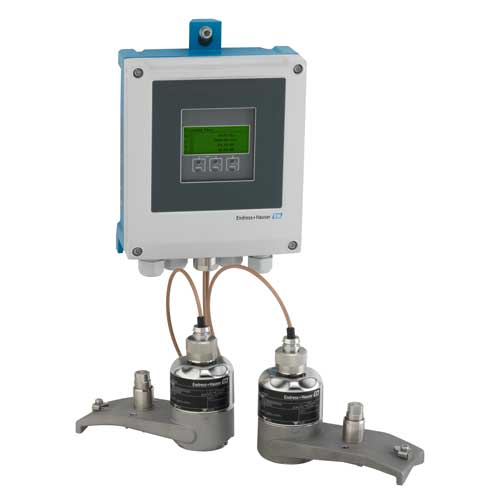
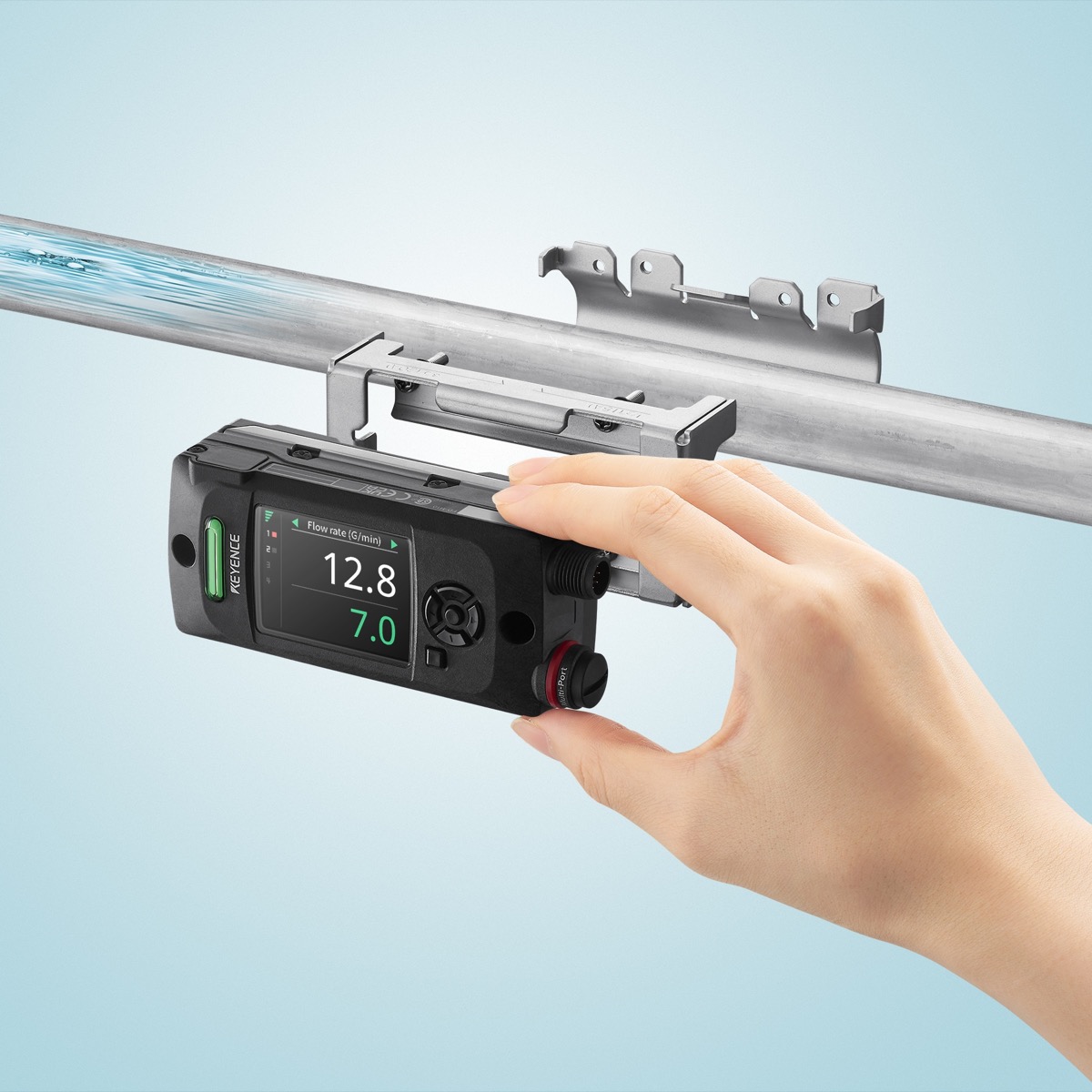
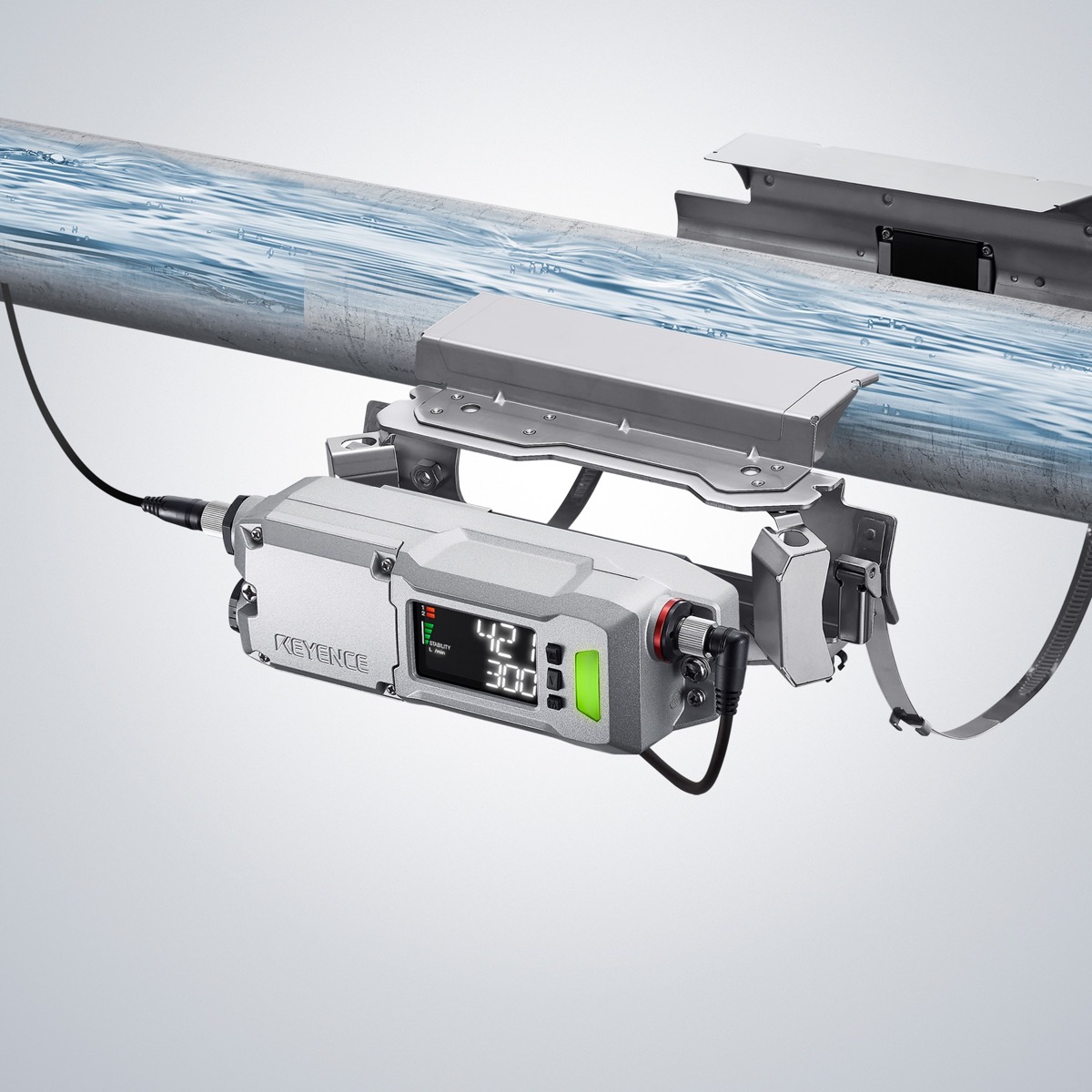
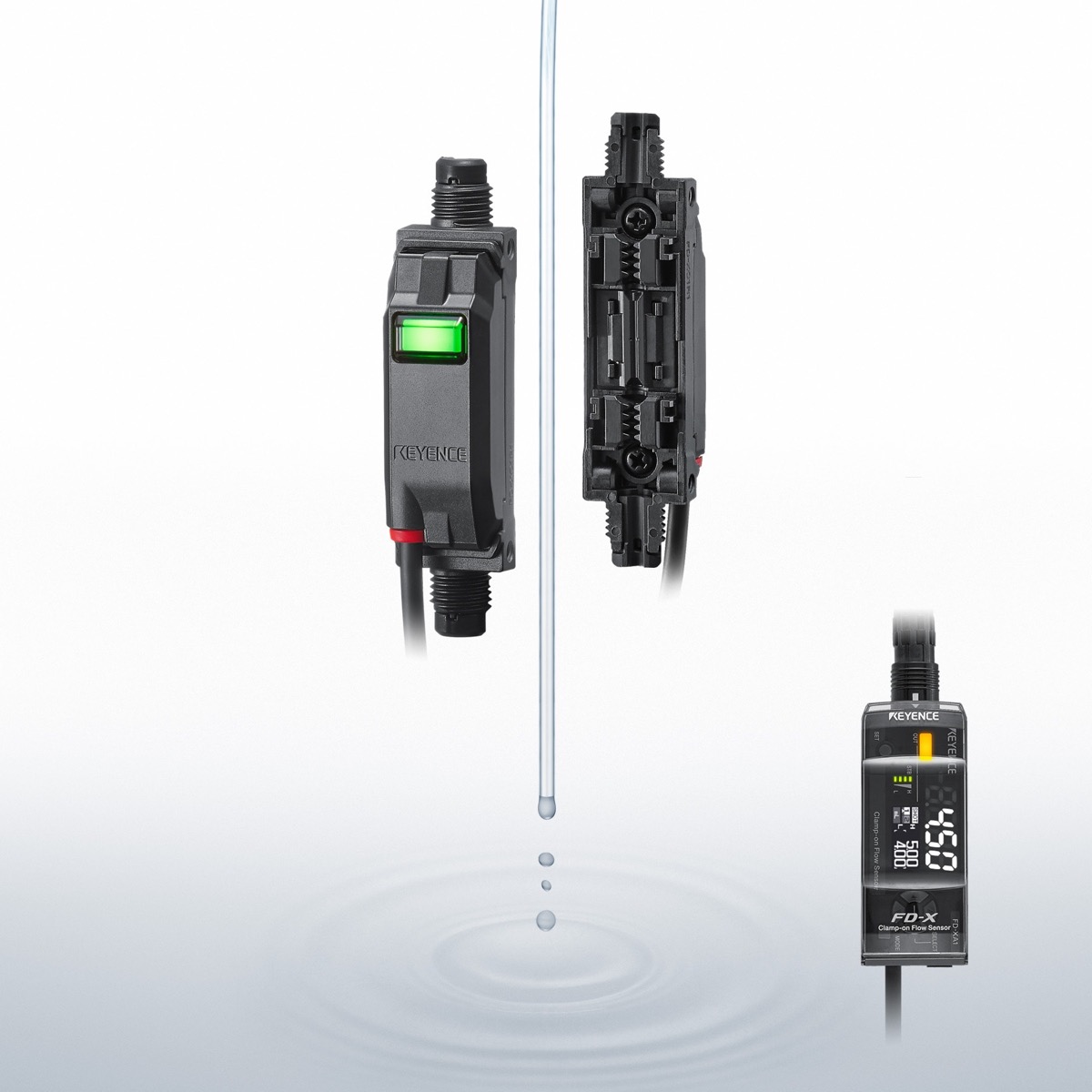
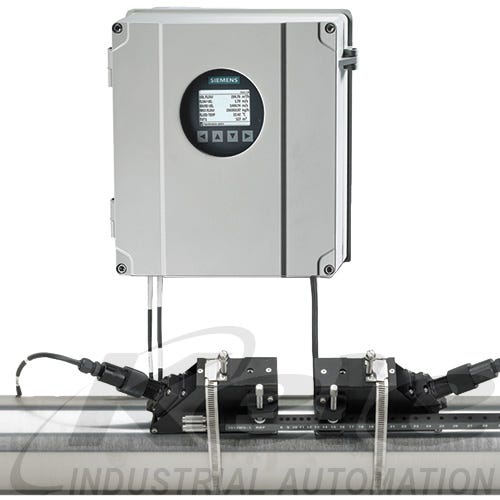
Two transducers are strapped or clamped to the outside of an existing pipe, spaced a calculated distance apart along its length. Like an inline transit-time meter, each fires a sound pulse toward the other through the pipe wall and the liquid; the meter reads the time-of-flight difference between downstream and upstream pulses to compute velocity, then flow. Nothing touches the liquid or penetrates the pipe, so installation needs no shutdown or cutting. The acoustic path does cross the pipe wall twice, which makes results more sensitive to pipe material, wall condition and scale than an inline (wetted) ultrasonic meter.
Good at
No shutdown, no cutting, no wetted parts, no pressure drop
Works on a very wide range of existing pipe materials and diameters
Can be portable (temporary survey) or permanently mounted
Weak at
Generally lower accuracy than an inline (wetted) ultrasonic meter of comparable price tier
Sensitive to pipe wall condition, scale/liner buildup, and correct transducer spacing/alignment
Most models have a real straight-run requirement
Not typically legal-for-trade billing-grade at the budget end
Sizes¼" to 2" across four sensor-body models (Keyence FD-Q); 0.5" to 394" / 12.7mm to 10m (Siemens SITRANS FS230); ½" to 160" / DN15–DN4000 (Endress+Hauser Prosonic Flow W400)
AccuracyRepeatability ±0.15–2.0% depending on response-time setting, explicitly positioned below process-grade accuracy (Keyence FD-Q); ±0.5–1% above 0.3 m/s with >10D straight run, repeatability ±0.25% (Siemens SITRANS FS230); ±3% o.r. at DN15, ±2% o.r. at DN25 and above (E+H Prosonic Flow W400)
Turndownnot stated
Straight run10D upstream / 5D downstream typical minimum, more in disturbed flow (Siemens SITRANS FS230); specified accuracy maintained at only 2×DN inlet run via 'FlowDC' (E+H Prosonic Flow W400); no straight-run figure stated (Keyence FD-Q)
Pressure lossNone. Clamp-on sensors add no obstruction to the bore.
Dirty waterEntrained air/bubbles and heavy internal scale both degrade signal quality for any transit-time ultrasonic meter; not independently quantified per model
Hot water0–85°C (32–185°F), Keyence FD-Q; sensor-dependent up to high-temperature options beyond 230°C, Siemens SITRANS FS230; −40 to +130°C (−40 to +266°F), E+H Prosonic Flow W400
Best for
Retrofitting flow measurement or verification onto existing pipe without a shutdown
Multi-point surveys with a portable unit
Large-diameter or hard-to-access lines where cutting in an inline meter is impractical
Avoid when
Need billing-grade accuracy at low cost (compact units like Keyence FD-Q are explicitly below process-grade accuracy)
Pipe has heavy internal scale/lining of unknown thickness
Insufficient straight run available and the model lacks a short-inlet-run feature
A bluff body (shaped obstruction) is placed across the flow; as liquid passes it, it sheds a regular, alternating series of vortices downstream (the von Kármán vortex street), and the shedding frequency is directly proportional to velocity. A sensor detects the shedding frequency and the meter converts it to flow. Vortex meters need a minimum velocity/Reynolds number to shed vortices in a stable, countable pattern, giving them a hard low-flow floor that mag and ultrasonic meters don't share.
Good at
No moving parts in the strict mechanical-wear sense (the bluff body doesn't move)
Works on liquids, gases and steam, which makes it common in mixed-service industrial facilities
Reasonably cost-effective to install
Weak at
Needs real straight run; one source states 15 diameters upstream and 5 diameters downstream
Ineffective at very low flow velocity or with high-viscosity liquids
Not commonly used for potable/utility water billing versus mag/ultrasonic
Sizesnot stated
Accuracynot stated
Turndownnot stated
Straight run15D upstream / 5D downstream (general industry source, not water-specific)
Pressure lossnot stated
Dirty waternot stated
Hot waternot stated
Best for
Steam, gas and liquid process flows in industrial facilities, especially where the same instrument type is wanted across multiple services
Avoid when
Application is potable or utility water billing at typical municipal velocities and sizes, where mag or ultrasonic almost always fit the straight-run and low-flow requirements better
Liquid is routed through one or more vibrating tube(s); as mass flows through a tube forced to vibrate, the Coriolis effect twists/deflects the tube in proportion to mass flow rate (not volumetric flow). Coriolis meters measure mass directly and can also derive density and, from that, volumetric flow, making them very accurate and largely insensitive to the fluid's temperature, pressure or viscosity.
Good at
Very high accuracy
Direct mass-flow and density measurement, which matters for custody transfer or chemical dosing
Effectively no straight-run requirement, unlike velocity-profile-dependent meters
Weak at
Expensive
Heavy
Higher pressure drop than mag/ultrasonic (liquid passes through curved/looped tubing)
Practically limited to smaller line sizes
Sizesnot stated
Accuracynot stated
Turndownnot stated
Straight runEffectively none. It does not rely on velocity-profile assumptions.
Pressure lossnot stated
Dirty waternot stated
Hot waternot stated
Best for
Custody-transfer or high-value fluid metering
Chemical injection/dosing
Applications needing true mass flow
Avoid when
Application is general potable or utility water flow or volume billing at typical municipal pipe sizes, where cost and the size ceiling rule Coriolis out long before mag or ultrasonic would be
Side by side
Water meter technologies compared on moving parts, size, accuracy, straight run, pressure loss, dirty-water tolerance and power
Technology
Moving parts
Typical sizes
Accuracy, as stated
Straight run
Pressure loss
Dirty water
Power
Positive displacement, nutating disc
Yes
5/8" to 2" (C700 and C710)
±1.5% in normal flow
None required
Highest of the mechanical types
Poor
None, or battery for an electronic register
Positive displacement, oscillating piston
Yes
5/8" to 1" (C700)
±1.5% in normal flow
None required
7.0 psi at 20 USGPM on 5/8" (Sensus SR II)
Poor
None, or battery
Single jet
Yes
5/8" to 6" (C712)
±1.5% claimed by DAE
Not stated
Not stated
Poor
None, or battery
Multi jet
Yes
5/8" to 2" (C708)
±1.5% in normal flow (Sensus PMM)
Not stated
14.0 psi at 30 USGPM on 3/4"
Poor
None, or battery
Turbine, including Woltmann
Yes
3/4" to 20" (C701)
Not stated in the sources reviewed
Not stated in the sources reviewed
Not stated in the sources reviewed
Moderate with a strainer
None, or battery
Insertion paddlewheel
Yes
1/2" to 36" (GF 2536)
Linearity ±1%, repeatability ±0.5%
Not stated in the datasheet
Negligible
Poor to moderate
Loop or external
Compound
Yes, two elements
2" to 8" (C702)
Not stated in the sources reviewed
Not stated in the sources reviewed
Not stated in the sources reviewed
Poor to moderate
None, or battery
Electromagnetic
No
DN15 to DN2000 by model
0.2% to 0.4% of rate (MAG 8000)
Down to 0D, verified to MI-001
Insignificant to about 0.36 psi
Good
Mains, loop, or D-cell packs
Ultrasonic, inline
No
1/2" to 20" (C715)
±1.5% normal, ±3% extended low flow
None to meet C715; 5D recommended
Not stated in the sources reviewed
Good, with empty-pipe and reverse-flow flags
Long-life internal battery
Ultrasonic, clamp-on
No
1/4" to 394" by model
±0.5 to ±1% (FS230); ±2 to ±3% of reading (E+H W400)
10D up and 5D down typical; 2D with E+H FlowDC
None
Sensitive to scale and entrained air
Mains or loop
Vortex
No, the bluff body is fixed
Not sized in this research
Not stated in the sources reviewed
15D up and 5D down
Not stated in the sources reviewed
Not stated in the sources reviewed
Mains or loop
Coriolis
No
Practically capped near 10"
Very high, no model figure sourced
Effectively none
Higher than mag or ultrasonic
Not stated in the sources reviewed
Mains or loop
Sizes and standards from the AWWA standards list. Pressure-loss figures from the Sensus SR II and Sensus PMM datasheets. Clamp-on figures from Siemens FS230 and E+H Prosonic Flow W400. Where a row says a value is not stated in the sources reviewed, no datasheet in this research gave it, and we would rather leave it blank than guess.
Output signals
Getting a number off the meter and onto a dashboard
The measuring element and the signal are separate decisions, and the signal is where most projects stall.
Pulse
A pulse output is a contact that closes once per fixed volume: one tick, one unit, for the life of the meter. A reed switch is a magnet-actuated dry contact, needs no power at the meter, and is rated well past a hundred million cycles for metering duty. Because a magnet closes it, a magnet held against the meter can also spoof it, which is why AMI-grade registers add their own tamper, leak and reverse-flow flags instead of trusting the raw pulse train. A solid-state output, meaning an open collector or a Hall sensor, needs a small supply but takes far higher rates and does not bounce.
Pulse weight and dividers
Pulse weight is the volume one closure represents, and it is set at the register rather than built into the meter body. On a Sensus OMNI+ register you choose which digit of the nine-digit totalizer drives the output, which steps the weight through 1, 10, 100 and on up to 100,000 US gallons, with parallel tables for cubic feet and cubic metres. The Signalizer exposes the same idea as DIP-switch scalars from x0.00001 through x1,000. That digit choice is all anybody means by a pulse divider.
The rate ceiling almost never binds
A representative industrial LoRaWAN pulse counter accepts up to 2000 Hz with a 250 µs minimum pulse width. Run that against real flow bands and the worst case in the whole size run, an 8" meter at 4000 USGPM, would need a 0.126 L pulse weight before it reached the ceiling, which is far finer than any register offers. So choose the weight for how quickly you want to see a leak and for what the register can actually be set to, not to protect the counter. Where the ceiling does start to matter is a raw frequency sensor: a GF Signet 2536 puts out 49 Hz per m/s, so about 294 Hz at the top of its range.
Debounce and wiring
Mechanical contacts bounce for a moment after they close, and the counting device suppresses the extra counts with a debounce window; the counter above states a 250 µs minimum pulse width and digital filtering for exactly that. Everything in this section is a dry contact or an open-collector sink, so the receiving device supplies its own pull-up. The Signalizer takes 12 to 26 AWG on screw terminals, a GF Signet 2536 ships with 7.6 m of shielded twisted pair and runs to 305 m through a junction box, and the pulse counter arrives with a 1 m tail. No manufacturer publishes a blanket maximum cable length, so treat each device's own figure as the limit.
4-20 mA
A current loop reports instantaneous flow rate: 4 mA is zero and 20 mA is whatever full-scale flow the transmitter is configured for. There is no accumulator on the wire, so a running total has to be integrated downstream, and the error in that total comes from how often you sample against how fast the flow really changes. Resolution belongs to the receiving device rather than the loop; the Signalizer generates its output through a 16-bit converter and offers fixed full-scale spans up to 18,000 USGPM. If the transmitter is loop-powered it draws its supply from the same pair, and adding a second loop supply on top of it causes damage, which the Signalizer's own quick-start guide states in as many words.
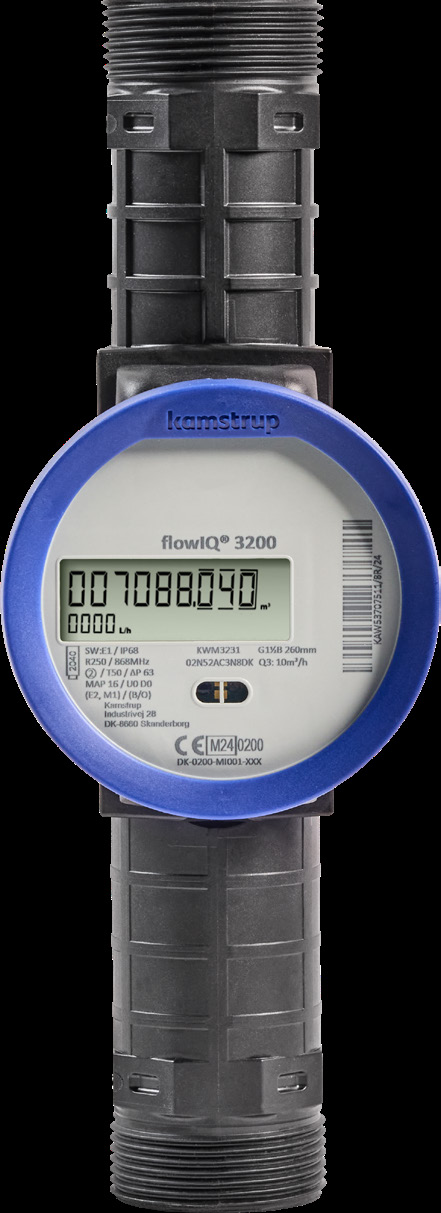
Modbus, HART, BACnet and M-Bus
These live on process instruments rather than on AWWA utility meters. Neptune, Sensus and Badger utility registers speak their own encoder protocols, while a GF Signet 9900 transmitter takes a plug-in Modbus RS-485 module or a HART module as ordering options. HART is a digital signal riding on top of the 4-20 mA loop, carrying diagnostics without disturbing the analog value. BACnet is a building-automation standard that a meter reaches through a gateway rather than a native output, and M-Bus is the European two-wire remote-reading bus you meet on Kamstrup-class meters. When a meter does speak Modbus it usually exposes a totalizer, a rate register and sometimes temperature and alarm bits, but the register map varies by instrument, so ask for it before you promise anything.
Encoder registers, and the encoded trap
An encoder register reports an absolute reading over a synchronous three-wire interface: power and clock on one wire, data on the second, common on the third. That is the real difference from a pulse. A pulse says one more unit happened and can never recover a missed count, while an encoder says the total is now this number, so a reader that lost power simply asks again. Neptune's ARB and E-CODER, Sensus UI-1203 and Badger's ADE and HR-E all work this way, and none of them does anything useful wired into a generic pulse counter.
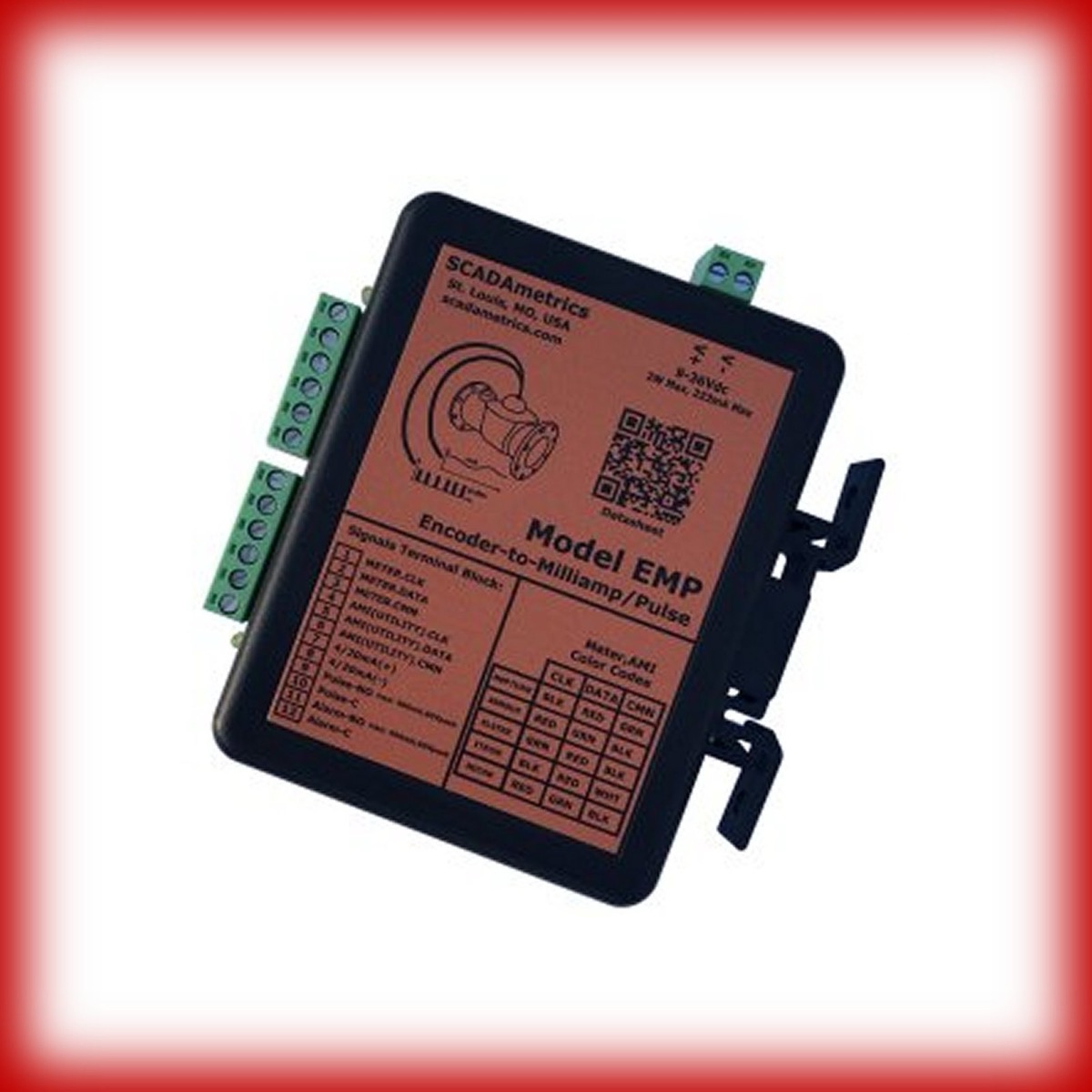
The ScadaMetrics Signalizer is the box that bridges it, and there is exactly one model, the EMP. The separate PDFs on ScadaMetrics' site are per-brand DIP-switch tables for the same physical unit. It decodes Neptune MACH 10, ProCoder and E-CODER, Sensus fixed and variable-digit registers and Elster or AMCO K-frame registers, and it produces a 4-20 mA rate signal, a dry-contact volume pulse and a fault contact, while passing the encoder straight through to a utility AMI endpoint. On the older Neptune ProRead it gives pulse only, because six digits are too coarse to hold a stable analog output.
Then there is the R900i. Neptune builds the R900 radio onto the same board as the encoder inside one sealed housing, on purpose, to cut installation cost and tamper points, and the product sheet lists no external wires as a feature. ScadaMetrics' footnote is blunt: the Signalizer is not compatible with the R900i versions of these registers. A standalone R900 is a different animal, wired to the register by three exposed terminals, so a Signalizer can sit in parallel with it and both keep working.
If a site is already full of R900i registers, check the part number first, because only the fused R900i units are affected. Neptune's registers are bayonet-mounted and field-swappable by design, so swapping the register for a standalone E-CODER or ProCoder is an option to confirm with a Neptune distributor. No Neptune procedure or compatibility table for that specific swap turned up in this research, so treat it as a question for the distributor rather than a settled fix.
How Quantify reads each signal
Our order of preference, and the hardware behind it.
Meter signal, the Quantify device that reads it, what it gives you, and our preference
Meter signal
Our device
What you get
Preference
Pulse, reed or solid state, from the meter's own register, a Signalizer, a Badger HR-LCD Pulse or a Sensus OMNI+
LoRaWAN pulse counter
Running total, counted pulses times the pulse weight
Preferred for consumption
4-20 mA, from a process meter's own transmitter or from a Signalizer reading an encoder
Analog LoRaWAN or Modbus node on the loop
Instantaneous flow rate
Preferred for rate
Encoder register: Neptune ARB and E-CODER, Sensus UI-1203, Badger ADE and HR-E
Signalizer EMP into a pulse counter, with an analog node off the same box for rate
Total, and rate from the same box
Preferred for encoder-only meters
Modbus RTU or TCP, on process instruments
Modbus gateway
Whatever the register map exposes, usually total and rate, sometimes temperature and alarms
Used where offered
Two ways in, one way out. The encoder path in cyan is the one most utility meters need.
Recommended pulse weight by meter size
Quantify guidance, not a standard. Flow figures are Neptune's published maximums for each size; the arithmetic and the recommendation are ours.
Recommended pulse weight by meter size, with pulse rate at maximum flow and time to one pulse at a small overnight leak
Size
Max flow
Max flow, L/s
Pulse weight we ask for
Pulses per second at max flow
Share of a 2000 Hz ceiling
Time to one pulse at a 2 L/min leak
5/8"
25 USGPM
1.58
1 L
1.58
0.08%
30 s
3/4"
35 USGPM
2.21
1 L
2.21
0.11%
30 s
1"
55 USGPM
3.47
1 L
3.47
0.17%
30 s
1-1/2"
100 USGPM
6.31
10 L
0.63
0.03%
5 min
2"
160 USGPM
10.09
10 L
1.01
0.05%
5 min
3"
500 USGPM
31.55
10 L
3.16
0.16%
5 min
4"
1250 USGPM
78.86
10 L
7.89
0.39%
5 min
6"
2000 USGPM
126.2
10 L
12.62
0.63%
5 min
8"
4000 USGPM
252.4
10 L
25.2
1.26%
5 min
Small sizes measure down to a fraction of a USGPM already, so a 1 L pulse keeps leak visibility in proportion to what the meter itself can resolve. From 1-1/2" up, a 2 L/min leak is close to or below the meter's own extended low-flow floor, so a finer weight buys little and costs radio airtime and battery. Flow figures from Neptune's MACH 10 residential, T-10 intermediate and MACH 10 C&I product sheets.
Sizing
Meter size is not pipe size
A pipe is sized for how much water it can carry. A meter is sized for the range of flows it can measure accurately, and those two answers often point at different diameters.
Q1 to Q4, and the R ratio
OIML R49, which is word for word the same text as ISO 4064, describes every meter with four flow points. Q1 is the lowest flow it still measures inside its permitted error, Q2 is the transitional point at 1.6 times Q1 that splits the range into a loose zone and a tight one, Q3 is the highest flow it can run at continuously, and Q4 is a short-duration overload fixed at 1.25 times Q3. A meter is designated by its Q3 and by R, the ratio Q3 divided by Q1, and the higher R is the further down into a trickle the meter keeps reading. One utility study found an R800 meter registered 8% more water than the R200 meter it replaced on the same service, which is 8% of that customer's consumption happening below what the old meter could see.
What the accuracy classes permit
Class 1 allows ±1% in the upper zone for water between 0.1 °C and 30 °C, widening to ±2% above 30 °C, and ±3% in the lower zone at any temperature. Class 2 allows ±2% in the upper zone, ±3% above 30 °C, and ±5% in the lower zone. Below Q1 there is no accuracy guarantee at all, which is the number that matters when you are sizing for leak detection.
The AWWA way of saying the same thing
AWWA organizes cold-water meters by technology rather than by one universal Q number, and utilities work from a stated safe maximum operating capacity per nominal size with continuous duty recommended at roughly half of it. A 5/8" displacement meter is rated 20 USGPM safe maximum and about 10 USGPM continuous, and a 2" is 160 and about 80. Different engineering guidelines apply different margins to the same underlying AWWA M-22 data, which is why the table below carries the same size twice under two standards with two different numbers; both are shown rather than averaged.
Velocity and pressure loss
The Uniform Plumbing Code and AWWA Manual M-22 both cap service velocity at 10 ft/s, while the International Plumbing Code treats anything past 5 to 8 ft/s as not usually recommended. Velocity above a meter's rated range wears moving elements faster and drives pressure loss up with roughly the square of velocity. AWWA publishes a maximum allowable head-loss curve that manufacturers plot their own meters against, and real figures sit in the range of 7.0 psi at 20 USGPM for a 5/8" displacement meter up to 14.0 psi at 30 USGPM for a 3/4" multi-jet, against effectively nothing for a mag or an ultrasonic meter.
Both mistakes are real, in opposite directions
Oversize the meter and typical flows fall under Q1, so ordinary draws and slow leaks go unmeasured, and even the flows that do register sit in the loose accuracy zone rather than the tight one. Undersize it and flows sit near or past the safe maximum, which the standards only permit for short bursts, so pressure loss climbs, the measuring element wears faster and accuracy drifts out of tolerance early. The failure that costs more is usually oversizing, because it is silent.
Getting the flow numbers honestly
Metered history beats every estimate: twelve months of utility bills, or a logged minimum, typical and maximum off an existing submeter, needs no citation beyond the client's own data. Where there is no history, a fixture-unit count or a mechanical engineer's hydraulic calculation is the right input, and it is worth paying for. Once you have the three numbers, check that the minimum clears the candidate meter's Q1, the typical sits comfortably inside the normal range rather than at its ceiling, and the peak stays under Q4.
Check a size against the standards
This tool needs JavaScript. The full flow tables are printed below it, so you can do the same check by hand.
Less than most people expect for water, and the two rules everybody quotes are both about something else.
NSF 61 and NSF 372 do different jobs
NSF/ANSI/CAN 61 says a wetted component does not leach contaminants into drinking water above the allowable thresholds. NSF/ANSI/CAN 372 is the separate check on lead, against a weighted average of 0.25% across the wetted surfaces. A meter can be listed to 61 and carry no 372 claim, which is exactly what several Neptune and Sensus datasheets do, so read both lines. Only a product bearing the mark is certified, so search the NSF listing rather than trusting a datasheet claim.
There is an AWWA standard per technology, not one stamp
Nothing is simply "AWWA approved". Each meter type has its own standard, and the one a datasheet cites tells you what family the meter belongs to.
C700 displacement type, metal alloy main case, 1/2" to 2".
C710 displacement type, plastic main case, 1/2" to 1".
C701 turbine type for customer service, 3/4" to 20", split into vertical-shaft Class I and horizontal high-velocity Class II.
C702 compound type, 2" to 8", a turbine mainline element plus a displacement bypass.
C703 fire-service type, 3" to 10".
C704 propeller type for waterworks, 2" to 72".
C707 encoder-type remote-registration systems, which is the standard behind E-CODER, UI-1203 and ADE class registers.
C708 multi-jet type, 5/8" to 2".
C712 single-jet type, 5/8" to 6".
C713 fluidic-oscillator type, 1/2" to 2".
C714 meters for residential fire-sprinkler systems, 3/4" to 2".
C715 electromagnetic and ultrasonic type for revenue applications, 1/2" to 20". This is the one a MACH 10 or a flowIQ cites.
C750 transit-time flowmeters in full closed conduits, a process standard rather than a revenue one.
C751 magnetic inductive flowmeters, likewise process rather than revenue.
This is the correction worth making out loud, because it comes up on nearly every project. Measurement Canada's own consultation page states that water meters are exempt from requiring approval and initial inspection before they are used to determine a customer's water consumption, unlike scales and gas pumps. Its role is verifying that trade devices measure accurately, while provincial and municipal authorities set billing practice and rates. You do not need a Measurement Canada approval to bill a tenant for water, which is genuinely different from gas, electricity and thermal energy.
Section 57(c.1) of the Ontario Energy Board Act makes unlicensed unit sub-metering an offence, and the OEB's Unit Sub-Metering Code sets installation, testing, reading and billing rules for licensees. The OEB's own scope statement limits all of that to electricity and says plainly that it does not regulate billing for natural gas or water. For a commercial or industrial water sub-meter the controlling documents are the municipal water by-law and the lease, which is a much shorter path than electricity sub-metering. A residential rental building is a different question, because the Residential Tenancies Act constrains suite-level billing, and that one is worth a lawyer rather than a meter catalog.
Guelph's sub-meter rebate requires sub-meters to meet or exceed AWWA and NSF/ANSI 61 standards, and its water by-law makes protecting the meter from freezing the property owner's job, including maintaining heat to it. Hamilton runs a formal submeter application through Meter Operations, sizes meters to AWWA M22, tests accuracy to AWWA standards, and bills the owner for the test and the replacement when a meter reads more than 2% out. Neither by-law mentions Measurement Canada anywhere.
Standard cold-water meters are built for roughly 30 °C to 50 °C. ISO 4064 and OIML R49 mark the range as a temperature class: T30 and T50 are cold, T70 and T90 are hot, and T130 and above are district heating. B Meters' GSD8-RFM shows the split cleanly, sold as a 0 °C to 50 °C cold version and a 30 °C to 90 °C hot version of the same multi-jet body. Seals, lubricants and register plastics are what fail first when a cold meter is run hot, so read the stated class instead of inferring it from the body material.
IP67 covers brief immersion to about a metre. IP68 covers continuous or deeper submersion, to a depth and duration the manufacturer states rather than a fixed number in the standard. A register or transmitter in a below-grade pit where water stands needs IP68, and IP67 is for positions that get weather but not standing water. There is no equivalent freeze-rating scheme, so treat freeze tolerance as the manufacturer's stated minimum operating temperature and read the local by-law on whose job it is to protect the meter.
Powered meters carry electrical marks too
NSF 61 and AWWA say nothing about electrical safety. On any powered meter look separately for a CSA or UL mark, and only where the installation is genuinely near fuel, solvent or dust, for a hazardous-area rating. Endress+Hauser's Promag H 200 is the worked example, listing ATEX, IECEx and cCSAus with an intrinsically safe Ex ia option, and Class I Division 2 Groups A to D is the North American classification to ask about. Most of the utility-grade catalog below needs none of this.
3-A Sanitary Standards, EHEDG and FDA-compliant wetted materials govern cleanability: compatibility with clean-in-place and steam-in-place, crevice-free geometry, a defined surface finish. That is not what NSF/ANSI/CAN 61 tests, which is chemical leaching into drinking water. A meter can be excellent on a dairy line and carry no NSF 61 listing at all, because it was never meant for a distribution system.
Wastewater, reclaimed water and irrigation sit outside the scope of NSF 61 and 372, because those standards exist to protect drinking water. What matters instead is solids tolerance and turndown, which is why electromagnetic and ultrasonic designs dominate there; a mag meter has nothing in the bore to foul. In Ontario, metered effluent flow is usually a condition inside a facility's own Environmental Compliance Approval rather than a blanket statutory rule, so read your ECA rather than assuming either way.
CRN: almost every water meter is exempt in Ontario
O. Reg. 220/01 does not apply to a fitting or piping carrying liquids no more hazardous than water at 65 °C or less and 250 psi or less, and separately exempts buried water piping at 65 °C or less and 740 psi or less. A standard water service meter sits squarely inside that exemption and needs no Canadian Registration Number. A hotter process line, a higher-pressure line, or anything that is not water falls outside it and is worth a direct question to TSSA rather than a guess.
A US gallon and a Canadian gallon are not the same unit; the American one is about 20% smaller. A spec sheet that only says "gallons" is ambiguous until somebody confirms which.
Why a Canadian meter reads in US gallons
Nothing in Canadian law forces a metric register, because water meters sit outside Measurement Canada's approval regime, so there is no rule to comply with. The large utility-meter manufacturers build primarily for the US market, so the stock configuration reads US gallons or cubic feet while Canadian municipalities bill in cubic metres. Specify the register unit on the purchase order, check it against the faceplate at commissioning, and write down the conversion factor you used so the next person does not have to work it out.
Three kinds of register
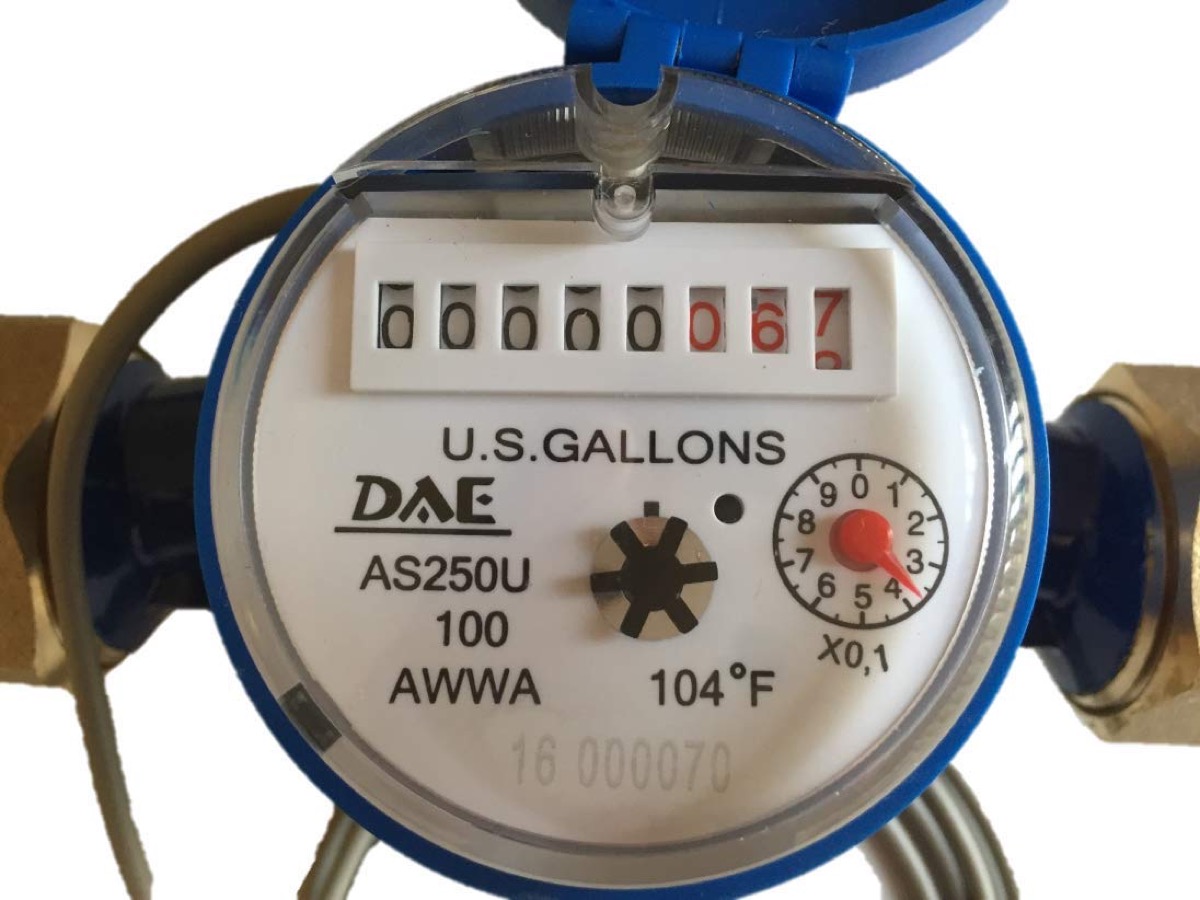
A mechanical odometer with a sweep hand gives the whole-unit total on numbered wheels and sub-unit resolution on the rotating pointer, and the reading convention is to take the lower number when the hand sits between two. An electronic LCD register is a digital totalizer that usually offers a choice of unit and often shows instantaneous rate alongside the total. An absolute encoder stores the reading electronically and non-volatilely, which is what lets an AMI endpoint or a Signalizer ask for it repeatedly without ever losing count.
Multipliers and rollover
Some registers print one or more fixed trailing zeros, or colour a digit differently, to signal a multiplier so the printed number is in tens or hundreds of units. Where the manufacturer's own manual does not confirm the multiplier for that exact model, treat it as not stated instead of guessing from a generic reading guide. Every totalizer also rolls over at its digit limit, and there is no universal rollover value across manufacturers, so pull it from the model's own datasheet.
Display resolution is not pulse resolution
The smallest increment the register displays and the volume one pulse represents are two separate numbers, set independently. A register at maximum resolution paired with a Signalizer can produce one pulse per litre, and the same Signalizer has a slower mode producing one pulse per ten litres; that is an installer setting, not a property of the meter. Before wiring anything into a counter, confirm the pulse weight the register is currently programmed to, and confirm it again at commissioning rather than trusting a datasheet default.
Power
Power options across the catalog
Option
What it means
Where you meet it
None
A fully mechanical register accumulates and displays with no power at all. Anything bolted on afterwards, such as an encoder driver, a Signalizer or an AMI radio, needs its own supply.
Neptune T-10, Badger Recordall, most displacement and turbine bodies
Battery
A sealed lithium cell, usually potted and not user-replaceable, rated for a multi-year design life. Read the figure per size rather than per family.
MACH 10 at 20 years on 5/8" to 1" and 10 years on 3" to 12"; Siemens MAG 8000 up to 15 years on a four D-cell pack
Loop-powered
A 4-20 mA device draws its operating power from the same pair that carries the signal, so no separate power run is needed. Never add a second loop supply on top of one.
Signalizer 4-20 mA output, most two-wire process transmitters
Externally powered
24 VDC or 120 VAC at the meter. Standard on process instruments, and the reason a mag meter in a remote pit is usually the battery version instead.
Siemens MAG 5100 W, GF Signet transmitters, most clamp-on ultrasonic units
What a display can and cannot do
Rate as well as total, a choice of unit, and a programmable pulse divider are register features rather than meter features, so they are ordered with the register. A meter body and its register are usually separate part numbers, and on Neptune's line the register is bayonet-mounted and swappable in the field. That is good news when a site needs a different signal later, and it is the reason an R900i, where the register and radio are one sealed unit, closes the door.
Decision tree
Eight questions, in the order that saves the most time
Answer these in order and the shortlist writes itself. Print this page and the tree fits on one sheet.
The same eight questions the picker asks, in the same order.
The decision tree in words
Purpose. Do you need a running total, an instantaneous rate, or both? A total means pulse or an encoder register; a rate means 4-20 mA; both means a meter that offers both, or a Signalizer reading an encoder.
Access. Can you cut the pipe and take a shutdown? If yes, an inline meter is more accurate and cheaper. If no, a clamp-on ultrasonic meter measures through the pipe wall with no shutdown and no wetted parts.
Water. Is it potable, and is it hot? Potable means NSF/ANSI/CAN 61 and, for lead, 372. Above about 50 °C you need a meter marked to a hot temperature class such as T70 or T90, not a cold-water meter.
Flow. Get the pipe size, then the minimum, typical and maximum flow. Use metered history where it exists; otherwise a fixture-unit count or a mechanical engineer's calculation. Do not guess.
Output signal. Pulse for consumption, 4-20 mA for rate, an encoder register plus a ScadaMetrics Signalizer where the meter has no direct output, or Modbus where a process instrument offers it.
Units and resolution. Match the register unit to your billing unit, in cubic metres for most Canadian utilities. Then set the pulse weight: 1 L up to 2", 10 L above that.
Power. No power at the meter position means a battery meter. Power available means a mag meter or a clamp-on unit becomes possible.
Shortlist. Run the picker below with those answers, then send the distributor checklist with your request for a quote.
Picker
Answer the same eight questions and get a shortlist
This runs entirely in your browser and sends nothing anywhere. It returns a requirements sheet you can paste into an email and a ranked list of meters from the catalog below, with the reason each one made or missed the cut.
This tool needs JavaScript. Without it, every question below is still readable, and the catalog and the decision tree do the same job by hand.
Meters ruled out and why
Catalog
Real meters, fully spec'd, with the datasheet behind every number
Filter with the rails, open Specs on any row for the full sheet, and tick up to three to compare. Where a datasheet did not state something, the row says not stated rather than filling the gap.
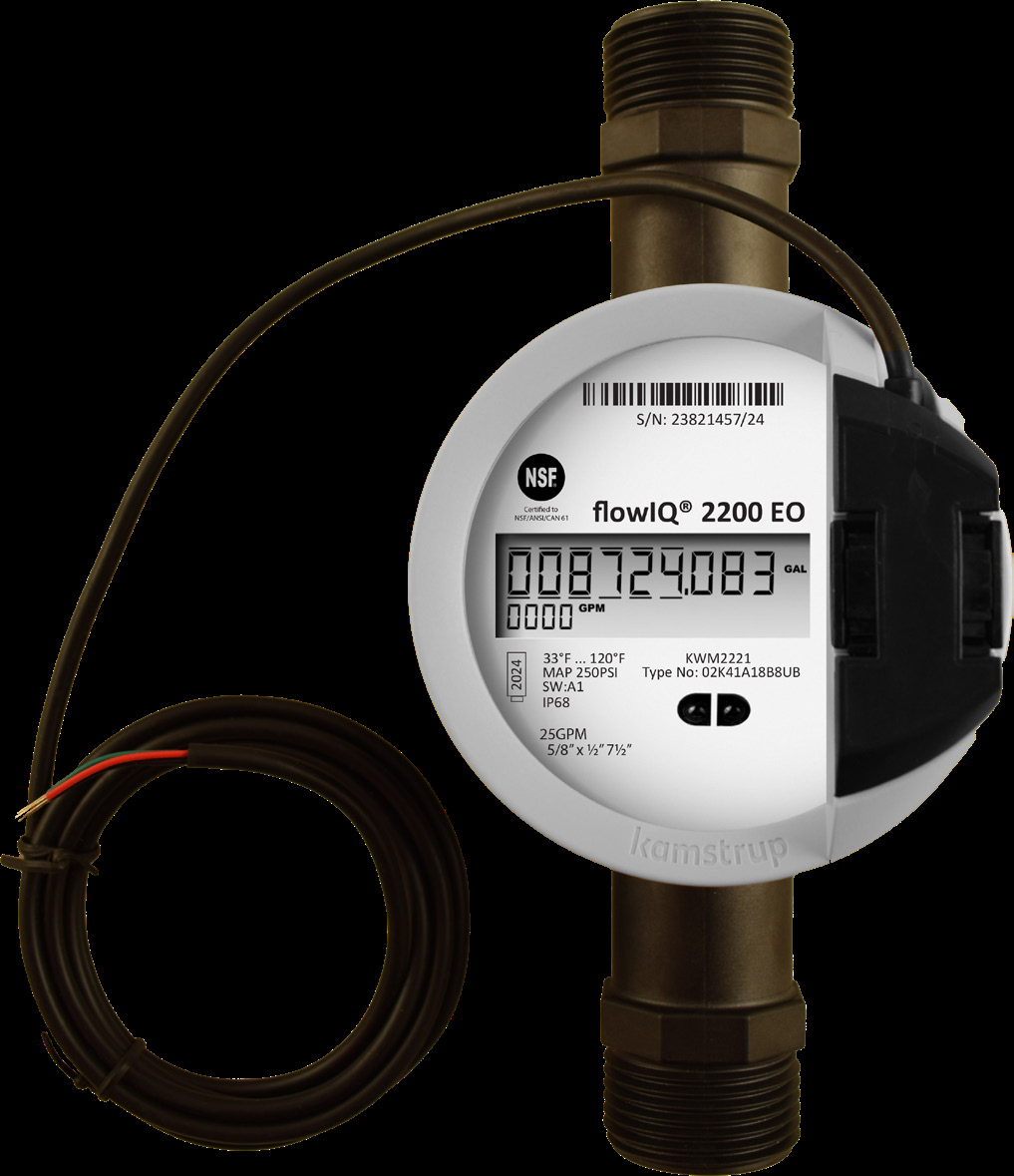
Three things are worth knowing before you read a row. Kamstrup's flowIQ 2200 only exposes a register we can read in the Encoded Output hardware variant, which implements the Sensus UI-1203 and UI-1204 specification and is also compatible with Neptune ProRead and E-CODER reading systems; the RF and Cellular variants of the same meter do not. Mueller's SSM calls its protocol an industry-standard encoder without naming Sensus or Neptune, so treat it as a Signalizer candidate to confirm rather than a proven one. And Hersey is no longer a brand, since Mueller's own brand list has dropped it and herseymeters.com is a parked error page, so the old Hersey turbine and compound role now sits with Mueller's MVR.
Price bands are comparative judgements by product class rather than quoted figures, because none of these manufacturers publish list prices for this equipment. Where we found a public reseller price, we kept it in our own notes to justify the band, and never print it here as though it were a quote.
58 meters and accessories
Compare
Manufacturer
Model
Technology
Sizes
Outputs
Potable
Max °C
Price
Quantify fit
Details
Badger Meter
E-Series UltrasonicE-Series Ultrasonic Meter (Cold Water Stainless Steel)
Ultrasonic, inline
5/8", 5/8 x 3/4, 3/4", 1"
Encoder register
NSF 61
60
$$
consumption: encoder through a Signalizer; rate: no route
Badger's solid-state transit-time ultrasonic residential meter, 5/8 in. to 1 in., with no moving parts and a sealed, non-removable register. The datasheet notes that there is currently no AWWA standard specific to residential ultrasonic meters. Badger also sells a separate E-Series G2 lead-free bronze line for commercial and industrial service, listed on the product page up to 8 in. Its specifications are not covered here.
Accuracy±1.5% over the normal flow range; ±3.0% from the extended low-flow range to the minimum flow value (measured at 45–85°F / 7–29°C)
Turndownnot stated
Water temperature1 to 60 °C
Max pressure175 psi
PotableNSF 61
Registerelectronic
Register unitsUSgal, ft³, m³
Display resolution9-digit straight-reading LCD, 7 mm digits; resolution 0.XX gal / 0.XXX ft³ / 0.XXXX m³
Power3.6V lithium thionyl chloride battery, fully encapsulated and non-replaceable, 20-year life
Display showsrate, total
Installcut into the line, vertical or horizontal, flow in the up direction
Extrasno moving parts in the flow stream, empty-pipe detection, reverse-flow indication (max 4–9 USgpm depending on size), fully submersible
Measurement Canadaunknown
Will not measure flow under an empty-pipe condition.
Badger digital / industry-standard encoder protocol (integral; ORION/GALAXY/Itron-compatible)
not stated
not stated
not stated
Datasheet states 'digital or industry standard encoder protocol' but does not name the wire protocol or confirm a pulse output.
Quantify fit consumption: encoder through a Signalizer; rate: no route
Datasheet states 'digital or industry-standard encoder protocol' but doesn't name the wire protocol or confirm a pulse output; confirm with Badger before assuming Signalizer compatibility.
consumption: encoder through a Signalizer; rate: no route
Badger's standard high-resolution encoder register, which bayonet-mounts to Recordall Disc, Turbo, Compound, Combo and Fire Service meter bodies. This is an encoder-only part: three-wire synchronous ASCII output, with no native pulse or 4–20 mA signal. Badger sells separate HR-LCD Pulse and HR-LCD 4-20 register variants for those signal types, which we have not spec'd here. Older Badger meters instead use the ADE (Absolute Digital Encoder), a similar two-wire asynchronous ASCII encoder for Touch-type readers.
Accuracynot stated
Turndownnot stated
Water temperature-10 to 60 °C
Max pressurenot stated
PotableAWWA C706/C707
Registerencoder
Register unitsUSgal, ft³, m³
Display resolution9-digit, auto-toggling between 9-digit and 6-digit consumption; electronic resolution is set per meter model and size, for example 0.01 gal / 0.001 ft³ / 0.0001 m³ for 5/8–1 in. Disc meters and coarser for larger Turbo and Compound sizes. See the datasheet table.
Powerlithium thionyl chloride AA cell, fully encapsulated; 20-year calculated battery life
Display showsrate, total, programmable
Installclamps on, no cut
Extrasmagnetic-tamper and encoder-removal alarms, 30-day no-usage alarm, end-of-battery-life alarm, bayonet mount, 4 orientations, IR-port field programming
Measurement Canadaunknown
Bayonet-mounts to Badger Recordall Disc, Turbo, Compound, Combo and Fire Service meter bodies; removable without disrupting water service.
Output signals
Type
Protocol
Pulse weights
Switch
Max Hz
Detail
Encoder register
Industry-standard ASCII, three-wire synchronous (Red = clock/power, Black = ground, Green = data)
not stated
not stated
not stated
No native pulse or 4-20mA output on this part; Badger sells separate HR-LCD Pulse and HR-LCD 4-20 register variants for those signal types.
Quantify fit consumption: encoder through a Signalizer; rate: no route
Pure encoder output (3-wire ASCII). It needs a Signalizer or equivalent converter to produce a pulse we can read directly.
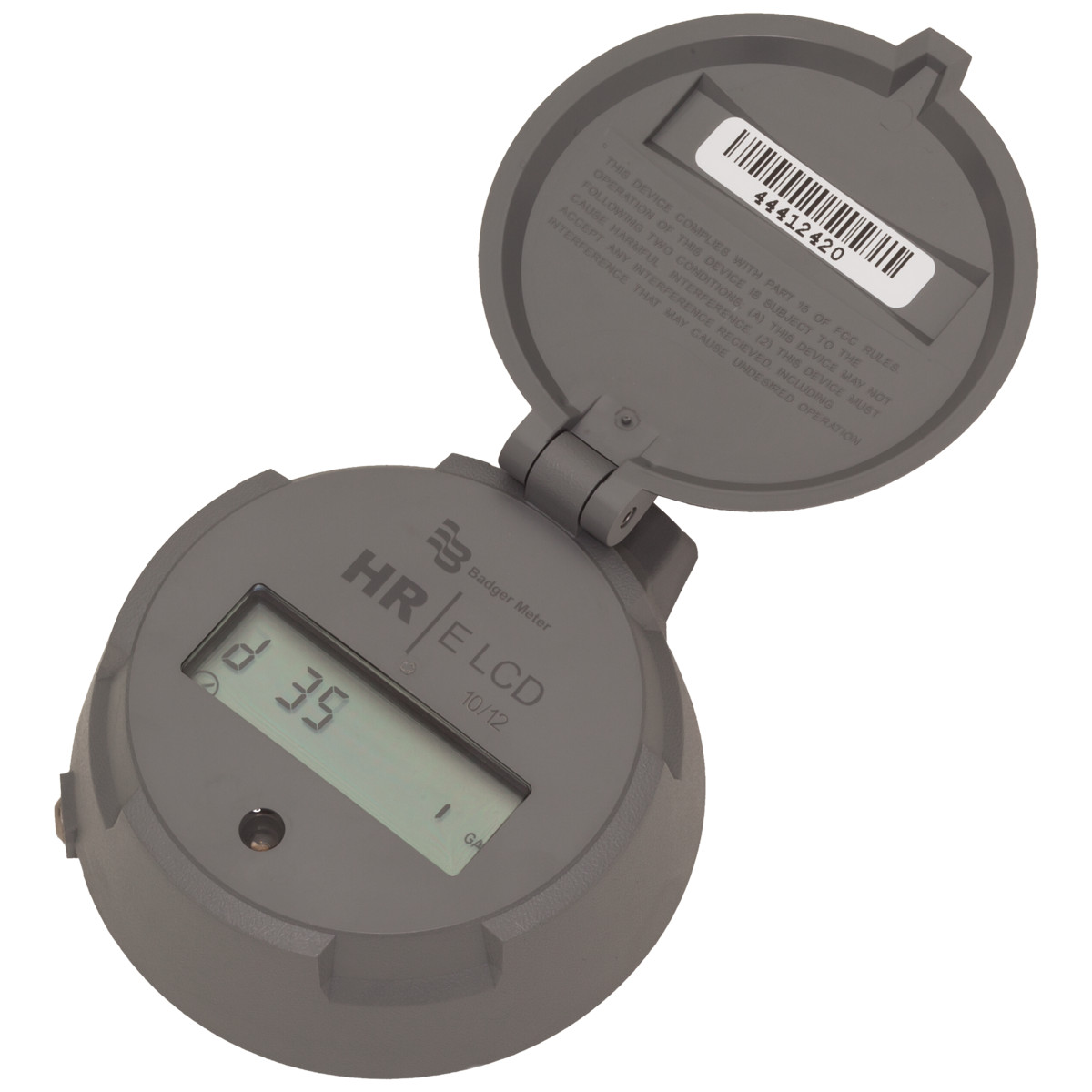
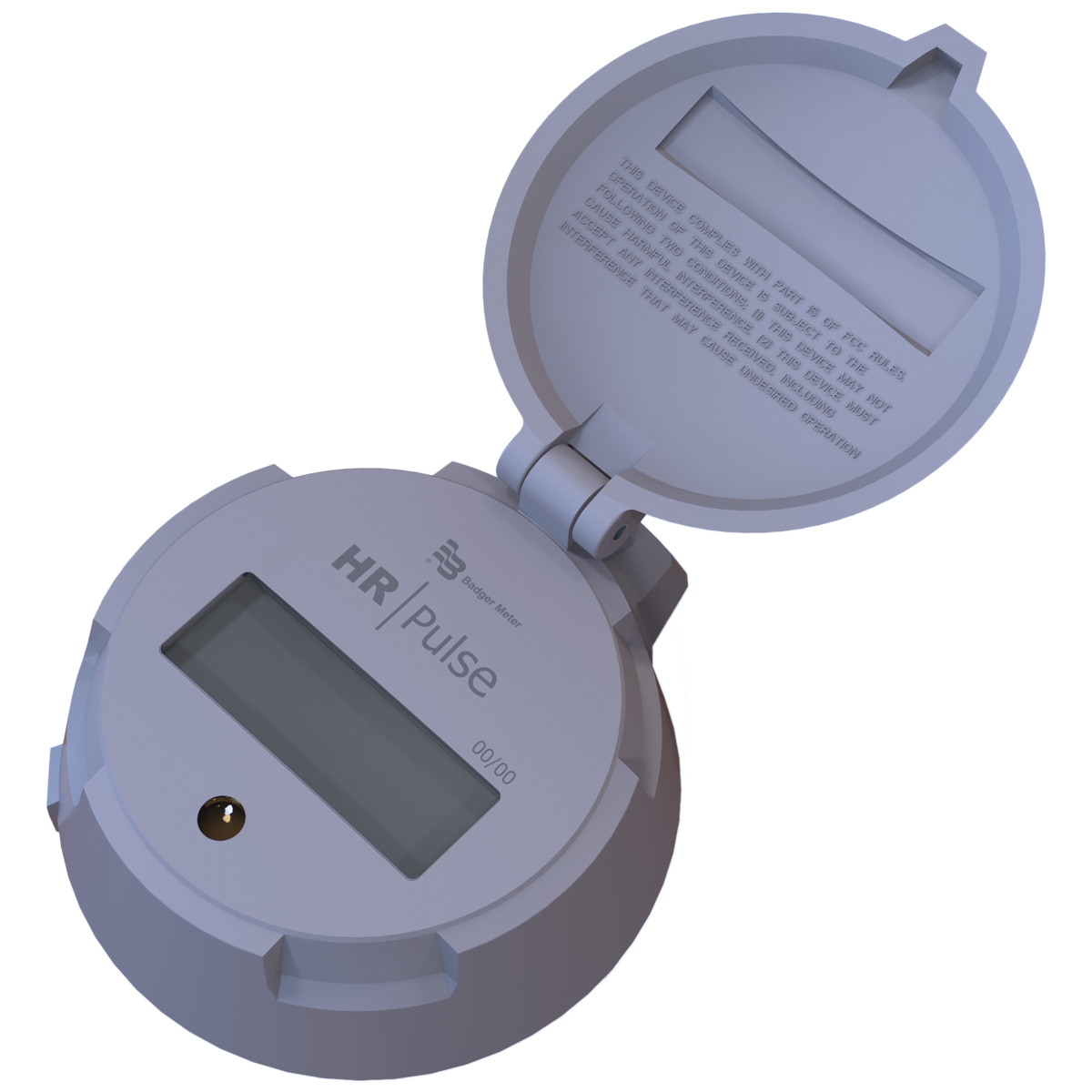
Badger's own fully electronic, solid-state pulse-output register, with no moving parts. It fits directly on Recordall Disc, Turbo and Compound series meters and produces a scaled volume pulse natively, so no separate encoder-to-pulse converter is needed.
Accuracynot stated
Turndownnot stated
Water temperature-40 to 60 °C
Max pressurenot stated
Potablenot stated
Registerelectronic
Register unitsnot stated
Display resolutionnot stated
Power9-50VDC, or an internal AA lithium thionyl-chloride battery rated 10 years at default settings
Extrasno moving parts: a solid-state electronic register, Tamper-resistant Torx security seal screws, Rated for flood/harsh-environment conditions
Measurement Canadaunknown
Register-level fit to compatible Badger meter bodies (Disc, Turbo, Compound series); not a clamp-on or DIN-rail accessory.
Output signals
Type
Protocol
Pulse weights
Switch
Max Hz
Detail
Pulse
not stated
not stated
Solid state
not stated
Scaled pulse output, factory-programmed as standard with field-programmable unit of measure, meter type/model, and rate-of-flow time/units.
Quantify fit consumption: pulse; rate: no route
A native pulse register, which we read directly with a LoRaWAN pulse counter and no Signalizer. It is the pulse-only sibling of the separate 'HR-LCD 4-20 Scaled/Unscaled Register' product, which carries the 4-20 mA path instead and is not spec'd here.
Price band not stated
Where to buy not stated
The manufacturer product page gives no price and names no Canadian distributor.
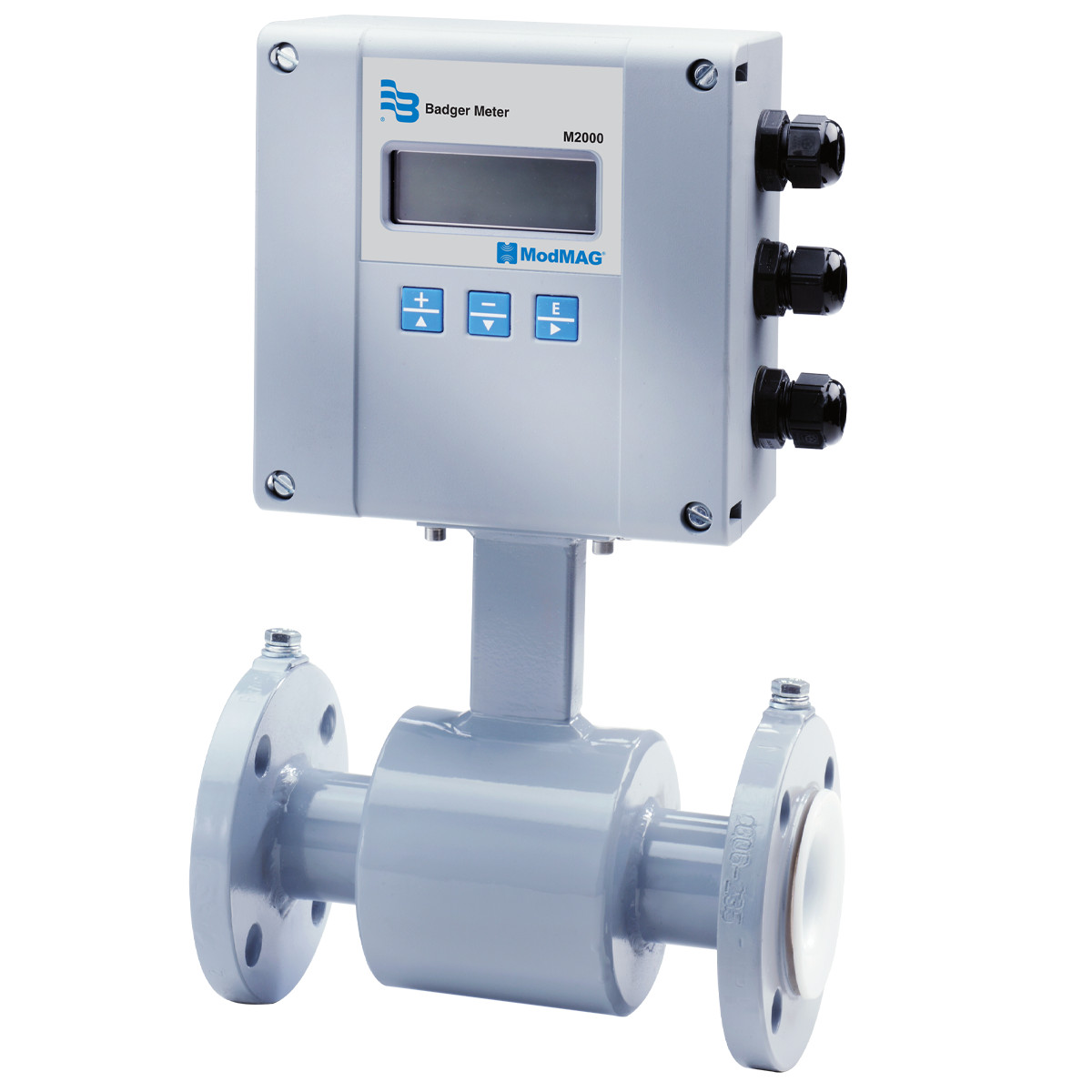
ModMAG M2000ModMAG M2000 Electromagnetic Flow Meter
Electromagnetic
1/2", 3/4", 1", 1-1/2", 2", 3", 4", 6", 8"
4-20 mA, Modbus, Pulse, Encoder register
NSF 61
150
$$$$
consumption: pulse; rate: 4-20 mA
Badger's line-powered process and industrial electromagnetic flow meter, the modern face of the ModMAG and Cox Instruments product family, in line sizes from 1/4 in. to 78 in. with a full multi-protocol output card. It stands in for Badger's whole ModMAG and Cox Instruments process line in this catalogue. It needs a minimum fluid conductivity of 5 µS/cm, so it will not work on de-ionized water, oil or other non-conductive process fluids.
Accuracy±0.20% of reading ±1 mm/s (standard); OIML/MID Accuracy Class 1, ±1% at ≥0.5 ft/s (0.15 m/s), DN50–300 with 0D up/downstream
Turndownnot stated
Water temperature-40 to 150 °C
Max pressurenot stated
PotableNSF 61, NSF 372
Registerelectronic
Register unitsm³, USgal, L
Display resolutionnot stated
Power100–240V AC (typ. 20VA/15W, max 26VA/20W) or optional 9–36V DC (typ. 10W, max 14W); line-powered, not battery
Recordall Compound SeriesRecordall Compound Series
Compound
2", 3", 4", 6"
Encoder register
NSF 61
40.6
$$$
consumption: encoder through a Signalizer; rate: no route
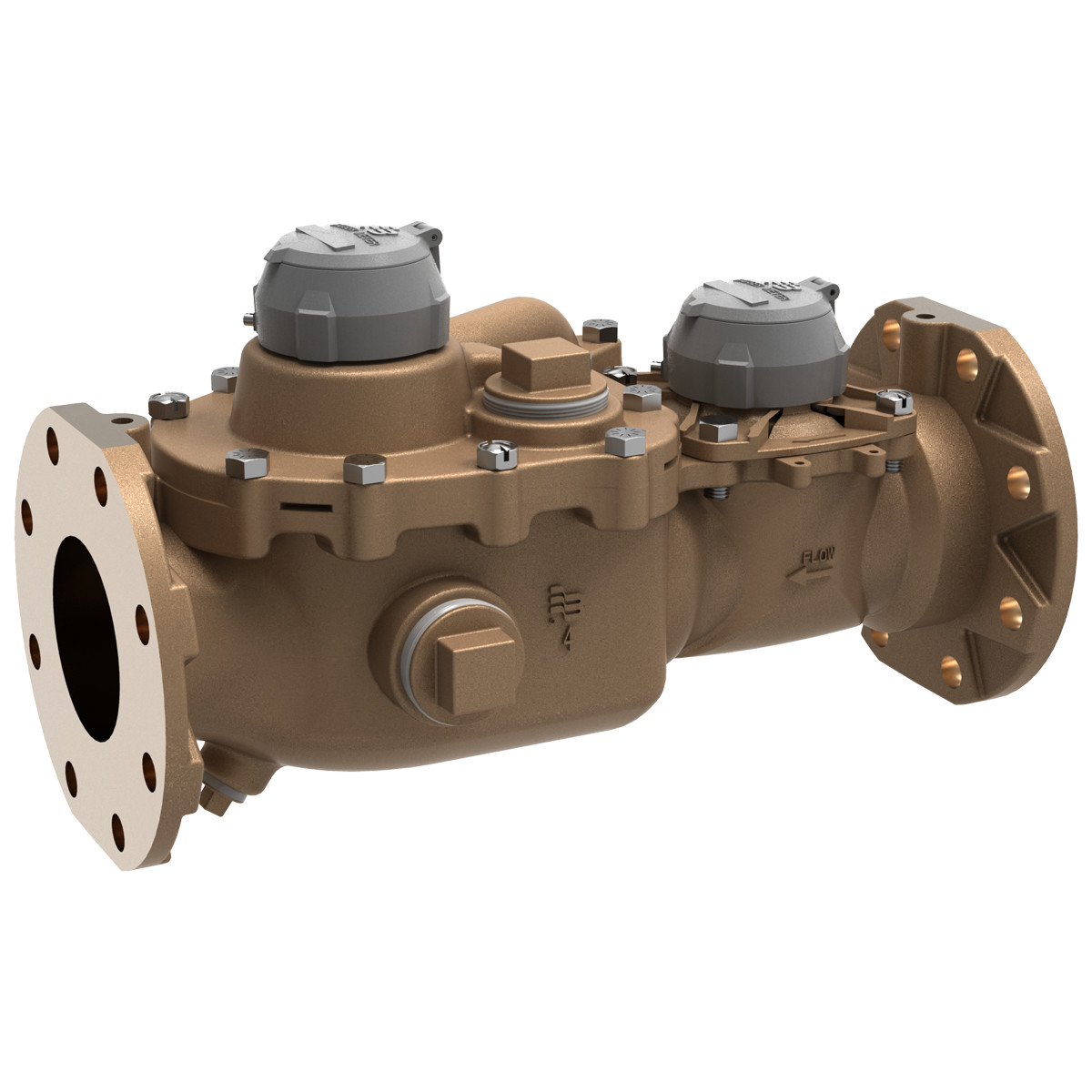
Badger's compound meter (positive-displacement disc chamber for low flow, turbine chamber for high flow, patented valveless crossover) for commercial/institutional buildings, 2 in. to 6 in.
Accuracy100% ±1.5% over typical operating range (AWWA C700/C702); 95–97% minimum crossover accuracy at the changeover flow rate
Recordall Disc SeriesRecordall Disc Series (Models 25/35/55/70/120/170)
Positive displacement
5/8", 5/8 x 3/4, 3/4", 1", 1-1/2", 2"
Encoder register
NSF 61
26.7
$
consumption: encoder through a Signalizer; rate: no route
Badger's nutating-disc residential and light-commercial meter, 5/8 in. to 2 in. The polymer M25 tops out at 3/4 in.; the lead-free bronze line runs 5/8 in. through 2 in. It ships with a plain mechanical sweep-hand register, and an AMR/AMI encoder (HR-E LCD or ADE) is always a separately ordered option rather than built in.
Accuracy100% ±1.5% over typical operating range (AWWA C700); low-flow minimum registration 95–98.5% depending on model/size
Powernone (base mechanical register); optional encoder is battery-powered
Display showstotal
Installcut into the line
Extrasbuilt-in strainer, twice the inlet area, register/chamber/strainer field-replaceable without removing the meter body, optional tamper-resistant seal screws
Badger HR-E LCD or ADE encoder (optional accessory, ordered separately)
not stated
not stated
not stated
Base meter ships with a mechanical sweep-hand register with no electrical output; see the badger-hr-e-lcd accessory entry.
Quantify fit consumption: encoder through a Signalizer; rate: no route
Base register is mechanical with no electrical output; add an HR-E LCD or ADE encoder (sold separately) plus a Signalizer to get a pulse signal Quantify can read.
Recordall Turbo SeriesRecordall Turbo Series (Models 160–6200)
Turbine
1-1/2", 2", 3", 4", 6", 8", 10"
Encoder register
NSF 61
48.9
$$
consumption: encoder through a Signalizer; rate: no route
Badger's direct-coupled "floating rotor" turbine meter for commercial/industrial/irrigation services with steady, higher flow demand, 1-1/2 in. to 12 in. Same mechanical-register-plus-optional-encoder pattern as the Disc series.
Accuracy100% ±1.5% over typical operating range (AWWA C701 Class II)
Turndownnot stated
Water temperatureup to 48.9 °C
Max pressure150 psi
PotableNSF 61, NSF 372, AWWA C701 Class II
Registermechanical
Register unitsUSgal, ft³, m³
Display resolution6-odometer-wheel register; capacity 100,000,000 gal (1-1/2–4 in.), 1,000,000,000 gal (6–10 in.), 10,000,000,000 gal (12 in.)
Powernone (base mechanical register); optional encoder is battery-powered
Display showstotal
Installcut into the line
Extrasfloating-rotor turbine design, reduced bearing wear, integral strainer option 1-1/2–4 in., external strainer option for larger sizes
Measurement Canadaunknown
Lead-free bronze alloy 1-1/2–10 in.; epoxy-coated cast iron for the 12 in. model.
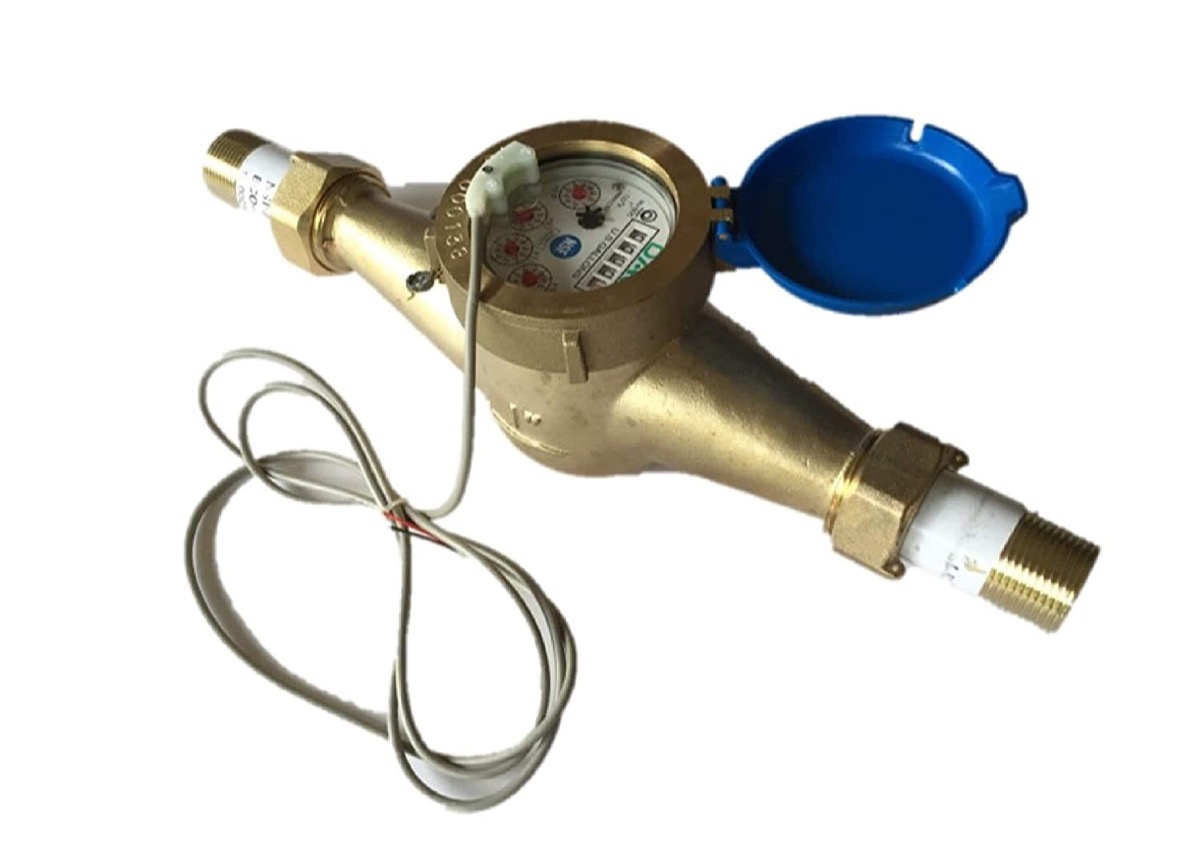
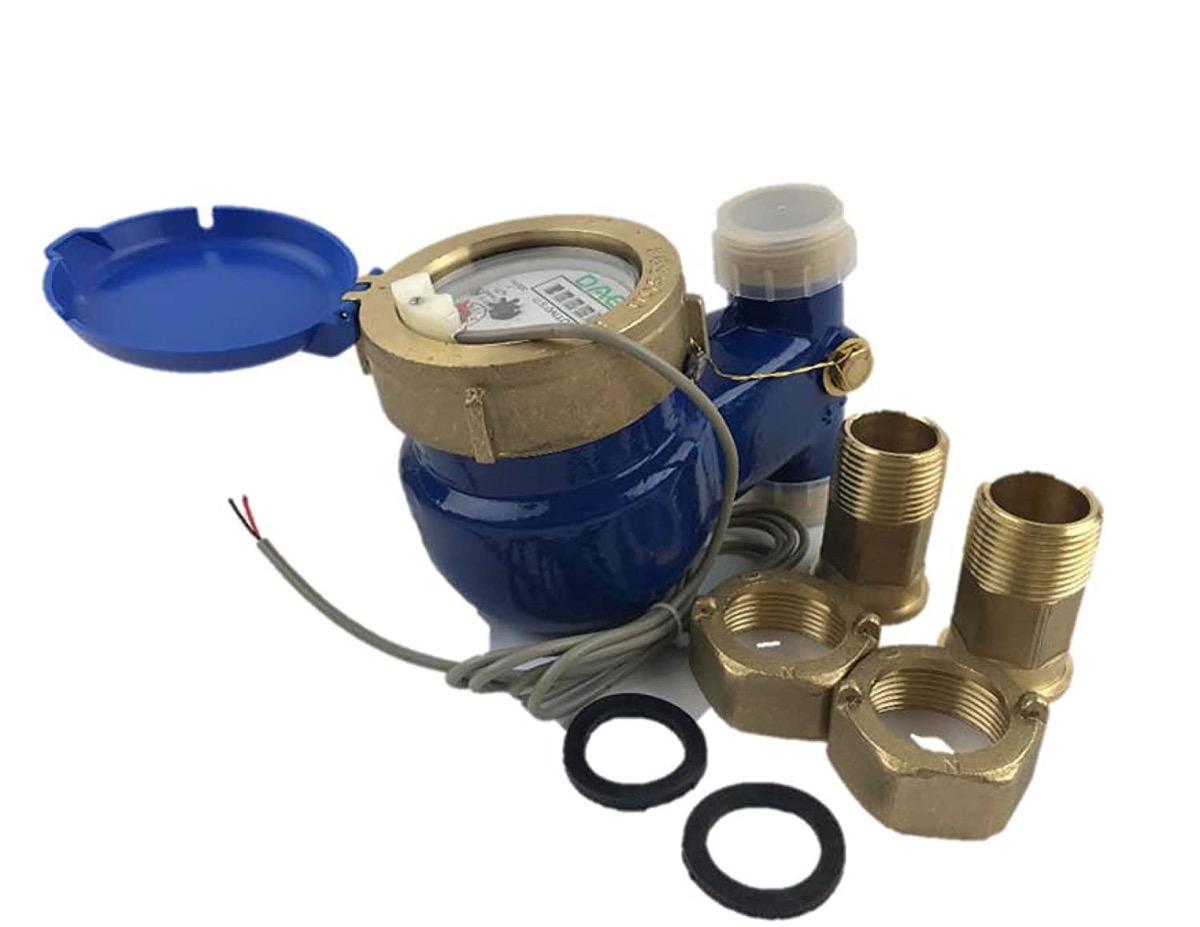
DAE's budget single-jet meter, brass body, in half-inch through 1-1/2 inch sizes, with a dry-contact reed-switch pulse output. This is the simple pulse-output meter you can buy on Amazon. It is explicitly not NSF 61 certified in several US states, so use the MJ-Series instead where lead-free potable certification matters.
Accuracy+/-1.5% within normal flow, per AWWA standard
Turndownnot stated
Water temperatureup to 40 °C
Max pressure232 psi
Potableno NSF 61
Registermechanical
Register unitsUSgal
Register units as statedUS gallon
Display resolutionnot stated
PowerNone required for the base meter (mechanical register); the reed-switch pulse output is a passive dry contact, no voltage supplied by the meter itself
Display showstotal
Installcut into the line
Extrashot-water variant available (AS250U-100RP)
Measurement Canadaunknown
Conforms to AWWA and ISO 4064 for clean water only. Bore is 0.77 in. on the 1 in. model. Sizes 1/2, 3/4, 1, 1-1/4 and 1-1/2 in. are listed for the family; we have per-size flow figures for the 1 in. model only.
Confirmed on Amazon.ca (e.g. AS130U-50P 1/2in): https://www.amazon.ca/DAE-AS130U-50P-Pulse-Output-Measuring/dp/B01DAXQI3G . DAE Controls LLC (Michigan, US) has no confirmed Canadian office or distributor; Amazon.ca is the verified purchase route.
Our pick This is the budget meter we point people to: a single-jet meter with a real reed-switch dry-contact pulse, live on Amazon.ca. One caveat. It is not NSF 61 certified, unlike DAE's own MJ-Series, so raise that before specifying it for potable service in a jurisdiction that requires NSF 61.
MJ-100 / MJ-seriesMJ-Series Multi-Jet Water Meter (NSF-61 lead-free)
Multi jet
1"
Pulse
NSF 61
50
$
consumption: pulse; rate: no route
DAE's potable-grade multi-jet meter, lead-free brass body, NSF-61 + NSF-372 + NTEP certified. DAE's own datasheet explicitly labels it 'Multi-Jet, Turbine Type.' Sizes 1/2in through 2in (MJS-200 stainless at 2in).
Accuracy+/-1.5% within normal flow, per AWWA standard
Turndownnot stated
Water temperatureup to 50 °C
Max pressure232 psi
PotableNSF 61, NSF 372, AWWA C708
Registermechanical
Register unitsUSgal, m³, ft³
Register units as statedUS gallon, cubic metre, cubic foot
Display resolution1st digit from the right = 100 gallon multiplier
PowerNone required for the base meter (mechanical register); the reed-switch pulse output is a passive dry contact, no voltage supplied by the meter itself
Display showstotal
Installcut into the line, horizontal inline mount, dial facing upwards; not for pit application (vertical/downward-flow needs DAE PD- or U-series instead)
ExtrasNTEP approved (Utah Water Research Lab; accepted by California under NTEP/CTEP), cloud-metering compatible (DAE CC2030 gateway + AMR130AN/AMR readers), hot-water variant available (MJ-100R), stainless variant available (MJS-200, 2in)
Measurement Canadaunknown
Conforms to AWWA C708, ISO 4064, ANSI/NSF 61, ANSI/NSF 372, for clean city water only.
0.1 gallon per pulse (1 in. MJ-100a). Dry-contact (no voltage) reed switch, 2-wire, 1.5 m lead. Switch rating is max 0.01 A at 24 V, the same electrical spec across the DAE range. Other SKUs exist: the MJ-100 with no pulse output, and the MJ-100m (cubic metre), MJ-100f (cubic feet) and MJ-100n (NTEP).
Quantify fit consumption: pulse; rate: no route
A genuine reed-switch consumption pulse. This is the DAE line to specify when NSF 61 lead-free potable certification is required, because the AS-series is not certified.
Confirmed on Amazon.ca (e.g. MJ-75m NSF61 3/4in): https://www.amazon.ca/DAE-MJ-75m-Potable-Couplings-Output/dp/B08CYDQ41L . DAE Controls LLC has no confirmed Canadian office; Amazon.ca is the verified purchase route.
DAE meter built for vertical installation, dial up, with water flowing upward. DAE's own copy does not state the jet mechanism, only that it is a velocity-type meter and distinct from its positive-displacement VM-series.
Accuracy+/-1.5% within normal flow, per AWWA standard
Turndownnot stated
Water temperatureup to 50 °C
Max pressure232 psi
PotableAWWA C708
Registermechanical
Register unitsUSgal
Register units as statedUS gallon
Display resolution1st digit from the right = 100 gallon multiplier
PowerNone required for the base meter (mechanical register); the reed-switch pulse output is a passive dry contact, no voltage supplied by the meter itself
Display showstotal
Installcut into the line, vertical only, dial facing upward, water flowing upward - DAE sells VM- or PD-series alternatives for downward flow
Extrashot-water variant available (V-75RP, V-100RP, V-200RP), 2in size available (V-200P)
Measurement Canadaunknown
Conforms to AWWA C708 and ISO 4064, clean city water only; not for pit application.
1 gallon/pulse (1in model). Dry-contact (no voltage) reed switch, 2-wire, 1.5 m lead. Switch rating: max 0.01 A @ 24 VAC/DC (typically ~0.005A with DAE's own AMR reader).
Quantify fit consumption: pulse; rate: no route
A genuine reed-switch consumption pulse. Use it only where the install is genuinely vertical with upward flow. It is the wrong orientation for a standard horizontal main.
Confirmed on Amazon.ca: V-75 (3/4in) https://www.amazon.ca/DAE-V-75-Vertical-Couplings-Measuring/dp/B07D915GPM and V-200P (2in) https://www.amazon.ca/DAE-V-200P-Vertical-Couplings-Gallons/dp/B08JPCDMXJ . DAE Controls LLC has no confirmed Canadian office; Amazon.ca is the verified purchase route.
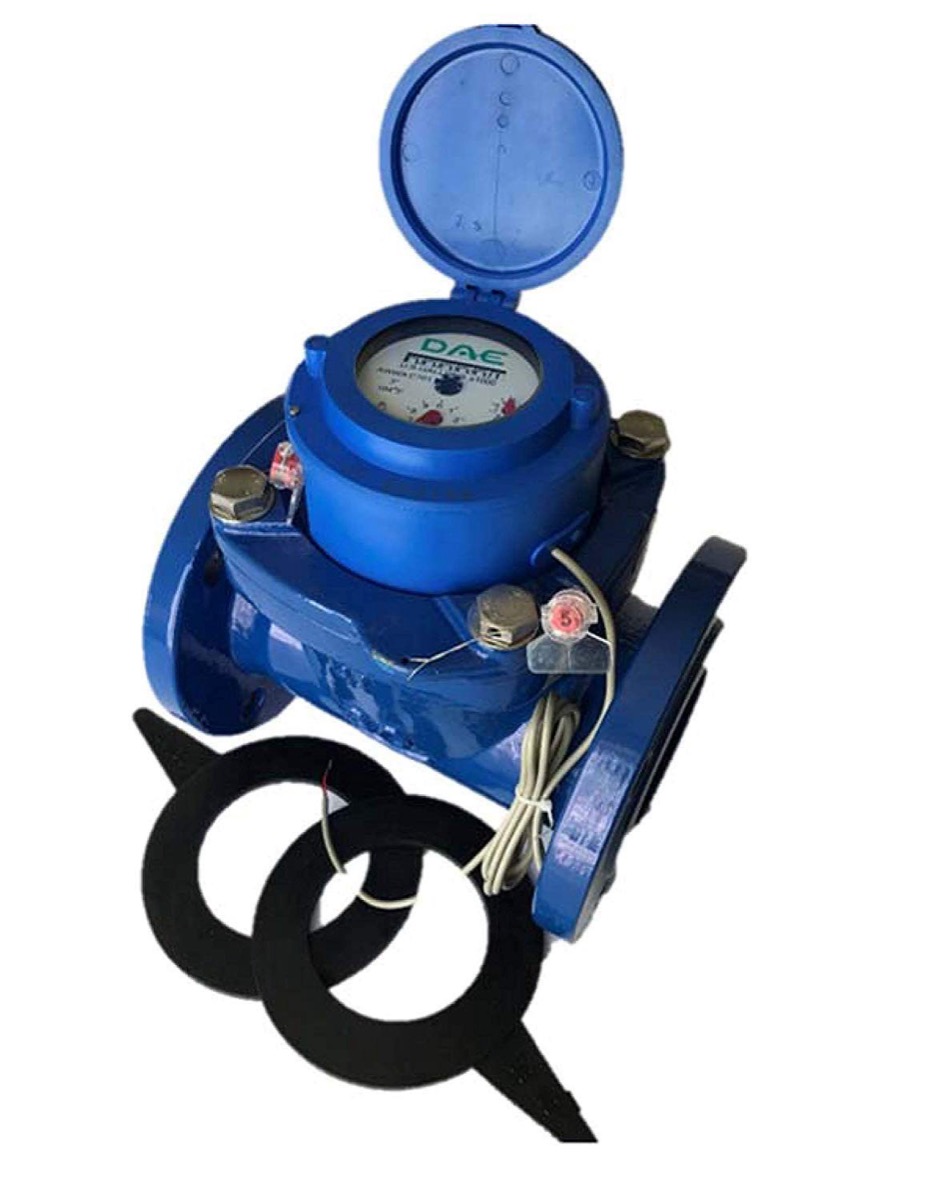
WP-200 / WP-seriesWP-Series Woltmann (Helix) Water Meter
Woltmann
2", 2-1/2"
Pulse
not stated
40
$$
consumption: pulse; rate: no route
DAE's large-bore Woltmann helix turbine meter, 2 in. and up, with a cast-iron flanged body. Base WP models are not NSF 61 certified, while the lead-free 'n'-suffix line (for example the WP-250n) is. Check the suffix rather than treating the WP family as uniformly certified or uncertified.
Accuracy+/-2% per AWWA C701 test procedure
Turndownnot stated
Water temperatureup to 40 °C
Max pressure232 psi
PotableAWWA C701
Registermechanical
Register unitsUSgal, m³
Register units as statedUS gallon, cubic metre
Display resolutionnot stated
PowerNone required for the base meter (mechanical register); the reed-switch pulse output is a passive dry contact, no voltage supplied by the meter itself
Display showstotal
Installcut into the line
ExtrasIP68-rated sealed dry dial, cloud-metering compatible (DAE CC2030/AMR), sizes up to 20in available (WP-2000P), hot-water variants available, lead-free NSF 61 'n'-suffix variants available (for example the WP-250n); base WP models are not NSF 61
Measurement Canadaunknown
ASME Class 125 flanges per B16.1. Conforms to AWWA C701 and ISO 4064, clean city water only. Cast iron body, epoxy-coated (lead-free coating on 'n'-suffix models). 2 year warranty.
1 pulse per 100 gallons (2in model). Dry-contact (no voltage) reed switch, 2-wire, 1.5 m lead. Switch rating: max 0.01 A @ 24 VAC/DC.
Quantify fit consumption: pulse; rate: no route
Genuine reed-switch consumption pulse, matching the rest of the DAE lineup. Confirm the 'n'-suffix NSF-61 variant is quoted whenever the job needs lead-free potable certification on a 2in+ meter.
Price band $$ (hundreds to about $1,500)
Where to buy not stated
We could not confirm WP-series (Woltmann) availability on Amazon.ca, unlike the AS, MJ and V lines. The fallback is ordering direct from daecontrol.com. Confirm cross-border shipping and duty for a cast-iron flanged meter before quoting a client.
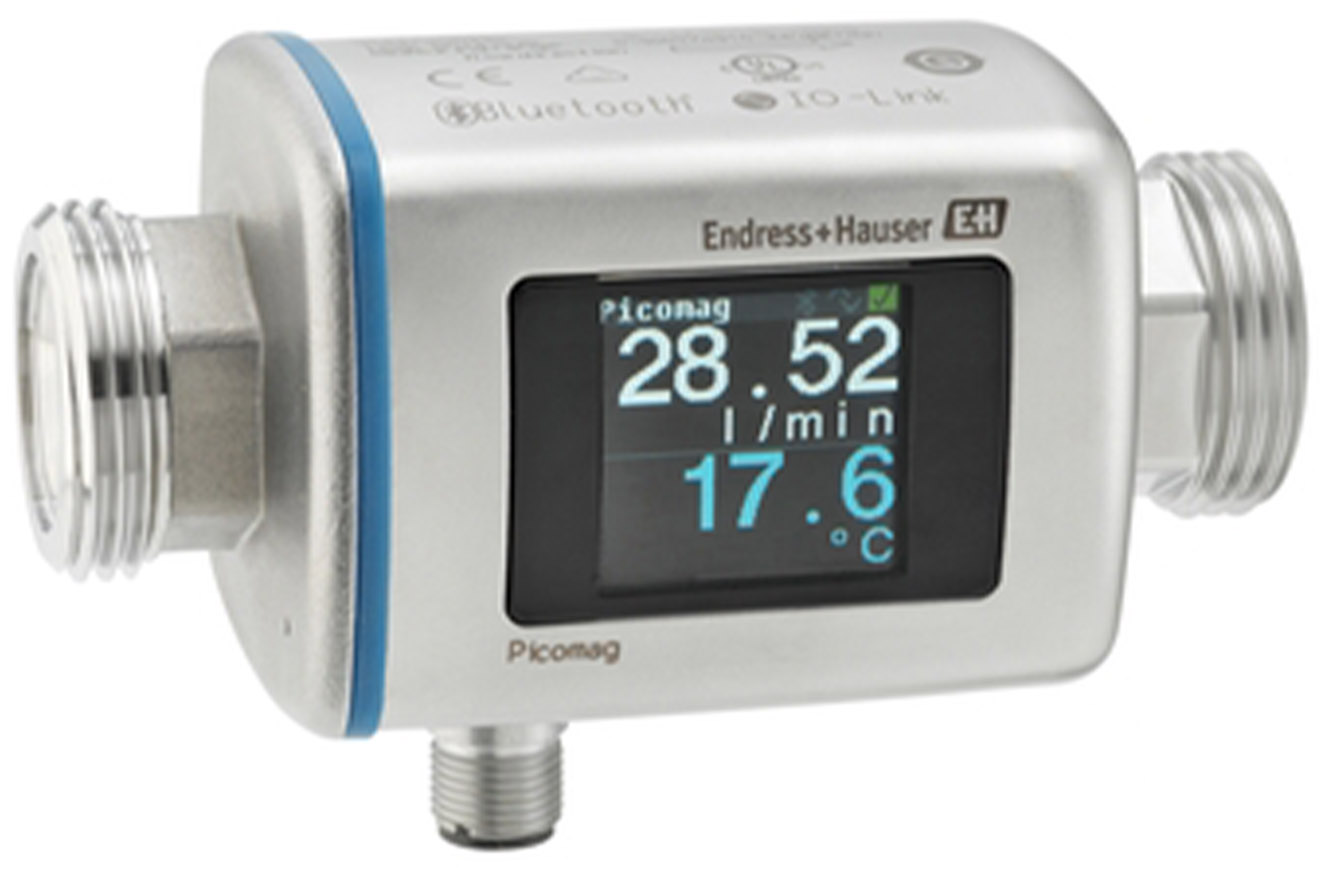
Compact, economical inline mag meter for 1/2" to 2" lines, aimed at OEM/skid/secondary-circuit use; configured and monitored via Bluetooth SmartBlue app in addition to wired I/O.
Accuracy±0.8% o.r. ±0.1% o.f.s.
Turndownnot stated
Water temperature-10 to 70 °C
Max pressure16 bar
Potablenot stated
Registerelectronic
Register unitsnot stated
Display resolutionnot stated
Power18-30 VDC
Display showsrate, total, programmable
Installcut into the line
ExtrasPEEK body, 316L (1.4404) electrodes, FKM/EPDM seals, process connections: G, R(BSP), NPT, TriClamp, press-fit, 1.4in TFT colour display, 'NSF' potable claim on page but exact standard (61 vs other) not confirmed from source text
Measurement Canadaunknown
Compact inline mag meter for secondary/utility circuits.
Weight-optimized version of Promag W 400 with a lap-joint flange (up to 12") for flange-pattern-independent installation; same measuring principle and drinking-water approvals, lighter pressure rating.
Endress+Hauser's simplified/entry-level electromagnetic flowmeter for basic water and wastewater tasks such as raw-water intake; same measuring principle as W 400 with a reduced hardware/software feature set.
Accuracy±0.5% o.r. ±1 mm/s
Turndownnot stated
Water temperature-20 to 90 °C
Max pressurenot stated
PotableNSF 61
Registerelectronic
Register unitsnot stated
Display resolutionnot stated
Power24 VDC, or 100-240 VAC/24 VDC
Display showsrate, total
Installcut into the line
ExtrasNSF/ANSI 61 listed as an application on the product page, positioned for elementary measurement tasks such as raw water intake
Measurement Canadaunknown
Size range independently cross-checked against a second (Instrumart) source because the manufacturer page appeared to reuse family-level copy.
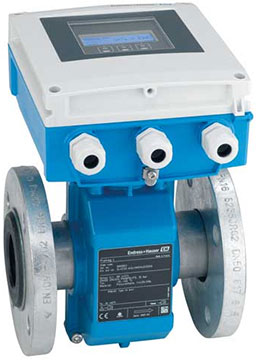
Endress+Hauser's standard electromagnetic (mag) flowmeter for water and wastewater, full-bore inline with no moving parts and effectively zero straight-run requirement, carrying real drinking-water approvals.
Installcut into the line, straight run 0 D upstream, ? D downstream
ExtrasACS, KTW-BWGL, WRAS BS 6920 drinking-water approvals (in addition to NSF 61), electrodes 1.4435 (316L), Alloy C22, or tantalum, 0 x DN inlet run per product page
Measurement Canadaunknown
Full-bore inline mag meter; product page states 0 x DN inlet run and no pressure loss.
Battery-powered portable clamp-on ultrasonic flowmeter for temporary monitoring, test measurements and verifying an already-installed meter. It is not a permanently wired process instrument.
Accuracymax. measurement error ±2.0%
Turndownnot stated
Water temperature-40 to 170 °C
Max pressurenot stated
Potablenot stated
Registerelectronic
Register unitsnot stated
Display resolutionnot stated
Powerbattery, mains-independent (duration not stated on the page checked)
Display showsrate, programmable
Installclamps on, no cut
Extrasintegrated data logger / 'site manager' with USB data transfer, four-line backlit touch control, automatic frequency scan for install optimization
Measurement Canadaunknown
Portable diagnostic instrument; medium temperature range depends on which clamp-on sensor pair is fitted (DN15-65: -40..+150C; DN50-300: -40..+170C; DN100-4000: -40..+80C).
Portable verification tool, not a permanent telemetry source; useful for spot-checking an existing installed meter's reading, not for ongoing Quantify monitoring.
Prosonic Flow W 400Proline Prosonic Flow W 400 / 9W4B
Ultrasonic, clamp-on
1/2-160"
4-20 mA, Pulse, Modbus
not stated
130
$$$$
consumption: pulse; rate: 4-20 mA
Endress+Hauser's permanently-installed clamp-on ultrasonic flowmeter for conductive and non-conductive liquids, covering a very wide size range with no process-pressure limitation since the sensors mount externally.
PowerAC 100-240 V or AC/DC 24 V (not loop-powered)
Display showsrate, total, programmable
Installclamps on, no cut, straight run 2 D upstream, ? D downstream
ExtrasFlowDC: specified accuracy maintained at as little as 2 x DN inlet run, no wetted parts / no process pressure rating (external clamp-on transducers)
Measurement Canadaunknown
Clamp-on ultrasonic, permanently installed transmitter with external sensor pair(s).
The permanent-install E+H answer to Keyence FD-Q/FD-R for large-bore clamp-on work, with HART/Modbus and a stated accuracy figure rather than a repeatability figure.
Simple, economical insertion paddlewheel velocity sensor with a single fixed output: an open-collector (solid-state) frequency signal proportional to pipe velocity. It has no local totalizer or display, so it needs a GF transmitter (9900, 9950 or 8150) or any counter that can read an open-collector frequency to turn the signal into a rate, a total, 4-20 mA or Modbus.
AccuracyLinearity +/-1% of max. range @ 25 C; Repeatability +/-0.5% of max. range @ 25 C
Turndown66:1
Water temperature-18 to 85 °C
Max pressure180 psi
PotableNSF 61
Registernot stated
Register unitsnot stated
Display resolutionnot stated
PowerSensor/loop powered by host transmitter (e.g. GF 9900), 5-24 VDC, <20 mA
Display showsnot stated
Installcut into the line
Extrasnot stated
Measurement Canadaunknown
Installs via GF's tee/saddle/weldolet/wet-tap fitting line into DN15-DN900 (PP/PVDF) or DN15-DN100 (PVC) pipe. PP body rated 12.5 bar @ 20 C, derating to 1.7 bar @ 85 C; PVDF 14 bar @ 20 C, derating to 6.9 bar @ 60 C. Wet-tap variant is lower-rated (7 bar @ 20 C, -18 to 60 C operating). Cable 7.6 m standard, extendable to 305 m.
Frequency proportional to velocity: 49 Hz per m/s (15 Hz per ft/s) nominal. Open collector, sinking 10 mA max, 5-24 VDC supply (<1.5 mA @ 3.3-6 VDC or <20 mA @ 6-24 VDC). This is not a scaled per-volume pulse and not a sine-wave coil signal. It is a solid-state transistor frequency output that a transmitter or counter has to convert into a rate or a total.
Quantify fit consumption: no route; rate: derived from pulses
Raw open-collector frequency only. It needs a 9900, 9950 or 8150 transmitter, or an equivalent frequency-counting PLC input, to produce either a totalized consumption pulse or a usable 4-20 mA or Modbus rate signal. The sensor on its own does neither.
Price band $$ (hundreds to about $1,500)
Where to buy not stated
We found no dedicated Canadian distributor for GF Signet instrumentation. Source it through GF Piping Systems Canada (gfps.com/en-ca) or US distributors such as Instrumart or Burt Process that ship to Canada.
Our pick One of the two GF Signet sensors we reach for. One correction worth knowing: it is not switch-selectable between reed and solid state. It has exactly one output, an open-collector solid-state frequency signal. The reed versus solid-state choice lives on the 2537, not here.
Next-generation paddlewheel flowmeter with an onboard configurable interface. It ships in one of four fixed output families per order code: mechanical Dry Contact Relay, Solid State Relay, Digital (S3L), or 4-20 mA. This is the model that carries a real mechanical versus solid-state choice, although GF's own term for the mechanical option is 'Dry Contact Relay' rather than 'reed switch'.
AccuracyLinearity +/-1% of max. range @ 25 C; Repeatability +/-0.5% of max. range @ 25 C; 100 ms nominal update rate
Turndownnot stated
Water temperature-18 to 85 °C
Max pressure181 psi
PotableNSF 61
Registerelectronic
Register unitsnot stated
Display resolutionnot stated
PowerDepends on ordered output: DCR 24 VDC nom +/-10%; SSR 6-24 VDC; S3L 5.0-6.5 VDC; 4-20mA loop 12-32 VDC. 21-30 mA max across variants.
Uses the same fittings as the 515 and 2536. PP body rated 181 psi @ 68F derating to 25 psi @ 185F; PVDF 203 psi @ 68F derating to 25 psi @ 185F. NEMA 4X/IP65 enclosure.
Mechanical SPDT relay (GF's own term is 'Dry Contact Relay', not 'reed switch'), 24 VDC nominal +/-10% regulated, 30 mA max; relay rated 5A @ 30VDC / 5A @ 250VAC. Field-selectable modes: Divider, which scales frequency; Total, which gives one pulse per set volume and is the mode that matters for consumption; and Flow Switch, a high/low alarm. Max pulse rate 300 Hz, min 0.5 Hz, max pulse width 50 ms.
Pulse
Pulse/Flow Switch - Solid State Relay (SSR)
not stated
Solid state
300
Solid-state relay, 6-24 VDC +/-10% regulated, 30 mA max; relay rated 100 mA @ 40VDC / 70 mA @ 33VAC. Same Divider/Total/Flow Switch mode options as the DCR version.
Other
Digital (S3L)
not stated
not stated
not stated
Serial ASCII, TTL level, 9600 bps, 5.0-6.5 VDC, 30 mA max (1.5 mA nominal). It works only with GF 9900, 9950-1/2 and 9950-10/11 transmitters. It is not a general-purpose digital output.
4-20 mA
not stated
not stated
not stated
not stated
12-32 VDC nominal +/-10%, 21 mA max. Loop accuracy +/-32 uA @ 25C/24VDC. Max cable 305 m. Max loop resistance 600 ohm @ 24VDC / 1 kohm @ 32VDC.
Quantify fit consumption: pulse; rate: 4-20 mA
The output depends on the order code. The DCR or SSR variant in Total mode gives a genuine scaled volumetric pulse for consumption. A separate 4-20 mA order code gives rate. The Digital S3L order code needs a 9900 or 9950 to be useful at all. One unit ships with only one of these, so confirm the exact part number before assuming a given output exists.
Price band $$ (hundreds to about $1,500)
Where to buy not stated
We found no dedicated Canadian distributor for GF Signet instrumentation. Source it through GF Piping Systems Canada (gfps.com/en-ca) or US distributors such as Instrumart or Serv-A-Pure that ship to Canada.
Our pick This is the GF Signet model with a genuine mechanical versus solid-state choice. GF calls the mechanical option a 'Dry Contact Relay' rather than a 'reed switch', but it is a different, electromechanical technology from the Solid State Relay option, and both are field-configurable between pulse, divider and switch duty. Confirmed on GF's own 2537 datasheet.
No-moving-parts insertion electromagnetic flow sensor for large pipe ranges, available blind or with a local LCD rate/total display and relays. Output is frequency/Digital (S3L) or 4-20 mA depending on order code.
AccuracyLinearity +/-1% of reading plus 0.1% of full scale; Repeatability +/-0.5% of reading @ 25 C; minimum conductivity 20 uS/cm
Turndownnot stated
Water temperature0 to 85 °C
Max pressure150 psi
PotableNSF 61
Registerelectronic
Register unitsnot stated
Display resolution2 x 16 characters (display version only)
Power4-20mA version 24 VDC +/-10%, 22.1 mA max; frequency/S3L version 5-24 VDC, 15 mA max; display-relay auxiliary 9-24 VDC, 0.4 A max
Display showsrate, total, programmable
Installcut into the line
Extrasempty-pipe detection (zero-flow output when not fully wetted), bi-directional flow (frequency output always bi-directional; 4-20mA configurable)
Measurement Canadaunknown
Automatic alignment/insertion depth via GF fitting line. Media operating temperature 0-85 C; max operating pressure 150 psi @ 77F derating to 20 psi @ 185F. Wetted material combos: PP/316L SS, PVDF/Titanium, PVDF/Hastelloy-C.
Frequency: 5-24 VDC +/-10%, 15 mA max, max pull-up 30 VDC, max current sink 50 mA, open-collector, bi-directional. Digital S3L: 5-6.5 VDC, 15 mA max, serial ASCII TTL 9600 bps. Compatible with GF 9900, 9900-1BC, 9950. Display version's relay output can mirror the frequency (Mirror Relay mode) but this is not confirmed as a preset per-volume pulse.
4-20 mA
not stated
not stated
not stated
not stated
24 VDC +/-10% regulated, 22.1 mA max, loop accuracy +/-32 uA @ 25C/24VDC, max cable 300 m, max loop resistance 300 ohm. Can be set uni- or bi-directional via display or 3-0252 configuration tool. 2551-XX-12 ships factory-scaled 0-5 m/s.
Quantify fit consumption: no route; rate: 4-20 mA
4-20mA order code gives a direct rate signal; frequency/S3L order code needs a 9900/9950 transmitter to derive rate or a totalized volume. No dedicated preset-volume pulse output confirmed on this datasheet (unlike the 2537's Total mode).
Price band $$$ (about $1,500 to $5,000)
Where to buy not stated
We found no dedicated Canadian distributor for GF Signet instrumentation. Source it through GF Piping Systems Canada (gfps.com/en-ca) or US distributors such as Instrumart that ship to Canada.
All-stainless insertion magmeter for hot-tap/ball-valve installation on large pipe, in two sensor lengths. Blind (4-20 mA) or frequency/Digital (S3L) output. Unlike its 2536/2537/2551 siblings, no NSF-listed part number is offered.
AccuracyLinearity +/-1% of reading plus 0.1% of full scale; Repeatability +/-0.5% @ 25 C; overall accuracy +/-2% of measured value (per ISO 7145 flow profile conditions); minimum conductivity 20 uS/cm. Max velocity derates to 3 m/s on pipes over DN1200 (48 in.)
Turndownnot stated
Water temperaturenot stated
Max pressurenot stated
Potableno NSF 61
Registernot stated
Register unitsnot stated
Display resolutionnot stated
Power24 VDC +/-10%, 22.1 mA max (4-20mA version, traditional 2-wire passive loop) or 5-24 VDC, 15 mA max (frequency/S3L version, powered by host instrument)
Display showsnot stated
Installcut into the line
Extrasempty-pipe detection, LED-assisted troubleshooting, bi-directional span (4-20mA types), two sensor lengths for hot-tap/ball-valve installs
Measurement Canadaunknown
Installs into standard 1 1/4 in. or 1 1/2 in. pipe outlets, ISO or NPT threads. 316L stainless steel body and electrodes, PVDF nosepiece, FPM O-rings. The datasheet sections we sourced do not give the exact fluid temperature and pressure rating, so confirm those with GF before quoting a client.
Open-collector frequency signal, compatible with any powered GF flow instrument (9900, 9900-1BC, 9950); max pull-up 30 VDC, max current sink 50 mA, 5-24 VDC supply, 15 mA max. Digital S3L: 5-6.5 VDC, 15 mA max.
4-20 mA
not stated
not stated
not stated
not stated
24 VDC +/-10% regulated, 22.1 mA max, loop accuracy +/-32 uA @ 25C/24VDC, max cable 300 m, max loop resistance 300 ohm. Ships factory-scaled 0-5 m/s. Programmable and reversible (bi-directional span).
Quantify fit consumption: no route; rate: 4-20 mA
Same pattern as the 2551: 4-20mA order code gives rate directly; frequency/S3L order code needs a 9900/9950 to be useful. No confirmed preset-volume pulse output.
Price band $$$ (about $1,500 to $5,000)
Where to buy not stated
We found no dedicated Canadian distributor for GF Signet instrumentation. Source it through GF Piping Systems Canada (gfps.com/en-ca) or US distributors that ship to Canada.
Single-channel panel- or field-mount transmitter that turns a GF Signet sensor's frequency/S3L signal (from a 2536, 2537, 2551, 2552 and others) into a usable 4-20 mA, relay, or Modbus signal. This is the 'needs a transmitter' half of the 2536/2551/2552 story.
AccuracyFrequency input accuracy 0.5% of reading
Turndownnot stated
Water temperaturenot stated
Max pressurenot stated
Potablenot stated
Registerelectronic
Register unitsnot stated
Display resolution3.90 in x 3.90 in auto-sensing backlit display
Power12-32 VDC (24 VDC nominal), 200 mA (300 mA with Relay Module); can be loop-powered with compatible sensors
Display showsrate, total, programmable
Installclamps on, no cut
Extrasfield-installable/replaceable plug-in modules: Modbus, Relay, H COMM, Batch, Direct Conductivity/Resistivity, second 4-20mA output, PC COMM configuration tool, no HART module available (unlike Seametrics' AG3000), compatible sensor list includes 515, 2536, 2537, 2540, 8510/8512, 2000, 2100, 2507, 2581, 2551, 2552, U1000, U3000
Measurement Canadaunknown
Panel or field mount; rear enclosure kits (hinged or flat cover) available for wall/pipe/panel mounting.
Output signals
Type
Protocol
Pulse weights
Switch
Max Hz
Detail
4-20 mA
not stated
not stated
not stated
not stated
One 4-20mA output in base unit (ANSI-ISA 50.00.01 Class H, isolated, fully adjustable and reversible); a second is available with the optional 4-20mA Output Module.
Modbus
Modbus RTU (RS-485)
not stated
not stated
not stated
Optional plug-in Modbus module for RS-485 Serial Modbus communications.
Pulse
Relay Module output
not stated
not stated
not stated
An optional plug-in Relay Module adds two dry-contact relays. That is the practical way to get a scaled consumption pulse out of a raw-frequency sensor such as the 2536 through the 9900.
Quantify fit consumption: pulse; rate: 4-20 mA
Base unit gives rate (4-20mA); add the Relay Module for a scaled consumption pulse, or the Modbus module for Modbus RTU. This is the accessory that makes a raw-frequency Signet sensor (2536) usable for Quantify's preferred signal types.
Price band $$ (hundreds to about $1,500)
Where to buy not stated
We found no dedicated Canadian distributor for GF Signet instrumentation.
consumption: encoder through a Signalizer; rate: no route
Kamstrup's static ultrasonic residential / multi-unit-building cold-water meter (and reclaimed-water variant), sizes 5/8 inch through 1 inch. No moving parts, hermetically sealed IP68 body, built-in acoustic leak detection, and a choice of integrated communication: Wireless M-Bus RF, NB-IoT cellular, or a Sensus-protocol Encoded Output register.
AccuracyAWWA C715-2018 compliant. Kamstrup's published accuracy curve stays within about ±5% from start flow (0.01-0.04 GPM depending on size) through minimum flow, tightening to roughly ±1.5% from transition flow to max flow, at water temperatures below 86°F/30°C.
Turndownnot stated
Water temperature0.5 to 50 °C
Max pressure250 psi
PotableNSF 61, AWWA C715-18
Registerdigital LCD, 9-digit volume + temperature + info codes
Register unitsUSgal, ft³
Display resolution0.01 GPM rate / 0.00 gal total (config 220, residential) or whole ft³ billing in 1,000s (config 154, district meters)
Power1×D-cell 3.6V/19Ah (RF & Cellular variants) or 2×A-cell 3.6V/3.6Ah (Encoded Output variant); battery warranty void above 95°F/35°C meter temperature. Kamstrup rates the meter for up to 20 years of operating life.
Display showsrate, total, programmable
Installcut into the line, horizontal or vertical
Extrasacoustic leak detection (service line & distribution main), water & ambient temperature logging, 460-day daily log, 100-day hourly log, 36-month monthly log (EEPROM)
Measurement Canadaunknown
Static ultrasonic design. Kamstrup states that installation is largely independent of piping and installation conditions. The datasheet gives no explicit straight-run figure.
Available on the 'Encoded Output' (EO) hardware variant only, powered by 2×A-cell battery. Kamstrup's own datasheet states this module also supports Neptune ProRead and Neptune E-Coder reading systems. RF and Cellular hardware variants do not expose this register.
M-Bus
Wireless M-Bus (EN 13757-4), 912.5/915/918.5 MHz (AMR) or 450-470 MHz (AMI), 128-bit AES encryption
not stated
not stated
not stated
RF hardware variant, 1×D-cell battery.
Other
NB-IoT cellular
not stated
not stated
not stated
Cellular hardware variant, 1×D-cell battery.
Quantify fit consumption: encoder through a Signalizer; rate: no route
Order the Encoded Output (EO) hardware variant. Its Sensus UI-1203/UI-1204 register is exactly the protocol the ScadaMetrics Signalizer already supports. The RF and Cellular variants do not expose a local register a Signalizer can read.
Kamstrup's own product photo shows an NSF/ANSI/CAN 61 mark on the meter face, a harmonized US and Canada drinking-water certification. That is a health-effects standard. It is not a Measurement Canada type approval, and it is not a confirmed Canadian stock listing.
Kamstrup's mid-range static ultrasonic utility meter, spanning nominal flows (Q3) from 1.6 to 40 m³/h across connections from G3/4B (R1/2) up to DN80, built to OIML R49 and MID type-approval for the European market. It runs on a single C-cell lithium battery rated up to 16 years, with Wireless M-Bus and Wired M-Bus confirmed. Kamstrup's product-centre page also lists Sigfox and linkIQ options.
AccuracyOIML R49 and MID (2014/32/EU) type-approved; maximum permissible error bands follow OIML R49. The technical description does not state the exact accuracy class.
Turndownnot stated
Water temperaturenot stated
Max pressurenot stated
Potablenot stated
Registerdigital display
Register unitsnot stated
Display resolutionnot stated
Power3.65V lithium, 1×C-cell; battery life up to 16 years at meter temperature below 30°C, down to about 8 years below 55°C.
Display showsrate, total
Installcut into the line
Extraswater temperature measurement (per Kamstrup product-centre summary)
Measurement Canadaunknown
Output signals
Type
Protocol
Pulse weights
Switch
Max Hz
Detail
M-Bus
Wireless M-Bus, 868 MHz (modes C1, T1-OMS)
not stated
not stated
not stated
not stated
M-Bus
Wired M-Bus (EN 13757, 300/2400/9600 baud)
not stated
not stated
not stated
not stated
Other
Sigfox / Kamstrup linkIQ
not stated
not stated
not stated
Listed on Kamstrup's flowIQ 3100 product-centre page, but not itemized in the technical-description manual.
Quantify fit consumption: not established; rate: no route
The technical description shows no pulse, encoder or Modbus output on this SKU. It reads as a wired and wireless M-Bus telemetry meter for European utility deployments. Check a full flowIQ 3100 datasheet, not just the technical-description manual, before assuming any locally readable signal exists.
Price band $$ (hundreds to about $1,500)
Where to buy not stated
Documented for OIML R49 and MID (EU) type-approval only. We could not confirm Canadian or US availability, so treat it as a European-market SKU until a Canadian distributor confirms stock.
flowIQ 3200flowIQ 3200 (KWM3231 platform, shared with flowIQ 2200; MID/OIML R49 type DK-0200-MI001-047)
Ultrasonic, inline
1", 1-1/4", 1-1/2", 2"
M-Bus, Other
not stated
50
$$
consumption: no route; rate: no route
Kamstrup's higher-flow static ultrasonic utility meter on the shared flowIQ 2200/3200 'KWM3231' platform, sizes 1 inch to 2 inch (DN20-DN40) in composite or stainless-steel bodies. MID/OIML R49 type-approved (accuracy class 2), integrated acoustic leak detection on every size, Wireless M-Bus and Kamstrup linkIQ radio, up to 16 years battery life.
AccuracyMID and OIML R49 metrological accuracy class 2; type-approval DK-0200-MI001-047. Measurement runs from 'min. cutoff' to 'max. cutoff', but accuracy is only guaranteed from Q1 to Q4 (see the sizes table). Kamstrup's product-centre copy states a dynamic range up to R1000 across the platform; the datasheet does not itemize the exact ratio per size.
Turndownnot stated
Water temperature0.1 to 50 °C
Max pressure16 bar
Potablenot stated
Registerdigital LCD display, rate + total
Register unitsm³
Display resolutionnot stated
Power3.65V lithium battery, 2×A-cell; up to 16 years battery life depending on the selected data package and installation temperature.
Display showsrate, total
Installcut into the line
Extrasintegrated acoustic leak detection (ALD) on all sizes, IK08 impact rating, IP68
Proprietary Kamstrup high-data-rate radio protocol. LoRaWAN is listed for some flowIQ 3200 configurations in Kamstrup's general marketing copy but was not confirmed for this specific KWM3231 SKU.
Quantify fit consumption: no route; rate: no route
No pulse, encoder or Modbus output on this SKU. Telemetry runs over Wireless M-Bus and linkIQ radio only, which needs a separate M-Bus receiver or gateway outside our usual signal chain of pulse, 4-20 mA, encoder via Signalizer, and Modbus.
Price band $$ (hundreds to about $1,500)
Where to buy not stated
Not confirmed as stocked through a Canadian distributor. It appears to be a European and MID-market SKU.
Clamp-on flow sensor that extends Keyence's coverage to hoses (including braided/pressure-rated rubber hose) in addition to metal and hard-plastic pipe, with high-temperature 'K' variants and stated pipe-temperature measurement.
Accuracy±3.0% of reading (10-100% of F.S.); ±0.3% of F.S. (0-10% of F.S.)
Turndownnot stated
Water temperature0 to 85 °C
Max pressurenot stated
Potablenot stated
Registerelectronic
Register unitsL
Display resolutioninstantaneous 0.01/0.1/1 L/min; totalized 0.01/0.1/1 L
Power20-30 VDC, ripple (P-P) 10% incl., Class 2/LPS
Display showsrate, total, programmable
Installclamps on, no cut
Extrasalso clamps to hose (braided, pressure-rated rubber), high-temperature 'K' variants to 180C, pipe-temperature measurement, accuracy +/-2.0C, built-in diagnostic function
Keyence's tool-free clamp-on flow sensor for metal or resin pipe from 1/4" to 2", and our first pick when a clamp-on sensor is the right answer. Fast to install and IO-Link ready. The published spec is a repeatability figure rather than a stated accuracy, and it does not measure temperature.
AccuracyNot stated as accuracy; published as repeatability: ±2.0% (0.5s response) to ±0.15% (60s response) of F.S., selectable response time
Turndownnot stated
Water temperature0 to 85 °C
Max pressurenot stated
Potablenot stated
Registerelectronic
Register unitsL
Display resolutioninstantaneous 0.01/0.1/1 L/min; totalized 0.1/1/10/100/1000 L
Power20-30 VDC, Class 2/LPS, 100-130 mA (excl. load)
Display showsrate, total, programmable
Installclamps on, no cut
Extrastool-free clamp-on install (~60s, no shutdown), EEPROM data retention 10+ years
Measurement Canadaunknown
Clamp-on ultrasonic; liquid must pass an ultrasonic pulse and not contain large air pockets or excessive bubbles.
ch.1/ch.2 selectable: control (threshold) output / pulse output / error output, NPN/PNP open-collector, 30 VDC / 100 mA max; pulse weight/scaling not published on the public spec page
4-20 mA
not stated
not stated
not stated
not stated
ch.2 selectable analog output, 4-20 mA / 0-20 mA, 500 ohm max load
Other
IO-Link v1.1 (COM2, 38.4 kbps)
not stated
not stated
not stated
configuration file downloaded from Keyence website
Quantify fit consumption: pulse; rate: 4-20 mA
Pulse output is a real selectable mode, but Keyence's public pages do not state a configurable pulse weight (e.g. 1 pulse = X L) the way a utility register does. Confirm exact scaling with Keyence before committing to a pulse-count integration.
Price band $$$ (about $1,500 to $5,000)
Where to buy keyence-canada-direct
Keyence sells direct in Canada with no distributor network. Orders placed by 2pm ET typically ship the same day.
Our pick Our first-choice clamp-on sensor: fast tool-free install, works on metal or resin pipe, with IO-Link and 4-20 mA available. Two caveats. Keyence sells the FD-Q for trending and deviation detection rather than billing-grade accuracy, and it tops out at 2". For larger mains, the Keyence option is the FD-R.
Keyence's larger-bore clamp-on flow meter, 1.5" to 8", for metal or resin pipe. Unlike the FD-Q, it also measures pipe temperature with a stated accuracy.
Accuracy±2.0% of reading (20-100% of F.S.); ±0.4% of F.S. (6-20% of F.S.)
Turndownnot stated
Water temperature-20 to 120 °C
Max pressurenot stated
Potablenot stated
Registerelectronic
Register unitsnot stated
Display resolutionnot stated
Power20-30 VDC or 100-240 VAC (both offered; confirm which ships with a given unit)
Display showsrate, programmable
Installclamps on, no cut
Extrastemperature measurement with stated accuracy (±3C to ±5C by range), temperature alarm output, IP69K / NEMA 4X
Measurement Canadaunknown
Clamp-on ultrasonic; tool-free install per Keyence marketing.
integrated pulse output; NPN/PNP open-collector, 30 VDC / 100 mA max; pulse weight not published on the public spec page
4-20 mA
not stated
not stated
not stated
not stated
4-20 mA / 0-20 mA analog, selectable for flow or temperature
Other
IO-Link v1.1
not stated
not stated
not stated
not stated
Quantify fit consumption: pulse; rate: 4-20 mA
This is the Keyence line to recommend above 2" pipe, where FD-Q stops. Also usable as a temperature source since it measures pipe temperature directly.
Price band $$$ (about $1,500 to $5,000)
Where to buy keyence-canada-direct
Keyence sells direct in Canada, with no distributor network.
Keyence's smallest clamp-on sensor, built for small-bore dispensing and shot-volume applications (adhesive, grease, chemical dosing) rather than bulk water metering; included for completeness since it is a current Keyence flow product.
Accuracy±0.1-1% of full scale depending on model/diameter
Turndownnot stated
Water temperature0 to 100 °C
Max pressurenot stated
Potablenot stated
Registerelectronic
Register unitsL
Register units as statedmL, L
Display resolution0.1/1/10 mL/min (XS1/XS8) or 0.001/0.01/0.1 L/min (XS20); shot volume to 0.001 mL
Power20-30 VDC incl. 10% ripple
Display showsrate, total, programmable
Installclamps on, no cut
Extrasshot-volume (dispensing) mode down to 0.001 mL, no temperature measurement
Measurement Canadaunknown
Designed for both dispensing (shot mode) and continuous small-bore flow monitoring.
open-collector NPN/PNP, 50 mA max; pulse weight not published on the public spec page
4-20 mA
not stated
not stated
not stated
not stated
4-20 mA / 0-20 mA selectable
Other
IO-Link v1.1 (COM2, 38.4 kbps)
not stated
not stated
not stated
not stated
Quantify fit consumption: not established; rate: 4-20 mA
Niche fit for Quantify: this is a chemical-dosing/shot-volume sensor, not a bulk utility water meter. Useful only if a client needs small-bore dosing-line monitoring.
Price band $$ (hundreds to about $1,500)
Where to buy keyence-canada-direct
Keyence sells direct in Canada, with no distributor network.
Mueller 420 Bronze420 Series Bronze positive-displacement meter
Positive displacement
5/8"
Encoder register, Other
NSF 61
37.8
$
consumption: not established; rate: no route
Mueller Systems' baseline nutating-disc positive-displacement residential meter, sold only in 5/8 inch with 1/2 inch or 3/4 inch outlet taps. Bronze maincase, epoxy-coated cast-iron (or optional bronze or polymer) bottom cover, and a permanently sealed magnetic-drive register available in standard visual-read, SSR (solid-state register) or ME-8 configurations. Mueller's site lists the 430 Series and the 420 Composite as discontinued, leaving the 420 Bronze as the current baseline model.
AccuracyAWWA C700 accuracy: 100% ±1.5% across the typical operating range of 0.5-20 USGPM; 95% minimum registration down to a typical low flow of 0.125 USGPM; maximum continuous operation rated at 15 USGPM.
Turndownnot stated
Water temperature0.5 to 37.8 °C
Max pressure150 psi
PotableNSF 61, AWWA C700
Registerpermanently sealed, magnetic-drive, straight-reading odometer (standard); SSR or ME-8 register options listed in the parts table
Register unitsUSgal, ft³, m³
Display resolution10 US gallon or 1 cubic foot per full sweep-hand revolution (5/8")
PowerNone for the standard mechanical register (passive magnetic drive); powered only if an electronic SSR/ME-8/AMR register is fitted.
Display showstotal
Installcut into the line, horizontal or vertical
Extrastamper-proof register locking pin, 360° sweep-hand test circle with low-flow (leak) indicator, field-replaceable register without removing the meter from the line
Measurement Canadaunknown
External straight pipe threads (NPSM) per ANSI B1.20.1. The nutating-disc measuring chamber is not stated to require straight-run piping.
SSR (Solid State Register) or ME-8 encoder register options
not stated
not stated
not stated
Register options appear only in the dimensional and parts table. This datasheet does not give the exact output protocol, meaning pulse weight or encoder format, so check the dedicated SSR and ME-8 register literature before quoting compatibility.
Other
AMR/AMI reading systems (listed as an option; specific protocol not named in this datasheet)
not stated
not stated
not stated
not stated
Quantify fit consumption: not established; rate: no route
The standard register is a plain mechanical odometer with no exposed signal. Fitted with the optional SSR or ME-8 register it most likely becomes encoder-readable, but this datasheet does not give the pulse weight or protocol for those registers. Confirm the specific register's output spec before assuming Signalizer compatibility.
Price band $ (under a few hundred dollars)
Where to buy not stated
Mueller Systems' own site (muellersystems.com) lists no Canadian office or contact for its metering division; see the manufacturer note. Canadian availability would run through a plumbing or waterworks distributor, and we could not confirm one by name.
Mueller MVRMVR magnetic-drive vertical turbine meter (MVR30/50/100/160/350/650/1300)
Turbine
3/4", 1", 1-1/2", 2", 3", 4", 6"
Other
NSF 61
54.4
$$$
consumption: not established; rate: no route
Mueller Systems' magnetic-drive vertical turbine meter, sized 3/4 inch through 6 inch, sold as a compact substitute for compound meters where low-flow sensitivity and tight installation space both matter. No straight-run piping requirement is stated, and it installs vertically or horizontally. Mueller's light-commercial page lists the MVR as a discontinued 'compound replacement' while the commercial and industrial page lists it as current, so treat it as active pending confirmation.
AccuracyANSI/AWWA C701 Class I. Typical low flow (95% min.) ranges from 1/2 GPM (3/4") to 5 GPM (6"); typical operating range (100% ±2%) is 1-30 GPM (3/4") up to 15-1300 GPM (6"); maximum continuous operation is 25 GPM (3/4") up to 910 GPM (6"), with a higher maximum-intermittent rating per size.
Display resolution10-1000 US gallon or 1-100 cubic foot per revolution, depending on size
PowerNone for the standard mechanical register (magnetic drive); powered only if an electronic AMR register is fitted.
Display showstotal
Installcut into the line, vertical or horizontal, straight run 0 D upstream, 0 D downstream
ExtrasRetro Thrust rotor design (tungsten carbide + sapphire bearings) for extended wear life, integral strainer, no external strainer required, optional test ports (1-1/2" and larger), rated for elevated water temperatures (80-130°F) or sand/small debris
Measurement Canadaunknown
Mueller states no straight-run piping is required before or after the meter.
AMR reading systems (option; specific protocol not named in this datasheet)
not stated
not stated
not stated
not stated
Quantify fit consumption: not established; rate: no route
The standard register has no exposed signal. An AMR reading-system option is mentioned, but the datasheet does not name the protocol. Same caveat as the 420 Bronze: confirm the actual electronic register fitted before assuming Signalizer compatibility.
Price band $$$ (about $1,500 to $5,000)
Where to buy not stated
We could not confirm a Canadian source by name. See the manufacturer note on Mueller Systems' Canadian presence.
Mueller SSMSolid State Meter (SSM), 5/8 inch to 1 inch (a separate SSM-Large datasheet covers 1-1/2 inch to 2 inch, not spec'd here)
Ultrasonic, inline
5/8 x 3/4, 3/4 short, 3/4 long, 1"
Encoder register
NSF 61
50
$$
consumption: encoder through a Signalizer; rate: no route
Mueller Systems' static ultrasonic residential/commercial meter with a 9-digit solid-state encoder register that reports in an industry-standard ASCII/encoder format for AMR/AMI systems (including Mueller's own Mi.Net). Sold 5/8 inch through 1 inch in this datasheet (1-1/2 through 2 inch covered by a separate large-body SSM datasheet). NSF/ANSI 61 Annex F/G and NSF/ANSI 372 certified, AWWA C715 compliant.
AccuracyAWWA C715 compliant. Operating-range accuracy ±1.5% (0.08-22 GPM on 5/8"x3/4"; 0.1-32 GPM on 3/4"; 0.1-55 GPM on 1"); low-flow-range accuracy ±5% (down to 0.025 GPM on 5/8"x3/4", 0.04 GPM on 3/4", 0.055 GPM on 1"). Starting flow as low as 0.017 GPM.
Turndownnot stated
Water temperature0.5 to 50 °C
Max pressure300 psi
PotableNSF 61, NSF 372, AWWA C715
Registersolid-state encoder register, 9-digit LCD
Register unitsUSgal, ft³, m³
Display resolution0.1 US gallon or 0.01 cubic foot visual display; 9-digit electronic (encoder) transmission, configurable to 0.001 m³
PowerTwo 3.6V lithium batteries; up to 20 years battery life.
Display showsrate, total
Installcut into the line
Extrasultra-low pressure loss (2.0 psi @ 15 GPM, 5/8"-3/4"; 1.5 psi @ 25 GPM, 1"), IP68, 42 days of hourly data logging with alarms
Compatible with Mueller Mi.Net and other AMR/AMI systems that read the standard encoder protocol; 18-inch Nicor connector, factory-potted.
Quantify fit consumption: encoder through a Signalizer; rate: no route
Mueller's datasheet describes the 9-digit ASCII encoder register only as an 'industry standard' format. Confirm it matches a protocol the Signalizer already decodes before quoting. Unlike Kamstrup's flowIQ 2200 EO variant, it is not named here as Sensus- or Neptune-compatible.
Price band $$ (hundreds to about $1,500)
Where to buy not stated
We could not confirm a Canadian source by name. See the manufacturer note on Mueller Systems' Canadian presence.
consumption: encoder through a Signalizer; rate: 4-20 mA
Solid-state absolute-encoder register that retrofits onto any Neptune mechanical meter (T-10, HP Turbine, TRU/FLO, HP PROTECTUS III). Gives a local 9-digit LCD reading plus a 3-wire encoder output that a Neptune R900 endpoint reads for AMR/AMI, or that a ScadaMetrics Signalizer converts into pulse and 4-20mA.
Display resolution9-digit local LCD; 8-digit remote (E-CoderPLUS protocol) or 6-digit remote (basic E-CODER) depending on the paired data collector.
PowerNo internal battery; solid-state, self-powered by the encoder mechanism (per the E-CODER product sheet).
Display showsrate, total
Installclamps on, no cut
Extrasleak flag (intermittent/continuous use pattern), tamper flag, reverse-flow flag, on-screen flow rate and direction
Measurement Canadaunknown
Bayonet-mount retrofit onto the existing Neptune meter register position; does not require removing the meter from service.
Output signals
Type
Protocol
Pulse weights
Switch
Max Hz
Detail
Encoder register
Neptune E-CODER, 3-wire, 8/9-digit
not stated
not stated
not stated
3-lead #22 AWG connecting wire, up to 500 ft to a receptacle or endpoint. Compatible with Neptune R900/cellular/LoRaWAN endpoints (AMR/AMI, not Quantify-readable) or a ScadaMetrics Signalizer, which uses the high digit count to derive both a dry-contact pulse-per-volume output and a 4-20mA flow-rate loop. Not available with the R900i integrated variant (see neptune-r900i).
Quantify fit consumption: encoder through a Signalizer; rate: 4-20 mA
This is the register Quantify wants to see on a Neptune meter: high enough resolution (8-9 digit) for a Signalizer to produce both pulse and 4-20mA. Per ScadaMetrics, set the Signalizer's sample period to 300+ seconds when paired with a MACH 10 to protect its battery.
E-CODER)R900i AccessoryR900i integrated encoder + radio endpoint
Other
not stated
Other
not stated
65
$$
consumption: no route; rate: no route
Neptune's integrated register-plus-endpoint package: an encoder (E-CODER or mechanical ProCoder) and an R900 RF, cellular or LoRaWAN transmitter potted into one sealed unit with no external wiring. This is the encoded trap to watch for. There is no accessible 3-wire encoder terminal, so nothing except Neptune's own AMR/AMI system can read it.
Accuracynot stated
Turndownnot stated
Water temperature-30 to 65 °C
Max pressurenot stated
Potablenot stated
Registerintegrated absolute encoder + RF/cellular endpoint (potted single enclosure)
Register unitsUSgal, IGal, ft³, m³
Display resolution8-digit high-resolution reading; exact figures depend on the underlying meter size (product sheet gives a per-meter-family table, e.g. 0.1 US gal on 5/8"-1" T-10, 10 US gal on 6"-10" HP Turbine).
PowerLithium battery with capacitor, fully potted with the circuit board in a single enclosure; not user-replaceable (unlike the older two-compartment legacy R900 box).
Display showstotal
Installclamps on, no cut
Extrasleak/backflow/tamper flags, 96 days of stored hourly history, eliminates field wiring (also removes the option to tap a local signal)
Measurement Canadaunknown
Drop-in replacement for a standard Neptune register on any compatible mechanical meter or MACH 10; no field wiring by design.
Output signals
Type
Protocol
Pulse weights
Switch
Max Hz
Detail
Other
Neptune R900 mobile + fixed-network RF (frequency-hopping spread-spectrum, 902-928 MHz per the ProCoder)R900i sheet); cellular and LoRaWAN)R900i variants also exist
not stated
not stated
not stated
Two-way endpoint; reads the internal encoder every 15 minutes and logs 96 days of hourly data. The ProCoder)R900i product sheet lists "no external wires" as a selling point, and ScadaMetrics' Signalizer datasheet states that the Signalizer "is NOT compatible with the R900i (integrated radio) versions" of Neptune registers. There is no exposed encoder terminal to tap for a pulse or 4-20 mA conversion, and no native pulse or 4-20 mA output either.
Quantify fit consumption: no route; rate: no route
This is the trap. It reads perfectly into Neptune's own Neptune360 AMI system, but our pulse, 4-20 mA and Modbus hardware has nothing to connect to. If a site already has R900i-equipped meters and needs a local signal, swap the register for a standalone E-CODER or ProCoder, which exposes a 3-wire encoder output, and add an external R900 endpoint or a Signalizer. Do not modify the R900i unit in the field.
HP PROTECTUS III (S)HP PROTECTUS III stainless-steel fire-service compound
Compound
4", 6", 8", 10"
Encoder register
NSF 61
not stated
$$$$
consumption: encoder through a Signalizer; rate: not established
Combined domestic/fire-service meter for a single water line (warehouses, hotels, hospitals with a sprinkler system): a bypass T-10 disc meter handles low flow and a mainline HP Turbine element opens via a detector check valve as flow rises. Stainless-steel construction, 4" through 10".
Accuracy100% ±1.5% across the Normal Operating Range per size (above); low flow holds 95%-101% accuracy down to 3/8 US gpm (4") through 1 US gpm (8"-10"). Maximum intermittent flow may exceed normal range (e.g. 1500 US gpm intermittent vs 1200 US gpm normal on the 4").
Turndownnot stated
Water temperaturenot stated
Max pressure175 psi
PotableNSF 61, NSF 372, AWWA C703
Registerdirect-read, centre-sweep, roll-sealed, magnetic-drive register with low-flow indicator (disc side and turbine side registered separately, combined for total consumption)
Register unitsUSgal, IGal, ft³, m³
Display resolution6-active-wheel odometer; resolution depends on disc-side vs turbine-side and meter size, per the product sheet's registration table.
PowerNone for the standard mechanical register.
Display showstotal
Installcut into the line
Extrascombined domestic + fire-service metering on one line, registers leaks or unauthorized use on fire lines, in-field calibration vane on the turbine UME, 300-series stainless-steel mainline body and strainer
Measurement Canadaunknown
Standard laying length stated to fit existing installations; left-side bypass; round flanged ends per AWWA C207 Class D.
ProRead / ProCoder / E-CODER / E-CODER)R900i / E-CODER)R450i / TRICON (optional, consult factory when fitted with ARB)
not stated
not stated
not stated
No native pulse or 4-20mA output. Same encoder-plus-Signalizer or R900-endpoint path as other Neptune mechanical meters.
Quantify fit consumption: encoder through a Signalizer; rate: not established
Fire-service and domestic combination meter. Treat consumption metering the same as the HP Turbine or T-10: an encoder retrofit plus a Signalizer. Not a typical submetering target for us; it is listed here for size-range completeness.
consumption: encoder through a Signalizer; rate: not established
AWWA Class II turbine meter for consistently moderate-to-high flows, 1-1/2" through 10", with a roll-sealed, interchangeable unitized measuring element. A related fire-service/compound variant, HP PROTECTUS III (bypass turbine + disc), is documented separately.
Accuracy100% ±1.5% across the Normal Operating Range per size (above), 98.5%-101.5% band overall per the datasheet. Maximum intermittent flow may exceed the normal range by up to ~25% (e.g. 200 US gpm intermittent vs 160 US gpm normal on the 2").
Turndownnot stated
Water temperatureup to 26.7 °C
Max pressure175 psi
PotableNSF 61, NSF 372, AWWA C701
Registerdirect-read, centre-sweep, roll-sealed, magnetic-drive register with low-flow indicator
Register unitsUSgal, IGal, ft³, m³
Display resolution6-wheel odometer; 100 or 1,000 US/Imp gal, 10 or 100 ft³, or 1 or 10 m³ per revolution depending on size.
PowerNone for the standard mechanical register; E-CODER retrofit is battery-free solid-state.
No native pulse or 4-20mA output on the base meter. Optional encoder registers add a 3-wire output readable by an R900 endpoint or (for ProCoder/E-CODER) a ScadaMetrics Signalizer.
Quantify fit consumption: encoder through a Signalizer; rate: not established
As-shipped mechanical register has no signal at all. Needs an E-CODER/ProCoder retrofit plus a Signalizer for pulse, or R900 endpoint for AMR only (not Quantify-readable).
consumption: encoder through a Signalizer; rate: 4-20 mA
Solid-state transit-time ultrasonic meter, 5/8" to 2", with no moving parts to wear. This is the meter we specify most often for water mains submeters, irrigation and general potable submetering. The 2025 revision adds embedded temperature monitoring as standard and an optional pressure sensor.
Accuracy100% ±1.5% across the Normal Operating Range per size (above); the extended low-flow range still holds ±3.0% down to 0.05 US gpm / 0.01 m³/h (5/8"-3/4"), 0.25 US gpm / 0.06 m³/h (1"), 0.30 US gpm (1-1/2") and 0.50 US gpm (2"). The optional UL 327B fire-service listing holds ±1.5% down to 2 US gpm (3/4"-1").
Power3.6V lithium thionyl-chloride battery, potted and non-replaceable; Neptune's residential MACH 10 FAQ states an expected 20-year battery life for the 5/8"-1" family (low-battery icon flashes about a year before end of life). Not stated separately for the 1-1/2"-2" intermediate size in the sourced datasheet.
Display showsrate, total
Installcut into the line, horizontal or vertical, straight run 0 D upstream, 0 D downstream
Extrasno moving parts (solid-state UME), empty-pipe detection, reverse-flow indication, excessive-flow warning, IP68 rated, submersible pit-set, embedded temperature monitoring with freeze warning (5/8"-1", standard); optional pressure monitoring
Measurement Canadaunknown
Datasheet states no straight-run figures; "can be installed in both horizontal and vertical applications."
No native pulse or 4-20 mA terminal on the meter itself. The reading is picked up by a Neptune R900, R900 LoRaWAN or cellular endpoint, or converted to pulse and 4-20 mA by a ScadaMetrics Signalizer, which needs a sample interval of 300 seconds or longer on the MACH 10 to protect battery life. None of that works on the MACH 10)R900i, the integrated no-wire version; see the R900i accessory entry.
Quantify fit consumption: encoder through a Signalizer; rate: 4-20 mA
There is no native pulse or 4-20 mA terminal on the meter body, so it needs a Signalizer, or a Neptune R900 endpoint feeding Neptune360, which we cannot read directly. Confirm the order is not the )R900i integrated variant, which blocks this path entirely.
Our pick We like it for four things Neptune states in its own literature: no moving parts to wear (a solid-state ultrasonic measuring element), low-flow accuracy holding ±3% down to 0.05 US gpm, empty-pipe and reverse-flow detection shown as LCD icons, and a wide rated range per size (5/8" runs 0.02 to 5.68 m³/h). One caution on battery life. The 20-year figure in the residential FAQ applies to the 5/8" to 1" family; the 3" to 12" commercial and industrial datasheet states 10 years, so the 20-year claim does not carry across the whole MACH 10 line.
consumption: encoder through a Signalizer; rate: 4-20 mA
Large-size version of the MACH 10 ultrasonic platform for water mains, facility supply and fire service, 3" through 12". Same solid-state UME technology with no moving parts as the residential MACH 10, but in turbine-length or compound-length lay lengths, UL Listed and FM Approved as standard.
Accuracy100% ±1.5% across the Normal Operating Range per size (above); extended low flow holds ±3.0% down to 0.50 US gpm (3") through 8.0 US gpm (12"). Safe maximum operating capacity (non fire service) equals the top of the normal range; fire-service maximum is slightly lower (e.g. 420 US gpm on 3" vs 500 US gpm normal).
Display resolution9-digit LCD for manual reads; 8-digit high-resolution remote reading (1 US gal / 0.1 ft³ on 3"-4"; 0.01 m³ on all; 10 US gal / 1 ft³ / 0.1 m³ on 6"-12").
PowerSealed lithium battery. Neptune states 10 years expected battery life for this 3"-12" commercial and industrial MACH 10, shorter than the 20-year figure quoted for the 5/8"-1" residential MACH 10.
Display showsrate, total
Installcut into the line, horizontal or vertical, straight run 0 D upstream, 0 D downstream
Extrasno moving parts (solid-state UME), empty-pipe detection, reverse-flow indication, excessive-flow warning, low-battery warning, UL Listed / FM Approved as standard, open flow path, low pressure loss
Measurement Canadaunknown
Datasheet states "can be installed in both horizontal and vertical applications" with no straight-run figures given.
No native pulse or 4-20 mA terminal. Compatible with Neptune R900 System endpoints. Also offered as the MACH 10)R900i (integrated radio, no exposed encoder wiring; see the R900i accessory entry) or the MACH 10)TC for the Sensus TouchCoupler.
Quantify fit consumption: encoder through a Signalizer; rate: 4-20 mA
Same signal path as the small MACH 10: it needs a Signalizer or a Neptune R900 endpoint. Watch for the )R900i integrated variant on large water-main installs, because it removes this option entirely.
Our pick The same solid-state ultrasonic platform as the residential MACH 10, with no moving parts and the same empty-pipe and reverse-flow detection, scaled up for water mains. Battery life on this size range is stated as 10 years, not the 20 years quoted for the small MACH 10.
consumption: encoder through a Signalizer; rate: no route
Earlier-generation Neptune absolute-encoder register (ARB VI). Auto-detects 2-wire or 3-wire wiring and gives a lower-resolution (4- or 6-digit) remote reading than E-CODER; still widely installed on existing Neptune meters.
Accuracynot stated
Turndownnot stated
Water temperature0 to 70 °C
Max pressurenot stated
Potablenot stated
Registerabsolute encoder, battery-free, reprogrammable ID
Register unitsUSgal, IGal, ft³, m³
Display resolution4- or 6-wheel encoded odometer; register capacity and per-revolution units scale with meter size (see 2012 ProRead product sheet registration table).
PowerNo battery; "error-free remote electronic capability without the need for batteries" per the ProRead product sheet.
Display showstotal, programmable
Installclamps on, no cut
Extrasleak detection on register face, tamperproof seal to meter, full sweep hand for field testing, 10-year register warranty
Measurement Canadaunknown
Available in pit-set (roll-sealed copper shell) or inside-set (plastic) housings; retrofits onto any Neptune meter bayonet mount.
Output signals
Type
Protocol
Pulse weights
Switch
Max Hz
Detail
Encoder register
Neptune ProRead / ARB VI, 2-wire or 3-wire auto-detect, 4- or 6-digit
not stated
not stated
not stated
3-lead #22 AWG wire, up to 500 ft to a receptacle or MIU (300 ft if two registers are networked to one remote). Compatible with R900/R450 endpoints, Pocket ProReader, Advantage, CE5320 and MRX920. ScadaMetrics states that a Signalizer connected to a ProRead register 'will only produce a pulse output signal', because the lower digit count is not enough for a usable 4-20 mA derivation.
Quantify fit consumption: encoder through a Signalizer; rate: no route
Pulse only via a Signalizer, not 4-20 mA, per ScadaMetrics' own compatibility note. We found no live ProRead product page on neptunetg.com, and the dedicated URL now redirects to the general registers listing, so the datasheet linked here is a distributor mirror of Neptune's 2012 PDF. A current-generation product sheet may exist under a different filename.
Neptune's AMR/AMI radio meter interface unit (MIU) that wires to an encoder register's 3-wire output and transmits Neptune's proprietary RF protocol. A standalone R900 (this entry) has exposed wiring terminals a third-party device like the Signalizer can also tap in parallel; the integrated R900i variant (fused into one sealed register housing) does not, and is not readable by Quantify's stack.
Accuracynot stated
Turndownnot stated
Water temperaturenot stated
Max pressurenot stated
Potablenot stated
Registernot stated
Register unitsnot stated
Display resolutionnot stated
Powerbattery-powered MIU (life not stated in sources reviewed)
Display showsnot stated
Installclamps on, no cut
ExtrasAuto-detects encoder register type, no programming required, Reactivated by swiping with a magnet to force an immediate transmission, Compatible encoder registers: Neptune ARB III/IV/V, ProRead (ARB VI), ProCoder, E-CODER (ARB VII); Sensus (Invensys) ECR II, ECR III, ICE, iPerl, Electronic Register, OMNI; Hersey/Mueller Translator; Badger ADE and HR E|LCD; Elster/AMCO InVision (Sensus protocol version), R900i (integrated) variant: the radio board sits on the same PCB as the encoder inside one sealed housing, which Neptune says cuts installation cost and reduces tamper points; there is no exposed 3-wire encoder pigtail on an R900i for a Signalizer or any other third-party device to tap
Measurement Canadaunknown
Standalone R900 wires to the register's exposed 3-wire terminals; wall or pit-mount. Pit endpoint requires the antenna above the lid for range.
Output signals
Type
Protocol
Pulse weights
Switch
Max Hz
Detail
Other
Neptune R900 proprietary RF (FHSS)
not stated
not stated
not stated
Proprietary mobile and fixed radio-frequency messages; auto-detects the connected encoder register type; no third-party (non-Neptune-licensed) receiver can decode this signal. Not a pulse, 4-20mA, or Modbus output.
Quantify fit consumption: no route; rate: no route
Our stack cannot decode Neptune's proprietary R900 RF protocol. Where a meter has a standalone (non-integrated) R900, wire a Signalizer directly to the register's own exposed 3-wire terminals, in parallel with the R900. Where the register is an R900i (integrated), there is no exposed register to tap at all; see the R900i entry for the options.
Price band not stated
Where to buy neptune-canada
Neptune Technology Group (Canada) Ltd. is a listed Neptune entity. There is no public list price, and we could not confirm a Canadian lead time.
consumption: encoder through a Signalizer; rate: 4-20 mA
Neptune's baseline mechanical utility meter: a nutating-disc positive-displacement design meeting AWWA C700, sold 5/8" through 2". Ships with a direct-read magnetic-drive odometer register; ProCoder or E-CODER absolute-encoder registers are optional retrofits for AMR/AMI or Signalizer pulse/4-20mA conversion.
Accuracy100% ±1.5% across the 'Normal Operating Range' per size (above). The narrower AWWA C700-certified range is 1-20 US gpm (5/8"), 2-30 (3/4"), 3-50 (1"), 5-100 (1-1/2"), 8-160 (2"). Low-flow accuracy (95%) extends down to 1/8 US gpm (0.03 m³/h, 5/8") through 1 US gpm (0.23 m³/h, 2").
Turndownnot stated
Water temperatureup to 26.7 °C
Max pressure150 psi
PotableNSF 61, NSF 372, AWWA C700
Registerdirect-read magnetic-drive odometer (standard); optional ProCoder or E-CODER absolute-encoder register
Register unitsUSgal, IGal, ft³, m³
Display resolutionStandard sweep-hand odometer (10 US/Imp gal, 1 ft³, or 0.1 m³ per revolution on 5/8-1"; 100 US/Imp gal, 10 ft³, or 1 m³ on 1-1/2-2"); optional 8-digit ProCoder/E-CODER high-resolution reading to 0.1 US gal / 0.01 ft³ / 0.001 m³ (5/8-1") or 1 US gal / 0.1 ft³ / 0.001-0.01 m³ (1-1/2-2").
PowerNone for the standard mechanical register; the E-CODER retrofit register is solid-state and requires no battery.
Datasheet does not state a straight-run requirement; Neptune markets the floating-chamber nutating-disc design as unaffected by in-line piping stresses.
T-10 has no native pulse or 4-20mA output. Fitting an optional ProCoder or E-CODER register adds a 3-lead #22 AWG encoder output (up to 500 ft to a receptacle/endpoint) that a Neptune R900 endpoint or a ScadaMetrics Signalizer can read; ProRead-equipped units are also available but the Signalizer will only derive a pulse from ProRead's lower digit count, not 4-20mA.
Quantify fit consumption: encoder through a Signalizer; rate: 4-20 mA
As shipped (standard register) there is no signal to read at all. With an E-CODER or ProCoder register added, a Signalizer gives both a pulse output and a 4-20mA rate loop; with the lower-resolution ProRead register a Signalizer gives pulse only. Confirm register type before quoting a Signalizer.
consumption: encoder through a Signalizer; rate: not established
Compound meter combining a disc element for low flow with a turbine element for high flow via a spring-loaded hydraulic transfer valve, for commercial sites with wide, varying demand. Sizes 2" HP, 3", 4", 6", and 6"x8".
Accuracy100% ±1.5% across the Normal Operating Range per size (above), 98.5%-101.5% band overall. Maximum continuous flow rates may be exceeded by up to 25% for intermittent periods per AWWA C702.
Turndownnot stated
Water temperatureup to 26.7 °C
Max pressure150 psi
PotableAWWA C702
Registerdirect-read, centre-sweep, roll-sealed, magnetic-drive register with low-flow indicator
Register unitsUSgal, IGal, ft³, m³
Display resolution6-wheel odometer; resolution varies by turbine-side vs disc-side and meter size per the product sheet's registration table.
PowerNone for the standard mechanical register.
Display showstotal
Installcut into the line
Extrasspring-loaded hydraulic valve minimises crossover-range accuracy loss, unitized measuring element for fast field service, in-field calibration vane
Measurement Canadaunknown
Not stated in the 2012 product sheet we sourced. Neptune has since published a 2022 installation and maintenance guide (https://dam.neptunetg.com/m/15606df0bd9ee6da/original/PUBLICATION_IM-TRUFLO-04-22.pdf); check it for current figures.
ARB V / ProRead (ARB VI) / E-CODER / E-CODER)R900i / TRICON (optional, consult factory when fitted with ARB)
not stated
not stated
not stated
No native pulse or 4-20mA output on the base meter; same encoder-plus-Signalizer or R900-endpoint path as other Neptune mechanical meters.
Quantify fit consumption: encoder through a Signalizer; rate: not established
The only TRU/FLO product sheet we could source dates to 2012 (PS TRUFLO 10.12), so the specs may have changed. That sheet does not state NSF 61 or 372 for the meter body itself, only for the strainer, so the potable certification is left unstated rather than assumed.
A DIN-rail signal generator that reads an encoder-type water meter register's 3-wire protocol (Neptune ARB/ProCoder/E-CODER/MACH 10, Sensus, Elster) and outputs a 4-20 mA flow-rate signal plus a dry-contact volume pulse and alarm, while passing the same encoder signal through unaffected to a utility AMI/AMR endpoint. Quantify's preferred way to read an encoder-only meter.
ExtrasIntegral pass-thru port keeps the meter's AMI/AMR endpoint connected even if the Signalizer loses power, Simulation mode emits 12mA and a 1 Hz pulse for testing, Programmed entirely via 16-pole DIP switches, no computer required, Compatible with ProRead registers for pulse output only (not 4-20mA, due to ProRead's coarser 6-digit resolution), not compatible with R900i (integrated radio) register versions, which have no exposed encoder wiring to tap
Measurement Canadaunknown
DIN-rail mounted accessory wired to the meter register's existing 3-wire encoder output; does not touch the meter body or piping. IP40 enclosure, not rated for submersion/outdoor use.
Output signals
Type
Protocol
Pulse weights
Switch
Max Hz
Detail
4-20 mA
not stated
not stated
not stated
not stated
Active loop-powered, 3 kV isolation, 16-bit DAC, with a selectable full-scale span from a fixed list of 16 steps (20 to 18,000 US gpm / 75 to 68,000 L/min). Do not add an external loop supply, because the Signalizer provides loop power itself.
Pulse
not stated
configurable via DIP switches: gallon, cubic foot, or cubic metre, scaled x1/x10/x100/x1000/x0.1/x0.01/x0.001/x0.0001/x0.00001
Solid state
not stated
Solid-state dry-contact, 3.75kV isolation, 1 pulse per selected encoder-resolution digit (scalars x1/x10/x100/x1000 or x0.1/x0.01/x0.001/x0.0001/x0.00001 against the encoder's native resolution). Contact closure duration = 50% duty cycle or 1000ms, whichever is less. 0.4 ohm typical closed-contact resistance, 500mA/60V max.
Other
not stated
not stated
Solid state
not stated
Solid-state dry-contact alarm output, closes on meter or Signalizer fault. Same isolation/rating as the pulse output.
Quantify fit consumption: pulse; rate: 4-20 mA
This IS the encoder-via-signalizer mechanism: Quantify reads the Signalizer's own pulse output for consumption and its 4-20mA output for rate, downstream of whatever encoder register it is decoding.
Price band $$ (hundreds to about $1,500)
Where to buy not stated
Sold direct from ScadaMetrics (Wildwood, Missouri, USA) through their own eStore. We found no Canadian distributor.
Our pick Our preferred way to read encoder-only meters (Neptune ARB/E-CODER, Sensus UI-1203, Badger ADE) into a pulse-first stack. It is a single hardware model rather than a family, and it does not work on R900i integrated registers.
Standard on all AG3000 units. Current-sinking pulse, isolated, 36 VDC @ 10 mA max, user-scalable 0.1-99,999.9 volume units/pulse, up to 200 pulses/sec (150/sec on battery-only units).
4-20 mA
not stated
not stated
not stated
not stated
External-DC option only. Isolated, passive, 24 VDC, 650 ohm max current loop.
HART
HART/4-20mA
not stated
not stated
not stated
External-DC option only.
Modbus
Modbus RTU (RS-485)
not stated
not stated
not stated
External-DC option only. Isolated, asynchronous serial RS-485, reconfigurable to RS-232 or 3.3V CMOS, factory-selectable.
Quantify fit consumption: pulse; rate: 4-20 mA
A scaled pulse for consumption is standard on every unit. Rate (4-20 mA) and Modbus both require the external-DC power option, so the base battery-only unit has neither.
Bronze multi-jet meter, cold (MJ) or hot-water (MJH) rated, in 3/4 to 2 inch sizes. This line shows the reed versus solid-state split cleanly: MJE and MJHE use a Hall-effect solid-state sensor, MJR and MJHR use a genuine two-wire reed switch, and MJT and MJHT are totalizer-only with no electrical sensor.
Accuracy+/-1.5% of reading
Turndownnot stated
Water temperatureup to 40 °C
Max pressure150 psi
Potablenot stated
Registermechanical
Register unitsUSgal, ft³, m³, L
Register units as statedGallons, Cubic Feet, Cubic Meters, Litres
Extrasdry-top design, tolerates low quality water, field-changeable pulse rate, calibration plug seal wire for tamper evidence
Measurement Canadaunknown
Cast bronze body, epoxy powder coated inside and out; union-end couplings for easy service. Cable 12 ft (4m) standard, 2000 ft max run for the sensor variants.
Solid-state Hall-effect device, requires power: 6 mA @ 12 VDC, max 20 mA / 24 VDC. Pulse rate field-changeable by relocating the register's pulse magnet.
Insertion turbine sensor with a GMR (Giant Magnetoresistive) pickup and one moving part, for 1-1/2 to 8 inch pipe. Seametrics' current site treats it as a legacy platform and points buyers to the IP810 and IP820 as the replacement. It is listed here for reference.
Accuracy+/-1.5% of full scale (calibrated)
Turndownnot stated
Water temperatureup to 93 °C
Max pressure200 psi
Potablenot stated
Registernot stated
Register unitsnot stated
Display resolutionnot stated
Power6-30 VDC @ 8 mA standard; Micropower option 3.5-16 VDC @ 0.3 mA max
Display showsnot stated
Installcut into the line
Extrasfield-repairable threaded jewel bearings, fixed-depth fitting ensures correct insertion depth, material choice by pressure/temperature class (brass/316SS/PVC/polypro)
Measurement Canadaunknown
No built-in display or totalizer. Add an FT420 (rate and total plus pulse and 4-20 mA), an FT415 (battery rate and total), an AO55 (blind 4-20 mA converter), or a PD10 (pulse divider for pump pacing) as needed. Pressure and temperature ratings vary by body material: brass 200 psi / 200 F, 316SS 250 psi / 200 F, PVC and polypropylene 175 psi at 75 F, derating with temperature.
Current-sinking pulse, 20 mA max, 30 VDC max on the standard version. The micropower option swings the pulse between supply voltage and 0 VDC, 3.5-16 VDC at 0.3 mA max, and is used with the FT415 battery indicator or the DL76 data logger. The signal can run up to 2000 ft without a transmitter.
Quantify fit consumption: no route; rate: derived from pulses
Raw pulse-type square wave proportional to flow rate. We found no stated pulses-per-gallon K-factor, so treat it like the 2536: it needs an FT420, AO55 or similar to produce a usable rate (4-20 mA) or total. It is not confirmed as a preset volumetric pulse.
Jadler Industries in Calgary, AB stocks Seametrics' current turbine and insertion lines. The TX80 itself is being phased out in favour of the IP810 and IP820, so confirm current availability before quoting.
Full-bore polypropylene-body magmeter for 1, 2 and 3 inch pipe. The WMP101 is externally powered with a pulse output for telemetry and data logging. The WMP104 is battery-powered with a local display only and no pulse output. Note the sizes: 1, 2 and 3 inch, not a half-inch to 2 inch range.
Accuracy+/-1% of reading (10-100% of max flow); +/-3% of reading (cutoff-10% of max flow)
Turndownnot stated
Water temperature-12 to 54 °C
Max pressure150 psi
Potablenot stated
Registerelectronic
Register unitsUSgal, ft³, L, m³
Register units as statedGallons/Minute, Million Gallons/Day, Cubic Feet/Second, Cubic Feet/Minute, Litres/Second, Litres/Minute, Million Litres/Day, Cubic Meters/Minute, Cubic Meters/Hour, Acre-Feet, Acre-Inch, Gallons, Gallons x1000, Cubic Feet, Litres, Megaliters, Cubic Meters, Cubic Meters x1000
Display resolution6 digits rate, 8 digits total
PowerWMP101: 10-30 VDC @ 60 mA max (15 mA avg), externally powered via 5-pin connector, 20 ft cable. WMP104: 6x AA 1.5V lithium (~1yr) standard, or 2x C 3.6V lithium extended (2-4yr).
Flange-clamp fitting kit (NPTF or BSP) included. NEMA 3X / IP64 environmental rating. Do not use an unregulated power supply above 18 VDC on the WMP101, because it can damage the meter.
WMP101 only (WMP104 has no pulse output). Current-sinking pulse, opto-isolated, 32 VDC max @ 10 mA max. Low-frequency mode: 1 unit/pulse, 10ms pulse width. High-frequency (-HF) mode pulse/gal: 1in=80, 2in=30, 3in=13 (or 21.14/7.93/3.44 pulse/L).
Quantify fit consumption: pulse; rate: no route
The WMP101 gives a scaled pulse for consumption, per the pulse-weight table above. The WMP104 (battery, no cable) is display-only and has no pulse output at all. There is no 4-20 mA or Modbus option on this family.
Flanged municipal and industrial magmeter, 3-12 inch, with NSF/ANSI 61 availability on 4-12 inch. It is the one Seametrics meter here with an explicit potable claim on its own spec sheet. It is discontinued: Instrumart's live listing says 'Retired products cannot be ordered', and Seametrics points to the iMAG4700 as the replacement. It is listed here for reference.
Accuracy+/-1% of reading (10-100% of max flow); +/-2% of reading (cutoff-10% of max flow)
Turndownnot stated
Water temperature-12 to 54 °C
Max pressure150 psi
PotableNSF 61
Registerelectronic
Register unitsUSgal, L, m³, ft³
Register units as statedGallons/Minute, Litres/Minute, Cubic Feet/Minute, Cubic Meter/Hour, Million Gallon/Day, Mega Litre/Day, Gallon, Gallon x1000, Litre, Litre x1000, Mega Litres, Cubic Meters, Cubic Feet x1000
Display resolutionnot stated
PowerWMX101: 8-32 VDC @ 30 mA max, externally powered, with 2x AA lithium battery backup during outages (>10yr life if outages are infrequent). WMX104: 2x D-cell 3.6V lithium, ~1yr life continuous use.
Display showsrate, total, programmable
Installcut into the line
Extrasempty-pipe detection, NSF/ANSI 61 available (4-12in), IP68 submersible option, discontinued: Instrumart lists it as retired, and Seametrics' current replacement is the iMAG4700
Measurement Canadaunknown
Same materials pattern as AG2000/AG3000 (3in ductile iron/Noryl; 4-12in welded steel/Santoprene-polypropylene). Chemical injection point must be downstream of the meter, or far enough upstream for complete mixing.
WMX101 only. Current-sinking pulse, opto-isolated, 30 VDC @ 10 mA max. High-frequency or 10/100/1000-units-per-pulse. High-frequency pulse/gal by size: 3in=25.228, 4in=16.362, 6in=6.307, 8in=3.344, 10in=2.150, 12in=1.530. WMX104 (battery) has no pulse output unless a post-factory output cable is added.
Quantify fit consumption: pulse; rate: no route
The WMX101 gives a scaled pulse for consumption, per the pulse-weight table above. There is no built-in 4-20 mA or Modbus; an AO55W accessory adds a remote 4-20 mA signal. It is discontinued, so do not specify it for new installs.
Price band $$$ (about $1,500 to $5,000)
Where to buy not stated
Discontinued and not orderable through Instrumart, which states 'Retired products cannot be ordered'. No current Canadian stock is confirmed. Specify the iMAG4700 for new projects instead.
consumption: encoder through a Signalizer; rate: no route
A magnetic-drive, oscillating-piston positive-displacement residential meter with the Sensus Electronic Register+. It is a positive-displacement meter rather than a multi-jet, in the same family as the SR II and the Recordall Disc, and it stops at 1 in. rather than 2 in.
Accuracy100% ±1.5% over normal operating flow range (1–50 USgpm depending on size); 95–101% in the low-flow range down to 1/4–3/4 USgpm
Turndownnot stated
Water temperature0.55 to 26.7 °C
Max pressure150 psi
PotableNSF 61, AWWA C710
Registerelectronic
Register unitsUSgal, IGal, ft³, m³
Display resolutionElectronic Register+: 0.1 gal/IG, 0.01 ft³, or 0.001 m³; optional standard mechanical dial: 10 gal, 1 ft³, or 0.01–0.1 m³ per sweep-hand revolution
Powerbattery-powered Electronic Register+; battery life not stated on this datasheet
Sensus Electronic Register+ (AMR/AMI, remote reading unit optional)
not stated
not stated
not stated
120-day hourly data logging with smart alarms (tamper, low battery, customer leak, reverse flow, high flow). Cabled pulse/encoder wiring is not itemized on this datasheet.
Quantify fit consumption: encoder through a Signalizer; rate: no route
The cabled output protocol is not itemized on this datasheet. It is most likely the same UI-1203-family register used across the Sensus positive-displacement line, but confirm before ordering.
Price band $ (under a few hundred dollars)
Where to buy kti-limited · wamco-waterworks
No public price or stock lead time. Contact the Ontario Sensus distributors, KTI Limited or WAMCO Waterworks.
consumption: encoder through a Signalizer; rate: no route
Sensus's residential and light-commercial electromagnetic meter: no moving parts, a 20-year accuracy warranty and 20-year sealed-battery life, built for AMI networks. Sizes run 5/8 in. to 1 in. only. It does not extend to 1-1/2 in. or 2 in. the way the older mechanical SR II and accuSTREAM lines do.
Accuracy±1.5% over the normal operating flow range (0.18–55 USgpm depending on size); ±3% low-flow range down to a 0.03 USgpm (0.007 m³/h) starting flow
Sensus AMI/AMR register (UI-1203-family 3-wire encoder is used across the Sensus meter line)
not stated
not stated
not stated
This datasheet documents integral FlexNet AMI radio compatibility only. A cabled encoder or pulse output is not itemized on the sheet, so confirm register wiring options before assuming Signalizer compatibility.
Quantify fit consumption: encoder through a Signalizer; rate: no route
Register's cabled output protocol is not documented on this datasheet; treat as an AMI-radio meter unless Sensus/distributor confirms a UI-1203 pull-wire output is fitted.
Price band $$ (hundreds to about $1,500)
Where to buy kti-limited · wamco-waterworks
No public price or stock lead time. Contact the Ontario Sensus distributors, KTI Limited or WAMCO Waterworks.
A compound meter (positive-displacement low-flow chamber plus turbine high-flow chamber, Floating Ball Technology) for commercial/institutional services with wide swings in demand, 1-1/2 in. to 10 in.
Accuracy100% ±1.5% across the operating range; 95–101.5% in the low-flow range; no restriction on sustained flow up to maximum continuous rating
Turndownnot stated
Water temperature0.6 to 26.7 °C
Max pressure200 psi
PotableNSF 61, AWWA C701/C702 Class II
Registerelectronic
Register unitsUSgal, ft³, m³, IGal
Register units as statedUSgal, ft³, m³, IGal, acre-ft
Power10-year guaranteed battery life (electronic register)
Display showsrate, total, programmable
Installcut into the line, any, straight run 0 D upstream, 0 D downstream
ExtrasFloating Ball Technology, for full accuracy in any installation orientation, AWWA-compliant V-shaped stainless strainer, no trigger valve required to meet AWWA C701/C702
Measurement Canadaunknown
Floating Ball Technology allows any orientation without accuracy loss per datasheet; U.S. ANSI B16.1 / AWWA Class 125 flanged connections.
Programmable pulse output via the OMNI electronic register. Pulse weight is not itemized on this datasheet, so confirm it at order time.
Encoder register
Sensus AMR/AMI (UI-1203-family)
not stated
not stated
not stated
Programmable AMR/AMI reading; 10-year guaranteed battery life.
Quantify fit consumption: pulse; rate: no route
The register supports both pulse and encoder AMR output. Exact pulse weight and encoder protocol are not itemized on this datasheet, so confirm them at order time.
Price band $$$ (about $1,500 to $5,000)
Where to buy kti-limited · wamco-waterworks
No public price or stock lead time. Contact the Ontario Sensus distributors, KTI Limited or WAMCO Waterworks.
UL Listed / FM Approved fire-service meter (same Floating Ball Technology turbine principle as T²), 4 in. to 10 in., for combined domestic-plus-fire or dedicated fire-protection services.
Accuracy100% ±1.5% across the operating range; 95–101.5% in the low-flow range; UL minimum flow 97% at 3 USgpm (8 in.) / 4 USgpm (10 in.)
Turndownnot stated
Water temperature0.6 to 26.7 °C
Max pressure175 psi
PotableNSF 61, AWWA C703 Class II
Registerelectronic
Register unitsUSgal, ft³, m³, IGal
Register units as statedUSgal, ft³, m³, IGal, acre-ft
Power10-year guaranteed battery life (electronic register)
Display showsrate, total, programmable
Installcut into the line, any, straight run 0 D upstream, 0 D downstream
ExtrasUL Listed, FM Approved for fire protection systems, AWWA/UL/FM-compliant V-shaped strainer with drain/debris-flush ports, integral flow straightener
Measurement Canadaunknown
U.S. ANSI B16.1 / AWWA Class 125 flanged connections; NPT test ports.
Sensus's straight turbine meter using the same Floating Ball Technology measuring principle as OMNI C²/F², for commercial/industrial services with a steadier, higher-flow demand profile than a compound meter. 1-1/2 in. to 10 in.
Accuracy100% ±1.5% across the operating range; 95–101.5% in the low-flow range
Turndownnot stated
Water temperature0.6 to 26.7 °C
Max pressure200 psi
PotableNSF 61, AWWA C701 Class II
Registerelectronic
Register unitsUSgal, ft³, m³, IGal
Register units as statedUSgal, ft³, m³, IGal, acre-ft
Power10-year guaranteed battery life (electronic register)
Display showsrate, total, programmable
Installcut into the line, any, straight run 0 D upstream, 0 D downstream
ExtrasFloating Ball Technology, for full accuracy in any installation orientation, AWWA-compliant V-shaped stainless strainer, integral flow straightener
Measurement Canadaunknown
Floating Ball Technology allows any orientation without accuracy loss per datasheet; U.S. ANSI B16.1 / AWWA Class 125 flanged connections.
Programmable pulse output via the OMNI electronic register. Pulse weight is not itemized on this datasheet, so confirm it at order time.
Encoder register
Sensus AMR/AMI (UI-1203-family)
not stated
not stated
not stated
Programmable AMR/AMI reading; 10-year guaranteed battery life.
Quantify fit consumption: pulse; rate: no route
The register supports both pulse and encoder AMR output. Exact pulse weight and encoder protocol are not itemized on this datasheet, so confirm them at order time.
Price band $$$ (about $1,500 to $5,000)
Where to buy kti-limited · wamco-waterworks
No public price or stock lead time. Contact the Ontario Sensus distributors, KTI Limited or WAMCO Waterworks.
Sensus's own electronic register, with a native, selectable digital pulse output alongside its encoder output. No separate converter is needed for consumption pulses on a Sensus meter, except on the OMNI+ R2 variant, which has no pulse output.
ExtrasSmart alarms: continuous usage, high flow, reverse flow, NFC read capability, including capturing a dead-battery read via an NFC-equipped Android device, 180 days of hourly interval data, 10-year warranty
Measurement Canadaunknown
Register-level fit to compatible Sensus meter bodies.
Output signals
Type
Protocol
Pulse weights
Switch
Max Hz
Detail
Encoder register
Sensus (UI-1203-family)
not stated
not stated
not stated
9-digit AMR/AMI reading output, hermetically sealed electronic pickup with no mechanical gearing.
Pulse
not stated
1, 10, 100, 1000, 10000, 100000 US gal (and equivalent decade steps in ft³, m³, acre-feet, depending on register size/units)
not stated
not stated
Optional digital pulse output, weight selectable by choosing which totalizer digit drives the pulse (decade steps from 1 unit up to 100,000 units, across USG, CuFt, m³ and AF registers). Not available on the OMNI+ R2 variant. Brought out via a dedicated Pulse cable, in several length options.
Quantify fit consumption: pulse; rate: no route
A native pulse register on every variant except the R2, which we read directly with a LoRaWAN pulse counter and no Signalizer. Confirm the specific OMNI or OMNI+ variant is not an R2 before assuming a pulse output is there.
SR IISR II Water Meter (register/output reference)
Positive displacement
5/8", 3/4", 1"
Encoder register
NSF 61
26.7
$
consumption: encoder through a Signalizer; rate: no route
Sensus's older brass positive-displacement residential meter, 5/8–1 in. It is here to document the Sensus register and output landscape. It ships with either a mechanical Direct Read dial, which has no output, or the Electronic Register+ with "cable output options", in practice the ECR (Electronic Communications Register), a UI-1203-family 3-wire encoder. Bismuth-bronze construction is explicitly NSF 372 (lead-free) certified, unlike the composite-bodied accuSTREAM.
Accuracy100% ±1.5% over normal operating flow range (1–50 USgpm depending on size); 95–101.5% in the low-flow range down to 1/4–3/4 USgpm
Turndownnot stated
Water temperature0.55 to 26.7 °C
Max pressure150 psi
PotableNSF 61, NSF 372, AWWA C700
Registerelectronic
Register unitsUSgal, IGal, ft³, m³
Display resolutionElectronic Register+: 0.01 gal/IG, 0.001 ft³, 0.0001 m³, 9 digits; Direct Read (mechanical, no output): 10 gal, 1 ft³, or 0.01–0.1 m³ per sweep-hand revolution
Powerbattery-powered Electronic Register+ (Direct Read dial variant has no battery/output)
The datasheet only states "cable output options" for the Electronic Register+. The specific ECR wire protocol is documented on third-party technical listings rather than the manufacturer datasheet, so confirm with Sensus before ordering.
Quantify fit consumption: encoder through a Signalizer; rate: no route
The Electronic Register+ 'cable output options' most likely means the ECR encoder used elsewhere in the Sensus line, but the wired protocol is not itemized on the SR II datasheet itself. Confirm before ordering for Signalizer use.
Price band $ (under a few hundred dollars)
Where to buy kti-limited · wamco-waterworks
No public price or stock lead time. Contact the Ontario Sensus distributors, KTI Limited or WAMCO Waterworks.
SITRANS FM MAG 5100 WSITRANS FM MAG 5100 W (electromagnetic sensor + MAG 5000 / MAG 6000 / MAG 6000 I transmitter)
Electromagnetic
1/2", 3/4", 1", 1-1/2", 2", 4", 6", 8", 12"
Pulse, HART, Modbus, Other
NSF 61
70
$$$$
consumption: pulse; rate: not established
Siemens' electromagnetic flow sensor built for ground water, drinking water, wastewater and custody-transfer water metering; it is not a standalone meter but pairs with a MAG 5000, MAG 6000 or MAG 6000 I transmitter to form a complete system. Sizes span DN 15 to DN 2000 (1/2 inch to 78 inches), with an optional OIML R49 / MID (EU) custody-transfer certification for water billing.
AccuracyDepends on the paired transmitter: the MAG 5000 gives ±0.4% of rate ±1 mm/s including sensor, and the MAG 6000 gives ±0.2% of rate ±1 mm/s including sensor. Those two figures come from a distributor spec sheet; they are not itemized in the sensor-only catalogue sheet. Siemens states the MAG 5100 W sensor was independently tested to 0.8% accuracy in zero-diameter upstream and zero-diameter downstream (0D/0D) installations. Flow tables for 1/2"-1-1/2" (DN15-40) and above 12" are not in the sheet we sourced, so those sizes are listed without minimum and maximum flows.
Installcut into the line, horizontal or vertical (MI-001 approved), straight run 0 D upstream, 0 D downstream
Extrasdirect-burial / constant-flooding rated (IP68 option), SENSORPROM auto-calibration upload, in-situ verification (SENSORPROM fingerprint), FM Fire Service Meter Class 1044 option
Measurement Canadaunknown
Siemens states 0D upstream / 0D downstream install per built-in-length design (ISO 20456); independently tested to 0.8% accuracy in that configuration.
Configurable volume pulse/frequency output on the MAG 5000/6000/6000 I transmitter.
HART
HART (USM II bus module, ordering option)
not stated
not stated
not stated
not stated
Modbus
Modbus RTU / RS485 (USM II module, ordering option)
not stated
not stated
not stated
not stated
Other
PROFIBUS DP/PA and FOUNDATION Fieldbus H1 (USM II module, ordering option)
not stated
not stated
not stated
not stated
Quantify fit consumption: pulse; rate: not established
Configurable pulse/frequency and Modbus RTU outputs are confirmed on the sensor catalogue sheet. A 4-20 mA current output is typical on this transmitter family, but the sheet we sourced does not state it. Check the separate MAG 5000/6000 transmitter datasheet before quoting the rate signal.
SITRANS FM MAG 8000SITRANS FM MAG 8000 battery-operated water meter (Basic/Advanced; 7ME6810 abstraction & distribution, 7ME6820 CT revenue & bulk)
Electromagnetic
1", 2", 4", 6", 8"
Pulse, Modbus, Other
NSF 61
70
$$$
consumption: pulse; rate: Modbus
Battery-powered electromagnetic utility water meter for abstraction, distribution-network and revenue metering, DN 25 to DN 1200 (1 inch to 48 inches). No moving parts; an internal or external D-cell battery gives up to 15 years of operation, with mains-power and add-on cellular/Modbus communication options.
AccuracyStandard calibration: ±0.4% of rate ±2 mm/s. Extended calibration (DN50-300 / 2"-12" only): ±0.2% of rate ±2 mm/s. Siemens warrants accuracy only down to a flow velocity of 15 mm/s, the default low-flow cutoff. The 34-page datasheet we sourced carries no per-size Q1-Q4 flow table, so sizes are listed without minimum and maximum flows; only the DN25-1200 size range is confirmed.
Turndownnot stated
Water temperature0 to 70 °C
Max pressure232 psi
PotableNSF 61
Registermicroprocessor transmitter, graphical LCD, rate + total + diagnostics, internal data logger
Register unitsUSgal, ft³
Register units as statedUSgal, ft³, bbl
Display resolutionconfigurable; pulse volume settable by multiplier (×0.0001 to ×1, per ordering codes L70-L74)
PowerInternal battery: 1× D-cell 3.6V/16.5Ah or 2× D-cell 3.6V/33Ah; external 4× D-cell 3.6V/66Ah. Up to 15 years battery life (4 D-cell external pack, DN25-150, lowest 1/60 Hz excitation). Optional mains power 12-24 V AC/DC or 115-230 V AC with battery backup.
Two programmable pulse outputs (A/B): A max 100 Hz (10 Hz in the 'Revenue' battery scenario), B max 50 Hz; configurable as forward/reverse volume, alarm, or call-up.
Modbus
Modbus RTU (IrDA optical port standard; RS232 or RS485 add-on module)
not stated
not stated
not stated
not stated
Other
3G/UMTS or IIoT Wireless Communication add-on module
not stated
not stated
not stated
Siemens' product copy says the IIoT and LW BLE add-on modules support LTE-M, NB-IoT or LoRaWAN networks. The technical-specification tables name only 3G/UMTS and the 'IIoT Wireless Communication Module'.
Quantify fit consumption: pulse; rate: Modbus
Battery-powered meter: no native 4-20 mA loop is offered (a continuous current loop would drain the battery). Use the pulse output for consumption and Modbus RTU (IrDA / RS232 / RS485 add-on) for rate and diagnostics.
Non-invasive clamp-on ultrasonic flowmeter using WideBeam transit-time technology; sensors clamp externally onto the outside of pipe from 0.5 inch to 394 inches (10 m) with no wetted parts and no pressure drop. Paired with the full-featured FST030 transmitter for this datasheet; Siemens also sells the simpler, single-channel FST020 transmitter for basic-application use.
Accuracy±0.5 to ±1% of reading for velocities above the stated threshold; the datasheet does not give the exact velocity cutoff. Repeatability ±0.25% per ISO 11631.
Turndownnot stated
Water temperature-40 to 120 °C
Max pressurenot stated
Potablenot stated
RegisterFST030 transmitter display
Register unitsnot stated
Display resolutionnot stated
PowerUniversal supply: 20-27 V DC or 100-240 V AC, 47-63 Hz; 20 W / 22 VA consumption (FST030 transmitter, wall-mount).
Installclamps on, no cut, clamp-on external, per Siemens sensor-selection chart
Extrasno pressure drop / fully non-invasive, SIL 1 capable per IEC 61508:2010, ATEX / IECEx / CSA hazardous-area transmitter and sensor options, high-temperature sensor variant to 230°C / 450°F, FST020 basic-application transmitter also available (single channel, RS232)
Measurement Canadaunknown
Sensor size/type is selected by pipe OD, wall thickness and material; Siemens advises avoiding the Reynolds transition region (1000<Re<5000) for best accuracy.
Output signals
Type
Protocol
Pulse weights
Switch
Max Hz
Detail
Pulse
not stated
not stated
Solid state
10000
41.6 µs to 5 s programmable pulse duration; 0-10 kHz frequency output, 50% duty cycle.
4-20 mA
HART 7.5 (channel 1)
not stated
not stated
not stated
0-20 or 4-20 mA (channel 1 is fixed 4-20 mA), <500 Ω load, 0-100 s adjustable time constant.
Modbus
Modbus RTU RS485 (alternative to HART wiring)
not stated
not stated
not stated
not stated
Other
SPDT relay (alarm/limit/flow direction) + digital input (totalizer reset, force output, zero adjust)
not stated
not stated
not stated
not stated
Quantify fit consumption: pulse; rate: 4-20 mA
Clamp-on and non-invasive, so it is a strong retrofit option where cutting the pipe is not possible. It is not a legal-for-trade billing meter, so use it for process and verification metering rather than customer billing.
These are the meters we specify most often. Every one of them has a caveat that turned up while checking the datasheets, and the caveat is the useful part.
The MACH 10's 20-year battery is a residential figure. Neptune's own C&I product sheet states 10 years for the 3" to 12" sizes, which are the ones that go on a water main, so do not carry the 20-year number across the line. Keyence's FD-Q does not measure temperature, whatever the family brochure suggests; that belongs to the FD-R and FD-H, and the FD-Q stops at 2", so FD-R is the Keyence answer for anything larger.
The GF Signet 2536 has exactly one output, an open-collector frequency signal at 49 Hz per m/s, and it is not switch-selectable; it needs a 9900, 9950 or 8150 transmitter, or a frequency-counting PLC input, before it produces either a totalized pulse or a 4-20 mA rate. The reed-versus-solid-state choice people remember lives on the 2537, where GF calls the mechanical option a Dry Contact Relay, and one unit ships with only one of the four output families, fixed by order code. The DAE AS250U is the budget pick and it is not NSF 61 certified, so keep it off potable service where a by-law asks for NSF 61 and use DAE's MJ-series instead.
Neptune
MACH 10
Solid-state transit-time ultrasonic meter, 5/8" to 2", with no moving parts to wear. This is the meter we specify most often for water mains submeters, irrigation and general potable submetering. The 2025 revision adds embedded temperature monitoring as standard and an optional pressure sensor.
Why we like it We like it for four things Neptune states in its own literature: no moving parts to wear (a solid-state ultrasonic measuring element), low-flow accuracy holding ±3% down to 0.05 US gpm, empty-pipe and reverse-flow detection shown as LCD icons, and a wide rated range per size (5/8" runs 0.02 to 5.68 m³/h). One caution on battery life. The 20-year figure in the residential FAQ applies to the 5/8" to 1" family; the 3" to 12" commercial and industrial datasheet states 10 years, so the 20-year claim does not carry across the whole MACH 10 line.
Sizes5/8", 3/4", 1", 1-1/2", 2"
TechnologyUltrasonic, inline
Quantify fitconsumption: encoder through a Signalizer; rate: 4-20 mA
Large-size version of the MACH 10 ultrasonic platform for water mains, facility supply and fire service, 3" through 12". Same solid-state UME technology with no moving parts as the residential MACH 10, but in turbine-length or compound-length lay lengths, UL Listed and FM Approved as standard.
Why we like it The same solid-state ultrasonic platform as the residential MACH 10, with no moving parts and the same empty-pipe and reverse-flow detection, scaled up for water mains. Battery life on this size range is stated as 10 years, not the 20 years quoted for the small MACH 10.
Sizes3", 4", 6", 8", 10", 12"
TechnologyUltrasonic, inline
Quantify fitconsumption: encoder through a Signalizer; rate: 4-20 mA
Keyence's tool-free clamp-on flow sensor for metal or resin pipe from 1/4" to 2", and our first pick when a clamp-on sensor is the right answer. Fast to install and IO-Link ready. The published spec is a repeatability figure rather than a stated accuracy, and it does not measure temperature.
Why we like it Our first-choice clamp-on sensor: fast tool-free install, works on metal or resin pipe, with IO-Link and 4-20 mA available. Two caveats. Keyence sells the FD-Q for trending and deviation detection rather than billing-grade accuracy, and it tops out at 2". For larger mains, the Keyence option is the FD-R.
DAE's budget single-jet meter, brass body, in half-inch through 1-1/2 inch sizes, with a dry-contact reed-switch pulse output. This is the simple pulse-output meter you can buy on Amazon. It is explicitly not NSF 61 certified in several US states, so use the MJ-Series instead where lead-free potable certification matters.
Why we like it This is the budget meter we point people to: a single-jet meter with a real reed-switch dry-contact pulse, live on Amazon.ca. One caveat. It is not NSF 61 certified, unlike DAE's own MJ-Series, so raise that before specifying it for potable service in a jurisdiction that requires NSF 61.
Simple, economical insertion paddlewheel velocity sensor with a single fixed output: an open-collector (solid-state) frequency signal proportional to pipe velocity. It has no local totalizer or display, so it needs a GF transmitter (9900, 9950 or 8150) or any counter that can read an open-collector frequency to turn the signal into a rate, a total, 4-20 mA or Modbus.
Why we like it One of the two GF Signet sensors we reach for. One correction worth knowing: it is not switch-selectable between reed and solid state. It has exactly one output, an open-collector solid-state frequency signal. The reed versus solid-state choice lives on the 2537, not here.
Sizes1/2-36 (PP/PVDF); 1/2-4 (PVC body)
TechnologyPaddlewheel, insertion
Quantify fitconsumption: no route; rate: derived from pulses
Next-generation paddlewheel flowmeter with an onboard configurable interface. It ships in one of four fixed output families per order code: mechanical Dry Contact Relay, Solid State Relay, Digital (S3L), or 4-20 mA. This is the model that carries a real mechanical versus solid-state choice, although GF's own term for the mechanical option is 'Dry Contact Relay' rather than 'reed switch'.
Why we like it This is the GF Signet model with a genuine mechanical versus solid-state choice. GF calls the mechanical option a 'Dry Contact Relay' rather than a 'reed switch', but it is a different, electromechanical technology from the Solid State Relay option, and both are field-configurable between pulse, divider and switch duty. Confirmed on GF's own 2537 datasheet.
A DIN-rail signal generator that reads an encoder-type water meter register's 3-wire protocol (Neptune ARB/ProCoder/E-CODER/MACH 10, Sensus, Elster) and outputs a 4-20 mA flow-rate signal plus a dry-contact volume pulse and alarm, while passing the same encoder signal through unaffected to a utility AMI/AMR endpoint. Quantify's preferred way to read an encoder-only meter.
Why we like it Our preferred way to read encoder-only meters (Neptune ARB/E-CODER, Sensus UI-1203, Badger ADE) into a pulse-first stack. It is a single hardware model rather than a family, and it does not work on R900i integrated registers.
Three routes: the manufacturer's own Canadian entity, a waterworks distributor with a territory, or direct shipping from the United States.
Neptune, GF Signet, Endress+Hauser and Keyence all have Canadian offices, and Keyence sells direct with no distributor at all. Sensus splits Ontario between two distributors, so getting the territory right matters before you ask anyone for a price. DAE has no Canadian entity and sells through Amazon.ca and its own store, which is exactly why it turns up on tight budgets. Mueller has a well-documented Canadian presence for hydrants and valves and no confirmed Canadian channel for its meters, so expect to go through a general waterworks distributor there.
Two names to strike off the list. Davis Controls in Oakville is the natural guess for Ontario flow instrumentation, and its own brands page carries none of the manufacturers in this catalog. Guillevin produced no page confirming it stocks any of them either, so treat that route as unverified rather than available.
Badger Meter runs an en-ca site but sells into Canada through the independent distributor below rather than a Badger-branded Canadian office; we found no Badger Meter-owned Canadian office street address. Search results suggest a second Canadian channel, ICONIX Waterworks and Corix, carrying Badger Meter product lines, but that product-line page returns a 404, so treat it as unconfirmed.
Westech Industrial Ltd.Eastern Canada (branch: Burlington, ON; corporate HQ: Calgary, AB)The site states "Available distribution: Eastern Canada" for Badger Meter's Industrial Metering technologies.
No Canadian office, warehouse, or distributor found
DAE Controls LLC is a US company with no confirmed Canadian legal entity, office or dedicated distributor. daecontrol.com sells direct from the US. Amazon.ca is the only confirmed Canadian purchase route, and only for the AS, MJ and V lines. Confirm cross-border shipping, duty and lead time before quoting a client on any DAE meter, especially the larger cast-iron WP-series.
Amazon.canational (e-commerce)A live Canadian purchase route for the AS-series, MJ-series and V-series; we checked the individual product links (for example https://www.amazon.ca/DAE-AS130U-50P-Pulse-Output-Measuring/dp/B01DAXQI3G , https://www.amazon.ca/DAE-MJ-75m-Potable-Couplings-Output/dp/B08CYDQ41L , https://www.amazon.ca/DAE-V-75-Vertical-Couplings-Measuring/dp/B07D915GPM ). WP-series (Woltmann, 2 in. and up) availability on Amazon.ca is not confirmed.
Budget-to-mid single-jet, multi-jet, vertical-mount, and Woltmann (helix) water meters with reed-switch pulse output, sold direct and via Amazon
Buying is a mix of direct E+H sales/service and channel/authorized-service partners. For the Promag and Prosonic Flow instruments in this catalogue, go direct to Endress+Hauser Canada (Burlington, ON) for a quote and configuration support. No public list pricing found; head-office phone +1-905-681-9292 / toll-free +1-800-668-3199.
Endress+Hauser Canada Ltd. (direct)ON/QC/AB, national coveragePrimary channel for Proline process instruments; in-house ISO 17025 / ISO 9001:2015 calibration labs and service centres.
Newark / element14 Canadanational (online)Electronic-component distributor carrying select E+H catalogue items; not the primary channel for full Proline process instruments.
Process instrumentation for flow, level, liquid analysis, pressure and temperature measurement, including electromagnetic (Proline Promag) and ultrasonic (Proline Prosonic Flow) flowmeters with drinking-water approvals
We could not confirm a dedicated Canadian distributor for Signet instrumentation, or a Canadian legal-entity address or phone number. Davis Controls (Oakville, ON) does not carry GF Signet or Georg Fischer, per its own brand list. US distributors including Instrumart, Burt Process Equipment, Serv-A-Pure and Streamline Filtration all ship into Canada but are not Canadian entities, so confirm duty and lead time before quoting a client.
GF Piping Systems CanadanationalGeorg Fischer's own Canadian storefront lists Signet as a brand. The pages carry no address, phone number or distributor list, so contact them directly to confirm Signet instrumentation stock and lead times.
Process & Steam SpecialtiesSouthern OntarioA confirmed Georg Fischer distributor for Southern Ontario, but confirmed for GF's plastic valves only. We could not confirm that it carries Signet flow instruments (2536, 2537, 2551, 2552, 9900). Phone (905) 828-9900 or 1-800-811-2175.
Flow, level and liquid-analysis process instrumentation (paddlewheel, magmeter, transmitters). It is the instrumentation brand of Georg Fischer Piping Systems.
Kamstrup does not publish list pricing. Water meters are sold through regional distributors and system integrators. In Canada the clearest lead is ICONIX Waterworks Canada; we could not confirm whether EJ Prescott and Team EJP cover Canada or only the US. For the Signalizer workflow, only the flowIQ 2200 Encoded Output (EO) hardware variant is relevant, so confirm that exact SKU is what a distributor has in stock rather than the RF or Cellular variants.
ICONIX Waterworks CanadaCanada (national, per page title)Kamstrup is named on a dedicated ICONIX 'manufacturer spotlight' page for Canada. That page did not render its full content for us, so scope and regional detail beyond the page's existence are unconfirmed.
EJ Prescott / Team EJPCanada, unconfirmedThe page lists a 'Kamstrup Water Meters' product line. EJ Prescott is a US waterworks distributor group, and press coverage describes 'Team EJP' ending a long-standing relationship with a competing meter manufacturer to represent Kamstrup, but this page does not itself state Canadian coverage.
Smart utility metering: ultrasonic residential and commercial water meters (the flowIQ range) with integrated Wireless M-Bus, NB-IoT cellular, Sensus-protocol Encoded Output and Kamstrup linkIQ communication. Kamstrup also makes heat and energy meters (MULTICAL, ULTRAFLOW), which sit outside this water-meter catalogue; we found no water-billing use of them in Canada.
Keyence sells direct in Canada, stating that 'there is no need to go through distributors.' Technically trained sales engineers visit customers on site with demo units, and orders placed by 2pm ET typically ship the same day. There is no public list pricing, so contact Keyence Canada for a quote.
sells direct, no Canadian distributor found
Industrial sensors and process instrumentation, including clamp-on ultrasonic flow sensors for OEM/process duty (not billing-grade utility water meters)
We found no Canadian office, contact or distributor on muellersystems.com, the metering-division site. Mueller Water Products' Canadian arm, 'Mueller Canada', is described on muellerwaterproducts.com/our-brands as supplying fire hydrants, gate valves, tapping sleeves, butterfly and check valves, couplings and castings; water meters are not in that Canadian product scope. 'Mueller Co. Water Products Division (Canada)' at muellercompany.com/en-ca also appears to be the hydrant and valve division rather than Mueller Systems metering. Treat Mueller Systems water-meter availability in Canada as unconfirmed until a distributor states it directly.
Mueller Systems sells through plumbing and waterworks distributors and does not publish list pricing. We could not confirm a Canadian distributor by name for Mueller Systems metering products. Mueller Water Products' Canadian presence (Mueller Canada, muellercompany.com/en-ca) is documented for valves and hydrants, not meters. Verify with a named Canadian waterworks distributor before quoting.
sells direct, no Canadian distributor found
Utility cold-water meters: positive-displacement (400/420/435/452/500 series), solid-state ultrasonic (SSM), vertical-turbine (MVR), fire-service and hydrant meters, plus magnetic (HbMAG) and check-valve products for light-commercial, commercial and industrial service. The historic 'Hersey' brand is not listed among Mueller Water Products' current brands (muellerwaterproducts.com/our-brands), and herseymeters.com no longer resolves to a working site. Hersey's product lines appear to have been folded into the Mueller Systems catalogue, with the MVR as the current vertical-turbine and compound-replacement line, rather than sold separately.
Neptune does not publish list pricing and does not sell direct online. It sells through regional distributors and its own project offices, with quotes through a Territory Manager (neptunetg.com/sales/). We found no public list price for any Neptune product.
Neptune Technology Group (Canada) Ltd.national (Mississauga, ON head office)Neptune's own Canadian subsidiary. It runs turnkey AMR/AMI project delivery and large-meter programs rather than an open parts counter. Phone (905) 858-4211, per neptunetg.com/sales/.
Evan Supply LimitedONOntario distributor stocking Neptune residential, commercial, industrial and fire-service meters, registers and RF endpoints. Its site states over 20 years as a Neptune distributor in Ontario.
Wolseley WaterworksON (national branch network)The product listing page confirms Neptune T-10 (small and intermediate) and turbine-type cold-water meters. Wolseley runs many Ontario branches, though we could not confirm a specific Ontario branch address.
Flow SystemsBC / YTStates that it is the exclusive Neptune distributor for British Columbia and the Yukon. Not an Ontario source; listed here for national coverage.
Utility cold-water meters (positive-displacement, turbine, compound, ultrasonic), absolute-encoder registers, and R900/LoRaWAN/cellular AMR-AMI endpoints; over 30 years of dedicated Canadian operations with coast-to-coast project offices.
Sold direct from the ScadaMetrics eStore (in stock at retrieval). One hardware model; the per-brand PDFs are DIP-switch personality sheets, not different products. Not compatible with Neptune R900i integrated-radio registers.
Flow Systems (BC)BCA confirmed Canadian reseller. Ontario buyers order direct from the ScadaMetrics eStore.
Encoder-to-signal converters for utility water meters: the Signalizer (Model EMP) reads Neptune, Sensus, Badger, Elster and other encoder registers and outputs a dry-contact pulse, a 4-20 mA flow-rate loop and an alarm contact, with a pass-through for the utility's AMI endpoint.
No Canadian subsidiary or office found; served via an independent Canadian distributor
We found no Seametrics distributor in Ontario. The one verified Canadian distributor, Jadler Industries, is in Calgary, AB. Davis Controls (Oakville, ON) does not carry Seametrics. US distributors including Instrumart, AWM Instruments and Valin ship into Canada but are not Canadian entities.
Jadler IndustriesAB (Calgary)Confirmed Canadian Seametrics distributor at 1345 Highfield Crescent, Calgary, AB T2G 5N2. It stocks the iMAG4700, IP100/IP200 and PS9800 lines. The page does not itemize the WMP, MJ, AG3000, TX80 or WMX models listed here. Note the location: Alberta, not Ontario.
Magnetic and mechanical (multi-jet, turbine) flow meters and environmental sensors for irrigation, industrial, and municipal water applications
Sensus water products reach Canada through Xylem Canada and the independent distributors below. We found no Xylem Canada or Sensus-owned Canadian office street address in public sources, so go through those distributors or the general Canadian contact form on Xylem's Sensus pages.
KTI LimitedON (excl. GTA & Northern Ontario) / QCListed as the Sensus water-products distributor for most of Ontario and Quebec. Aurora, ON. Source: the Sensus international Find-a-Distributor list (2025).
WAMCO WaterworksGreater Toronto Area & Northern Ontario onlyListed as the Sensus water-products distributor for the GTA and Northern Ontario specifically. Barrie, ON. Source: the Sensus international Find-a-Distributor list (2025).
utility cold-water meters (positive-displacement, electromagnetic, compound, turbine, fire-service) and their AMR/AMI registers
Siemens Canada Limited is the national subsidiary, though we could not confirm a Canadian office or contact page for the SITRANS process-instrumentation business from primary sources.
Siemens sells SITRANS instrumentation through its own Digital Industries sales channel and a network of solution partners and system integrators. The siemens.com/ca/en product and company pages returned 404s every time we tried them, so we could not retrieve a Canada-specific SITRANS distributor or office page. Confirm directly with a Siemens Canada sales contact before quoting lead times.
sells direct, no Canadian distributor found
Industrial flow measurement: electromagnetic (SITRANS FM MAG series) and ultrasonic clamp-on (SITRANS FS/FST) flowmeters used for water/wastewater treatment, distribution, custody transfer and general process industry.
What to send a distributor
Quantify's own checklist, not a manufacturer or standards document. Send all nine and the quote comes back right the first time.
Pipe size. Nominal size and schedule or wall, such as 3/4" NPT, 2" flanged, Schedule 40.
Flow rate. Minimum, typical and maximum expected flow, with the unit written out: L/min, m³/h or USGPM.
Register units. m³, US gallons, Imperial gallons, litres or ft³, and say whether the billing system fixes it.
Output signal. Pulse and the pulse weight, 4-20 mA, encoder and which protocol, or Modbus.
Potable or not, hot or cold. This sets NSF 61 and 372 and the temperature class.
Orientation and installation. Horizontal, vertical or any, and how much straight run you have upstream and downstream.
End connections. Threaded, flanged, sweat or coupling, and the material.
Register type. Mechanical odometer, electronic LCD or absolute encoder, and whether it has to be AMR-ready.
Power. Battery and the design life you need, loop-powered, or external 24 VDC or 120 VAC, and whether power exists at the meter position at all.
Glossary
Every term on this page, defined once
Alphabetical, and each entry links to the others it depends on.
3-A Sanitary Standards
North American hygienic-design standard for equipment in contact with food, dairy and beverage product. It governs cleanability (CIP and SIP compatibility, crevice-free design, defined surface finish) rather than drinking-water chemical leaching, so it is a separate certification track from NSF/ANSI/CAN 61.
See also EHEDG, FDA-compliant wetted materials
4-20mA
An analog current-loop signal reporting instantaneous flow rate (not a running total), scaled linearly so 4mA represents zero/minimum flow and 20mA represents the transmitter's configured maximum flow. A running total is obtained downstream by integrating (sampling and summing) the rate signal over time, which introduces its own error if the sampling interval is coarse relative to how fast the real flow rate changes.
See also Loop-powered (2-wire transmitter), 4-wire transmitter
4-wire transmitter
A 4-20mA transmitter with separate power terminals from its signal terminals, freeing the current loop from also having to power the device's electronics.
See also Loop-powered (2-wire transmitter), 4-20mA
4–20 mA (current loop)
An analog signal standard where a continuously varying current between 4 and 20 milliamps represents a measured value across its range (e.g., 4 mA = zero flow, 20 mA = maximum rated flow), widely used to send an instantaneous flow-rate signal to a PLC or SCADA system.
See also encoder register, loop-powered
Accuracy
How closely a meter's reported volume matches the true volume that passed through it, usually expressed as a percentage of reading (for example ±1.5%). Accuracy is not constant across a meter's whole flow range; it is normally specified per flow band (see Q1–Q4).
See also turndown, Q1, Q2, Q3, Q4
accuracy class (ISO 4064 / OIML R49)
Class 1: MPE of ±1% in the upper flow zone (Q2–Q4) for water 0.1–30°C (±2% above 30°C), and ±3% in the lower flow zone (Q1–Q2), regardless of temperature. Class 2: MPE of ±2% in the upper flow zone for 0.1–30°C water (±3% above 30°C), and ±5% in the lower flow zone. The manufacturer specifies which class a meter meets.
See also ISO 4064, OIML R49, Q1/Q2/Q3/Q4
AMI (Advanced Metering Infrastructure)
A metering system that automatically and continuously collects meter data (often on a fixed radio network) and sends it back to the utility or building owner, typically supporting frequent (e.g., hourly) reads without a person visiting each meter.
See also AMR, endpoint
AMR (Automated Meter Reading)
A metering system that collects meter data automatically, usually through a drive-by or walk-by radio read rather than a continuous fixed network. It is a simpler and usually cheaper step up from manual reading, and a step below full AMI.
See also AMI, endpoint
ARB
Neptune's family of absolute-encoder register protocols/hardware generations (ARB III, IV, V, ProRead = ARB VI, E-CODER = ARB VII). Newer E-CODER registers run in a basic mode equivalent to ProRead, or automatically switch to a higher-resolution 'E-CoderPLUS' mode (8-digit remote reads plus leak/tamper/reverse-flow flags) when paired with an R900/R450 radio endpoint.
See also Encoder register (absolute encoder), E-CoderPLUS, ProRead
ATEX
European Union hazardous-area (explosive atmosphere) directive and certification scheme, the European equivalent of the North American Class I Division 1/2 system. Offered on some process-grade electromagnetic and ultrasonic flowmeters for installations near flammable vapours or dust.
See also Class I Division 2, intrinsically safe
AWWA C700
AWWA standard for cold-water meters, displacement type, with a metal alloy (bronze) main case. This is the classic residential and small-commercial positive-displacement meter.
See also AWWA C710, AWWA standards
AWWA C701
AWWA standard for cold-water meters, turbine type, for customer service. It covers the Class I and Class II turbine meters used on larger commercial and industrial connections.
See also AWWA standards
AWWA C702
AWWA standard for cold-water meters, compound type. A compound meter combines a displacement element for low flow and a turbine element for high flow in one body, for wide-range demand.
See also AWWA standards
AWWA C704
AWWA standard for propeller-type meters in waterworks applications, meaning the propeller and Woltmann-style meters used on large mains and for bulk water measurement.
See also AWWA standards
AWWA C707
AWWA standard for encoder-type remote-registration systems for cold-water meters. It governs the electronic encoder registers used for AMR and AMI reading, such as Neptune E-Coder, Sensus UI-1203 and Badger ADE-class registers.
See also AWWA standards, AMI
AWWA C708
AWWA standard for cold-water meters, multi-jet type. These are velocity meters, common on residential and small-commercial services.
See also AWWA standards, AWWA C712
AWWA C710
AWWA standard for cold-water meters, displacement type, with a plastic main case. Same displacement technology as C700, but with a technical-plastic (composite or polymer) body that is inherently lead-free.
See also AWWA C700
AWWA C712
AWWA standard for cold-water meters, single-jet type: a simpler, lower-cost velocity meter than multi-jet.
See also AWWA C708
AWWA C713
AWWA standard for cold-water meters, fluidic-oscillator type. These meters use a fluidic-oscillator mechanism with no moving parts in the flow path.
See also AWWA standards
AWWA C715
AWWA standard for cold-water meters, electromagnetic and ultrasonic type, for revenue applications. It covers the electromagnetic and ultrasonic meters used for utility billing, such as the Neptune MACH 10.
See also AWWA C750, AWWA C751
AWWA C750
AWWA standard for transit-time flowmeters in full closed conduits, meaning ultrasonic transit-time process flowmeters. It is distinct from C715, which covers electromagnetic and ultrasonic revenue meters.
See also AWWA C715, AWWA C751
AWWA C751
AWWA standard for magnetic inductive flowmeters, meaning magnetic (mag) process flowmeters.
See also AWWA C715, AWWA C750
AWWA M6
AWWA's reference manual, "Water Meters: Selection, Installation, Testing, and Maintenance." The fifth edition was published in 2012, and a 2018 addendum added testing guidance for meters conforming to AWWA C715 (electromagnetic and ultrasonic revenue meters).
See also AWWA standards, AWWA C715
AWWA standards
The American Water Works Association publishes a separate meter standard per technology (the C700 series and related numbers), plus the M6 manual, "Water Meters: Selection, Installation, Testing, and Maintenance". "AWWA-compliant" is a technology and accuracy spec, not a health and safety certification like NSF 61.
See also AWWA C700, AWWA M6
BACnet
The global data communication standard for building automation and control networks, providing vendor-independent interoperability among networked building equipment. No water meter in this catalogue has it natively. A meter reaches a BACnet network through a gateway or converter rather than a direct BACnet output on the meter itself.
See also Modbus (RTU/TCP)
Clamp-on meter
A meter (almost always ultrasonic) whose sensors mount to the outside of an existing pipe rather than being inserted into the flow stream, so it can be installed and removed without cutting the pipe or stopping flow.
See also transit-time, straight run
Class I Division 2
North American (NEC and CEC) hazardous-area electrical classification for locations where flammable gases or vapours may be present under abnormal conditions. It applies only to powered meters and transmitters installed near fuel, solvent or other flammable process lines. It is not a default requirement for utility water metering.
See also ATEX, intrinsically safe
Compound meter
A meter that combines two measuring elements of different sizes (typically a small precision element for low flows and a larger element for high flows) with an automatic valve that switches between them, giving good accuracy across a very wide flow range.
See also turndown, R-ratio
Contact bounce / debounce
The brief, rapid make-break oscillation a mechanical contact (like a reed switch) can produce right after closing. A debounce window in the counting device's firmware suppresses these as false extra pulses. Solid-state outputs don't bounce mechanically but may still need input filtering against electrical noise.
See also Reed switch, Minimum pulse width
Coriolis meter
A meter that measures mass flow directly by detecting the Coriolis-force-induced twist in a vibrating tube as fluid passes through it; unlike most other meter types it does not need a separate density measurement to report mass, and can also report density.
See also mag meter, vortex meter
CRN (Canadian Registration Number)
Design-registration number issued by a provincial authority (TSSA in Ontario) confirming that a pressure-retaining component's design has been accepted for use at specified conditions, under the Boilers and Pressure Vessels regulation (O.Reg 220/01 in Ontario). Water-service fittings and piping carrying water at ≤65°C and ≤250 psi, or buried water piping at ≤65°C and ≤740 psi, are explicitly exempt, which covers most standard water meters. Check hotter, higher-pressure or non-water process lines with TSSA case by case.
See also TSSA
Dry contact
A contact, mechanical or solid-state, that switches on its own without being 'wetted' by a voltage supplied at the switch itself. The receiving device supplies whatever voltage it needs to sense the open or closed state. Reed-switch and open-collector pulse outputs are both dry contact by this definition.
See also Reed switch, Open collector
EHEDG
The European Hygienic Engineering & Design Group, the European counterpart to 3-A Sanitary Standards, covering hygienic equipment design for food, beverage and pharmaceutical processing.
See also 3-A Sanitary Standards, FDA-compliant wetted materials
Electromagnetic flow meter (mag meter)
A flow meter with no moving parts that measures the voltage induced as a conductive liquid moves through a magnetic field (Faraday's law); the induced voltage is proportional to flow velocity. Requires the liquid to be electrically conductive.
See also transit-time, clamp-on
Empty-pipe detection
A feature (mainly on electronic and mag meters) that recognizes when the pipe is not fully flooded and suppresses or flags the reading, since most flow-measurement principles are unreliable or invalid when the pipe isn't full.
See also low-flow cutoff
EN 14154
European harmonised standard for water meters, referenced by the EU Measuring Instruments Directive (MID), that (with EN ISO 4064) sets out the temperature-class system (T30/T50/T90/T130) used for cold- versus hot-water meters.
See also T30 / T50 / T90 (temperature class)
Encoded vs. pulse
An encoder output is not a pulse output. A pulse tells a reading device 'one more unit happened'; an encoder tells it 'the total is now X.' You cannot wire an encoder register's clock, data and common pins into a generic pulse-counter input. The reading device has to speak the specific encoder protocol to decode a number from it.
See also Encoder register (absolute encoder), Pulse output
Encoder register
An electronic register that stores the meter's exact reading as a digital value rather than only a mechanical position, so it can be read out precisely by an endpoint, a handheld reader, or a converter device instead of relying on someone reading a dial.
See also endpoint, register, pulse output
Encoder register (absolute encoder)
A register that digitizes the actual position of the meter's measuring element into a multi-digit number and reports that number over a protocol-specific wire interface, rather than emitting undifferentiated pulses. Because it reports an actual reading, a device that misses a read can ask again and get the correct current total, unlike a pulse counter, which has no way to recover a missed count. Examples: Neptune ARB/ProRead/ProCoder/E-CODER, Sensus UI-1203/1204, Badger ADE/HR-E.
See also UI-1203, ARB, Encoded vs. pulse
Endpoint
The radio transmitter module attached to (or built into) a meter that sends its reading out to an AMR or AMI collection system.
See also AMI, AMR, encoder register
Environmental Compliance Approval (ECA)
Legal instrument issued under Ontario's Environmental Protection Act and Ontario Water Resources Act, setting facility-specific monitoring and discharge conditions (including, commonly, hydraulic flow limits) for wastewater dischargers. Metered effluent flow is a common ECA condition but is set per-facility, not a single universal statutory rule.
FDA-compliant wetted materials
Materials in a meter's wetted flow path (commonly 316/316L stainless steel, PFA, or PEEK) that meet US FDA requirements for food-contact surfaces, typically specified alongside 3-A and/or EHEDG certification for food and beverage process meters.
See also 3-A Sanitary Standards, EHEDG
Flow conditioner
A fitting installed upstream of a meter to straighten and even out the flow profile, used when the available straight-run length is shorter than the meter's ideal requirement.
See also straight run
HART
A digital communication protocol superimposed on top of a 4-20mA current loop, carrying secondary data (diagnostics, a secondary variable, device identification) without disturbing the primary analog rate signal. Available as a plug-in module on some process transmitters (e.g. GF Signet's Type 9900).
See also 4-20mA, Modbus (RTU/TCP)
Insertion / paddlewheel meter
A meter whose sensing element, a small paddlewheel or similar rotor, is inserted through the pipe wall into the flow stream rather than having the whole flow pass through a dedicated meter body. It is cheaper to install on existing large pipe than a full-bore meter.
See also clamp-on, straight run
intrinsically safe
A design/output rating (often marked Ex ia) limiting electrical energy in a circuit so it cannot ignite a flammable atmosphere even under fault conditions. Relevant to a meter's pulse, 4-20 mA or Modbus output when that signal must cross into a hazardous-area classified zone.
See also Class I Division 2, ATEX
IP67
Ingress Protection rating for temporary, shallow water exposure: protection against immersion up to 1 metre deep for up to 30 minutes. Adequate for weather-exposed, above-grade installations that are not prone to standing water.
See also IP68
IP68
Ingress Protection rating for continuous or deeper submersion (manufacturer-specified depth and duration beyond IP67's baseline). The rating to specify for a register or transmitter installed in a below-grade pit or vault where standing water is possible.
See also IP67
ISO 4064
International standard for cold- and hot-potable-water meters covering metrological and technical requirements (Part 1) and test methods (Part 2). ISO 4064-1:2014 is identical to OIML R49-1:2013; ISO 4064-2:2014 is identical to OIML R49-2:2013. Defines the Q1–Q4 flow points and the Class 1 / Class 2 accuracy system.
See also OIML R49, accuracy class
K-factor
The number of pulses a meter outputs per unit of volume (the inverse of pulse weight), used mainly with turbine and some insertion-style flow meters to convert a raw pulse count into a flow rate or total volume.
See also pulse weight, pulse output
Lead-free
In North American plumbing code, a wetted-surface material standard (following the 2014 US federal Reduction of Lead in Drinking Water Act and equivalent Canadian provincial adoption) limiting the weighted-average lead content of components that contact potable water; meters sold for drinking-water service are generally required to meet it.
See also NSF 61, NSF 372, potable
lead-free (weighted average)
The 0.25% maximum weighted-average lead content on wetted surfaces required by NSF/ANSI/CAN 372, consistent with the US Safe Drinking Water Act. Standard bronze/brass alloys often exceed this limit; reformulated "low-lead" or "NL/LF" brass, stainless steel, and composite/polymer bodies are typically compliant, but only a 372 listing confirms it.
See also NSF/ANSI/CAN 372
Loop-powered
A device (commonly a 4–20 mA transmitter) that draws the electrical power it needs to operate from the same two-wire current loop it uses to send its signal, avoiding a separate power wiring run.
See also 4-20 mA (current loop)
Loop-powered (2-wire transmitter)
A 4-20mA transmitter that draws its own operating power from the same two wires that carry the current-loop signal, rather than having separate power terminals. An external loop supply must never be added on top of an already-active loop-powered device, or damage can result.
See also 4-wire transmitter, 4-20mA
Low-flow cutoff
The flow rate below which a meter stops registering consumption at all, rather than just under-reading. It matters for catching slow leaks and very low continuous draws.
See also Q1, empty-pipe detection
M-Bus
A European standard for the remote reading of water, gas or electricity meters over a low-cost two-wire wired bus, with a Wireless M-Bus variant; forms the basis of the Open Metering System used to combine multiple utility types on one network. Common on European heat/water meters.
See also Modbus (RTU/TCP)
Maximum pulse rate
The highest pulse frequency (in Hz) a reading device can reliably count, set by its minimum pulse width and debounce design. Choosing too fine a pulse weight on a fast meter can in principle exceed this ceiling. For standard AWWA drinking-water meters read by an industrial LoRaWAN pulse counter (2000 Hz class), though, the ceiling is rarely the binding constraint. Register resolution and leak-detection needs usually matter more.
See also Pulse weight, Minimum pulse width
Measurement Canada
Federal body, part of ISED, administering the Weights and Measures Act. Water meters are explicitly exempt from Measurement Canada's approval and initial-inspection requirements, unlike gas pumps, scales and other trade devices. Provincial and municipal authorities set water billing practices and fees, not Measurement Canada.
See also Weights and Measures Act
Minimum pulse width
The shortest contact-closure duration a reading device is specified to reliably detect, which together with debounce timing sets the device's maximum pulse (input) frequency. Example: the Milesight EM300-DI LoRaWAN pulse counter specifies a 250-microsecond minimum pulse width and accepts up to 2000 Hz.
See also Maximum pulse rate, Contact bounce / debounce
Modbus
An open, widely-supported digital communication protocol that lets a meter or instrument report multiple values (flow rate, total, alarms, diagnostics) over a single wired connection to a PLC or SCADA system, instead of one wire per signal.
See also 4-20 mA (current loop), encoder register
Modbus (RTU/TCP)
An industrial communication protocol where a master device (RTU or PLC) reads a slave instrument's registers over RS-485 (Modbus RTU) or Ethernet (Modbus TCP). Those registers are typically a running totalizer and flow rate, and sometimes temperature or alarm bits. It is more common on process instruments, such as GF Signet's Type 9900 transmitter with a plug-in Modbus module, than on standard AWWA utility cold-water meters, whose registers typically use their own encoder protocols instead.
See also HART, Encoded vs. pulse
Multi-jet meter
A velocity-type meter that directs water through several jets around a rotor rather than one, which balances the forces on the rotor and generally improves accuracy and durability over a single-jet design of the same size.
See also single-jet meter, woltmann meter
NSF/ANSI/CAN 372
Standard verifying that a drinking-water component's wetted surfaces meet a maximum weighted-average lead content of 0.25% (0.2% for solder and flux). Products certified to NSF/ANSI/CAN 61 must generally also be evaluated to 372 unless specifically exempted by the US Safe Drinking Water Act. A meter can be NSF 61-listed without being separately verified to 372, so check both.
See also NSF/ANSI/CAN 61, lead-free (weighted average)
NSF/ANSI/CAN 61
Joint US and Canada standard evaluating the health effects of materials and products that contact drinking water. It certifies that a wetted component, such as a meter body, seal or register housing, does not leach contaminants above allowable thresholds. It says nothing about measurement accuracy.
See also NSF/ANSI/CAN 372, lead-free (weighted average)
Nutating disc meter
A positive-displacement meter that measures volume by counting the wobbling (nutating) motion of a disc as water fills and empties a fixed measuring chamber. It is the most common residential mechanical meter design.
See also positive-displacement, single-jet, multi-jet
OIML R49
International Organization of Legal Metrology recommendation for water meters, textually identical to ISO 4064. Defines flow-rate points Q1 (minimum), Q2 (transitional), Q3 (permanent/nominal) and Q4 (overload), and the maximum permissible error (MPE) for accuracy Class 1 and Class 2 meters.
See also ISO 4064, accuracy class, Q1/Q2/Q3/Q4
Open collector
A common solid-state pulse/frequency output design where a transistor 'sinks' current to a common/ground rail when active, and is otherwise off (floating), rather than switching a voltage directly. The receiving device supplies its own pull-up voltage. GF Signet's Type 2536 paddlewheel sensor is an example: an open-collector output sinking up to 10 mA, producing a frequency proportional to velocity (49 Hz per m/s nominal) rather than a scaled volume pulse.
See also Solid-state output, Dry contact
Positive-displacement meter
A meter that measures volume directly, by repeatedly filling and emptying a chamber of known size and counting the cycles. Nutating-disc meters are the most common example.
See also nutating disc meter
Potable
Safe to drink. On a meter spec sheet, "potable" service usually implies the wetted materials meet drinking-water certifications (NSF 61/372) and lead-free requirements, as opposed to a meter built only for non-potable process or irrigation water.
See also NSF/ANSI/CAN 61, lead-free
Pressure loss (head loss)
The drop in water pressure caused by water passing through the meter itself, which the meter's own resistance to flow creates; larger, less-restrictive meter designs generally cause less pressure loss at a given flow rate.
See also straight run
ProRead
Neptune's ARB VI absolute encoder register: 6-digit resolution, field-programmed with a dedicated Neptune ProRead Portable Programmer. Its coarser resolution is why third-party converters like the ScadaMetrics Signalizer can only extract a pulse output from a ProRead register, not a stable 4-20mA signal (which needs the finer 8-9 digit MACH 10/ProCoder/E-CODER protocols).
See also ARB, Encoder register (absolute encoder)
Pulse divider / scaler
The setting (a DIP switch, a register-programming choice, or a selected totalizer digit) that determines pulse weight by choosing which decade of the meter's total volume drives one pulse. Sensus's OMNI+ register does this by letting the installer pick which digit of the totalizer feeds the pulse output; ScadaMetrics' Signalizer does it with DIP-switch scalars (x1, x10, x100... x0.1, x0.01...) applied to the encoder's native resolution.
See also Pulse weight, Encoder register
Pulse output
A signal from a meter (a switch closure or voltage transition) generated every time a fixed volume of water passes, letting an external counter, PLC, or data logger track consumption without reading the register visually.
See also pulse weight, reed switch, solid-state switch
Pulse weight
The volume one pulse represents, set at the register (or on an accessory such as a Signalizer or scaled register), e.g. 1 litre, 10 US gallons, 0.001 cubic metre. Fine weights give better resolution but produce more pulses per litre; coarse weights are easier on radio/battery budgets but blur short-duration events like a small leak.
See also Pulse output, Pulse divider / scaler
Q1 (minimum flow rate)
Under ISO 4064 / OIML R49, the lowest flow rate at which a meter is required to stay within its stated (larger) error limits.
See also Q2, Q3, Q4, R-ratio
Q1/Q2/Q3/Q4
The four defining flow-rate points under ISO 4064 and OIML R49: Q1 (minimum flow rate), Q2 (transitional flow rate), Q3 (permanent or nominal flow rate, given in m³/h and used to designate the meter), and Q4 (overload flow rate). Q2/Q1 is fixed at 1.6, and Q4/Q3 is fixed at 1.25.
See also ISO 4064, OIML R49, accuracy class (ISO 4064 / OIML R49)
Q2 (transitional flow rate)
Under ISO 4064 / OIML R49, the flow rate that marks the switch-over point between the wider lower-flow error band and the tighter upper-flow error band.
See also Q1, Q3, Q4
Q3 (permanent flow rate)
Under ISO 4064 / OIML R49, the highest flow rate a meter is designed to run at continuously, under normal conditions, without degrading accuracy or service life. It is the main size/capacity number used to compare meters under the modern standard.
See also Q1, Q4, R-ratio
Q4 (overload flow rate)
Under ISO 4064 / OIML R49, the highest flow rate a meter can handle for short periods without being damaged or permanently losing accuracy, even though it is not meant to run there continuously.
See also Q3, Q1
Qmin / Qmax
Older, plainer terms (still used loosely, especially by North American manufacturers alongside or instead of the ISO Q1–Q4 system) for the lowest and highest flow a meter is rated to measure.
See also Q1, Q4, turndown
R-ratio (R value)
The ratio Q3/Q1 under the modern ISO 4064 and OIML R49 system, a single number that summarizes a meter's turndown. A higher R means the meter reads accurately over a wider span between its lowest and highest rated flows.
See also turndown, Q1, Q3
R900i (integrated register)
Neptune's fused register-and-radio design, where the R900 radio board is built onto the same circuit board as the encoder inside one sealed housing. Neptune states this is deliberate, to cut installation cost and reduce tamper points. It means there is no exposed 3-wire encoder pigtail for a third-party device such as a Signalizer to tap. A standalone (non-'i') R900 does have exposed wiring and can be read alongside a Signalizer wired to the register.
See also Encoder register (absolute encoder), ARB
Reed switch
A magnetically actuated dry contact: two ferromagnetic reeds sealed in glass, closed by a magnet fixed to the meter's rotating measuring element as it turns. It needs no power at the meter end. Rated in the hundreds of millions to billions of cycles for metering duty. Because it is magnetically actuated, an external magnet held against the meter can force spurious closures, which is a known tamper vector.
See also Solid-state output, Dry contact, Contact bounce
Register
The display and counting mechanism on a water meter, whether a mechanical odometer with a sweep hand, an electronic LCD or an absolute encoder. It shows the accumulated volume and, on many models, the current flow rate.
See also totalizer, encoder register, sweep hand
Rollover
What happens when a meter's totalizer reaches the maximum value it can display and resets to zero to keep counting. The reading has not gone backward; it has wrapped around.
See also totalizer, register
Single-jet meter
A velocity-type meter in which a single stream of water strikes a rotor at one point, turning it at a speed proportional to flow rate; simple and low-cost, generally used on smaller residential/commercial lines.
See also multi-jet meter, woltmann meter
Solid-state output
A pulse or frequency output produced electronically (open-collector transistor, Hall-effect sensor, or optical sensor) instead of a mechanical switch. Needs a small supply voltage but has no moving parts to wear or bounce, and tolerates higher pulse rates than a reed switch.
See also Reed switch, Open collector
Solid-state switch
An electronic (no moving contacts) pulse output, typically able to run at higher pulse rates and with a longer service life than a mechanical reed switch.
See also reed switch, pulse output
Straight run
The length of unobstructed, uniform-diameter pipe required immediately upstream (and sometimes downstream) of a meter so the flow profile is settled enough for the meter to read accurately, usually expressed as a multiple of pipe diameters (e.g., 10D).
See also flow conditioner, clamp-on
Strainer
A fitting installed upstream of a meter (especially turbine and Woltmann types) to catch debris that could damage the meter's moving parts or skew its reading.
See also straight run
Submeter
A secondary meter installed downstream of the main utility meter to measure consumption for a specific tenant, process, or area, so usage can be tracked or billed separately without touching the utility's own billing meter.
See also endpoint
Sweep hand
The rotating pointer on a mechanical meter's circular test dial that shows sub-unit consumption (fractions of a gallon or litre) between the whole-number digits on the odometer wheels.
See also register, low-flow indicator
T30 / T50 / T90 (temperature class)
EN 14154 and ISO 4064 temperature classifications for a water meter's rated operating temperature range: T30 (cold, 0.1–30°C), T50 (cold, up to 50°C), T90 (hot, up to 90°C, commonly from 30 or 50°C up to 90°C), and higher classes such as T130 for higher-temperature service. A meter has to be rated to the class matching its actual water temperature. A standard cold-water meter is not safe on a hot line.
See also EN 14154
Totalizer
The part of a meter (mechanical or electronic) that accumulates and displays the running total volume that has passed through it, as opposed to the instantaneous flow rate.
See also register, rollover
Transit-time (ultrasonic) meter
An ultrasonic flow meter that measures the difference in travel time between an ultrasonic pulse sent with the flow and one sent against it; the time difference is proportional to flow velocity.
See also clamp-on, mag meter
TSSA
The Technical Standards and Safety Authority, which administers Ontario's Pressure Equipment Act and the province's Boilers and Pressure Vessels regulation (O.Reg 220/01), including CRN design registration.
See also CRN (Canadian Registration Number)
Turndown (as it applies to signal reading)
The ratio between a meter's maximum and minimum accurately measurable flow. It matters for signal choice because a wide turndown means the meter reports, or pulses, across a very large dynamic range. A 4-20 mA span or pulse weight chosen for the top of the range may under-resolve the bottom, which is exactly where overnight leaks live.
See also Pulse weight, 4-20mA
Turndown (turndown ratio)
The ratio between a meter's maximum and minimum flow rates within its accurate operating range. A higher turndown means the meter stays accurate over a wider spread of flows, which matters when demand varies a lot (e.g., a building with both a dripping tap and a fire pump).
See also accuracy, Q1, Q3, R-ratio
UI-1203
Sensus's synchronous, clock-driven, three-wire encoder protocol (also called 'the Sensus protocol'), adopted industry-wide: red wire = power + clock, black = common ground, green = bidirectional data, data transmitted in ASCII, roughly 5V with clock frequencies in the low hundreds of Hz. Full register-level command documentation requires an NDA with Sensus/Xylem.
See also Encoder register (absolute encoder), ARB
unit sub-metering (Ontario)
Licensed activity under s.57(c.1) of the Ontario Energy Board Act, 1998, governed by the OEB's Unit Sub-Metering Code. It applies to electricity only: the OEB explicitly does not regulate sub-metering of water or natural gas. Water sub-metering in Ontario is governed instead by each municipality's water by-law and by the lease or contract between the parties.
See also Measurement Canada
Vortex meter
A flow meter that counts the frequency of vortices shed behind a bluff body placed in the flow stream. The shedding frequency is proportional to flow velocity.
See also transit-time, mag meter
Weights and Measures Act
The federal Canadian statute Measurement Canada administers to ensure devices used in trade measure accurately. Its regulations specifically exempt water meters from the approval/inspection regime applied to other trade devices.
See also Measurement Canada
Woltmann meter
A turbine-type meter with the rotor axis parallel to the flow (an axial turbine), used on larger pipe sizes where jet-type meters are impractical. It is common on utility mains and large commercial and industrial services.
See also turbine, multi-jet meter
Questions we get
Frequently asked, honestly answered
Each answer carries the source it came from. Where the answer is that nobody has published one, it says so.
Do I need Measurement Canada approval to bill a tenant for water?
No. Water meters are exempt from Measurement Canada's approval and initial-inspection requirements under the Weights and Measures Regulations, unlike gas pumps, scales and other trade devices. Measurement Canada's own role is verifying that devices used in trade measure accurately; provincial and municipal authorities set water billing practices and fees, not Measurement Canada.
Is water sub-metering regulated the same way as electricity sub-metering in Ontario?
No. The Ontario Energy Board's Unit Sub-Metering Code and its licensing requirement under s.57(c.1) of the Ontario Energy Board Act, 1998 apply to electricity only. The OEB explicitly does not regulate sub-metering of water or natural gas. Water sub-metering is instead governed by the local municipal water by-law and by the lease/contract between the parties.
Can I put a process meter on a potable water line?
Only if its wetted parts carry NSF/ANSI/CAN 61 certification (and, where lead content matters, NSF/ANSI/CAN 372). A meter designed for wastewater, reclaimed water or irrigation duty is generally not certified for drinking-water contact even if it's mechanically and dimensionally compatible with the pipe.
Is a brass or bronze meter automatically lead-free?
No. Standard bronze and brass alloys often exceed NSF/ANSI/CAN 372's 0.25% weighted-average lead limit. Look for a meter specifically listed as NSF/ANSI/CAN 372 certified, or built from reformulated lead-free brass, stainless steel, or composite and polymer materials. Material alone is not proof of certification.
What's the difference between NSF/ANSI/CAN 61 and NSF/ANSI/CAN 372?
NSF/ANSI/CAN 61 certifies that a drinking-water component does not leach harmful contaminants generally. NSF/ANSI/CAN 372 is a narrower, separate certification verifying lead content against a 0.25% weighted-average limit on wetted surfaces. A product can be NSF 61-listed without also being separately verified to 372, so check both listings if lead content matters for the application.
Do I need a CRN for a flow meter installed in Ontario?
Usually not, for a standard water-service meter. Ontario Regulation 220/01 exempts fittings and piping carrying water at 65°C or less and 250 psi or less (or buried water piping at 65°C or less and 740 psi or less) from TSSA's Boilers and Pressure Vessels registration, which covers most utility and building water services. A meter on a hotter process line, a higher-pressure line, or a line carrying something other than water should be checked with TSSA directly rather than assumed exempt.
It depends on the technology: C700 (positive-displacement, metal case), C710 (plastic case), C701 (turbine), C702 (compound), C704 (propeller), C708 (multi-jet), C712 (single-jet), C713 (fluidic-oscillator), C715 (electromagnetic and ultrasonic revenue meters), C707 (encoder remote-registration systems), and C750 and C751 for transit-time and magnetic-inductive process flowmeters. There is no blanket "AWWA-approved" mark. Each meter type has its own standard.
Can a standard cold-water meter be used on a hot water line?
Not reliably. Standard cold-water meters are typically rated to about 30-50°C. Hot-water service needs a meter built and marked to a higher EN 14154 or ISO 4064 temperature class, such as T90, rated to 90°C. The seals, lubricants and register materials in a cold-water-rated meter are not necessarily built for continuous higher-temperature exposure.
What does an IP68 rating mean and when do I need it on a water meter?
IP68 means the register or transmitter is rated for continuous or deeper submersion, as opposed to IP67's brief, shallow-submersion rating (up to 1 metre for up to 30 minutes). Specify IP68 for any meter or register installed in a below-grade pit or vault where standing water is a real possibility; IP67 is generally adequate for above-grade, weather-exposed locations.
Does my meter need a hazardous-area electrical rating?
Only if it is powered and installed where flammable vapours, gases or dust could be present, for example near a fuel or solvent line. In that case, look for Class I Division 2 (North America) or ATEX (Europe) marking, and, if you are wiring the output into a control system, an intrinsically safe output option. Most utility-grade water metering has no need for this rating at all.
Do I need 3-A or EHEDG certification for a food or beverage flow meter?
If the meter's wetted parts touch a food, dairy or beverage product, yes. 3-A Sanitary Standards, EHEDG and FDA-compliant wetted materials are the relevant certification track. That is a separate track from NSF/ANSI/CAN 61, which is a drinking-water standard focused on chemical leaching rather than on cleanability (CIP and SIP compatibility, crevice-free design) the way 3-A and EHEDG are.
Does a wastewater, reclaimed water or irrigation meter need any drinking-water certification?
No. Non-potable lines do not require NSF/ANSI/CAN 61 or 372. What matters instead is solids and debris tolerance and turndown, which is why electromagnetic (mag) and ultrasonic meters, with no wetted moving parts, are the common choice for effluent, reclaimed water and irrigation service.
Pipe size alone does not size a meter. You need the actual minimum, typical and maximum flow the line will see, then match those to a meter's Q1–Q4 bands (or AWWA low, normal and max), which is why a 2-inch line can carry meters of several different capacities. AWWA Manual M6 is the standard reference for working through the selection. Check each candidate meter's own datasheet rather than assuming pipe size determines meter size.
Why does my meter read in cubic feet (or US gallons) instead of cubic metres or litres?
Most utility-grade meters sold in North America (Neptune, Sensus, Badger, Mueller and others) are made primarily for the US market and ship in their US stock configuration, meaning US gallons or cubic feet, unless the buyer orders or programs a metric register. Canadian water meters are not currently regulated as trade devices by Measurement Canada, so no federal requirement forces a metric register, even though most Canadian municipalities bill in cubic metres.
What's the difference between a US gallon and a Canadian (Imperial) gallon?
They are different sizes. 1 US gallon is exactly 3.785411784 litres, while 1 Canadian (Imperial) gallon, defined in Canada's own Weights and Measures Act, is exactly 4.54609 litres, about 20% larger. A meter spec sheet or register that just says "gallons" without specifying US or Imperial should be treated as ambiguous until confirmed.
Are water meters regulated as trade devices in Canada?
Not currently. Measurement Canada states that water meters are exempt from the approval and initial-inspection requirements that apply to devices like gas pumps and scales. Measurement Canada ran a public consultation in 2021 on whether to change this, citing AWWA M6, ISO 4064 / OIML R49, and NIST Handbook 44 as the relevant existing standards, but as of this page's research date no new approval requirement is in force.
It varies by manufacturer and model, and depends on the reporting/reading interval and ambient temperature. As one data point, Kamstrup lists its MULTICAL 21 water meter's internal lithium battery at up to 16 years and its flowIQ 2200 at up to 20 years "depending on use and setup." Always confirm the rated battery life for the specific model and configuration you're buying rather than assuming a figure.
What's the difference between a pulse output and a 4–20 mA output?
A pulse output sends a discrete signal, a switch closure or voltage transition, every time a fixed volume passes, which suits cumulative consumption. A 4–20 mA output is a continuously varying analog current that represents the instantaneous flow rate at any moment across its calibrated range. Our preferred setup reads consumption from pulse, either directly or from an encoder register through a converter such as the ScadaMetrics Signalizer, and flow rate from 4–20 mA.
Can an encoder-register meter be read by a standard pulse counter?
Not directly. An encoder register (Neptune ARB/E-Coder, Sensus UI-1203, Badger ADE) stores its reading digitally rather than generating pulses on its own. It needs a converter wired to the register, such as the ScadaMetrics Signalizer, to translate the encoder reading into a pulse train, and optionally a 4–20 mA signal, that a standard counter or PLC can use.
Is a Neptune R900i compatible with Quantify's pulse/4–20 mA/encoder signal chain?
Not straightforwardly. The R900i is an integrated encoder and radio meter with no separately exposed register output. The encoder reading is consumed internally by the built-in AMI radio, so there is no accessible pulse or 4–20 mA signal to tap without that radio module. Confirm the exact model and configuration before assuming compatibility.
What does NSF/ANSI 61 certification mean, and do I need it?
NSF/ANSI/CAN 61 sets minimum health-effects requirements for chemicals and impurities a product might indirectly impart to drinking water. It is the standard certification for any meter, valve or fitting that will be in contact with potable water. NSF/ANSI/CAN 372 covers lead content separately. If the meter is going on a drinking-water line, check the manufacturer's own listing or search NSF's database rather than assuming certification from a general product description.
AMR (Automated Meter Reading) typically means a drive-by or walk-by radio read. It is automated, but someone still has to pass near the meter. AMI (Advanced Metering Infrastructure) uses a fixed network to collect readings continuously, often hourly or more often, without anyone visiting the site.
Why does straight-run pipe length matter for meter accuracy?
Most flow-measurement principles assume a settled, symmetrical velocity profile in the pipe, and a bend, valve or pump immediately upstream disturbs that profile and can bias the reading. Manufacturers specify a minimum straight-run length upstream, and sometimes downstream, usually expressed as a number of pipe diameters ("D"). A flow conditioner can shorten the length needed when space is tight. Check the specific meter's installation manual for its required straight-run distance.
Can I buy a water meter from the same places I buy plumbing supplies (Amazon, Grainger)?
It depends on the brand. DAE's pulse-output meters are sold directly on Amazon.ca and from the manufacturer's own online store. Grainger.ca stocks small generic mechanical meters (e.g., GPI-branded), but none of the twelve utility/process brands in this catalogue were found for sale there. The larger utility brands (Neptune, Sensus, Badger, Kamstrup, Mueller) generally sell through their own Canadian entity or a small number of named waterworks distributors, not general industrial marketplaces.
Can a mechanical meter be installed in any orientation (vertical, horizontal, upside down)?
It depends on the model. Some mechanical meter designs are only accurate horizontal, some tolerate any orientation, and each manufacturer's installation manual either states this or does not. AWWA Manual M6 covers general meter-installation practice. This catalogue records each model's confirmed orientation rating individually rather than assuming one answer covers every meter.
It depends which R900 you have. A standalone R900 endpoint is wired to the register by exposed terminals, so we can wire a ScadaMetrics Signalizer to the same register in parallel and get a pulse for consumption and a 4-20 mA signal for rate without touching the R900 itself. An R900i, the integrated version, has the radio built onto the same board as the encoder inside one sealed housing, with no exposed wiring to tap; look for a register model name ending in ')R900i'. Neptune's own documentation says the integration is deliberate, to cut install cost and reduce tampering. If you have an R900i, we cannot read it with our pulse, 4-20 mA and Modbus stack. The options are reading it through a Neptune-licensed AMR/AMI system, or replacing the register with a non-integrated one where the meter body supports it.
For a 5/8"-1" residential-size meter, 1 litre is a good default. It is fine enough to see a small overnight leak within about 30 seconds of it starting, and nowhere near any counter's frequency ceiling even at the meter's maximum rated flow. For 1.5" and larger meters, 10 litres is usually the better choice: at that size a couple of litres a minute is already close to the meter's own minimum measurable flow, so a finer pulse buys little real leak sensitivity while generating more radio traffic and battery drain for no benefit. This is our own guidance for balancing resolution against pulse volume rather than a manufacturer or AWWA specification, so always check which decade values your specific register lets you select.
Can I get both flow rate and total consumption from one meter?
Yes, several ways. Some registers (the Sensus OMNI+, except the R2 variant) offer a native pulse output alongside their encoder output. A ScadaMetrics Signalizer wired to any compatible encoder register produces a 4-20 mA rate signal and a volume pulse from the same box at the same time. And some process transmitters expose both a rate value and a totalizer over Modbus. What you cannot do is get a running total directly off a bare 4-20 mA loop. That signal only ever represents instantaneous rate, so any total shown on a dashboard fed purely by 4-20 mA has been integrated from that rate downstream rather than read off the meter.
What's the difference between a pulse output and an encoder register?
A pulse output tells a reading device 'one more unit of volume just passed'. It is a bare count, and if the reading device misses a pulse, that volume is gone for good. An encoder register instead reports an actual number, the current total, over a protocol-specific wired connection, so a missed read just means asking again. Because of this, you cannot wire an encoder register straight into a generic pulse counter. The reading device has to speak that register's specific protocol (Neptune's ARB/E-CoderPLUS, Sensus's UI-1203, Badger's ADE/HR-E protocol) to get a number out of it.
In principle, yes. A reed switch is closed by a magnet, so an external magnet held against the meter can force spurious closures without opening the meter at all. Reed switches themselves are very durable mechanically, with manufacturers commonly rating hermetically sealed types past a billion cycles, so wear is not the concern; magnetic spoofing is. This is a real reason utility-grade registers increasingly add independent tamper, reverse-flow and leak detection flags rather than relying solely on a bare pulse count.
What's the ScadaMetrics Signalizer, and is it one product or several?
It is one physical product, the Model EMP: a DIN-rail box that reads an encoder register's 3-wire signal and generates a 4-20 mA rate output, a dry-contact volume pulse and a dry-contact alarm, while passing the original encoder signal through to your utility's AMI or AMR endpoint unaffected. ScadaMetrics publishes separate instruction sheets for Neptune, Sensus and other brands because the DIP-switch settings differ by protocol, but the hardware underneath is the same unit, and it also natively decodes Elster-protocol registers.
Will the Signalizer work with my ProRead register?
Partially. The Signalizer will decode a ProRead register and give you a pulse output, but not a 4-20 mA output. ProRead's 6-digit resolution is coarser than the 8 and 9 digit MACH 10, ProCoder and E-CODER protocols the Signalizer needs for a stable analog signal. If you need flow rate as well as consumption from that meter, you would need to upgrade the register (Neptune's literature notes that ProRead registers can be field-upgraded to ProCoder or E-CODER) or use a different rate-reporting method.
Does Modbus work on standard water utility meters like Neptune or Sensus?
Not typically. Neptune and Sensus utility registers use their own proprietary encoder protocols (ARB/E-CoderPLUS, UI-1203) rather than Modbus, and none of the current Neptune product literature we reviewed lists Modbus as a meter output. Modbus and HART show up much more often on process instruments. GF Signet's Type 9900 transmitter, for example, takes a plug-in Modbus RS-485 module and a separate plug-in HART module as accessories.
Why does my pulse counter's maximum Hz rating matter if it never gets close to being hit?
For a standard AWWA-sized drinking-water meter, in practice it usually does not. Working the numbers for a Milesight EM300-DI class LoRaWAN pulse counter, rated to 2000 Hz, against Neptune's own published maximum flow rates from 5/8" up to 8", even a fine 1-litre pulse weight only reaches about 1.6 pulses per second at 5/8", and roughly 25 pulses per second at 8" with a 10-litre weight. That is a small fraction of the counter's ceiling. The Hz rating matters more as a sanity check, so you know you have plenty of headroom, and for raw unscaled frequency outputs from process sensors such as paddlewheel meters, which run continuously rather than in scaled volume pulses.
Is a 4-20mA signal 2-wire or 4-wire, and does it matter?
Both exist. A loop-powered (2-wire) transmitter draws its own operating power from the same two wires carrying the signal. That is convenient, but you must never add an extra loop power supply on top of an already-active loop-powered device, or you can damage it; the Signalizer's own documentation warns of exactly this. A 4-wire transmitter has separate power terminals, which frees the loop from also powering the electronics. Check your specific transmitter's documentation before wiring power.
Does Badger have its own pulse-output register, or do I need a Signalizer?
Badger sells its own dedicated pulse register, the HR-LCD Pulse Scaled Register: a solid-state register with no moving parts that fits directly on Recordall Disc, Turbo and Compound series meters and produces a scaled pulse output natively. No separate converter is needed. Sensus offers the same thing on its OMNI+ register, except on the R2 variant, which does not support pulse output. A Signalizer-style converter is for when the register only exposes an encoder signal and has no native pulse option.
The standards, guides, manuals and tools this page was built from.
Standards
AWWA Standards ListAmerican Water Works AssociationThe full current catalogue of C700-series meter standards, so you can match a meter's stated standard to what it actually means.
City of Guelph Water By-law (2024-20910)City of GuelphExample Ontario municipal water by-law: meter ownership, freeze-protection responsibility, no-bypass rule.
Weights and Measures Act (R.S.C., 1985, c. W-6)Government of Canada (Justice Laws)The federal statute behind Measurement Canada's authority over trade devices, for anyone who wants to read the underlying law.
NIST Guide to the SI, Appendix B: Conversion FactorsNational Institute of Standards and Technology (NIST)The authoritative source for the exact US-gallon-to-litre and other volume conversion factors used on the page.
NSF/ANSI/CAN 372 Technical RequirementsNSF InternationalThe lead-free standard: the 0.25% weighted-average lead rule that separates a real lead-free meter from a marketing claim.
Guides and explainers
Ultrasonic Flow Meter Working PrincipleBronkhorstA third manufacturer's knowledge-base explanation of transit-time ultrasonic measurement, useful for readers comparing sources.
How Ultrasonic Flowmeters WorkDwyer InstrumentsA second, instrument-manufacturer take on ultrasonic flow measurement for cross-checking the RealPars explainer.
How to Read a Neptune Water MeterFlume (help centre)A plain-language walkthrough of reading a Neptune register and sweep-hand dial, useful for training installers and clients.
Measurement Canada Water Meter Consultation, IntroductionInnovation, Science and Economic Development Canada (Measurement Canada)The primary source confirming that water meters are currently exempt from Measurement Canada approval. It corrects a common misconception.
FD-Q Series Clamp-on Flow SensorKeyence CanadaKeyence's own Canadian product page for the FD-Q, our first-choice clamp-on ultrasonic sensor.
Neptune C&I Meter Comparison ChartNeptune Technology GroupNeptune's own commercial/industrial meter comparison and sizing matrix, including the MACH 10.
Neptune Technology Group Literature LibraryNeptune Technology GroupIndex of Neptune's product sheets and manuals by meter family, and the starting point for spec-checking any Neptune model.
Ontario Energy Board Unit Sub-MeteringOntario Energy BoardConfirms that the OEB's sub-metering licence and Code apply to electricity only, not water, which matters for anyone submetering tenants.
Sensor Spotlight: Pulse CounterQuantify EnvironmentalQuantify's own explainer on how a pulse counter turns an existing meter's pulse output into remote monitoring data.
Wolseley Waterworks water metersWolseley CanadaA Canadian waterworks distributor's own meter offering page, confirming which utility brands are stocked country-wide.
Sensus products on Xylem CanadaXylem CanadaXylem's own Canadian landing page for the full Sensus meter lineup (Cordonel, SR II, accuSTREAM, ally, iPERL, Hydroverse).
SCADAmetrics Signalizer Model EMP product pageSCADAmetricsThe manufacturer's own page for the Signalizer, the encoder-to-pulse/4-20mA converter central to Quantify's preferred signal chain.
ROI CalculatorsQuantify EnvironmentalOur own interactive calculators for the payback on metering and monitoring, water included. A natural next step from this page.
Seametrics distributorsSeametricsSeametrics' own distributor search tool, the starting point for finding regional stock/support.
Not sure which one? Send us the pipe size and a photo of the line.
Most of the time that photo answers half the questions on this page, because the register on the meter you already have tells us what signal we can get off it. We will tell you what we would put in, what it reads in, and what it takes to get it onto a dashboard.